The car sat all day in a stacked Orange County garage. You walk back, tap the handle, and nothing moves. That’s usually a tired 12-volt battery, not an empty traction pack. Long sits in theme-park structures, office decks, and beach lots finish these packs. A jump can wake the computers for a while. A new 12V is the actual repair.
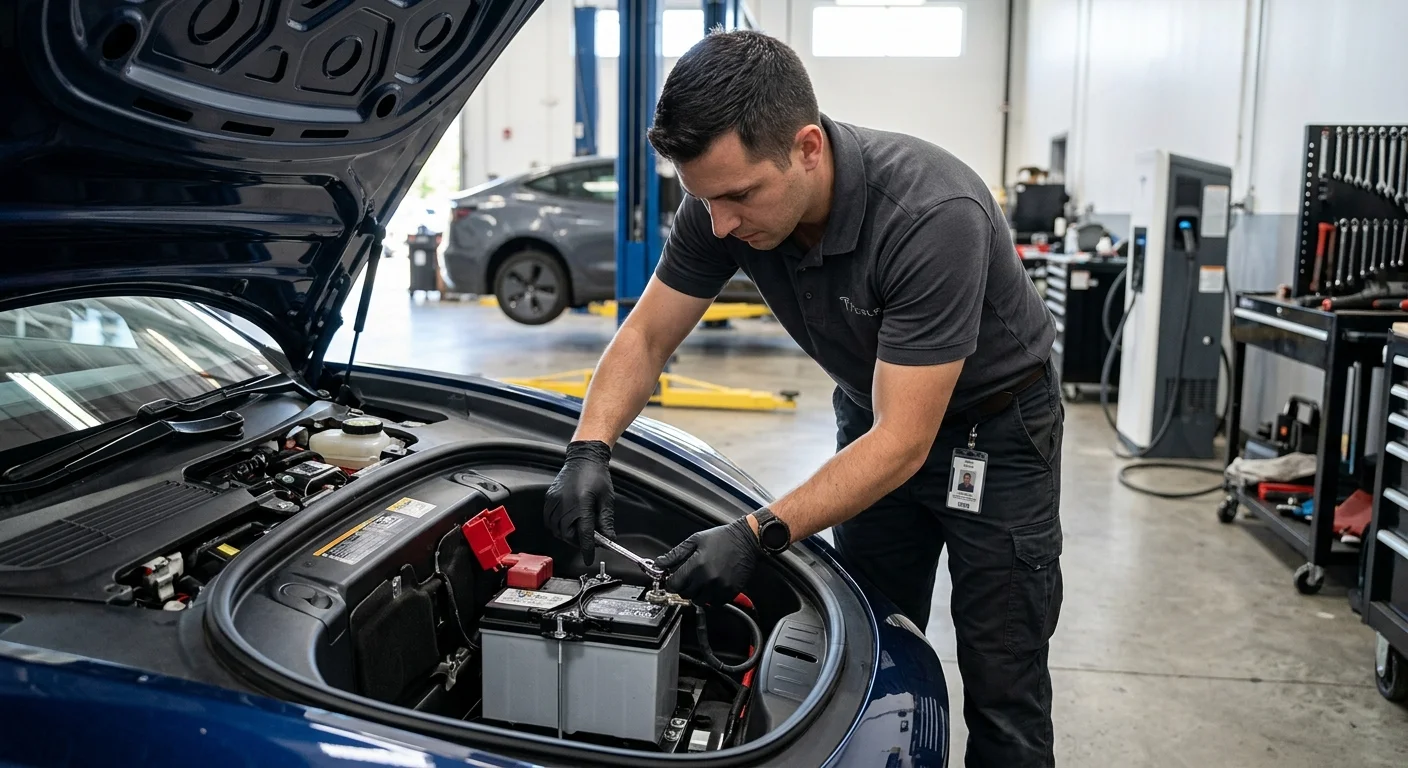
The sit is the problem, not the miles
Most Orange County EV days are short hops. You park at work in an Irvine office deck. You leave a Tesla in an Anaheim structure through a long park day. You stack a car near South Coast in Costa Mesa. You come back from the sand in Huntington Beach and the car won’t wake. The traction battery barely used any range. The 12-volt pack still worked the whole time you were gone.
It keeps control modules alive. It feeds cameras if those features stayed on. It answers key checks when people walk past the stall. In a hot inland garage in Tustin or Santa Ana, thermal systems can wake on their own. None of that shows up as freeway miles. It still ages the small battery.
As of December 31, 2025, the California Energy Commission counted 210,842 battery-electric cars on Orange County roads. Teslas were 138,121 of those. That’s 65.51% of the county’s BEVs. Most 12V calls here look like a Model 3 or Y that sat. The same sit still kills a Rivian, a Mach-E, an Ioniq 5, or an ID.4.
Coastal lots and inland decks don’t treat a 12V the same way. A Huntington Beach stall after a full beach day is a long unplugged sit. You get a warm cabin and damp air. A Tustin office-park garage in summer is a closed box. A Yorba Linda or North Tustin HOA garage can stay shut for days. A Buena Park theme-park lot can hold a car from opening until close. The chemistry doesn’t care that you only drove a few miles to get there.
South county has its own version of the same sit. A San Clemente or Dana Point harbor lot can hold a car through a full water day. Mission Viejo and Lake Forest HOA garages stay closed while you’re away. Laguna Hills decks off Cabot and Moulton follow the same weekday pattern as Irvine. They just sit farther south. The 12V still drains in the dark.
A Fullerton campus lot and a Santa Ana downtown structure produce the same dead-dash surprise. The car sat. The 12V worked the hours you didn’t.
If you want Tesla’s early language, read Tesla 12V clues you can catch before a stranding. When the car is already dark, see when the 12-volt dies, why the EV looks completely dead.
What the 12V does when you press the brake
The big pack turns the motors. It doesn’t run the car’s brain by itself. The 12-volt battery powers the computers, the screens, the locks, and the lights. It also powers the contactors. Those are the switches that connect the high-voltage pack to the rest of the car. No 12V means those switches stay open. You get no drive. You get no charge port. Door handles may not present. The frunk may stay shut.
Tesla’s Model Y owner’s manual is clear on a related failure. Once the high-voltage pack is exhausted, the low-voltage battery loses support. The car then needs an external 12-volt supply before the traction pack can take a charge. That’s an empty-pack story. A tired 12V with range still sitting in the pack is a different story. Both look like a brick from the sidewalk. Dead Tesla: how to tell 12V failure from a dead pack walks that split.
Think of the 12V as the key to the building. The fuel can still be inside. If the key is dead, nothing in the building turns on.
How the car tells you the pack is fading
You don’t need a scan tool for the early tells. Watch how the car wakes after a long sit in the structure.
The center screen is slow to light. It flickers. It stays black for a beat after you open the door. Handles don’t present every time. The fob works on the second try. Interior lights look weak. Windows crawl. After a workday in Irvine or a park day in Anaheim, random service lines stack on the display. Then the brake pedal does nothing. That last sign means the 12V couldn’t start the boot sequence.
Tesla and several other makes will say it in plain text. A “12V battery replacement due” alert isn’t a soft reminder. Newer Model 3 and Y cars moved to a lithium 12-volt pack. Older ones used AGM. The warning still means the same thing. Schedule the swap. Don’t wait for a Friday night in a Buena Park garage.
A published, county-wide replacement interval couldn’t be confirmed from a primary source. Tesla, Rivian, Ford, Hyundai, and the rest put their own language in the owner’s manual. Check that page for your year and VIN. In Orange County the practical trigger is age plus a long-sit habit. Theme-park structures, workplace decks, and beach lots are the pattern. If the car already needed a jump after a parked day, treat replacement as due now.
What replacement actually is
Replacement means a new 12-volt battery of the correct chemistry. It isn’t a high-voltage pack job. It isn’t a software refresh. It isn’t a tow by default. The old battery comes out. The new one goes in. Terminals get tightened. The car reboots. Some leftover alerts clear after a short drive.
Tesla lists service in Costa Mesa, Buena Park, Santa Ana, Irvine, Anaheim, and Aliso Viejo. Those city names came from Tesla locator paths. Street addresses weren’t opened directly during research on September 5, 2026. Confirm the current address in Tesla’s own finder before you book. Collision shops are a separate list. Don’t assume a body center stocks a 12V.
Independent shops and mobile techs also do this swap. For the Tesla process, not a price, see replacing a Tesla 12V in Orange County.
A parts price, a labor rate, and an Orange County average couldn’t be verified from a primary source. The shop or the mobile tech who does the work sets the number. Ask for a written quote before anyone pulls a cable. Charge Pro OC doesn’t set prices. The operator bills you directly.
Don’t mix chemistries. A lithium 12V isn’t an AGM stand-in. The tray, the hold-down, and the charging logic differ. Use the part the manual names, or the part a dealer scans to your VIN.
A jump is a bridge, not the repair
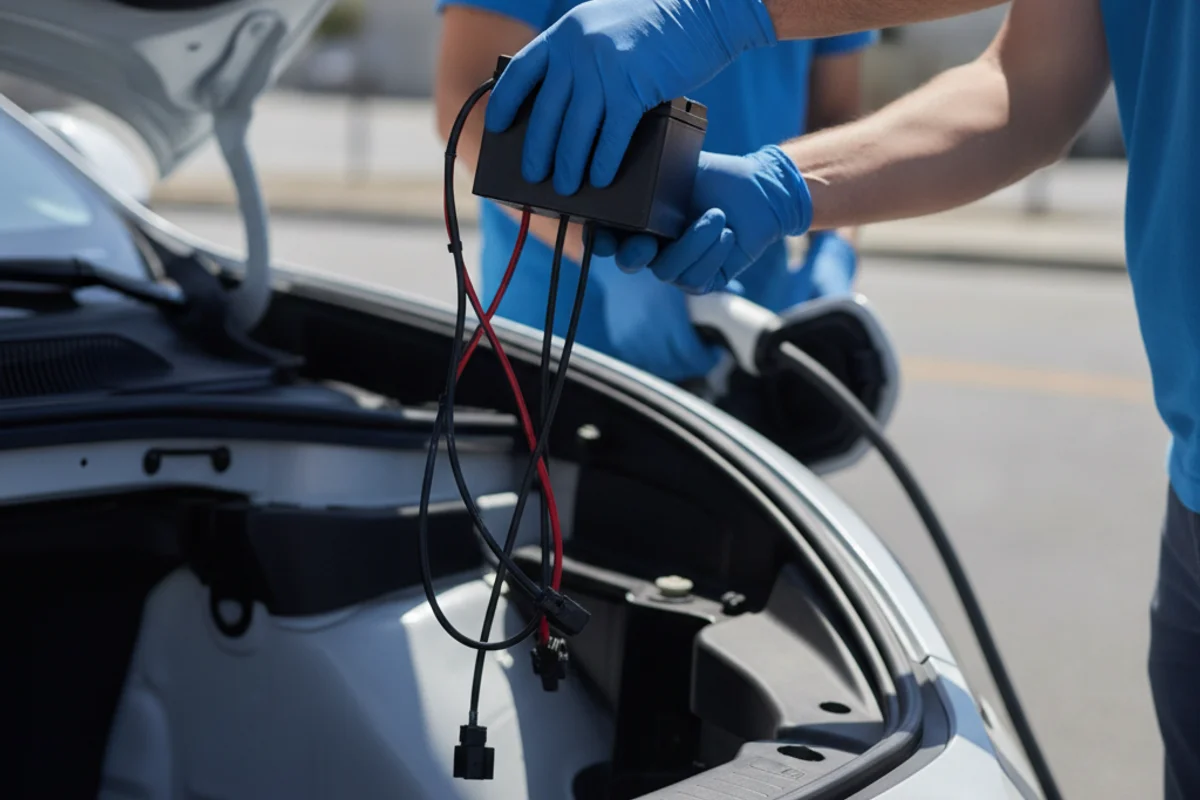
If the garage is already dark, you need 12-volt power at the jump points. Many EVs hide those points behind a bumper cover or a frunk panel. The owner’s manual shows the exact spot for your car. You never attach leads to the orange high-voltage hardware.
A jump pack, or a tech with the right leads, can bring the computers up. The high-voltage pack can then support the 12V again for a while. That window is how you roll to a shop. It’s also how a mobile tech tests and swaps on the curb. Keep driving on a failing 12V and it’ll dump again. The second failure often happens in the next structure. Read EV battery dies again after a jump before you treat a jump as a fix.
If you’re already in a stacked Costa Mesa deck, stay with the car. Call for help at the stall. Don’t push a silent EV into a travel lane. The Costa Mesa parking-structure playbook covers that layout. The same idea holds in Irvine office decks and Tustin lots off Red Hill and Franklin. It holds in Anaheim structures along Katella and Lincoln too.
The independent operators we connect you with can jump a 12V on site. They can replace it there when they have the matching part. They also bring a 240-volt Level 2 source if the traction pack is the real problem. Teslas take a native NACS plug. Other brands use a CCS or J1772 adapter. Typical charging time is 15 to 30 minutes for about 10 to 20 miles of range. That’s charging time, never an arrival time. The operator quotes you before work starts.
For a Tesla that needs the 12V restored so you can reach a service city, use Tesla 12V battery jump.
Should you swap it in the driveway
Some owners can. Plenty shouldn’t. EVs store faults if you pull the 12V without the right mode. Many Teslas want service mode before that disconnect. Other brands have their own sequence. The owner’s manual is the source. A forum thread isn’t.
If you still do the work, park in a safe stall. Wear eye protection. Use insulated gloves. Negative cable off first. Positive on first when the new pack goes in. Secure the hold-down clamp. A loose battery in a frunk becomes a projectile in a hard stop. Lithium 12V packs have their own handling rules. If you can’t name the chemistry under the cowl, stop and get a tech.
Battery location isn’t standard. Many Model 3 and Y packs sit under the frunk cowl, behind trim. Some Mach-E years use the frunk. Others use a rear seat area. Hyundai and Kia layouts differ again. Look it up for your VIN before you buy a tool kit.
A reversed cable can wreck modules. A wrong part can leave the car asleep. That’s why a driveway swap is optional. It isn’t the default plan.
After the new battery is in
Give the car a wake-and-drive cycle. Watch the display for a leftover alert. If the replace-battery message returns the next morning, the new unit or the charging circuit needs a look. A healthy new 12V shouldn’t need another jump after one sit.
Then change the habit that killed the last pack. In Orange County that habit is usually a parked workday or a park day. It’s rarely a long highway trip. Cabin cameras and overheat protection keep the low-voltage system busy in a hot inland garage. If you use those features, know they wear the 12V.
Plug in when the building has a working Level 2 stall. As of December 31, 2025, the CEC counted 5,600 public Level 2 ports in Orange County, and 1,475 public DC fast ports. A plug during a long sit takes load off the small battery. It doesn’t save a pack that’s already due.
You can still strand a 12V next to a busy Supercharger. Irvine has a 40-stall site at 1920 Main St. Tustin has 36 stalls at 14661 Franklin Ave. Anaheim has sites on Lincoln, Katella, Euclid, and Santa Ana Canyon Road. Buena Park has stalls at 6940 Beach Blvd and 8888 Knott Ave. Huntington Beach has a site at 6913 Warner Ave. Costa Mesa has sites on Bristol, South Coast Drive, and Hyland. Newport Beach has Tesla stalls at 4241 MacArthur Blvd. Electrify America lists eight DC fast ports at Fashion Island, 401 Newport Center Dr. Those are real places people already park. A dark 12V doesn’t care that fast stalls sit on the same property.
If the traction pack is empty, that’s a different call. Tesla’s roadside-assistance page couldn’t be opened directly during research on September 5, 2026. Confirm the current wording on Tesla’s own roadside page, or in Tesla’s North America roadside PDF. Search-index text described help for a depleted battery as not a financially covered service. It described 500-mile transport as tied to a warrantable breakdown. Don’t rely on that summary until you read Tesla’s page. Tesla’s roadside number, as published on the Santa Ana service page, is 877-798-3752.
When you should call
If the EV won’t wake after a long sit, don’t guess in the aisle. A black dash can be a 12V, an empty pack, or both. Stay out of traffic. Call for someone who works EVs.
Charge Pro OC is a referral line for Orange County. We match stranded drivers with independent local operators. We don’t own trucks or equipment. We don’t employ technicians. We hold no licence. The operator quotes before starting and bills you directly.
Call (949) 444-0151 when you need that match.