The map said free. You had two bars and a grocery stop in Fountain Valley. Now you are in a Costa Mesa or Irvine lot staring at a dark screen, a locked cable, or a paid session that never showed up on the pin.
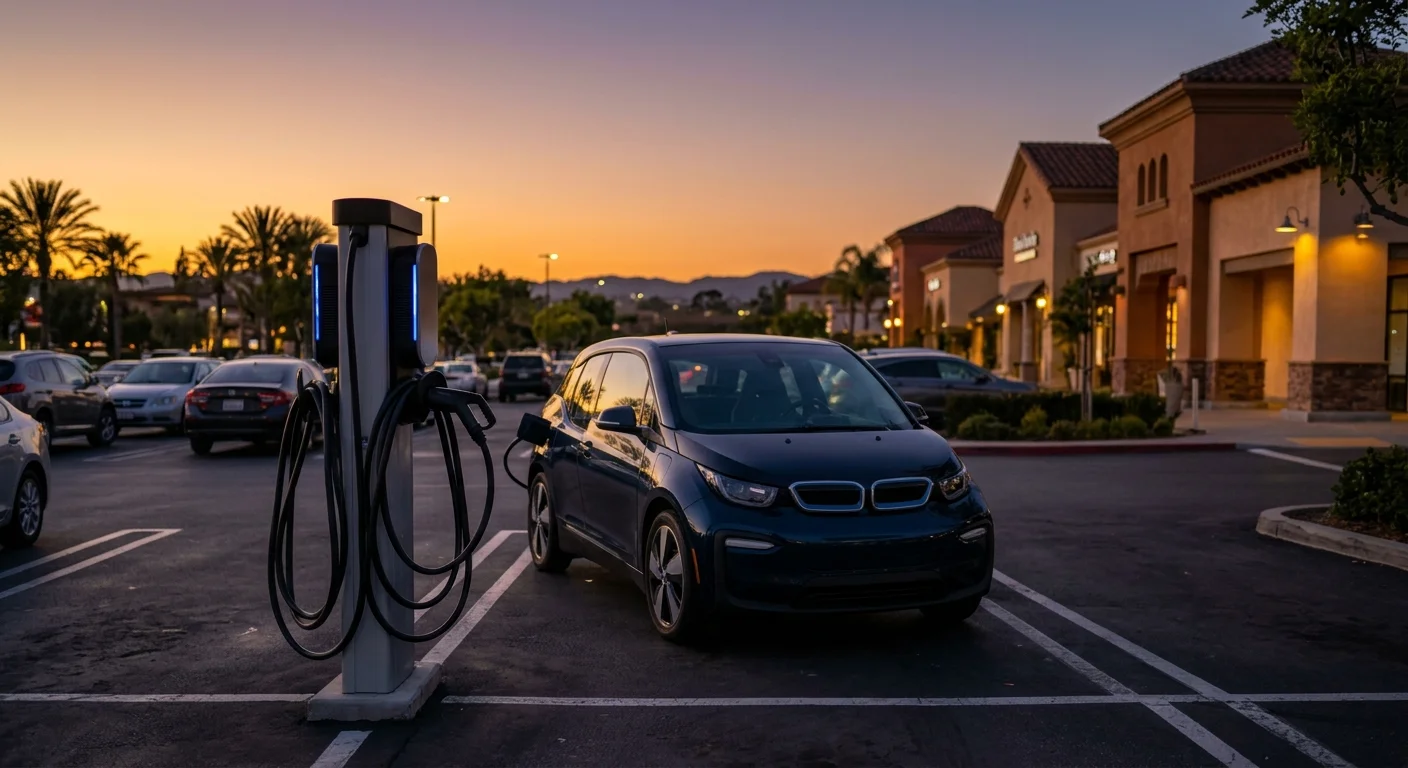
Free on the app is not the same as a stall that works
Orange County has a lot of plugs. As of December 31, 2025, the California Energy Commission counted 7,095 public charging ports in the county: 20 Level 1, 5,600 Level 2, and 1,475 DC fast. Shared-private ports add another 4,685. That is a dense map. It is a map of hardware, not of complimentary sessions.
The county also had 210,842 battery-electric vehicles on that same date. That works out to about 36.8 zero-emission vehicles per public port, tighter than California’s 24.4. A complimentary stall gets used. A pin that looked empty at breakfast can be a line by lunch in Anaheim, Santa Ana, or the Irvine Spectrum garage.
PlugShare, in-car nav, and network apps mix guest rates, member rates, and old free tags into one icon. A green pin can mean the last check-in was complimentary. It can mean the host listed it as free last year. It can mean the first hour is complimentary and the idle fee starts after that. This page does not set stall prices and does not scrape live rates, so you will not find a dollar figure here.
Hardware fails in the same lots. A dark ChargePoint at a dealership or a mall stall looks like a live unit until you tap. If the screen never wakes, treat it as a dead charger. Walk through what to do when a public EV charger is dead before you idle on the last bar waiting for a reboot.
Tesla Superchargers are a separate layer. The U.S. Department of Energy Alternative Fuels Data Center lists 48 Supercharger sites and 861 DC fast ports inside Orange County. Tesla holds about 59 percent of the county’s public DC fast ports. Those rows do not publish a guest price here. Open the Tesla app and read the site card before you detour off I-5 or the 405.
CEC charger counts combine surveys, grant lists, AFDC, PlugShare, and other listings, updated twice a year. A pin can lag a broken unit. A pin can lag a new paid rate. Trust the stall screen over last week’s screenshot.
Workplace, mall, and city lots that look free until they are not
Plenty of Orange County pins sit in office parks, dealerships, and civic lots. ChargePoint’s local DC fast footprint is mostly single-plug sites: 71 stations and 76 DC fast ports, about 1.1 ports per site, clustered at dealerships and offices. Those stalls often look public. Many start only with an employee RFID or a company app.
After hours a workplace unit may lock, switch to a guest rate, or sit behind a garage gate. Guest access on a Tuesday can vanish on a Saturday. The employer sets that. Southern California Edison publishes workplace and make-ready programs on its own pages. Current rebate amounts, and which employer lots stay open to the public, could not be confirmed here. Check SCE, your employer, and the stall before you treat a workplace pin as a public complimentary charge.
Malls work the same way. Fashion Island in Newport Beach has an Electrify America site with 8 DC fast ports. Irvine, Costa Mesa, and Anaheim malls sit on mixed Level 2 and DC fast. Shopping does not make the session complimentary. Garage parking, validation, and the charging session are separate bills. Idle fees can start after a short window. Those figures change by network and by day, so they stay off this page.
City halls and civic lots are not a countywide free program we could verify. Some cities post parking rules on their own sites. Some do not. A painted “EV only” stall is a parking rule. If the city’s parking page and the stall screen disagree, follow the screen and the posted sign.
Apartments and HOAs add another trap. A complimentary charger in a Santa Ana or Fullerton garage is often resident-only. California Civil Code 4745 limits how an HOA can block a resident from installing a station. It does not make guest charging free. If you are not on the lease, assume you need permission and a live rate in the app.
Complimentary Level 2 still shows up in Orange County. Hosts still list it. Those listings change. Confirm it live. Do not build a commute around a pin you have not opened today.
What to check before you burn the last bar hunting a free plug
Hunting a free stall is a range problem. Inland August heat is a hard teacher. NOAA’s 1991 to 2020 normal for Anaheim is 86.8 F in July and 88.8 F in August. AAA’s 2026 dynamometer study found an 8.5 percent range loss with air conditioning at 95 F. Coastal lots in Huntington Beach or Seal Beach run cooler. Canyon grades in Silverado and Trabuco Canyon do the opposite. A free pin 9 straight-line miles from Silverado to the Irvine Walnut Superchargers is a bad bet if you cannot climb back.
Check these before you leave the curb:
- Live rate in the network app and on the stall screen, not a screenshot
- Connector (NACS, CCS, J1772) and whether the adapter is already in the car
- Hours, garage gates, and whether a city or campus permit is required
- How recent the last PlugShare or in-app check-in is
- Distance versus remaining range, counting the hill, not the map’s crow-fly
Set this up while you still have range. The charging apps to open before you strand walk through that habit. PlugShare, the car’s map, Tesla, ChargePoint, Electrify America, and EVgo disagree with each other on any given afternoon. Cross-check two of them.
If remaining range cannot cover the detour and a backup paid stall, stop hunting. Orange County’s Supercharger deserts are real in a few places. Laguna Beach sits 5.3 straight-line miles from Mission Viejo Crown Valley, over hills. Coto de Caza and Rancho Santa Margarita sit 5.1 miles from Laguna Hills Cabot. Modjeska, Trabuco Canyon, Williams Canyon, and Silverado sit 7 to 9 miles from the nearest Supercharger. Inside Rancho Santa Margarita, the meaningful public DC fast site in the AFDC data is EVgo at 22351 Antonio Parkway, with 14 DC fast ports. Confirm that rate in the EVgo app. A free Level 2 in those pockets is a rumor until the app and the stall agree.
On a freeway shoulder the free option people remember is FSP. OCTA’s Freeway Service Patrol is free to motorists. It does not charge an EV. A jump-start restores a 12V accessory battery, not a depleted traction pack. The listed FSP outcome for a depleted EV is a free tow to a CHP drop zone, during published hours, on patrolled segments, and not guaranteed. That is a tow, not a charge.
When a matched curb charge beats another unpaid stall
There is a point where the next free pin costs more than it saves. You are already on the last bar. The stall you drove to is dark. The backup is a gated workplace. Or you are in Laguna Beach, Coto, or the canyons, and the nearest fast site is over a ridge.
A matched local operator bringing mobile EV charging to the curb is the move that stops the hunt. Charge Pro OC is a referral service. We connect you with licensed, independent local operators. We do not own the truck, set the operator’s price, or promise an arrival window. The operator quotes you directly.
A typical rescue charge is 10 to 20 miles of range in 15 to 30 minutes of Level 2 charging. That is charging time, not travel time. Public and workplace Level 2, per the Alternative Fuels Data Center, is about 25 miles of range per hour. The rescue figure sits inside that band. Enough range to reach a working paid stall, or to get home, beats another unpaid pin that may be offline.
Tesla roadside is a different product. Tesla’s policy answers a depleted battery with transportation, not on-site charging. Running out of charge sits outside the warrantable-breakdown transport Tesla describes. If the pack is empty, a tow to a Supercharger is one path. A curb charge is another. For a fully depleted pack, out-of-charge recovery is the referral to request.
Skip the three-mall loop on 8 percent. Inland north county (Anaheim, Fullerton, Yorba Linda) and south county lots do not share the same backup. Anaheim has seven Supercharger sites. Irvine has six. Laguna Beach has none inside city limits. Geography is the decision, along with the word free on a pin.
A public stall that is occupied or dead also leaves you sitting on private property. California Vehicle Code 22658 governs private-lot tows, including signage at the entrance. A painted EV stall is still private property. Sitting dead in a mall garage is a parking problem.
How to confirm a price in the app, not on this page
Searchers looking for the cheapest EV charging station near them want a number. This page will not invent one. Networks change guest rates, membership rates, and idle fees without notice. City lots change posted parking rules. A blog post with a dollar figure is stale the day after it publishes.
Confirm the price where the session starts. Open the network app for that stall. Read today’s guest rate. If the app wants an account, create it in the lot, not on the 405. Then read the stall screen. If the screen and the app disagree, the screen and the cable in your hand are the session you are buying.
PlugShare is a check-in log. Use it to see whether the unit has worked recently, then confirm cost in the network app. The U.S. Department of Energy explains charging levels. It does not publish Orange County lot rates.
Charge Pro OC does not offer free charging. We do not run stalls. We do not discount public sessions. The search “free EV charging stations Orange County” is a search for a live pin that still works. Complimentary Level 2 still exists in spots. Superchargers and most DC fast are paid networks. The only rate that matters is the one on the stall in front of you.
If you cannot confirm a rate, treat the stall as paid or unavailable. Drive to a known working paid site with range to spare, or stay put and request a matched curb charge. Hunting on fumes is how a cheap session becomes a tow.
When to call us
If you are too low to reach a working stall, or the free pin you trusted is dark, stay with the car and request help rather than burning the last miles. Call us at (949) 444-0151 and we’ll connect you with a local EV rescue operator. The operator quotes the curb charge directly and bills you; we do not set that price.