You’re on the 405 in Fountain Valley, or in a Costa Mesa garage after dinner, watching a single-digit range number. The search fills itself: level 2 charger near me. The map answers with a mall plug, a workplace lot, or a garage stall. That pin only helps if the car can still roll there, the cable is free, and you have time to sit.
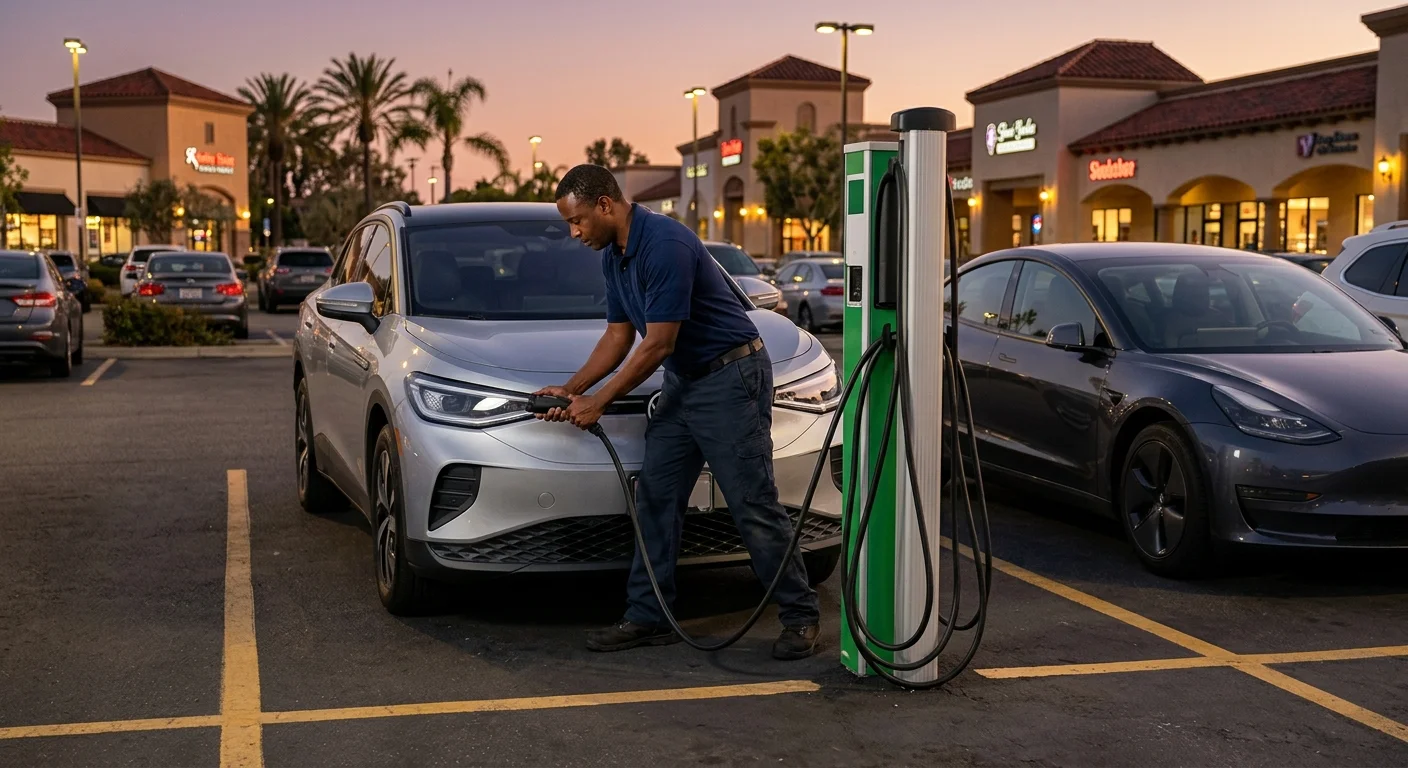
What a Level 2 stall actually gives a stranded OC driver
A public Level 2 stall is 240-volt AC. The U.S. Department of Energy Alternative Fuels Data Center puts Level 2 output between 2.9 and 19.2 kW. Public and workplace units run at 40 to 80 amperes. AFDC’s published pace is about 25 miles of range per hour of charging. The 240-volt, 9.6 kW figure on this site is 240 volts at 40 amps, the bottom of that public band.
That is parking-lot pace, not freeway pace. Fifteen to 30 minutes of Level 2 charging is the typical rescue window here: 10 to 20 miles of range. Enough to reach a faster stall or get home across town. Not enough to fill a pack while you idle in a loading zone.
Orange County had 5,600 public Level 2 ports as of December 31, 2025, per the California Energy Commission. Public Level 1 was 20 ports. Public DC fast was 1,475. Public ports totaled 7,095. Shared-private Level 2 added 4,621 more, mostly workplaces and gated sites you cannot count on from a public “near me” search. Most public AC in this county is Level 2. A level 2 ac charger near me is the common public plug. A wall outlet is not.
If you need the Level 1 vs Level 2 vs DC split when the car is already dead, read what those charging levels mean when you’re stranded. If the real question is a DC fast stall versus staying put, use rapid charger near me or a mobile rescue. This page is narrower: a public AC stall versus help at the curb when the pack is already too low.
The county also had 210,842 registered battery-electric vehicles and 260,833 zero-emission vehicles on that same CEC snapshot. That is 36.8 ZEVs per public port, against 24.4 statewide. Teslas were 65.51% of Orange County’s BEVs. The stall you want is often busy because the fleet is dense, not because the map is empty.
This page is not a catalog of wall units. Charge Pro OC does not sell or install chargers. If you are pricing a home Level 2, ask the seller and a licensed electrician. We do not publish equipment prices. Some retail and workplace lots advertise a free session. No countywide free-stall rule turned up in the verified ledger. Check PlugShare, the network app, and the post at the stall before you assume the session is free.
Why near-me results send you to a mall, not the shoulder
“Near me” on Google, Apple Maps, PlugShare, and the car’s own map means a geocoded parking space. Those pins sit at South Coast Plaza, the Irvine Spectrum, Fashion Island, Westminster Mall, Brea Mall, grocery lots along Beach Boulevard, and office garages in Irvine and Newport. They sit where a property owner poured a pad and pulled a permit.
They do not sit on the I-5 shoulder south of Irvine. They do not sit on the 91 in Anaheim. They do not sit on Santiago Canyon Road, Ortega Highway, or the SR-241 toll road. A level 2 ev charging station near me is a lot you still have to reach. The search does not move the stall to the car.
OCTA’s Freeway Service Patrol will jump a 12-volt battery, change a tire, or tow you to a CHP drop zone on the segments it patrols. FSP has no out-of-charge EV category and does not offer charging. A jump restores the accessory battery, not a depleted traction pack. Published weekday hours end at 7:00 p.m. Weekend hours end at 6:30 p.m. FSP does not run overnight or on listed holidays. OCTA’s web page and fact sheet also disagree on SR-57 and the Express Lanes, and neither published list includes the TCA toll roads. Do not plan a freeway charge around a patrol truck.
Tesla’s roadside policy answers a depleted pack with transportation, not an on-site charge. That transport is paid. Running out of charge sits outside the warrantable-breakdown list. If you drive a Tesla, the in-car map still prefers Superchargers and destination stalls you can drive to. Those are DC or lot plugs. They are not a cable on the shoulder.
Canyons and a few south-county pockets make that drive worse. Silverado is 9.0 straight-line miles from the nearest Tesla Supercharger. Trabuco Canyon is 7.3. Laguna Beach is 5.3 over hills. Coto de Caza and Rancho Santa Margarita sit 5.1 miles from Laguna Hills Cabot Road. Those are Supercharger gaps, measured from Census place centroids, not a claim that zero Level 2 plugs exist there. The practical point is the same. The pin on your phone is a lot, and the lot may sit over a ridge you no longer have the miles to climb.
Full, offline, or too slow to save the day
CEC charger counts mix surveys, grant lists, AFDC, PlugShare, and other online sources, updated twice a year. A pin can lag. A stall can show available and sit behind a cone, a broken screen, or a gas car. PlugShare check-ins and the car’s live map beat a county spreadsheet when you are deciding whether to roll.
Even a working Level 2 stall can be the wrong tool. Twenty-five miles of range per hour is fine if you are 8 miles from home in Garden Grove and can wait. It is the wrong math if you are on the 405 with 3 miles of indicated range and the nearest open stall is 7 miles into a structure. It is also the wrong math if you only need enough to reach a DC fast site, and sitting on AC for an hour burns the evening.
A fully depleted pack is a different failure. Tesla’s Model Y manual is the logged example. Once range is exhausted, the low-voltage battery loses support and needs an external power supply before the high-voltage pack can charge. A public Level 2 cable in a mall will not wake a car that cannot close contactors. If the dash is dark, treat it as a 12-volt problem first, then a pack problem.
Connectors matter too. Most public Level 2 in North America is J1772. Newer cars and Teslas may want NACS. Adapters live in the frunk until they do not. Confirm the plug on the stall photo in PlugShare and on the car’s map before you spend the last miles driving to it.
Inland heat cuts the margin further. AAA’s 2026 dynamometer study found an 8.5 percent range loss with air conditioning at 95 F. Anaheim’s NOAA 1991-2020 August normal is 88.8 F. John Wayne Airport’s August normal is 80.4 F, the best published proxy for west Irvine. A coastal hop in Huntington Beach is not the same as a climb out of Silverado or a stop-and-go crawl through the Orange Crush on SR-22.
When a matched mobile Level 2 charge is the better call
Stay with the car when you cannot safely reach a stall under the remaining range. Stay when the only open pin is a garage you cannot enter. Stay when you are in a gated community, a canyon, or on a freeway shoulder. Stay when the pack is already too low to gamble on a “near me” result that sits at a mall.
Searches for mobile charging stations near me often mean the same moment. You are not hunting a second directory of lots. You need power where the car already is.
A matched local operator can bring Level 2 power to the curb. Charge Pro OC is a referral service. We do not own the truck, hold the trade license, or set the price. The independent operator quotes you, bills you, and does the work. A typical session adds 10 to 20 miles of range in 15 to 30 minutes of charging. That is charging time, not a promise about when anyone arrives.
That bump is often the whole job. Enough to roll off the 5, off Laguna Canyon Road, or out of a dead stall at a beach lot and into a working public charger. If the car will not wake, the operator you are connected with can sort whether this is a pack, a 12-volt, or a tow. For a car that still accepts charge but cannot move, start with mobile EV charging. If you are already at zero, use out-of-charge recovery.
Do not wait on FSP for a charge. Do not wait on Tesla roadside for an on-site plug. Those programs do other things. The decision is simple. If the stall is reachable, open, and fast enough for the miles you need, drive to it. If it is not, keep the car where it is and get a curb charge.
How to check PlugShare and the car’s map before you move
Open PlugShare and the manufacturer’s map before you leave the space you are in. Filter for Level 2 if that is what you can use. Filter for DC fast if you can still reach one and your car accepts it. Read the last check-in. Look at the connector photo. Confirm the stall is public, not a residents-only garage.
Then compare that pin to your indicated range, with a margin for heat, hills, and a stall that is already taken. Level 2 chargers near me can look dense on a zoomed-out map of Anaheim, Irvine, and Santa Ana. Zoom in and you are looking at specific lots, hours, and plugs. One full row at a grocery store is not a second option around the corner.
If the live pin is closer than your remaining range, with room to miss a full stall, drive there. If it is not, do not spend the last miles proving the map wrong. Stay out of the travel lane. In California, turn signals shall be flashed as warning lights when the vehicle is disabled on the roadway and still has a working simultaneous-flash device. That is mandatory, not optional.
Google and Apple Maps are fine for a first look. They are not a substitute for PlugShare check-ins or the car’s own availability feed. Network apps only see their own stalls. Use more than one source. Then make the stall-or-curb call once, while you still have a choice.
When to call us
Call when a level 2 charger near me is a mall pin you cannot reach, a stall that is full or offline, or a wait that will not cover the miles you still need. Call us at (949) 444-0151 and we’ll connect you with a local EV rescue operator. The operator quotes the work, does the charge at the car, and bills you directly.