If the Tesla Supercharger Irvine pin you reached is occupied or offline, open Tesla’s live map before moving. Irvine has six verified Supercharger sites, but this page cannot tell you which stall is open now. Choose another site only when the car has enough range for the full route with margin. Otherwise, park safely and arrange help at the car.
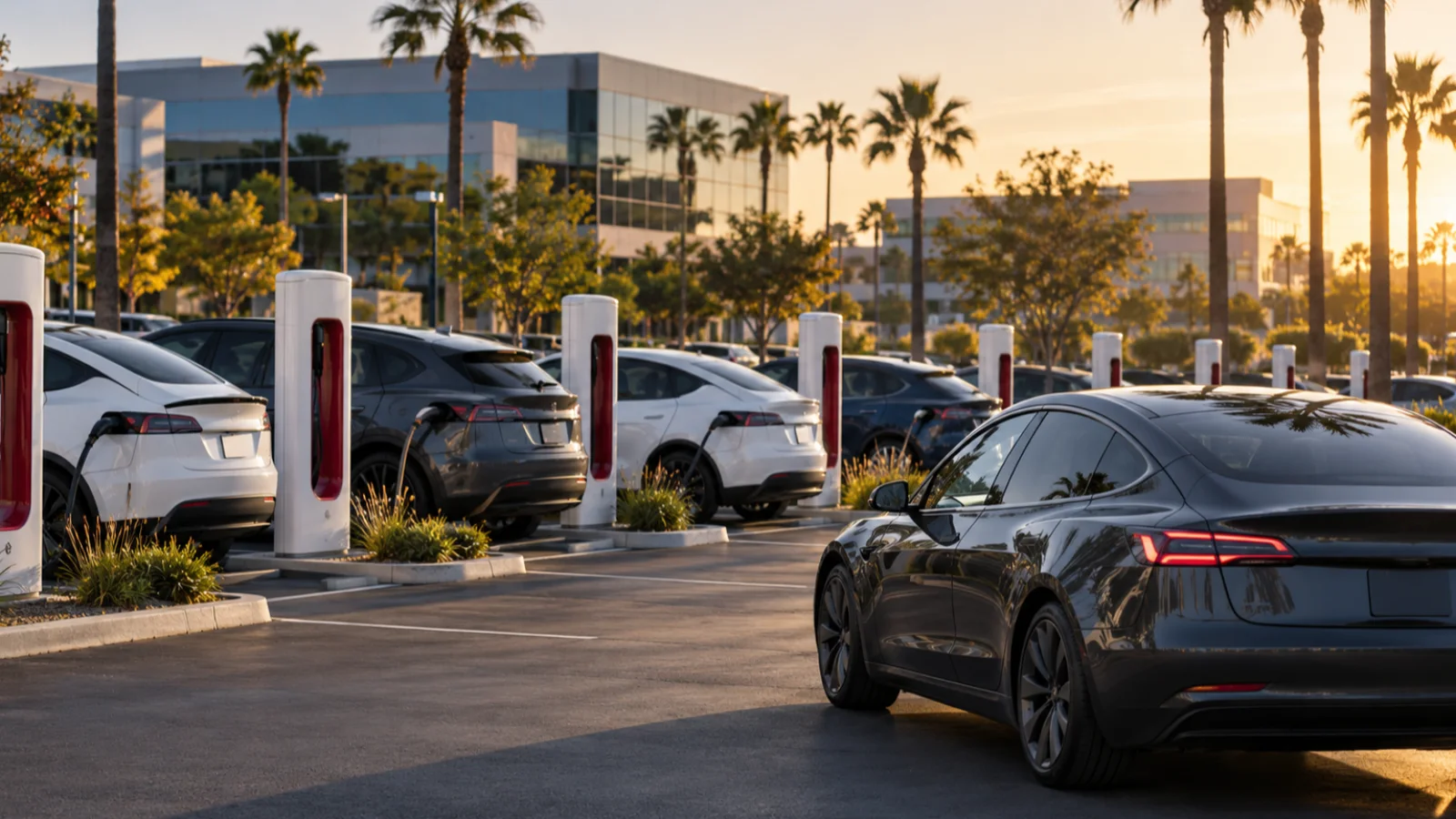
Irvine has six verified Supercharger sites
The U.S. Department of Energy’s Alternative Fuels Data Center lists these six Tesla Supercharger sites in Irvine:
- 14346 Culver Drive: 16 stalls, maximum connector power 250 kW
- 1920 Main Street: 40 stalls, maximum connector power 250 kW
- 3021 Michelson Drive: 12 stalls, maximum connector power 75 kW
- 5396 Walnut Avenue: 12 stalls, maximum connector power 250 kW
- 5406 Walnut Avenue: 8 stalls, maximum connector power 250 kW
- 950 Spectrum Center Drive: 16 stalls, maximum connector power 250 kW
Irvine’s six sites are second to Anaheim’s seven. Main Street is the largest Irvine site and, at 40 stalls, the largest in Orange County apart from the 49-stall San Clemente Vista Hermosa west site. Those are inventory facts. They are not a claim that every stall works, that every site is busy, or that a particular cable is free tonight.
AFDC reports maximum connector power, not Tesla V2, V3, or V4 labels. The maximum is not a promise of the rate your car will receive. State of charge, equipment status, and other conditions affect the session. Tesla’s in-car navigation and current Supercharger map are the tools for live status.
Occupied or offline is a decision, not a citywide fact
The title describes the moment a driver faces, not the condition of every Irvine Supercharger. One row can be occupied while another site has room. A location can also appear on an inventory list while individual stalls are temporarily offline. Current occupancy changes too quickly for a blog post to publish as fact.
Open Tesla’s map and match your actual address. Check whether the site is shown as available, limited, or unavailable. Then open PlugShare for recent driver reports. If the two sources disagree, plan around the less optimistic result until you can confirm the hardware yourself.
Do not count cars from an old photo or trust a screenshot sent earlier in the day. Do not assume a larger site means a shorter wait. Main Street has 40 verified stalls, while Walnut has two separate verified addresses with 12 and 8 stalls. The live map, not the size on paper, answers which move makes sense now.
If you are already at Spectrum Center, use the Irvine Spectrum guide for the garage-specific problem. This article stays on the wider Irvine choice between waiting, driving to another verified Supercharger, and getting help where the Tesla sits.
The I-5 and I-405 squeeze changes the route
Irvine’s charger pins spread across Culver, Main, Michelson, Walnut, and Spectrum Center Drive. They do not form one interchangeable row. The Spectrum site sits near the I-5 and I-405 merge. Main and Michelson serve the office-park side of the city. Walnut and Culver pull drivers toward different parts of the arterial grid.
A pin that looks close on a zoomed-out map can require a freeway merge, a long arterial approach, and a specific shopping-center entrance. Use Tesla navigation for the full driving route. Include the driveway and any detour the map shows. If the display has only a thin buffer, do not spend it crossing Irvine for a stall that may fill before you arrive.
Use this quick check:
- Confirm the address in Tesla’s live map.
- Read the current availability shown for that site.
- Compare the complete route with the range remaining.
- Keep enough margin for traffic, a missed entrance, or a change in status.
- If the car cannot cover that route with margin, stay where it is.
That last choice matters near the 5 and 405. A low car in a legal office-park space is easier to help than a car that reaches zero on a freeway ramp. If you are already stopped in a travel lane or another dangerous position, call emergency services first. Do not request a charge in a live lane.
Is it the traction pack or the low-voltage system?
A Tesla that will not move after sitting in an Irvine garage may have a different problem from a car that drove its range estimate to zero. Ask what happened before the screen went dark.
If the car showed usable traction range before a long sit but now will not wake, the low-voltage system may need attention. If the range reached zero, Tesla’s Model Y owner’s manual says the low-voltage battery can lose support and require an external power supply before the high-voltage pack can charge. In either case, do not diagnose the car from the sidewalk. Report the symptoms.
A low-voltage jump can restore access and controls. It does not add driving range to an empty traction pack. An on-site charge adds energy to the traction pack, but a fully dark car may need low-voltage support first. Tell the operator whether doors open, screens light, the car shifts, the charge port opens, and what range the display showed before shutdown.
Tesla’s roadside policy answers a depleted battery with transportation rather than on-site charging. That assistance is not financially covered for simply running out of charge. Tesla publishes 877-798-3752 for roadside on its Santa Ana service page. Ask Tesla what its current policy provides for your car and location.
Waiting, rerouting, or getting help at the car
Waiting can make sense when Tesla’s map shows a short queue and the car is already at a safe Supercharger site. Rerouting can make sense when another verified Irvine site shows availability and the car has enough range for the entire route with margin. Help at the car makes sense when the current site is unusable and the next confirmed option is outside that safe range.
Tesla roadside rescue covers the local recovery choices when the car cannot move. Mobile EV charging is the on-site charging path when the traction pack needs enough energy to reach a working charger or another safe destination. A typical rescue charge adds 10 to 20 miles of range in 15 to 30 minutes of Level 2 charging. That describes charging time only. It is not an arrival promise and it is not a full recharge.
The broader city guide, EV roadside assistance in Irvine, covers apartment lots and shared chargers. Irvine’s Supercharger pattern also differs from Anaheim, where seven verified sites spread across Lincoln, Katella, Euclid, Imperial Highway, and Santa Ana Canyon. See Anaheim Tesla Superchargers when full for that geography.
Charge Pro OC is a referral service. It connects you with independent local EV charging professionals. It owns no truck, performs no work, sets no price, and promises no arrival time. The independent operator explains what they can do, provides the quote, and bills you directly.
What to send on the call
Share the exact address or a dropped pin. In an office garage, add the building, level, and nearest entrance. At Spectrum, name the structure and floor. On Walnut, confirm whether you are at 5396 or 5406. Those are separate verified Supercharger addresses.
Then give the Tesla model, range shown before it stopped, and exact warning text. Say whether the car powers on and whether the charge port opens. If you reached a Supercharger, explain whether every stall appeared occupied, the site showed offline, or your session failed. That is enough detail for the independent operator to discuss the next step without a made-up diagnosis.
When to call us
Call when the Irvine Supercharger in front of you is occupied or offline and the next verified site is outside the range the car can safely cover. Stay with the Tesla in a lawful, safe place. Call Charge Pro OC at (949) 444-0151 and we will connect you with an independent local EV rescue operator.