If your EV is out of charge on SR-57, get as far out of the travel lane as the car can still move, turn on the hazards, and stay away from live traffic. If you are exposed in a lane or narrow gore, call 9-1-1 first. Once the scene is stable, ask for range at the car. A short Level 2 charge may get you off the Orange Freeway and into Brea, Fullerton, Anaheim, or Orange without a tow.
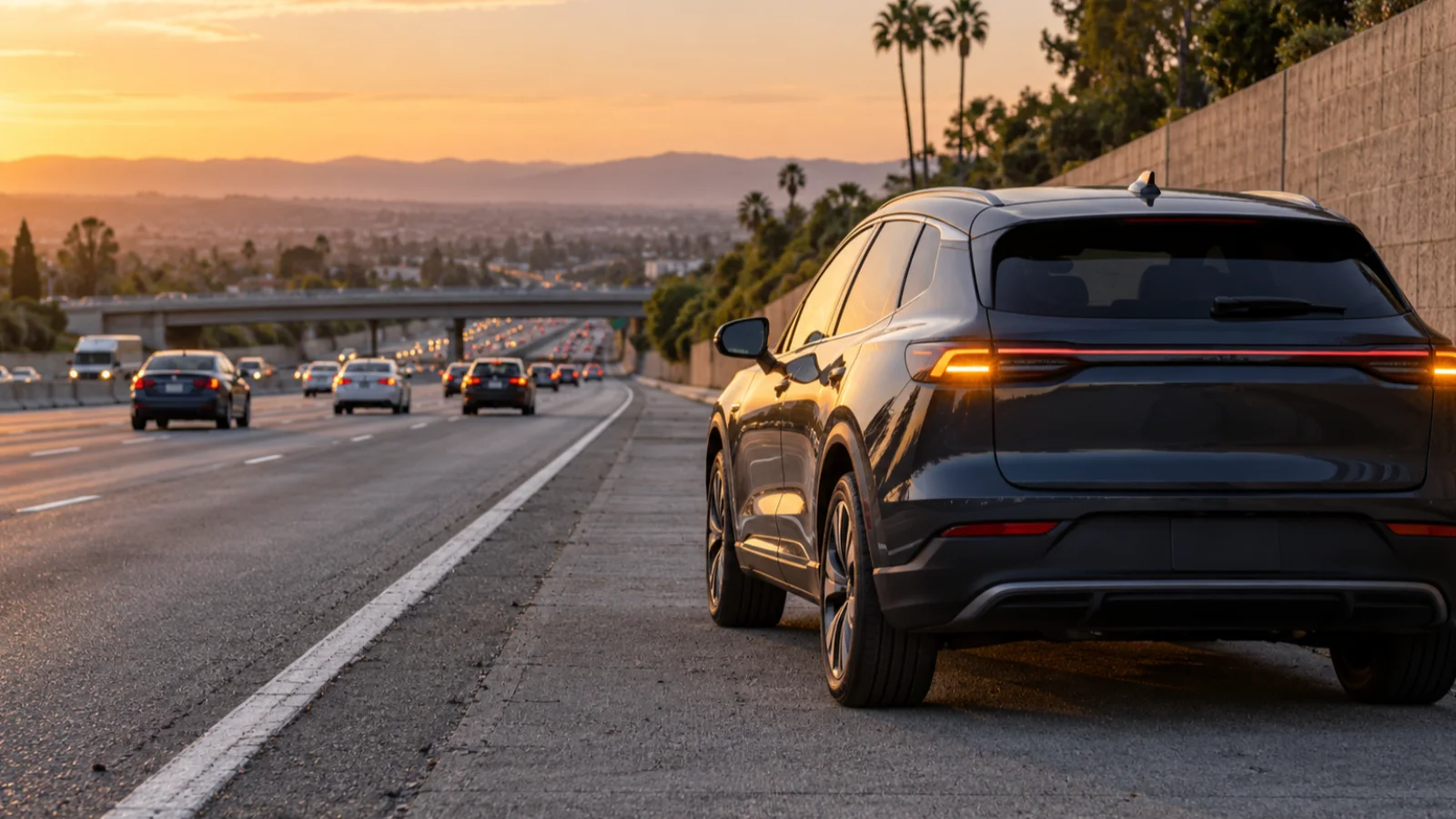
What empty on the 57 looks like
The 57 puts several different stops under one freeway name. Northbound near Brea, you may be approaching the 91 with shopping traffic around Brea Mall. Through Fullerton and Anaheim, the road carries you toward the 91 and the ramps feeding the Orange Crush. Farther south, SR-57 meets SR-22 and I-5 in a dense set of merges before the route reaches Orange.
That location changes how help reaches you. “On the 57” is not enough. Give the direction of travel, the last exit, and whether you are north or south of the 91. If you are near the Crush, name the ramp you took or the freeway you were joining. The SR-22 Orange Crush guide covers that adjoining east-west route. This page stays with the north-south SR-57 stop.
An empty pack also differs from a dead 12-volt system. If the dashboard still works but the car will not drive, tell the operator the traction pack reached zero. If screens, locks, and the charge port are dark, mention the low-voltage symptoms too. A 12-volt jump can wake accessories. It does not put driving range into the traction pack.
The OCTA sources disagree about SR-57 patrol coverage
OCTA publishes two Freeway Service Patrol coverage sources, and they do not match. Its current program web page lists I-5, SR-22, SR-91, and I-405 segments. It omits SR-57. OCTA’s fact sheet dated August 1, 2026 lists SR-57 from Tonner Canyon to SR-22, along with the 91 and 405 Express Lanes.
That is a source conflict, not a question this page can settle. The OCTA FSP web page omits SR-57, while the OCTA fact sheet includes it. Do not assume either that a patrol truck is assigned to your stretch or that none can come. Call 5-1-1, select Motorist Aid, give the exact location, and ask. For an emergency, call 9-1-1.
FSP’s published service list does not include charging an EV traction pack. It includes a 12-volt jump and a tow off the freeway to a CHP-designated drop zone. For a depleted EV, the listed FSP outcome is that tow during service hours on a patrolled segment, and service is not guaranteed. A drop zone gets the car out of the freeway environment. It does not refill the pack.
The OCTA consumer page publishes weekday hours of 6:00 a.m. to 7:00 p.m. and limited weekend service from 10:00 a.m. to 6:30 p.m. FSP does not operate overnight or on its listed holidays. Those are program hours, not a promise of coverage or arrival on SR-57.
Shoulder first, then range, then a charger
Use the remaining motion to clear the lane if you can do so without crossing traffic. Avoid stopping in a gore or on the left shoulder when a safe right shoulder remains reachable. Once stopped, keep the hazards on. California law requires the simultaneous warning lamps when a vehicle is disabled on the roadway and the device still works.
Do not walk the shoulder toward an exit or a charging pin. Do not stand behind the car in the lane. If the shoulder is narrow or the car is exposed, stay buckled inside unless a peace officer or responder tells you to move. If staying inside creates an immediate danger, call 9-1-1 and follow the dispatcher’s instructions.
The four-hour freeway rule is not a safe waiting window. California Vehicle Code 22651 allows immediate removal when a vehicle obstructs traffic or creates a hazard. A vehicle that remains more than four hours on a freeway right-of-way and cannot move under its own power may also be removed. After four hours it can be towed, and sooner if it is in the way.
Once you are protected, decide whether the car can accept power. Out-of-charge recovery is the charge-first option. The approved rescue range for this site is 10 to 20 miles added in 15 to 30 minutes of Level 2 charging. That is time connected to the charger, not an estimate for when an operator reaches you.
Ten to 20 miles is meant to get you off SR-57 and to a suitable charger or home. It is not a full battery session. Pick the destination before charging starts so the added range has a clear job.
Brea, Fullerton, the 91, and the Orange Crush
Near Brea, identify whether you are north or south of the SR-91 interchange. A driver saying “near Brea Mall” still needs to provide direction and the last ramp. The 57 and 91 split creates different approaches for a roadside vehicle.
Through Fullerton, name a nearby exit rather than a city alone. A northbound stop heading toward the 91 is different from a southbound stop approaching Anaheim. The operator needs a legal route to your shoulder, not only a map pin dropped across a median.
At the south end, the 22, 57, and I-5 ramps compress the problem. If you stopped on a connector, name both freeways and your intended direction. Do not try to cross striped pavement or walk toward another ramp. The correct help has to reach the side where the car sits.
For the broader county procedure, including other freeway and toll-road stops, use the Orange County freeway out-of-charge guide. SR-57 adds the OCTA source conflict and the North County interchange detail. The safety order stays the same.
Orange County had 210,842 registered battery-electric vehicles as of December 31, 2025, according to the California Energy Commission. The county also had 7,095 public charging ports. Those plugs are useful after the car has enough range to leave the freeway. They do not make the shoulder a charging location by themselves.
Why a tow is the last move when the car only needs range
A tow is required when the car cannot accept power, has collision damage, is leaking, or must be cleared immediately for safety. A fully disabled EV may also need low-voltage support before it can charge. Tell the responder what the car is doing rather than assuming every zero-range stop is identical.
If the car is safely positioned and can accept a charge, adding range at the car avoids moving an empty vehicle to a drop zone and arranging power again. That is why this page starts charge-first. It is not an instruction to reject CHP or FSP direction. If responders require the vehicle to move, the scene-safety decision comes first.
If a hook is required, the matched operator or a separate tow company handles it. Charge Pro OC does not tow and owns no truck. The company doing the work decides what equipment is suitable and quotes the driver directly.
How the matched-operator call works
Charge Pro OC is a referral service. It matches drivers with independent local EV charging professionals. It performs no work, owns no equipment, sets no price, and promises no arrival time. The operator quotes and bills you directly.
For a useful request, say: “Northbound SR-57, south of the 91, right shoulder, dark blue EV, traction pack at zero, dashboard still on.” Change those details to match the stop. If you are on a ramp, name it. If the screens are dark, say that the 12-volt system may also be down.
Use emergency EV roadside assistance when you are not sure whether you need a charge, a low-voltage jump, or a tow assessment. If the pack is clearly empty and the car can accept power, ask for out-of-charge recovery.
Call (949) 444-0151 to be connected with a local operator. Keep the hazards on, stay out of live lanes, and follow CHP or FSP instructions if they reach you first.