A CCS charging near me search is not a reason to spend your last miles on the next map pin. First confirm that the site has CCS Combo 1, then check PlugShare and your car’s own map for current status. If the stall is full, offline, or farther than the car can safely travel, stay with the car and arrange help there.
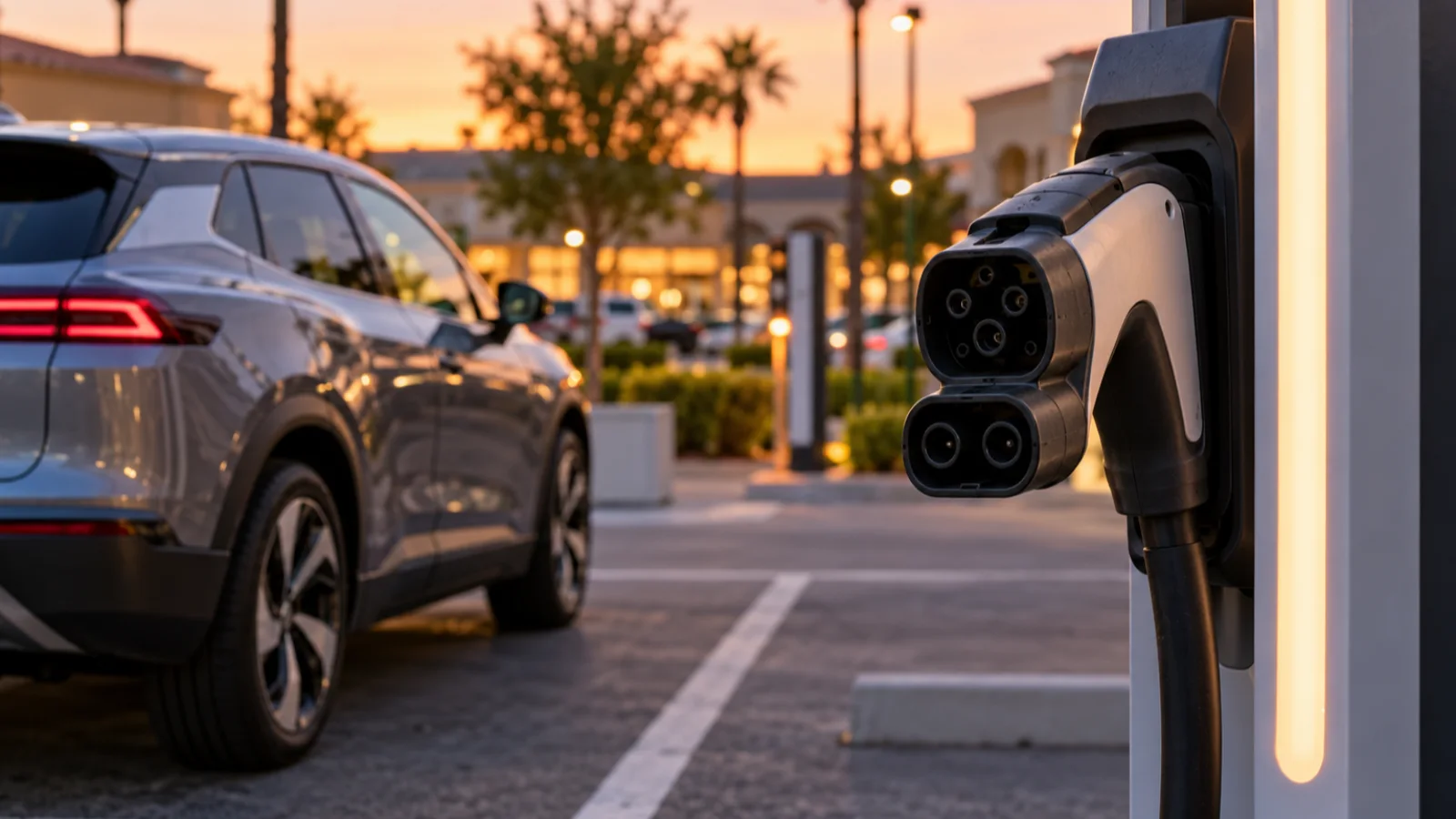
What to verify at an Orange County charging lot
Start with the connector named in your vehicle manual and charging screen. Then match that name against the connector listed for the station in your car’s map and the network’s current app. Do not infer compatibility from a generic “EV charging” pin.
This page is for a driver whose car identifies CCS as the required fast-charging connection. If your car names a different connector, follow the carmaker’s current guidance for that vehicle instead. Model year, configuration, adapters, and network access can change which equipment a car may use.
Do not use this page as a live stall directory. Open PlugShare and the car’s navigation or charging app. Match the address, connector, and network. Check recent status before moving. A pin that says DC fast but does not identify CCS is not confirmed for your car.
Orange County had 1,475 public DC fast ports as of December 31, 2025, according to the California Energy Commission. That county total does not say which ports are CCS, which are occupied now, or which will start a session for your model. The live decision still happens on the two maps in your hand.
Connector fit comes before distance
When the range estimate is low, verify the connector before the mileage. A nearby site using a different connector is not automatically better than a confirmed CCS site farther away. A slower charging option may work when you have time and an open stall, but it is a different recovery plan from the fast-charging stop you searched for.
Adapters add another compatibility check. Use only access and adapter guidance published for your exact car and the exact charging network. If the carmaker’s published page does not confirm the adapter and site combination, it could not be confirmed here. Do not gamble the remaining range on a forum photo or a borrowed adapter.
Tesla’s Lake Forest site at 24372 Rockfield Boulevard is a verified exception worth understanding. The federal Alternative Fuels Data Center lists that location with Magic Dock, CCS1 plus NACS, 16 stalls, and a maximum connector rating of 325 kW. That is inventory information, not a live promise. Check Tesla’s current map before driving there, especially when the pack is already low.
If your immediate problem is an occupied Level 2 handle, read what to do when a J1772 stall is full. If the open pin is Tesla-style hardware, use the NACS charger decision guide. The CCS question is narrower: does the available DC handle fit this car, and can the car reach it without using its last safe margin?
Full, offline, or too far when you are already low
Use a simple sequence before you move:
- Confirm the inlet named for your exact car. Model year and configuration matter, so use the car’s manual and current carmaker guidance.
- Confirm CCS at the destination in the car’s map and PlugShare. Match the street address, not just the nearest pin.
- Check current reports and network status. If one source shows a fault or closure, treat the site as uncertain.
- Compare the full driving route with the range shown by the car. Include the lot entrance and a margin for a wrong turn or blocked access.
- Pick a second confirmed CCS site only if the car can reach it too. If it cannot, stop searching from behind the wheel.
Do not circle a shopping center waiting for the status to change. Park legally while the car can still shift. If it is already disabled in a travel lane or an unsafe position, call emergency help first. A roadside charge is not performed in a live lane.
There is also a difference between a dark car and an empty traction pack. A jump to the 12-volt system does not add miles to the traction battery. Tell the operator whether the display reached zero, whether the car powers on, and whether the charge port opens. Those details are more useful than guessing at the cause.
Stanton, Placentia, and a thin-looking CCS map
Some Orange County searches look dense because the map mixes connector families. Stanton and Placentia illustrate the trap. Neither has a Tesla Supercharger inside the city line. The nearest Supercharger to Stanton is 2.3 straight-line miles away at Garden Grove’s Valley View Street site. The nearest to Placentia is 2.4 straight-line miles away on Yorba Linda Boulevard.
Those facts describe Tesla geography, not a CCS recommendation. A non-Tesla driver should not treat the nearest Supercharger pin as usable CCS unless the live network map and the carmaker’s current guidance both confirm access. Search specifically for CCS, then verify the result in the car’s own map.
The same rule applies in larger shopping fields. A Tesla row, a J1772 post, and a non-Tesla DC island may sit in one property while using separate networks and connectors. Walk to the equipment if you can do so safely. Read the handle and screen. Do not leave a low car idling while you inspect a distant pin.
When the nearest confirmed CCS site is beyond the range you have, the map search is finished. The next decision is energy at the car or transport, not a more optimistic search term.
A matched operator for a non-Tesla at the curb
Charge Pro OC is a referral service. It connects drivers with independent local EV charging professionals. Charge Pro OC owns no truck, performs no work, sets no price, and promises no arrival time. The operator tells you what they can do, quotes the work, and bills you directly.
Non-Tesla EV rescue is the service path when an Ioniq 5, EV6, Mach-E, Bolt, Ariya, or another non-Tesla cannot reach a compatible charger. Mobile EV charging is the on-site charging option. A typical rescue charge adds 10 to 20 miles of range in 15 to 30 minutes of Level 2 charging. That is charging time only, not an arrival estimate, and it is meant to reach a confirmed charger or another safe destination rather than fill the pack.
Have the exact location ready. Share the make and model, remaining range, whether the car turns on, and the connector you found at the unusable stall. Say “CCS stall offline,” “NACS only,” or “J1772 occupied” if that is what you can see. Clear information helps the independent operator decide whether the car needs a charge, low-voltage support, or another recovery option.
When to call us
Call when the next confirmed CCS handle is full, offline, or outside the range the car can safely cover. Stay with the car in a lawful, safe location. Call Charge Pro OC at (949) 444-0151 and we will connect you with an independent local EV rescue operator.