A search for an AAA EV charging truck is a search for a plug, not a brochure. The car is already stopped: a Model Y on the I-405 shoulder, a Bolt in a Huntington Beach lot, a packed garage in Irvine after the last percent disappeared. Membership is a separate question. The live question is whether the club sends a charging truck, a tow to a stall, or a jump that will not refill the pack.
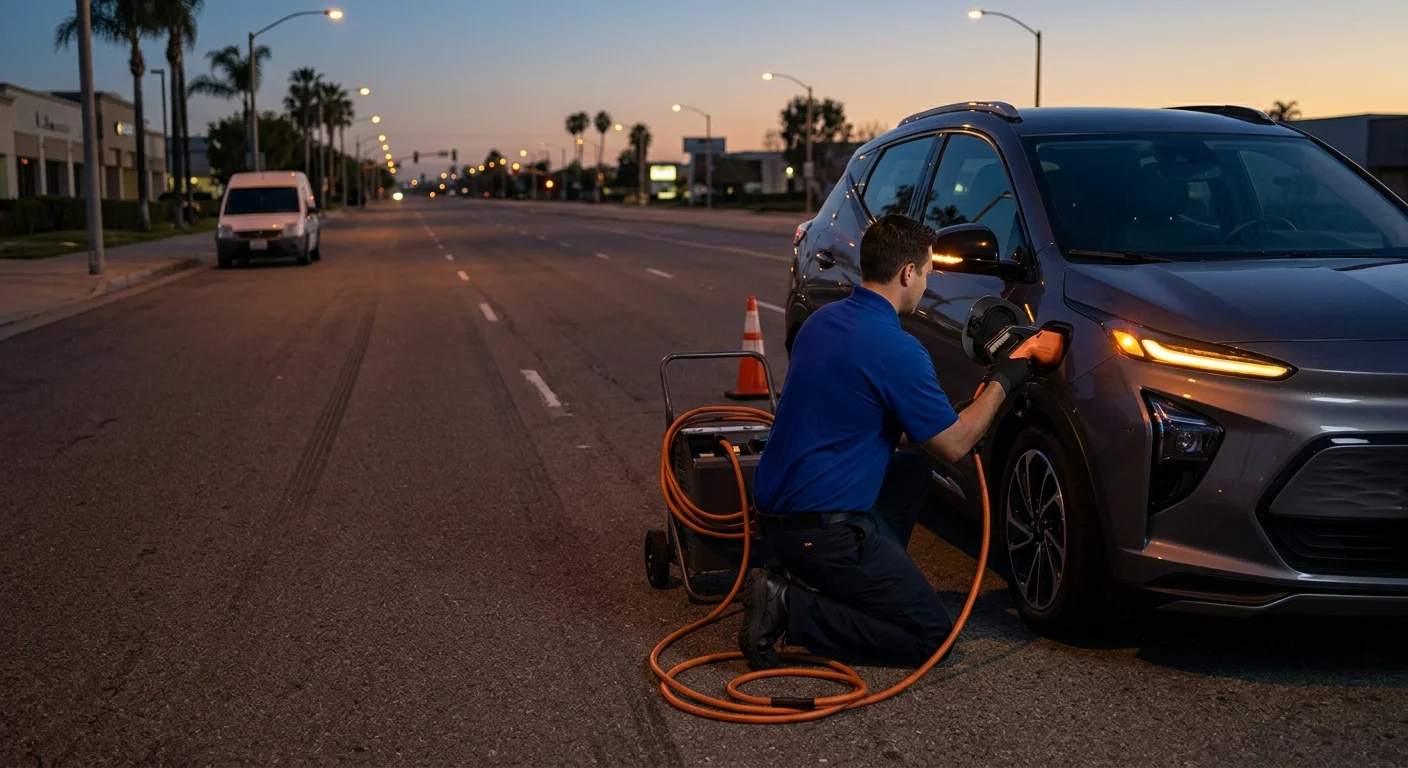
What AAA publishes for EV members in California
This site’s verified claims ledger has no confirmed row that AAA dispatches a charging truck in California. It also has no confirmed row that AAA refuses to. So this page will not invent either. If you need the asset that plugs in, you confirm it on AAA’s current Electric vehicle roadside assistance page, then with the dispatcher, before you wait.
Orange County cards are regional. Members here are typically with the Auto Club of Southern California, not a club in another state. A national marketing page, or a club page written for Oregon or the East Coast, is not your coverage. Open aaa.com. Open your club’s member app. Read the live service list for this club, on this date.
Look for the actual job names. Tow. Jump start. Lockout. Fuel for gas cars. Mobile EV charging, if that line appears at all, and if California is named with it. If a charging truck is not listed for California, treat it as unconfirmed for this stop. Do not sit on Beach Boulevard waiting for a truck the page never promised.
Some AAA clubs advertise mobile charging in named cities of their own. That is club copy, not an Orange County inventory. None of those out-of-state lists is in this site’s verified ledger, and none of them answers a Santa Ana or San Clemente shoulder. Ask one sentence when a person picks up: are you sending a charging truck, a flatbed, or a 12-volt jump.
The demand behind the search is real. As of December 31, 2025, Orange County had 210,842 registered battery-electric vehicles, 8.54% of the county’s light-duty fleet, per the California Energy Commission. Teslas were 138,121 of those BEVs, 65.51% of the county’s battery-electric fleet. A lot of those drivers grew up on Superchargers and assume a club truck works the same way. Confirm the asset. Do not assume it.
Charging truck, tow to a stall, or a jump: three different jobs
Three jobs get mixed into one search. They are not interchangeable.
A charging truck, if one is actually coming, is a mobile EV charger for roadside use. On this site the typical rescue charge is 10 to 20 miles of range in 15 to 30 minutes of Level 2 charging. That is charging time, not travel time. The Alternative Fuels Data Center puts public Level 2 around 25 miles of range per hour. That is a bump to a stall or home, not a full pack. How mobile EV rescue trucks work is that Level 2 bump, not a Supercharger on wheels.
A tow to a stall is a different job. Tesla’s roadside policy answers a depleted battery with transportation, not on-site charging. That transport is paid, not a financially covered service. Tesla will move a warrantable undrivable car up to 500 miles to a Service Center. Running out of charge sits outside that covered list. A tow still needs a stall that can take the car: a working plug, the right connector, and a space the flatbed can enter. A drop at a CHP zone is not a charge.
A jump is a third job. EVs have a low-voltage battery. A jump can wake accessories. It does not refill a dead traction pack. Tesla’s Model Y manual says that once range is exhausted, the low-voltage battery loses support and needs external power before the high-voltage pack can charge. Orange County’s Freeway Service Patrol will jump a 12-volt battery. OCTA and Caltrans FSP pages have no out-of-charge EV category and do not offer EV charging. The listed FSP outcome for a depleted EV is a free tow to a CHP-designated drop zone, during FSP hours, on patrolled segments, and not guaranteed.
If you called AAA expecting a charging truck and the unit that is coming is a tow, you did not get the asset you searched for. If they send a jump, same mismatch. Get the job named before you hang up. Then decide whether AAA or mobile EV charging is the next call, based on the asset, not the logo on the card.
OC places AAA coverage still leaves you sitting
A tow-to-stall plan fails in Orange County places a club van may still reach.
SR-241, the Foothill Toll Road, is the clear example. OCTA’s published FSP coverage lists I-5, SR-22, SR-91, I-405, and, on the fact sheet, SR-57 and the Express Lanes. Neither the OCTA web page nor the fact sheet lists SR-73, SR-133, SR-241, or SR-261. FSP’s published coverage area does not list the toll roads. A dead EV on 241 is not sitting next to a Supercharger. The nearest Tesla sites sit in Irvine, Lake Forest, and Mission Viejo, off the toll alignment. A tow still has to leave the road, clear the plaza, and find an open stall.
Beach lots are the next miss. Huntington Beach has a Supercharger at 6913 Warner Ave: 24 stalls, max 325 kW. That does not help a car that died in a PCH lot after a beach day if the lot is full, the curb is red, or the flatbed cannot enter. Seal Beach’s nearest Supercharger is 3.2 straight-line miles to Garden Grove Valley View. Laguna Beach is a real Supercharger desert: 5.3 straight-line miles to Mission Viejo Crown Valley, over hills. Those miles are centroid-to-site straight lines, not road miles. A tow from Main Beach is a canyon climb, not a two-block roll.
HOA garages fail the same plan. Irvine, Ladera Ranch, Coto de Caza, and Aliso Viejo stack cars in gated structures. A flatbed needs clearance, permission, and a path. Coto de Caza and Rancho Santa Margarita sit 5.1 straight-line miles from the Laguna Hills Cabot Road Supercharger. The canyon box is worse. Silverado is 9.0 miles from Irvine Walnut. Trabuco Canyon is 7.3 miles from Lake Forest Muirlands. A stall that exists on a map is not a stall the tow can deliver you to while you sit in a private garage.
Private-property tows have their own California rules under Vehicle Code 22658, including entrance signage and a drop-fee ceiling. That statute is about removal, not charging. An HOA that will not let a truck in leaves you sitting either way. So does a beach lot with no charger inside the gate.
How to confirm your card before you wait on hold
Before you wait on hold, confirm the card in the console.
Read the club name. Orange County members are typically Auto Club of Southern California. Benefits do not copy across club lines. Open the member app and the EV roadside page. Screenshot the service list. Then call. Ask four things, in this order.
One: is this a depleted traction pack, a dead 12-volt, or a no-start you cannot sort. Two: are you sending a charging truck, a flatbed, or a jump. Three: if it is a tow, which charging site, and can that site take this connector. Four: if the asset is not a charging truck, say so now.
Keep hazards on if you are on the roadway. California Vehicle Code 25251 makes flashing warning lamps mandatory when a vehicle is disabled on the roadway and equipped with a simultaneous-flash device, if that device was not rendered inoperative. CVC 21809, the Move Over law as of January 1, 2026, covers a stationary vehicle displaying flashing hazard lights. Other drivers must change lanes or slow. That protects you. It does not summon a charger.
On a freeway during FSP hours, you can also call 5-1-1 and select Motorist Aid. For emergencies call 9-1-1. FSP is free. FSP is not a charging truck. The OCTA web page lists weekdays 6:00 a.m. to 7:00 p.m., and limited weekends 10:00 a.m. to 6:30 p.m. FSP does not operate overnight or on listed holidays. After four hours on a freeway right-of-way, CVC 22651(f) allows removal if you cannot move the car under its own power. It can be towed sooner if it is in the way. There is no four-hour grace period.
If AAA cannot name a charging truck, stop waiting for one. That is the moment to use a mobile EV charging service as backup, not as a speech against the club.
A local mobile charge as the backup, not a rival speech
This is not a pitch to drop AAA. The membership-versus-rescue comparison lives on the page linked above. This page is narrower. It asks whether a charging truck is the asset that shows up.
Charge Pro OC is a referral service. It matches drivers with licensed, independent local operators. It does not own a charging truck. It does not hold a trade license. It does not perform the work. The operator you are connected with quotes and bills you. The brand sets no price and promises no arrival window.
When the pack is empty and you need to roll, out-of-charge recovery is the job: a Level 2 bump on site so you can reach a stall or home. Public Orange County charging is dense on paper. As of December 31, 2025, the county had 7,095 public ports, including 1,475 public DC fast ports. Tesla still holds 59% of public DC fast ports here, 861 of them across 48 Supercharger sites. The county also runs 36.8 zero-emission vehicles per public port, versus 24.4 statewide, using CEC registration and charger counts. That density helps if you can drive. It does not help if you cannot. DOE EV basics are the same story at the national level: the network is built for a car that can still move.
A local operator with a mobile EV charger for roadside use is the backup when the club sends a tow you cannot use, or when the stall the tow has in mind is a gated garage, a beach lot, or SR-241. Keep the AAA card. Confirm the asset. Then call a local match if the truck you need is not the truck they are sending.
When to call us
Call when the pack is empty, AAA cannot name a charging truck, and a tow to a stall will not get you off a toll road, a beach lot, or an HOA garage. Call us at (949) 444-0151 and we’ll connect you with a local EV rescue operator.