The car dies on a private Emerald Bay drive after a long day on the water, and there is no Supercharger behind the gates to finish the trip. Pacific Coast Highway sits below you. The nearest named fast stalls are in Laguna Beach’s orbit and in Newport, and they still may not get you up this hill.
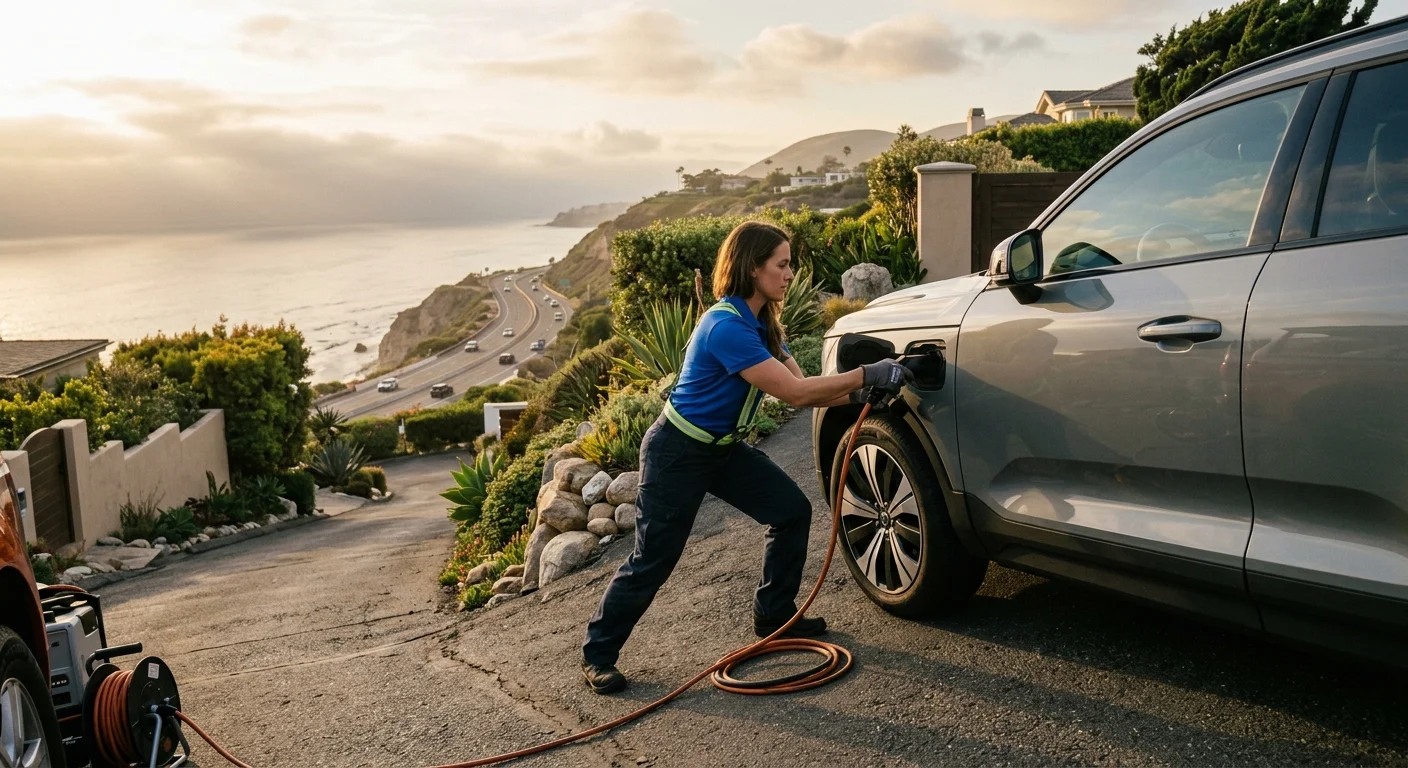
Emerald Bay has no public charging inside the gates
Emerald Bay is a gated strip on the Orange County coast, between Laguna Beach and Newport Coast. It is not a Census place of its own. In the charging data that can be checked, it sits inside the Laguna Beach Tesla Supercharger desert.
That desert is real. Laguna Beach’s nearest logged Tesla Supercharger is 5.3 straight-line miles away, at 27741 Crown Valley Parkway in Mission Viejo. That line crosses hills, not a short hop down PCH. No Tesla Supercharger site is listed for Emerald Bay. None is listed for Laguna Beach either. Orange County has 48 Tesla Supercharger sites and 861 Tesla DC fast ports, per the U.S. DOE Alternative Fuels Data Center inventory this site uses. None of those 48 sit inside these gates.
County totals do not prove a Level 2 pedestal on a private street. The California Energy Commission reports Orange County public ports as a county figure: 7,095 public ports as of December 31, 2025, including 1,475 public DC fast ports. That file does not break out Emerald Bay. A public charger count for this community could not be confirmed from that dataset, or from the Supercharger list used here.
Plan as if you will not find a public stall inside the gates. Residents charge at home. Guests, vendors, and weekend visitors do not get a public DC fast stop on these private streets. California Civil Code 4745 limits how a homeowners association can block a resident from installing an EV charging station. That statute is about a station at a home or an assigned space. It does not create a public charger. It does not set gate rules for a rescue truck.
If the pack is empty here, the work is on-site mobile EV charging or a short move after you are off PCH. Charge Pro OC does not run trucks and does not perform the charge. The brand connects you with a licensed local operator who brings the charger to the car.
PCH, the grade, and a weekend that sits all day
Pacific Coast Highway is the only real through road. The houses sit above it on steep private streets. A weekend in Emerald Bay often means the car sits for hours: beach, lunch in Laguna, climate control on, then a climb back up the drive.
AAA’s 2026 dynamometer study found an 8.5 percent loss of range when running air conditioning at 95 F. Coastal Orange County is usually cooler than inland Anaheim. That does not make the hill free. A low state of charge on PCH plus a grade into a gated street is how cars get stuck on a slope instead of a lot.
Do not leave the car in a travel lane on PCH. A vehicle that obstructs traffic or creates a hazard on a highway may be removed immediately under California Vehicle Code 22651(b). There is no waiting period for that. If you can roll to a lawful pull-out, a driveway, or a legal shoulder that is not blocking through traffic, do that. Turn on hazard lights. In California, flashing the turn signals as warning lights is required when a vehicle is disabled on the roadway and equipped with a simultaneous-flash device (Vehicle Code 25251).
Freeway Service Patrol will not be the backup you hope for on this stretch. OCTA’s published FSP coverage lists Orange County freeways such as I-5, SR-22, SR-91, and I-405. Those pages do not list Pacific Coast Highway. FSP is free during its published hours, and it is a tow to a CHP drop zone, not a charge. Caltrans FSP assist codes include Out of Gas. They do not list an out-of-charge EV category. A jump-start restores a 12V accessory battery, not a depleted traction pack.
Weekend PCH in this corridor crawls. A dead EV in the lane is a problem for everyone behind you. Get the car off the through lanes first. Then deal with charge. The U.S. Department of Energy’s electric vehicle pages are useful for how Level 2 and DC fast differ. They will not put a stall on this bluff.
Laguna Beach and Newport stalls that still leave you short
People assume Laguna Beach has a Supercharger because it is a destination. It does not, in the AFDC inventory this site uses. The closest Tesla Supercharger to the Laguna Beach place centroid is that Mission Viejo Crown Valley site, 5.3 straight-line miles inland. Straight-line is not road miles. The canyon and the ridge sit in between.
North of Emerald Bay, Newport Beach has a Tesla Supercharger at 4241 MacArthur Boulevard: 12 stalls, maximum 250 kW. Electrify America has 8 DC fast ports at Fashion Island, 401 Newport Center Drive. Those are real, named sites. They still leave a depleted car on Emerald Bay short, because you have to drive to them. An empty pack does not make MacArthur or Fashion Island. The hill between the water and Newport Coast is its own problem. Drivers stall on that climb even when they planned the stop. That pattern is in stalled on the Newport Coast climb.
South into town, EV roadside assistance in Laguna Beach is the neighboring pattern: coastal parking, no Supercharger in the city, and a long sit while the car uses climate and screens. A downtown Laguna Level 2, if you find one, is not a DC fast fill. AFDC puts public Level 2 in a band that yields about 25 miles of range per hour. A typical mobile rescue charge is 10 to 20 miles of range in 15 to 30 minutes of Level 2 charging. That is charging time, not travel time, and it is enough to reach a named fast site once the car can move.
Tesla’s roadside policy answers a depleted battery with transportation, not on-site charging. That transport is paid when the car simply ran out of charge. Tesla’s covered transport of up to 500 miles to a Service Center is for a warrantable breakdown that leaves the car undrivable. Running out of charge sits outside that list. Tesla’s roadside number, published on the Santa Ana service page, is 877-798-3752. That is Tesla, not Charge Pro OC.
If you can still roll a few miles, those Newport and inland Superchargers matter. If you cannot, a matched operator with emergency EV roadside assistance is the local path.
Gate access for a matched operator
Emerald Bay is gated. A rescue operator cannot guess the guest policy. A public city or community page that states after-hours gate rules, vendor hours, or a posted guest-pass process for Emerald Bay could not be confirmed for this article. Do not assume the truck rolls in because you called.
Have a resident at the gate. Have a guest code if you were given one. Tell the operator the car’s exact street, not Emerald Bay as a blob. Private drives here are steep and narrow. The operator quotes and bills you directly. Charge Pro OC sets no price, owns no trucks, and does not promise an arrival window.
If the car is on PCH below the gates, say so. A truck that cannot enter still may be able to work on a lawful pull-out. Blocking the highway is the wrong place to wait. If the car is already inside, stay with it so the operator is not turned away at the kiosk.
Civil Code 4745 is not a gate-pass law. It stops an HOA from unreasonably blocking a charging-station install. Gate access for a mobile charger is a community and property-manager question. Ask the resident or the gate staff. If they cannot answer, say that on the call so the operator is not surprised.
Keep the car out of the PCH travel lanes while you wait. Hazard lights on if you are near the roadway. The matched pro is licensed and insured. The brand is a referral service only.
Dead 12V after the coast versus a truly empty pack
A full coast day kills the 12V as often as it empties the pack. The car sits. Climate runs. Doors open on a steep drive. The 12-volt system supports computers, locks, and the contactors that let the high-voltage pack charge. Tesla’s Model Y owner’s manual is plain on the empty-range case: once range is exhausted, the low-voltage battery loses support and needs an external power supply before the high-voltage battery can charge.
That is why a dead EV on an Emerald Bay driveway is two different jobs. A truly empty traction pack needs a Level 2 rescue charge, then a drive to a DC fast site if you still need a fuller fill. A 12V that dropped after hours of sitting may look identical: no wake, no door handle, no charge port. Supporting the 12V is not the same as filling the pack. The operator you are connected with sorts that on site.
Do not keep cycling the car hoping a percent point appears. If hazards still work, leave them on if you are near PCH. If you are on a private drive, stay out of the roadway and keep the car in park. Orange County had 210,842 battery-electric vehicles as of December 31, 2025, and 36.8 zero-emission vehicles per public port, denser than the state’s 24.4. This coast still has pockets with no public DC fast inside the neighborhood. Emerald Bay is one of them.
When to call us
When the car will not make MacArthur, Fashion Island, or Crown Valley, and you are on the Emerald Bay strip or on PCH below it, you need a matched mobile rescue, not a hope that a stall appears inside the gates. Stay off the through lanes, and have gate access ready if the car is already inside. Call us at (949) 444-0151 and we’ll connect you with a local EV rescue operator.