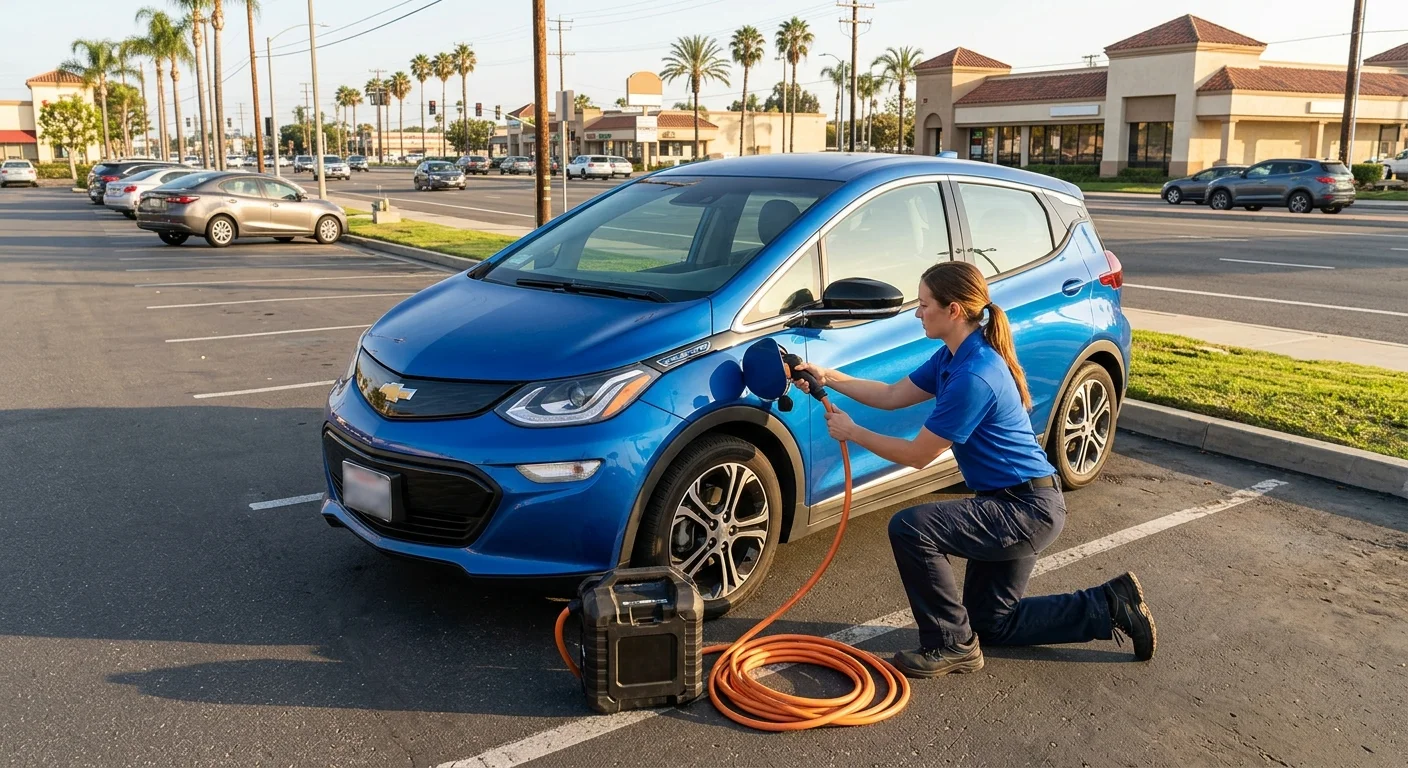
You’re in a Westminster lot with a Chevy Bolt that will not wake. The pack may be empty, or the 12V may have gone to sleep after a long Bolsa errand. Either way, the Tesla Superchargers at Westminster Mall are not a Bolt’s backup.
Why Westminster is a hard Bolt map
Westminster sits on a CCS-unfriendly slice of north Orange County. Bolsa Avenue through Little Saigon, Beach Boulevard, and the I-405 edge look busy. That traffic is not the same as a Bolt-ready fast-charge map. The stalls people notice first at Westminster Mall are Tesla Superchargers. A Bolt uses CCS, not Tesla NACS, unless you already own a confirmed adapter and have used it. Do not treat the mall’s Tesla row as your Plan B.
Orange County held 210,842 battery-electric vehicles as of December 31, 2025, according to the California Energy Commission. Teslas were 138,121 of those BEVs, or 65.51 percent of the county’s battery-electric fleet. Tesla also holds 59 percent of Orange County’s public DC fast ports: 48 Supercharger sites and 861 DC fast ports, per the U.S. DOE Alternative Fuels Data Center snapshot logged for this site. The remaining non-Tesla DC fast inventory is real (175 stations, 591 ports countywide). It is spread across the county. It is not sitting in a neat Bolt-only cluster on Bolsa.
Westminster also sits next to Garden Grove and Midway City, which does not fix the connector problem. Midway City’s nearest Supercharger is 1.6 straight-line miles to Westminster Mall. That site is still Tesla. Garden Grove’s Tesla sites at 12891 Harbor Blvd and 12161 Valley View St add more Tesla stalls, including a 32-stall Harbor site and a 16-stall Valley View site. A Bolt driver who follows “charging near me” pins into those lots can spend the last miles on the wrong plug.
Heat and stop-and-go on Beach and Bolsa eat range the same way they do anywhere in inland-adjacent north county. AAA’s 2026 dynamometer study found an 8.5 percent loss of range when running air conditioning at 95 F. That is not a Westminster-only figure. It is a reason a short errand can finish lower than the dash suggested at lunch. Pair that with Orange County’s 36.8 ZEVs per public port (260,833 ZEVs over 7,095 public ports), versus 24.4 statewide, and a CCS car has less slack when a stall is occupied, offline, or the wrong standard.
If you only needed a generic city rescue overview, we already keep EV roadside assistance in Westminster. This page is narrower: a Chevy Bolt that died here, on this map, with this plug.
CCS stalls, mall lots, and Superchargers you cannot use
The Tesla Supercharger at 1025 Westminster Mall has 24 stalls and a listed maximum of 75 kW. AFDC records it as public, available, Tesla network, with an open date of December 21, 2018. Those are NACS stalls on Tesla’s network. A Bolt’s native inlet is CCS. Magic Dock (CCS1 plus NACS) is logged for this site at a Lake Forest Supercharger, not at Westminster Mall. Do not assume the mall stalls will take a Bolt.
GM’s published pages were not confirmed here for a Bolt-to-Supercharger adapter, year by year. If you already carry an adapter that you have used on this car, that is your confirmation. If you do not, write the mall Supercharger off for this stop. The same caution applies to nearby Tesla sites in Garden Grove, Fountain Valley, Cypress, and Huntington Beach. AFDC reports maximum connector power at those sites. It does not turn them into CCS destinations.
Countywide, public DC fast charging (Tesla included) ran 223 stations and 1,452 ports in the AFDC snapshot this site uses. Strip Tesla out and you still have 175 stations and 591 ports on networks such as Electrify America, EVgo, EVCS, and ChargePoint. ChargePoint’s Orange County DC fast set is 71 stations and 76 ports, roughly 1.1 ports per site, mostly dealership and office single-plug units. That mix matters in Westminster because a “CCS charging near me” search can land you on a single occupied dealership plug, a Tesla-only mall row, or a Level 2 pedestal that will not refill a dead pack before the lot closes.
Mall lots and structures add a second trap. You are on private property. California Vehicle Code 22658 governs private-property tows when the required entrance signage is in place: a sign not less than 17 inches by 22 inches, lettering not less than one inch high, in plain view at all entrances, stating vehicles will be removed at the owner’s expense and listing local traffic law enforcement plus each authorized towing company’s name and phone. Sitting in a stall “until a charger frees up” can turn into a tow if the property is posted. If a wrecker is already coupled and you return before the car leaves the property, CVC 22658 lets the company charge not more than half the regular towing charge. The full charge may be imposed only after the vehicle has been removed and is in transit.
Level 2 in a garage or on a street is a different tool. The U.S. DOE Alternative Fuels Data Center describes public and workplace Level 2 in a 40 to 80 amp band, and states approximately 25 miles of range per hour of charging. A typical mobile rescue charge logged for this brand is 10 to 20 miles of range in 15 to 30 minutes of Level 2 charging. That is charging time at the car, not a promise about when an operator arrives. It is enough to reach a confirmed CCS stall or get home. It is not a full pack.
If the car still has range and the session at a public pedestal failed, that is a charge-fault problem, not a dead-car problem. Work through Chevy Bolt won’t charge: what to check before you assume the pack is empty.
12V sleep after a long Bolsa errand
A Bolt that “died” after hours on Bolsa, in a Westminster Mall structure, or on a Beach Boulevard errand is often the 12-volt battery, not a zero pack. The notes on this car class are simple: 12V sleep after a long sit is as common as an empty traction battery. Cabin cameras, the radio, climate, and a charge-port door that was left thinking all add load. North-county heat raises accessory draw. The dash can go dark while the high-voltage pack still shows miles you cannot reach.
Do not import Tesla 12V lore onto this hatchback. Tesla’s Model Y manual describes the low-voltage battery losing support once range is exhausted, and needing an external power supply before the high-voltage battery can charge. That is a Tesla document. It is not a Chevy Bolt procedure. This page could not confirm a single GM-published 12V post map that covers every Bolt and Bolt EUV year. The owner’s manual for your year is the authority for clamp points, fuse access, and whether a jump is even specified. Guessing from a Tesla video is how people damage a module.
What you can check without a wrench: fob range, interior lights, the dash wake, whether the charge-port door still motorized, and whether the car chirps or stays inert. A pack at 40 percent with a black screen is a 12V suspect. A pack at 0 percent with a live dash is an energy problem. Both look like “the Bolt died” from the sidewalk.
If you are on I-405 along Westminster, treat it as a disabled vehicle, not a parking event. CVC 25251 requires flashing the turn signals as warning lights when a vehicle is disabled on the roadway and equipped with a simultaneous-flash device, if that device was not rendered inoperative. CVC 21718 lets a genuinely disabled vehicle temporarily stop on a freeway when another vehicle has been summoned to render assistance. After four hours on a freeway right-of-way, CVC 22651(f) allows removal if the driver cannot move it under its own power. It can be towed sooner if it obstructs traffic or creates a hazard under 22651(b). Effective January 1, 2026, CVC 21809 (the Move Over law) also covers a stationary vehicle displaying flashing hazard lights.
OCTA’s Freeway Service Patrol covers I-405 from I-605 to SR-73 on the published web list, which includes the Westminster stretch. Call 5-1-1 and select Motorist Aid. FSP is free. FSP does not operate overnight. Published web hours are Monday through Friday, 6:00 a.m. to 7:00 p.m., and limited weekend service 10:00 a.m. to 6:30 p.m. FSP does not operate on listed holidays. Caltrans FSP assist codes include Out of Gas and no out-of-charge EV category. A jump-start restores a 12V accessory battery, not a depleted traction pack. The listed FSP outcome for a depleted EV is a free tow to a CHP-designated drop zone, during hours, on patrolled segments, and not guaranteed.
What to check before you call
Work the car in this order so you do not call the wrong kind of help.
Confirm you are safe. Hazards on. People out of live lanes. On the freeway, stay behind the barrier if you can. In a mall structure, stay with the car if the lot is posted for removal.
Read the dash, not your memory of this morning’s percentage. Note the indicated miles, any red battery or service messages, and whether the screen wakes with the fob or the brake. Photograph the cluster if it will light. That photo is what a matched operator uses to decide 12V support versus a CCS-capable Level 2 rescue charge.
Look at the inlet. A Bolt’s CCS port will not mate with a Tesla Supercharger cable. If you already drove to 1025 Westminster Mall for those 24 stalls, you are at the wrong hardware unless you have a confirmed adapter on this car. Walk the rest of the lot for a CCS or J1772 pedestal before you spend the last mile hunting Tesla NACS.
Try a known-good public Level 2 only if the car will still accept a plug and you can stay with it. AFDC’s public Level 2 figure is about 25 miles of range per hour. That will not refill a brick in a short grocery stop. It can prove the inlet still talks.
If the car is inert and you cannot open the port, stop. Port-release and 12V access are year-specific. Use the owner’s manual. Do not pry the door. Do not jump from a gas car’s running engine unless your manual says that layout is allowed.
Sort location. A Bolsa street stall, a mall structure, and the I-405 shoulder are three different jobs. Private-property tow rules apply in the first two. FSP and CVC disabled-vehicle rules apply on the freeway. FSP will not put energy in the traction pack.
Skip dealer-lot questions while you are stranded. Tax credits, whether Chevy still builds the Bolt, and heat-pump trim lists do not open the port. The search that landed you here is a car that died in Westminster. Stay on that.
When those checks still leave you stuck, you want non-Tesla EV rescue, not a Tesla-only truck and not a wrecker as the first move. If you are already on the shoulder and need a broader Orange County backup, emergency EV roadside assistance is the matching path.
How a matched non-Tesla operator works here
Charge Pro OC is a referral service. We connect you with a licensed, independent local operator. We do not own the truck, we do not hold a trade license, and we do not charge the car. The operator quotes you, bills you, and does the work. That split matters on a Bolt because the hardware on scene has to be CCS-capable. A Tesla-only cable does not help.
What the operator typically brings to a Westminster stop is Level 2 energy at the curb or in the lot. The approved rescue-charge figure on this site is 10 to 20 miles of range in 15 to 30 minutes of Level 2 charging. That window is charging time, not travel time. It is consistent with AFDC’s roughly 25 miles of range per hour on Level 2. The goal is enough range to reach a confirmed CCS stall, a home plug, or a safe surface street off I-405. It is not a full recharge in the mall.
Tell the operator the exact pin: Westminster Mall structure, a Bolsa lot in Little Saigon, Beach Boulevard, or the I-405 shoulder by the Westminster ramps. Connector standard (CCS), indicated percentage, whether the 12V looks asleep, and whether FSP is already rolling if you are on the freeway. If FSP tows you to a CHP-designated drop zone, say so. A drop zone is short-term. Local parking rules can still apply, and you should move the car soon.
Do not expect the brand to set a price or an arrival window. Those belong to the operator. Do not expect FSP, Tesla Superchargers, or a mall Tesla row to substitute for a CCS rescue. Orange County’s public-port mix is Tesla-heavy by design of the inventory, not by accident. A Bolt in Westminster has to plan around that, or call for a matched non-Tesla EV rescue when the map runs out.
For background on why EVs and public charging look the way they do, the U.S. Department of Energy’s electric vehicle pages are a clean primer. For California’s ZEV counts and charger inventory, use the Energy Commission, not a forum screenshot.
When to call us
Call when the Bolt will not wake in a Westminster lot, on Bolsa, on Beach Boulevard, or on the I-405 shoulder, and you have already ruled out a wrong-plug Supercharger hunt. Call when the 12V looks asleep after a long sit, or the pack is empty and you need a CCS-capable Level 2 charge at the car instead of a wrecker. Call us at (949) 444-0151 and we’ll connect you with a local EV rescue operator.