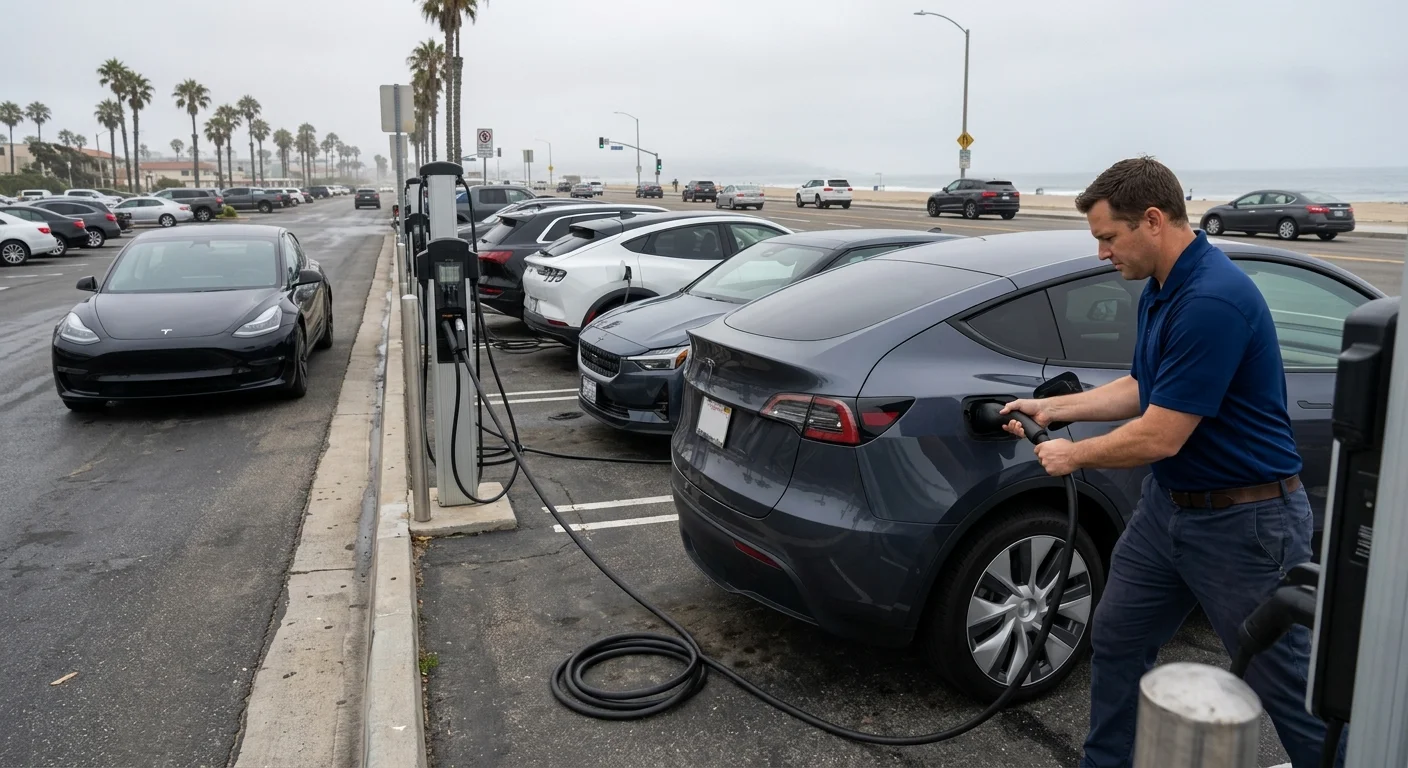
A Tesla Supercharger Huntington Beach search usually means you are already on PCH with the gauge in the teens. The only Supercharger the U.S. DOE Alternative Fuels Data Center lists inside the city is at 6913 Warner Avenue: 24 stalls, 325 kW max, open since September 8, 2025. That address is inland of the pier. If those stalls are queued or offline, a beach lot adds no miles.
Why beach-day Superchargers fill before the pack is empty
Huntington Beach stacks surf traffic, Tesla ownership, and one in-city Supercharger on the same Saturday. Orange County had 210,842 battery-electric vehicles as of December 31, 2025. Tesla accounted for 138,121 of them, 65.51 percent of the county’s BEV fleet. Cars roll in from Sunset Beach, Downtown Main Street, and the Bolsa Chica lots with climate on and a plan to top up after the water.
The pack is often still showing miles when the line forms. Drivers plug because the next move is the 405, Costa Mesa, or a late table inland. Others plug because Sentry, cabin overheat protection, and phones ran all afternoon. The marine layer keeps this coast cooler than Anaheim. AAA’s 2026 dynamometer study still found an 8.5 percent range loss with air conditioning at 95 F. On a clear Huntington Beach afternoon the A/C still runs. Range falls while you wait for a stall that is already taken.
Warner Avenue is a through street, not a charger at the sand. Beach-day arrivals bunch after lunch and again near dusk. A 24-stall site looks large on a Tuesday. On a warm weekend it is a single funnel. Orange County holds 48 Tesla Supercharger sites and 861 DC fast ports. Huntington Beach has one of those sites. That is the occupancy math.
The California Energy Commission counts 7,095 public charging ports in Orange County, including 1,475 public DC fast ports. Tesla holds 59 percent of the county’s public DC fast ports. A packed Supercharger here is a local traffic pattern. It is a crowded Saturday at the coast with one Tesla DC address inside the city line.
PCH lots, the 405, and stalls that still leave you short
Pacific Coast Highway through Huntington Beach is parking, surf traffic, and city lots. The Supercharger address is 6913 Warner Avenue. Confirm any PCH pin on Tesla’s live map before you spend the last bar hunting it. A Tesla Supercharger at Bella Terra could not be confirmed in the AFDC inventory used for this page. If Tesla’s map later shows a new site, trust the live map. Do not treat a mall pin as a Supercharger until that map says so.
The nearest listed non-Tesla DC fast option inside the city is EVgo at 21190 Beach Boulevard, with 3 stalls. That is a different network and a small site. It will not absorb Supercharger overflow.
When Warner is queued, the next AFDC Superchargers sit just over the city line. Fountain Valley lists 9430 Warner Avenue (12 stalls, 250 kW) and 17940 Newhope Street (16 stalls, 150 kW). Westminster Mall lists 24 stalls at 75 kW. Costa Mesa has sites on Bristol Street, Coast Drive, and Hyland Avenue. Garden Grove’s Harbor Boulevard site has 32 stalls at 250 kW. Those are real addresses in other cities, with other occupancy. Check the live map before you leave the lot.
The 405 is the inland escape and a common place a low Tesla stops. OCTA’s Freeway Service Patrol covers I-405 from I-605 to SR-73 on published hours. Weekdays that is 6:00 a.m. to 7:00 p.m. Weekends it is limited, 10:00 a.m. to 6:30 p.m. FSP is free. It does not charge an EV. The listed outcome for a depleted EV is a tow to a CHP-designated drop zone, during hours, on patrolled segments, and not guaranteed. After 7:00 p.m. on a weekday, FSP is done. Hazard lights are mandatory on the roadway under CVC 25251 if the car is equipped and the flasher still works. CVC 21809, the Move Over law as of January 1, 2026, covers a stationary vehicle showing flashing hazards.
A full stall, an offline stall, and a stall eight miles inland all leave you short if the car cannot make Warner on the miles it has left.
How to check Tesla’s map without inventing a stall count
Tesla’s in-car nav and the Supercharger map on tesla.com are the occupancy source. PlugShare is a public log. AFDC is the inventory source this page uses. Do not mix those into a stall count from memory.
AFDC reports maximum connector power, not a Tesla V2, V3, or V4 label. Tesla does not publish generation in that dataset. The Huntington Beach Warner site is listed at 325 kW max. That is a ceiling. It is not a promise at your stall, at your state of charge, or on a shared cabinet. If the app shows a site offline, believe the app.
Open the Tesla map, pin Huntington Beach, and read the live stall status. If the pin is grey, occupied, or missing, stay put. Screenshot the pin so you have the address. 6913 Warner Avenue is the confirmed in-city Supercharger as of the AFDC pull logged for this site. If a second Huntington Beach Supercharger appears, the live Tesla map is the confirmation. This page will not invent one.
CEC charger counts mix surveys, grant data, AFDC, PlugShare, and other sources, updated semi-annually. A blog post should not freeze a stall number Tesla can change overnight. Use the map. Then decide whether you can wait, reroute to Fountain Valley or Westminster, or stay with the car.
For charging basics, the U.S. Department of Energy keeps a plain explainer on electric vehicles. County and state charger totals live at the California Energy Commission. Those pages will not tell you if Warner is free at 4 p.m. Only Tesla’s live map does that.
Dead 12V after a long beach sit versus a truly empty pack
A long beach sit and a truly empty pack look the same from the sidewalk. The car is dark. The app may be silent. The doors may not present.
Tesla’s Model Y owner’s manual is direct on a depleted-range case. Once range is exhausted, the low-voltage battery loses support. It needs an external power supply before the high-voltage pack can charge. That is a 12V problem stacked on an empty pack.
A 12V sleep after a full beach day is as common as an empty pack. Cabin climate, Sentry, a phone in the console, and hours of parked electronics pull the low-voltage battery while the traction pack still shows a number. The car will not wake. Supercharger navigation cannot help if the car cannot drive to Warner.
Tesla’s roadside policy answers a depleted battery with transportation, not on-site charging. That transport is paid. It is not a financially covered service. Transportation of up to 500 miles to the nearest Service Center is for a warrantable breakdown that renders the vehicle undrivable. Running out of charge sits outside that list. Tesla’s Santa Ana service page publishes roadside at 877-798-3752. Call Tesla for Tesla’s policy.
Telling the two failures apart matters for the operator you get matched with. A 12V jump can restore accessories so the car can accept a charge. An empty pack needs energy at the car, or a tow to a working stall. Tesla roadside rescue is the path when you cannot move. If the pack still has miles and the car will not wake, say that on the call. If the gauge hit zero on PCH, say that too.
Huntington Beach lots after a beach day also mean private-property tow risk if you leave a dead Tesla in a posted space. CVC 22658 sets the signage rules for a private-property tow. Read the lot signs. Stay with the car when you can.
A matched operator at the car when the queue will not move
When Tesla’s map shows Warner full and the next Supercharger is Fountain Valley or Costa Mesa, the car may not have the miles. A matched local operator comes to the car. Charge Pro OC is a referral service. It does not own trucks, does not hold a trade license, and does not perform the work. The independent operator you are connected with quotes and bills you directly.
A typical rescue charge is 10 to 20 miles of range in 15 to 30 minutes of Level 2 charging. That is charging time, not a promise of when someone arrives. AFDC describes public Level 2 as roughly 25 miles of range per hour. That is often enough to reach 6913 Warner Avenue, 9430 Warner in Fountain Valley, or home if home is closer.
Mobile EV charging is the product when the pack is empty and the queue will not move. For lots, PCH, and the 405 shoulder around this city, see EV roadside assistance in Huntington Beach. Inland Supercharger queues run on a different clock. Anaheim Tesla Superchargers when full covers that inland pattern.
Stay out of the 405 travel lanes. If you are already on the freeway, call 511 for FSP during hours, or 911 if you are in danger. A mobile charge in a live freeway lane is the wrong ask. A CHP drop zone, a city lot, or a legal curb is where an operator can work. The matched pro is licensed and insured. Charge Pro OC is the match.
When to call us
A packed Tesla Supercharger Huntington Beach site, a dead 12V after a beach sit, or an empty pack on PCH is a stay-with-the-car problem. Call when Tesla’s map will not free a stall and the car cannot make Fountain Valley or Warner on its own. Call us at (949) 444-0151 and we’ll connect you with a local EV rescue operator.