The Costa Mesa Freeway will strand an EV between stalls faster than most Orange County routes. John Wayne traffic, the 405 merge, and the 22/55/57 stack all chew range while the lane behind you keeps moving. If the pack is already empty, stay on the shoulder, keep the hazards flashing, and get miles added at the car.
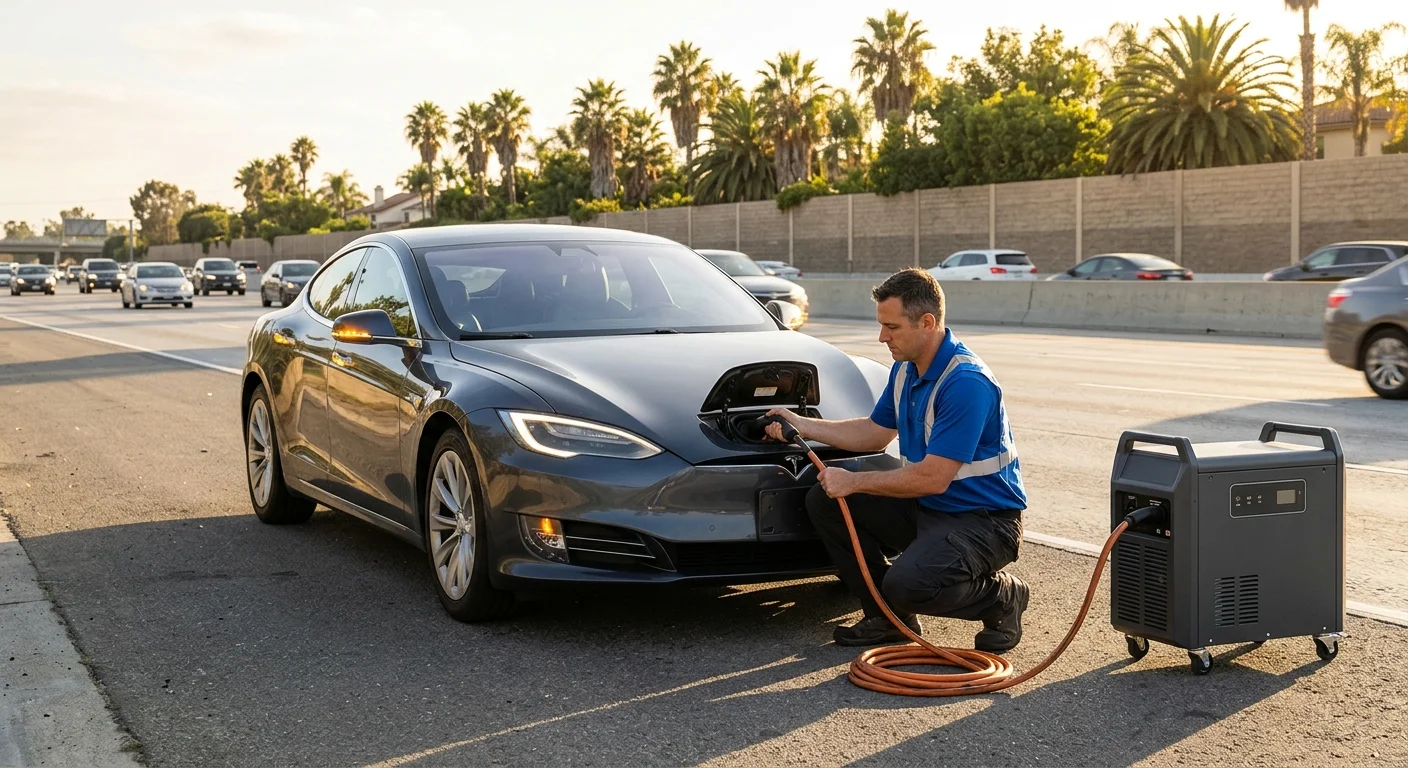
What empty on the 55 actually looks like
Empty on SR-55 is rarely a mystery. You were already low leaving Newport, Costa Mesa, or Tustin. Then the 55 stopped moving. Climate control kept running. The last estimated miles fell through. The car went into limp, then into a hard stop on the Costa Mesa Freeway.
The usual scene is a dark EV on the right shoulder, hazards on, sound wall on one side and live lanes on the other. Palm-lined walls are common through Costa Mesa and Santa Ana. The shoulder is the only lawful place to sit. Standing in a lane to flag someone down is how people get hit. Stay in the vehicle if you can. If you must step out, use the passenger side, stay behind a barrier if one is there, and keep your body off the pavement.
This is a disabled-vehicle problem first. California Vehicle Code 21718 lets a genuinely disabled vehicle stop on a freeway when another vehicle has been summoned for help. California Vehicle Code 25251 says you flash the hazards when you are disabled on the roadway. California Vehicle Code 21809, the Move Over law as of January 1, 2026, tells other drivers to change lanes or slow for a stationary vehicle showing hazards. None of that makes the shoulder safe. It only makes sitting there lawful while help is on the way.
A jump-start will not refill a dead traction pack. Orange County’s Freeway Service Patrol can jump a 12-volt accessory battery, change a tire, or tow off the freeway to a CHP-designated drop zone. OCTA and Caltrans pages do not list an out-of-charge EV category, and they do not offer charging. If the high-voltage pack is empty, the listed FSP outcome on a patrolled segment is a free tow to a drop zone during published hours, and even that is not guaranteed.
If the car is a Tesla and the range is already gone, Tesla’s roadside policy answers a depleted pack with transportation, not on-site charging. That transport is paid. It is not a financially covered service. Tesla’s Model Y manual also notes that once range is exhausted, the low-voltage battery can lose support and need external power before the high-voltage pack will take a charge. Plan for that if the screens are already dark.
Costa Mesa, the 405 merge, and the 22/57 crush
South of the 405, SR-55 is airport traffic. John Wayne sits between the 55 and the 405. Baker, MacArthur, and Bristol back up in both directions. A car that was fine in Newport Beach can hit zero on the Costa Mesa rise toward the merge. If you can still roll, the nearest Tesla Superchargers in Costa Mesa are at 1400 Bristol Street (12 stalls, up to 250 kW), 1475 South Coast Drive (20 stalls, up to 250 kW), and 3303 Hyland Avenue (8 stalls, up to 250 kW). Newport Beach has another at 4241 MacArthur Boulevard (12 stalls, up to 250 kW). Those addresses come from the U.S. Department of Energy Alternative Fuels Data Center. They only help if you still have enough miles to exit.
The 405 merge is where southbound 55 traffic meets the San Diego Freeway. Northbound 55 traffic is climbing out of that same knot. Either way, you are in a weave, not a quiet curb. An empty car in that weave belongs on the shoulder the moment you know you will not make the next exit. Do not try to coast to a mall stall from a dead pack in a travel lane.
North of 17th Street and the Santa Ana River, the 55 feeds the 22/55/57 stack. Locals call the wider 5/22/57 knot the Orange Crush. Your problem on the 55 is the approach, not the 22 itself. If you already stopped on the Garden Grove Freeway, that stretch has its own notes in out of charge on SR-22. On the 55, the crush is stop-and-go that burns the last bar of range while Tustin and Orange exits sit one interchange away.
If you can limp off in Santa Ana or Tustin, Superchargers sit close to the corridor. Santa Ana has 28 stalls at 1008 17th Street, up to 325 kW, and 20 stalls at 300 East 5th Street, up to 75 kW. Tustin has 12 stalls at 14521 Red Hill Avenue, 36 stalls at 14661 Franklin Avenue, plus smaller sites on Kensington Park Drive and Flight Way. Irvine’s 40-stall site at 1920 Main Street is the large one west of the 55/405 split. The City of Orange has no Supercharger inside city limits. The nearest logged site is about 1.7 straight-line miles to Anaheim at East Katella Avenue, which is not a useful limp from a dead pack on the 55.
North of the crush, the 55 runs toward the 91 through Orange. That is a different traffic diet: fewer airport weaves, more commute stacks at Chapman, Katella, and Lincoln. The pack still dies the same way. Heat does not help. AAA’s 2026 dynamometer study found an 8.5 percent range loss with air conditioning at 95 F. Inland Orange in late afternoon is that kind of heat.
The California Energy Commission counted 210,842 battery-electric vehicles in Orange County as of December 31, 2025. That is 8.54 percent of the county’s light-duty fleet. An empty EV on the 55 is a volume problem, not a freak event.
Shoulder first, then range, then a stall
Order of operations on SR-55 is shoulder, then range, then a stall. Reverse that order and you walk into traffic.
Get the car as far right as it will go. Hazards on. If you have a warning triangle, it goes behind the car, not in a live lane you then have to retrieve. Stay inside if the car still has 12-volt power for locks and climate. If you are on a narrow shoulder with traffic close, calling 9-1-1 is the right first move. A disabled EV in a travel lane is an immediate hazard. California Vehicle Code 22651(b) lets officers remove a vehicle that obstructs traffic or creates a hazard with no waiting period. California Vehicle Code 22651(f) also lets a freeway vehicle be removed after four hours if it cannot move under its own power. That is permission to tow, not a four-hour grace period. After four hours it can be towed, and sooner if it is in the way.
FSP’s published coverage lists I-5, SR-22, SR-91, and I-405 on OCTA’s web page. The August 2026 fact sheet also lists SR-57 and the 91 and 405 Express Lanes. The two sources disagree on those extras. Neither list names SR-55 as a patrolled route. Coverage on the Costa Mesa Freeway itself could not be confirmed from those public OCTA pages. Call 5-1-1 and ask for Motorist Aid anyway. For an emergency, call 9-1-1. CHP’s non-emergency line is 1-800-TELL-CHP (1-800-835-5247). Do not email OCTA for a rescue.
Once you are stable, the job is miles, not a wrecker. A matched local operator doing out-of-charge recovery adds range at the car. The typical rescue charge on this network is 10 to 20 miles of range in 15 to 30 minutes of Level 2 charging. That is charging time, not an arrival promise. The U.S. Department of Energy’s Alternative Fuels Data Center puts public Level 2 in a band that works out to roughly 25 miles of range per hour. Ten to twenty miles is enough to leave the 55 and reach a Costa Mesa, Santa Ana, or Tustin stall. For broader EV charging context, see the Department of Energy’s electric vehicle pages.
Do not walk the corridor looking for a charger. Do not cross live lanes on foot. Do not stand in the gore at the 405. If CHP or FSP arrives on a stretch they are actually working, take the safety instructions they give you. A drop-zone tow is a valid outcome if the car is in a bad spot. It is still a tow. You will still need a charge after you are off the freeway.
The same play holds at night. FSP does not operate overnight. Published weekday hours on OCTA’s consumer page run 6:00 a.m. to 7:00 p.m., with limited weekend hours 10:00 a.m. to 6:30 p.m. FSP is closed on listed holidays. Those hours describe the patrol program on listed freeways. They are not a confirmed SR-55 schedule. After dark on the 55, you are in CHP and private-help territory.
Why a hook is the last move if the pack only needs miles
A hook is the last move when the pack only needs miles. Towing an EV off SR-55 is sometimes required. A car in a travel lane, a leaking pack, a collision, or a Tesla that has lost 12-volt support and will not accept charge may need a flatbed. Tesla’s own roadside path for a depleted battery is transportation, not a charge truck. That is a real option. It is also slower, and it still leaves you with an empty EV at the other end.
A tow from the 55 dumps you at a CHP drop zone or a yard. Local parking rules can still apply at a drop zone. You have to move the car soon or risk a citation or a second tow. The yard path adds storage. California Vehicle Code 22658 sets private-property tow rules, signage, drop fees, and rate ceilings, but a freeway rotation tow is a different program under CHP. Either way, you still have an empty pack when the ride ends.
Charge-first keeps the car in your hands. The operator the referral connects you with brings Level 2 gear, restores enough range to reach a public stall, and leaves you as the driver again. You then finish at a Supercharger or another DC fast site. Orange County had 1,475 public DC fast ports as of December 31, 2025, per the California Energy Commission, and 48 Tesla Supercharger sites with 861 DC fast ports inside the county per the Alternative Fuels Data Center. The 55 corridor is not a charging desert. The shoulder is just a bad place to wait for a hook if the pack can take a charge.
If a hook is required, the matched operator or a separate tow company handles it. Charge Pro OC does not own a truck, does not perform the work, and does not set the tow rate. The operator quotes you. You pay that operator.
For the wider freeway pattern across I-5, I-405, the 91, and the rest, see out of charge on an Orange County freeway. The 55 is the same rule with a different merge: charge on the shoulder when it is safe, tow only when the car cannot take power or cannot stay out of the lanes.
How a matched operator works a freeway shoulder here
Charge Pro OC is a referral service. It matches you with a licensed, independent local EV charging professional. It performs no work, owns no trucks, and holds no trade license. The operator quotes and bills you. The brand sets no price and promises no arrival window.
When you call, pin the location. On SR-55 that means direction, the last exit you passed, and whether you are on the right shoulder or in a gore. Baker versus 17th Street versus Chapman is the difference between Costa Mesa-side gear and a Tustin-side operator. Say if the screens are dark. Say if it is a Tesla, because a fully exhausted Tesla may need 12-volt support before the pack will charge.
The operator works the shoulder the way any roadside pro should: upstream warning, passenger-side approach, no standing in live lanes. They connect Level 2, add the 10 to 20 miles, and disconnect. You drive to the stall. If the site you wanted is full, Costa Mesa and Tustin both have more than one Supercharger. Garden Grove Harbor has 32 stalls at 12891 Harbor Boulevard if you came off toward the 22. Do not sit on the 55 hoping a stall opens.
Emergency EV roadside assistance is the broader call when you are not sure whether this is an empty pack, a 12-volt failure, or both. Out-of-charge recovery is the charge-first path. Tesla owners can still call Tesla at 877-798-3752. That number is on Tesla’s Santa Ana service page. It will not put a charger on the shoulder for a depleted pack. Keep it as a parallel call, not the only call.
You stay in the car unless the operator or CHP tells you to move. You do not direct traffic. You do not stand at the rear bumper in the lane. The Costa Mesa Freeway is fast even when it looks slow. A gap in traffic is not a safe workspace.
When to call us
If the pack is empty on SR-55 and the car is sitting on the shoulder, this is the moment for a mobile EV rescue operator, not a walk for a stall. Call us at (949) 444-0151 and we’ll connect you with a local EV rescue operator. Stay in the car with the hazards on until that operator, CHP, or FSP is with you.