Drivers searching ev battery types in Orange County often mean pack chemistry. Roadside help still starts with 12-volt versus traction pack. The badge on the hatch doesn’t change that split.
Orange County’s mix still fails in two ways
The California Energy Commission counted 210,842 battery-electric vehicles in Orange County. That count is as of December 31, 2025. Teslas were 138,121 of that BEV fleet, or 65.51 percent. Plug-in hybrids added 47,567 more. Zero-emission vehicles totaled 260,833. That’s 10.56 percent of the county’s light-duty fleet.
Orange County held 12.02 percent of California’s battery-electric vehicles. It made up 8.33 percent of the state’s light-duty fleet. The county is Tesla-heavy. It isn’t Tesla-only.
A Model 3 on the 405 can fail like a Mach-E in Santa Ana. So can a Chevy on Buena Park’s auto row. So can a Hyundai after a Huntington Beach day. The first useful question isn’t pack chemistry. It’s which of the car’s two battery jobs just stopped.
The pack moves you, and the 12-volt wakes the car
The traction pack is the large battery under the floor. It stores the energy that turns the motor. You refill it at home, at a Supercharger, or at another public stall. When people say “the EV battery,” they usually mean this one.
The 12-volt battery is the smaller system. It doesn’t propel the car. It powers computers, locks, lights, the screen, and the pack’s connecting relays. If that small battery fails, the car can go silent. The pack underneath can still be full.
An empty traction pack is an energy problem. You need a charge, or a ride to a charger. A failed 12-volt is a low-voltage problem. Some models allow a manufacturer-approved jump. Some don’t. The right move depends on your exact car.
That’s the split that should lead the call. Chemistry doesn’t.
Chemistry belongs in a buying tab, not on the shoulder
Ownership threads argue about nickel manganese cobalt versus lithium iron phosphate. They argue about suppliers and charge curves. None of that changes a dark car on Katella, Crown Valley, or the 91.
The operator who reaches you isn’t reading cell chemistry from the curb. They’re asking what the dash still shows. Whether the app still sees the car. Whether a handle presents. Whether the charge port will open. Those clues sort energy from low voltage.
A long article on pack types won’t explain a black screen in a Costa Mesa garage. The message on the dash will. Save the chemistry reading for the next time you’re comparing cars.
Charge Pro OC has no verified pack capacity, voltage, or cell-mix figures for any model. Those numbers shouldn’t drive a roadside choice anyway. If you need them, open the current owner’s manual.
A named charger nearby doesn’t name the failure
Orange County had 7,095 public charging ports as of December 31, 2025. Public Level 2 made up 5,600 of them. Public DC fast made up 1,475. Public Level 1 made up 20. AFDC data shows 48 Tesla Supercharger sites in the county. Those sites carry 861 Tesla DC fast stalls. Tesla holds 59 percent of Orange County’s public DC fast ports.
Large sites are easy to name. The Supercharger at 1920 Main Street in Irvine lists 40 stalls. San Clemente’s site at 101 W Avenida Vista Hermosa lists 49. Garden Grove lists 32 stalls at 12891 Harbor Boulevard. Electrify America lists eight DC fast ports at Fashion Island. EVgo lists 14 DC fast ports at Plaza Antonio in Rancho Santa Margarita.
If the 12-volt is dead, the car may not unlock. It may not present a handle. It may not take a plug, even with a stall across the lot. Tesla’s Model Y owner’s manual describes the low-voltage battery losing support once range is gone. The high-voltage pack then needs an external power supply before it can charge. That’s Tesla’s published path, not a local guess.
Tesla’s own roadside policy answers a depleted pack with transportation, not an on-site charge. Confirm the current wording on Tesla’s roadside-assistance page before you assume coverage. Running out of charge isn’t the warrantable-breakdown path in that policy. The 12-volt versus pack split still decides what you should ask for.
Give the make, year, and the exact warning
Two facts beat a chemistry search when you call. State the make, model, and model year. Then read the dashboard copy word for word.
Jump points and approved steps change by brand and year. A Tesla frunk step isn’t a Rivian step. It isn’t a Mach-E step either. A Hyundai in Garden Grove isn’t a Tesla with different paint. That’s why non-Tesla EV rescue is its own category.
Empty range, or a charge readout at zero, points at the traction pack. A black screen points at low voltage. So does a handle that stays flush. So does a message that names the 12-volt or auxiliary battery. “It just died” tells an operator almost nothing. “The screen went black and the app lost the car” tells them a lot.
Say what still works. Interior lights, the phone app, the fob, and charge-port controls all ride the 12-volt system. If some of those still answer while the car won’t drive, that’s a clue. Tesla owners can use dead pack versus dead 12V.
Charge, jump, or a ride, once you know which battery quit
Most stranded-EV calls land in three buckets after that check.
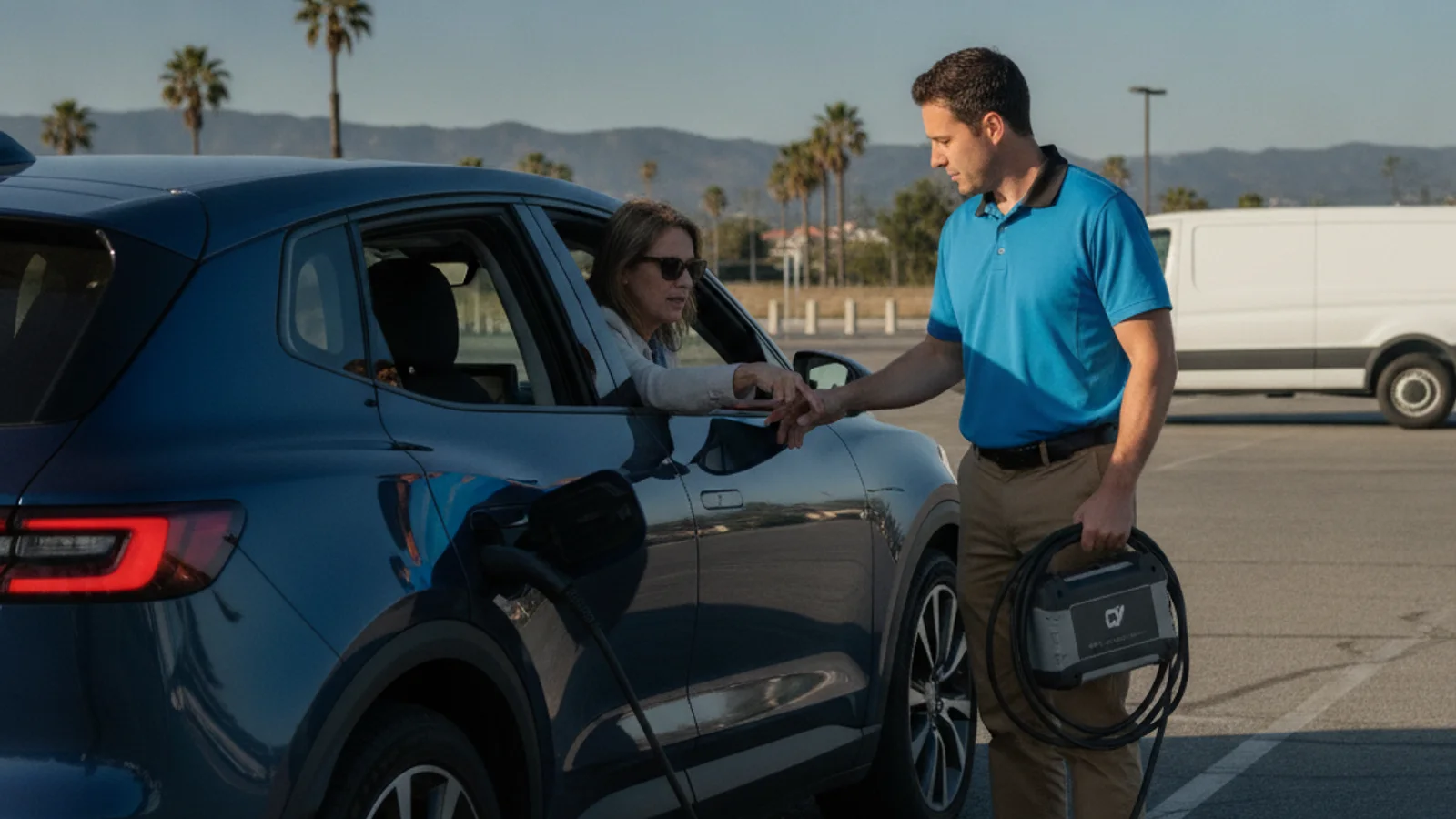
Charging fits when the traction pack is empty and the car can take a plug. Independent operators in this network bring a 240-volt Level 2 source to the vehicle. Tesla owners get a native NACS plug. Other EVs use a CCS or J1772 adapter. A typical session adds about 10 to 20 miles of range. That usually takes 15 to 30 minutes of charging time. That window is charging time, not an arrival time. Mobile EV charging is the referral path for that energy problem.
When the 12-volt has failed, a jump may fit. That’s only if the manufacturer supports a jump for that model. It isn’t universal. Some cars hide jump points behind a cover or in the frunk. Don’t copy a clip filmed on another make. Confirm the steps with the operator and the owner’s manual before anyone touches a terminal. For that failure mode, start with when the 12-volt dies on the road. After you’re rolling, the 12V replacement guide covers the lasting fix.
Transport fits when the cause isn’t confirmed. It also fits when the car can’t be reached safely. It fits when the manufacturer’s process for that warning sends you to a shop. Ask the operator which bucket they see. A guess is worse than starting with “we don’t know yet.”
Charge Pro OC is a referral line. It matches stranded EV drivers with independent local mobile rescue operators. It performs no work, owns no trucks, and employs no technicians. The operator quotes you before starting and bills you directly. The pros we connect you with are licensed.
Confirm the car-specific steps in the manual
This article stays general on purpose. It can’t list your jump-point location. It can’t decode every warning string. It can’t say whether your manufacturer allows a roadside 12-volt jump. Those answers change by make, model, and year.
The current owner’s manual is the first place to look. Tesla, Rivian, Ford, Hyundai, GM, and the rest publish their own steps. Use those, not a screenshot from a different year. For county charging context after you’re moving, open the Orange County EV charging hub. The U.S. Department of Energy electric vehicle overview is a general reference. It still won’t replace your manual.
If you can’t tell which battery failed, say that. An honest “I don’t know if this is the pack or the 12-volt” is a better start than a guess.
When to call for a match
Call when the EV won’t power on. Call if it won’t take a charge. Call if a warning doesn’t make sense. The matched operator uses the vehicle details and the exact message. They sort charging, a jump, or a ride from there. The county playbook lives on EV roadside assistance. Call (949) 444-0151 and we’ll connect you with a local operator.