The clamps bite, the screen wakes, and you think you’re done. Ten minutes later the Tesla is dark again in a Huntington Beach beach lot or a Buena Park all-day garage. A portable jump starter for Tesla is a 12-volt tool. It can bring the computers back. It cannot refill the drive pack, and it often cannot hold a tired 12V through a real restart.
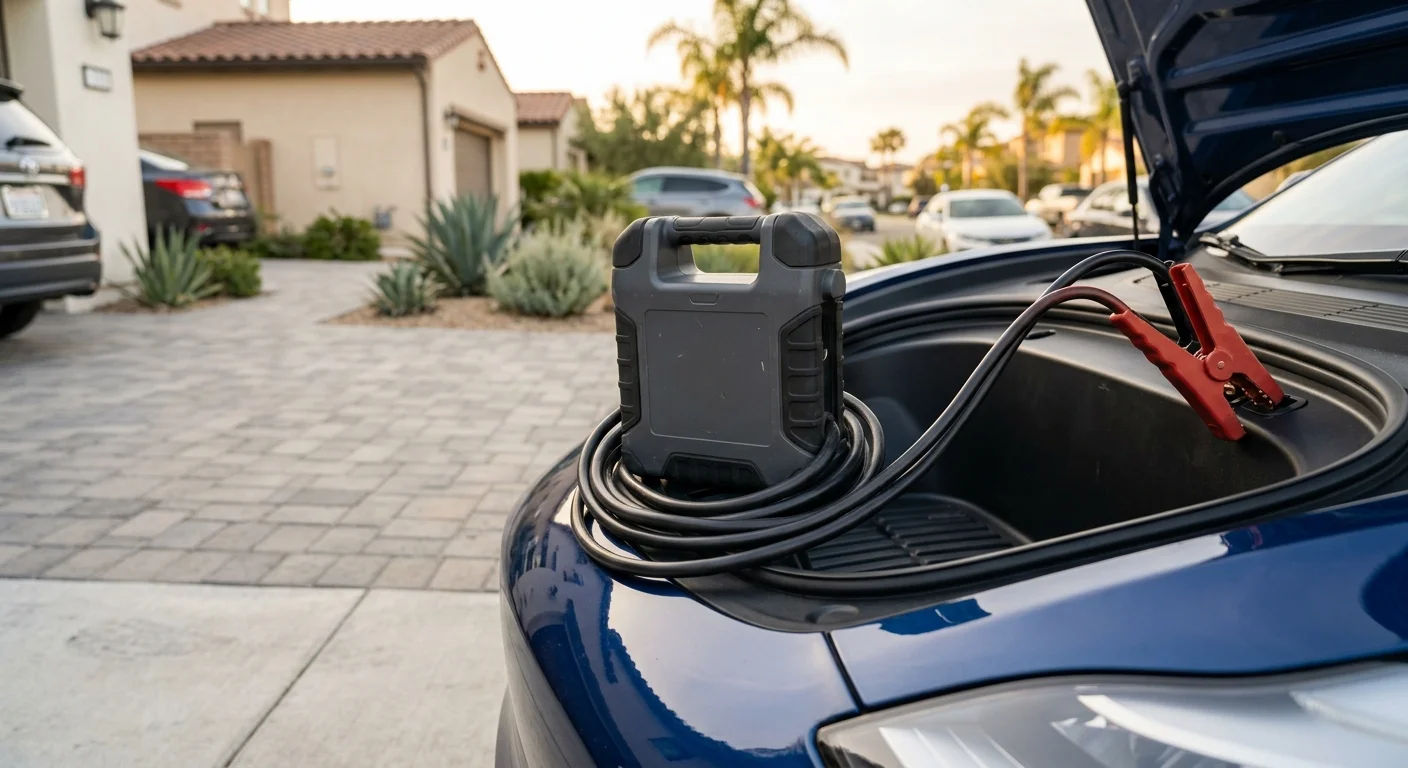
Why a Tesla still needs a 12V jump
People search can you jump start a Tesla because the car has no starter motor. That is true, and it is also why the 12V still matters. The drive pack stores the miles. The low-voltage battery runs the computers, latches, and contactors that let those miles get used. When the 12V is flat, the car can look fully dead even with range on the high-voltage pack.
Orange County is a Tesla-heavy place to learn that the hard way. As of 2025-12-31, the California Energy Commission counted 138,121 Teslas among 210,842 battery-electric vehicles registered in the county, 65.51% of the local BEV fleet. Teslas were 5.59% of all Orange County light-duty vehicles. Plenty of those cars sit for hours in coastal lots, office structures, and theme-park garages. The 12V is what fails first on a lot of those sits.
Tesla’s Model Y owner’s manual is blunt about the empty-range case. Once range is exhausted, the low-voltage battery loses support. The car then needs an external power supply before the high-voltage battery can charge. A pocket jumper is one form of that external 12V supply. A matched Tesla 12V battery jump is another. Neither one is a Supercharger session.
You jump the published 12V points only. Never clamp the high-voltage pack. Clamp locations change by model and year. If a post is not in your Tesla owner’s manual, it could not be confirmed for this page, so do not guess. For the model-by-model map of what Tesla actually publishes, use how to jump-start a Tesla by model. This page is about the product sitting in your frunk, and when that product is the wrong tool.
A Tesla jump starter, in the sense people mean when they buy one, is a compact 12V booster. It is not a portable drive-pack charger. Keep those jobs separate and the next hour gets simpler.
What a portable pack can wake, and what it cannot
A portable pack can wake a sleeping 12V system. On a good day that is enough. Screens come back. Doors unlatch. The car closes the contactors and drives out of the stall. That is the whole job the gadget was built for, the same job it does on a gas car with a dead accessory battery.
It cannot put miles into the traction battery. Peak-amp numbers on a box describe a 12V cranking pulse, not DC fast charging. If the car is out of range, a jumper may only get you far enough to see the empty-pack warning. Tesla’s Model Y manual still wants external 12V support before that pack will take a charge. After that you need a charger, a Supercharger, or a mobile Level 2 rescue, not another squeeze of the boost button.
It also cannot hold a 12V that is already at the end of its life. The Huntington Beach and Buena Park pattern is the same one we hear from all-day lots countywide. You clamp a cheap jumper. The screen lights. You pull the clamps. The car dies again before you clear PCH or Beach Boulevard. Sentry, cabin climate, and a hot parked cabin all load the low-voltage side. A pack that was already weak will not restabilize because you gave it a two-minute pulse.
Is there a portable battery pack for Tesla. Yes, for the 12V. Is there a portable EV charger for Teslas. That is a different machine. The operators Charge Pro OC matches for an empty pack use Level 2 charging on site. The approved rescue figure on this site is 10 to 20 miles of range in 15 to 30 minutes of that charging (charging time, not arrival). A consumer jump pack does not do that work.
Can you use a jump starter on an EV. On the 12V, at Tesla’s published points, following the owner’s manual. Not on the orange high-voltage cables. Not as a workaround for an empty drive pack.
A Tesla jump starter is also not the Tesla lending its pack to a neighbor’s gas car. That reverse jump is a different, unsafe ask. We cover it in why you should not jump a gas car with a Tesla. The product in your trunk is for your 12V, not for theirs.
Lithium 12V on newer Model 3 and Y: extra care
Some newer Model 3 and Model Y cars use a lithium 12V instead of a conventional lead-acid unit. Chemistry, year, and procedure live in your owner’s manual, not on a jumper-pack box. We do not repeat the lithium diagnosis here. Read lithium 12V dead on Model 3 and Y before you treat every Tesla like a Civic in a Costco lot.
Extra care, in plain terms, means this. A lithium 12V can sit in a state that lights a cheap pack’s “ready” light and still will not hold the car. Boost or override modes on consumer jumpers were written for flooded lead-acid cranking. They are not a Tesla procedure. If the first attempt does not leave the car stable, stop. A second or third pulse is how people cook a small lithium 12V they cannot replace in a beach parking stall.
Do not invent a clamp point because the lithium pack is “probably near” a module you can see. If Tesla did not publish that point for your VIN’s manual, it is unconfirmed. Leave the high-voltage hardware alone. Leave orange cables alone. Leave the drive pack alone.
If the car woke, then died, then woke on a second clamp, you already have the answer. The jumper is a bandage. The 12V is the fault, or the car is out of range and the 12V has lost support, which Tesla describes for Model Y once range is exhausted. Either way, the pocket pack has done what it can do. The next step is a person who jumps Teslas for a living, not another Amazon listing.
Heat does not help. Inland lots in Anaheim and Fullerton run hotter than a Huntington Beach stall. NOAA’s 1991 to 2020 normals put Anaheim at 86.8 F in July and 88.8 F in August. A lithium 12V that was marginal at 9 a.m. is worse after a theme-park day in Buena Park. Do not keep cycling it.
When to stop DIY in an Orange County lot
Stop after one clean attempt that does not leave the car able to stay on. Stop sooner if you cannot find a jump point that is actually in the manual. Stop immediately if anyone wants to clip onto the high-voltage pack.
Huntington Beach all-day lots are the coastal version. You parked near the water, walked the pier, and came back to a silent Tesla. There is a Supercharger at 6913 Warner Ave with 24 stalls, max 325 kW per the U.S. DOE Alternative Fuels Data Center, but a dead 12V may not let you drive there. If the drive pack is empty, the jumper still does not fill it. The Warner site is a charger, not a 12V rescue. For the lot pattern itself, see Huntington Beach lot, EV dead after a beach day.
Buena Park is the inland, all-day garage version. Knott’s traffic, Beach Boulevard errands, hours of sentry on a packed lot. Tesla Superchargers sit at 6940 Beach Blvd (24 stalls, max 150 kW) and 8888 Knott Ave (28 stalls, max 325 kW). Same limit: you have to be able to power the car to use them. A jumper that only flashes the screen does not get you onto a stall. Stalled EV in Buena Park theme park lots is the local write-up for that stall.
If you are on a freeway instead of a lot, Freeway Service Patrol can jump a battery. That jump restores a 12V accessory battery, not a depleted traction pack. FSP is free during published hours on listed segments. Call 5-1-1 and select Motorist Aid. FSP does not operate overnight, and it does not operate on listed holidays. The listed FSP outcome for a depleted EV is a free tow to a CHP drop zone, during hours, on patrolled segments, and not guaranteed. A pocket jumper on the shoulder of the 405 does not change that.
California Vehicle Code 25251 requires hazard lamps when you are disabled on the roadway and the car has a working simultaneous-flash device. CVC 21718 lets a genuinely disabled vehicle stop on a freeway when help has been summoned. CVC 22651(b) still lets a vehicle that is blocking traffic be removed immediately. Do not stand in a lane to fuss with clamps.
Private lots have their own clock. CVC 22658 governs private-property tows when the signage is right. A Tesla that keeps dying in a paid garage is a tow risk, not a DIY project. That is the moment to hand the 12V job to a matched operator.
How a matched 12V operator finishes the work
Charge Pro OC is a referral service. We connect you with licensed, independent local EV rescue operators. We do not jump the car, own the truck, or set the price. The operator you are matched with does the 12V work and bills you directly.
What that operator is there to finish is the job the portable pack started and could not hold. Confirm it is a 12V fault, not an empty drive pack. Apply 12V at Tesla’s published points. Stabilize the low-voltage system so the car can stay awake. If the pack is empty, that is a different call: Tesla roadside rescue, which may include a mobile Level 2 charge of 10 to 20 miles of range in 15 to 30 minutes of charging.
Tesla’s own roadside policy answers a depleted battery with transportation, not on-site charging. That transport is paid. It is not a financially covered service. Transportation of up to 500 miles to the nearest Service Center is for a warrantable breakdown that leaves the car undrivable. Running out of charge sits outside that. Tesla’s Santa Ana service page publishes 877-798-3752 for Tesla roadside. Use it for Tesla’s process. Use us when you want a local 12V or mobile-charge operator instead of a transport quote.
Do not expect a consumer jumper and a matched operator to be the same event. The pack in your frunk is a first try in a quiet driveway. An Orange County lot at closing time, a lithium 12V that will not hold, or a car that needs 12V support before it will charge is the operator’s job. The U.S. Department of Energy treats EVs as a high-voltage system plus a 12V system for a reason. Keep those systems straight and you stop buying the wrong tool.
If the 12V jump takes and the car still will not charge, you have left jumper territory. That is a charge-port, station, or pack issue, not a peak-amp problem. Leave it. The operator in front of you can sort the next step. You should not.
When to call us
Call when a portable jump starter for Tesla wakes the screen and the car dies again, when you cannot find a manual jump point, or when the pack is empty and the 12V has lost support. Call us at (949) 444-0151 and we’ll connect you with a local EV rescue operator.