The car that still had range when you parked can sit dead when you walk back from the water. Sunset Beach is a thin Huntington Beach neighborhood on Pacific Coast Highway, sand on one side and the Bolsa Chica wetlands on the other, and it has no Tesla Supercharger of its own. When the pack is empty, or the 12V has dropped after a long sit, the useful move is a charge at the curb in the stall you already occupy.
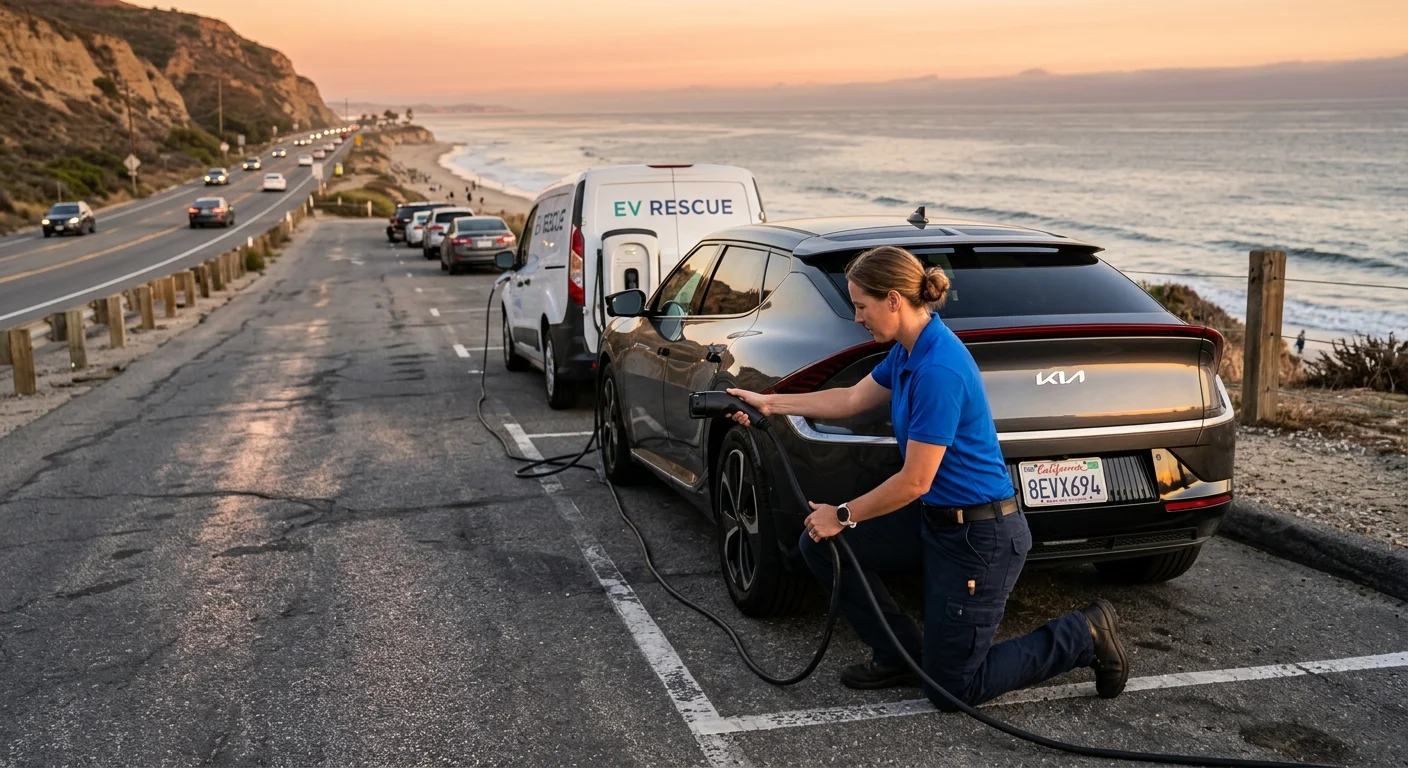
Sunset Beach has no Supercharger of its own
Sunset Beach is not a separate Census place. It is a Huntington Beach neighborhood, a short linear community on PCH. Tesla Superchargers are mapped to city sites, and this strip does not have one. Huntington Beach does. The U.S. Department of Energy Alternative Fuels Data Center lists a Supercharger at 6913 Warner Ave with 24 stalls and a maximum of 325 kW, opened September 8, 2025. That address sits inland, toward the 405, not on the sand.
Orange County looks charger-rich on a county map and still tight at the beach. The California Energy Commission counted 7,095 public ports here as of December 31, 2025, including 1,475 public DC fast ports. Against 260,833 registered zero-emission vehicles, that is 36.8 ZEVs per public port, versus 24.4 statewide. Weekend visitors from inland Orange County and the 405 corridor feel that math when they arrive with just enough range to park.
Tesla still dominates the local battery-electric fleet. In that same CEC snapshot, Tesla accounts for 138,121 of 210,842 Orange County BEVs, or 65.51 percent. A lot of the cars that stall on this strip are Teslas. Tesla’s roadside policy answers a depleted battery with transportation, not with on-site charging. That transport is paid, and running out of charge sits outside the warrantable-breakdown coverage that can move a car up to 500 miles to a Service Center. Tesla’s Santa Ana service page publishes 877-798-3752 for roadside. Confirm live stalls on Tesla’s map before you assume Warner is open. Inventories change, and AFDC records maximum connector power, not a V2, V3, or V4 label.
Charge Pro OC is a referral service. It matches you with licensed, independent local operators. When you need range added where you sit, we connect you with a pro who brings mobile EV charging to the stall. CEC charger counts mix surveys, grant data, AFDC, PlugShare, and other listings, and they update twice a year. Treat any “chargers near Sunset Beach” screenshot as a hint, then verify the stall is public, available, and the right connector for your car.
PCH, the wetlands, and a weekend lot that sits all day
The geography is the constraint. PCH is the only through road. Lots are narrow. Inland you face the Bolsa Chica Ecological Reserve, not a mall with a charging plaza. On the water side, parking is a thin band between the highway and the sand. Weekend cars arrive before noon and sit through the afternoon. Climate control, music, phones, and cabin cameras keep drawing on the low-voltage system the whole time.
That sit is why Sunset Beach EV charging trouble shows up after the beach day, not on the drive in. The car had enough range to reach the lot. It may not have enough to leave, especially after cabin power while parked, then a crawl south into Huntington traffic or north toward Seal Beach. Overflow from Huntington Beach’s main lots pushes more EVs onto this strip. Drivers who cannot find a stall closer to the pier end up here, in a community that was never built around a charging plaza.
Pacific Coast Highway is not on OCTA’s published Freeway Service Patrol lists. Those pages name stretches of I-5, SR-22, SR-91, I-405, and, on the fact sheet, SR-57 and the Express Lanes. The web page and the fact sheet disagree on some of those freeway pieces. Neither list names PCH. FSP is free during its posted hours, on patrolled freeway segments, and it is not guaranteed. Listed help is a 12V jump, a gallon of gas, a tire change, water, or a tow to a CHP drop zone. There is no out-of-charge EV category. A jump does not refill a traction pack. A car in a beach stall is not on a freeway patrol beat.
Stay out of the PCH travel lanes. California Vehicle Code 22651(b) lets a vehicle that obstructs a highway or creates a hazard be removed immediately. There is no waiting period. Code 25251 requires hazard lamps to flash when a vehicle is disabled on the roadway and equipped to do so. As of January 1, 2026, the Move Over law in Vehicle Code 21809 also covers a stationary vehicle showing flashing hazards. Other drivers must change lanes or slow. That still does not make the PCH shoulder a charging bay. If you still have a few percent, pull fully into a legal stall or a lot, then call for help.
Huntington and Seal Beach stalls that still leave you short
The nearest fast plugs sit in Huntington Beach and Seal Beach, which is why a dead car on this strip still feels stranded. Warner Avenue’s Supercharger is a real site: 24 stalls, up to 325 kW. It does not help a car that cannot climb off PCH. AFDC also lists an EVgo site at 21190 Beach Blvd in Huntington Beach with 3 stalls, and an EVgo site at 801 Pacific Coast Hwy in Seal Beach with 4 stalls. Four coastal fast stalls in Seal Beach is better than zero on the Sunset Beach sand. It is still a small bank. A queue, an outage, or the wrong connector leaves you short.
If you still have enough range to roll, those two directions are the honest ones: inland on Warner toward the Supercharger, or north on PCH toward Seal Beach. We cover both neighboring patterns in EV roadside assistance in Huntington Beach and a stalled EV in Seal Beach after the lot. If the car is already at zero, you cannot use them until someone adds range where you are. That is out-of-charge recovery, not a hope that PCH traffic will open a path.
Countywide, Tesla holds 59 percent of Orange County’s public DC fast ports (48 stations, 861 ports). Excluding Tesla, AFDC counts 175 stations and 591 DC fast ports across EVgo, Electrify America, EVCS, ChargePoint, and smaller networks. None of that inventory sits in a Sunset Beach plaza. Do not plan on a free session on this strip. Public DC fast charging here runs on those paid networks. Charge Pro OC does not set network prices and does not publish a per-kWh figure. Check the live session price in the Tesla, EVgo, or other network app before you plug. Level 2 at a workplace or a retailer can be a different deal. Confirm the posted terms on the stall.
Drivers often hear an 80/20 habit for public DC fast charging: stop near 80 percent because the rate tapers as the pack fills. That is a Supercharger strategy. A curb rescue is not a fill to 80 percent. The typical rescue charge for this service is 10 to 20 miles of range in 15 to 30 minutes of Level 2 charging. That is charging time, not an arrival window. AFDC describes public Level 2 as roughly 25 miles of range per hour. You are buying enough range to reach Warner, Beach Blvd, or 801 PCH, then finishing there.
Leaving the car overnight in a beach lot while you wait for a stall to open is a tow risk. On private property, Vehicle Code 22658 requires a large tow-away sign at each entrance, with the towing company’s name and phone, before a lot can remove a vehicle at the owner’s expense. If those signs are up, the lot can have the car taken. Confirm the posted rules. Do not treat a Saturday stall as overnight storage at a charging station. There is no public charging station on the Sunset Beach strip to leave it at.
Dead 12V after the beach versus a truly empty pack
Two failures look the same from the sand. One is a dead 12V. The other is a truly empty traction pack. After a full beach day, the 12V case is as common as the empty pack. Cabin screens, door latches, and a car that will not wake often point at the low-voltage battery, even when the display still showed miles in the morning.
A Tesla Model Y owner’s manual describes what happens once range is exhausted: the low-voltage battery loses support and needs an external power supply before the high-voltage pack can charge. An empty pack can become a 12V problem too. A jump of the 12V restores accessories. It does not refill the traction pack. If the car still has indicated range and will not wake, the operator you are connected with may start with a 12V recovery. If the indicated range is zero, you need energy into the charge port.
Tesla roadside is set up to transport a depleted car, not to charge it in the lot. Independent local operators can do on-site Level 2. You contract with that operator and pay that operator. Charge Pro OC does not quote a brand price and does not promise an arrival window.
Bring the simple facts when you call: exact stall or PCH cross street, whether the car will unlock, whether the display still shows miles, connector type, and whether you are fully out of the travel lane. Tesla drivers can call Tesla as a transport option. Keep a local out-of-charge path if you want to stay with the car and add range at the curb. Stay out of the highway to flag help. Keep the hood out of traffic. Do not try to charge one EV from another on this strip. The U.S. Department of Energy’s electric vehicle pages are a clear primer on charging levels. Mixing two unknown packs at a beach curb is not.
On-site help without blocking Pacific Coast Highway
The safest place to take a curb charge is the stall you already occupy. Stay in the lot. Keep the car fully out of the PCH lanes. Use hazards if you are disabled and the car can flash them. People walking between bumpers and the highway need a clear path. Bolsa Chica pull-offs and the small lots along this stretch were not designed for a second vehicle sitting in the aisle. The operator who arrives needs room to park legally, not a second obstruction.
If the car died in a travel lane, the first job is to get it out of the live highway, not to start a charge in traffic. Vehicle Code 22651(b) is immediate for a hazard. A short push into a legal stall, a private tow you hire, or an operator working from a lawful position beats a charging cable across a PCH lane. Charge Pro OC matches you with an independent operator. That operator brings their own equipment, quotes you, and bills you. A typical Level 2 rescue is that 10 to 20 mile bump, in 15 to 30 minutes of charge time, so you can reach a public DC fast site that actually exists.
Tell the operator if you are on the wetlands side or the sand side. Those are different access problems. Weekend foot traffic, bike traffic, and PCH congestion all change how close a second vehicle can get. If a lot attendant is on duty, say so. Private lots set their own access rules, and the operator still has to follow them.
Once you have enough range, leave the strip and charge inland or in Seal Beach. Finish at a site with real stall count. Warner’s 24 Supercharger stalls and Seal Beach’s four EVgo stalls are the mapped options closest to this story. Recheck Tesla’s map and the network apps for availability before you roll. A full bank in Huntington on a Sunday is a common outcome.
When to call us
Call when the car will not leave a Sunset Beach stall, when you are at zero on PCH and cannot reach Warner or Seal Beach, or when the 12V has dropped after a long beach sit and the pack still needs energy. Call us at (949) 444-0151 and we’ll connect you with a local EV rescue operator.