Drivers who search for a car recovery service in Santa Ana usually have a car that will not roll. On Civic Center Drive or a downtown one-way, that often means an empty EV, not a wreck. The first useful split is a wrecker versus a charge at the curb.
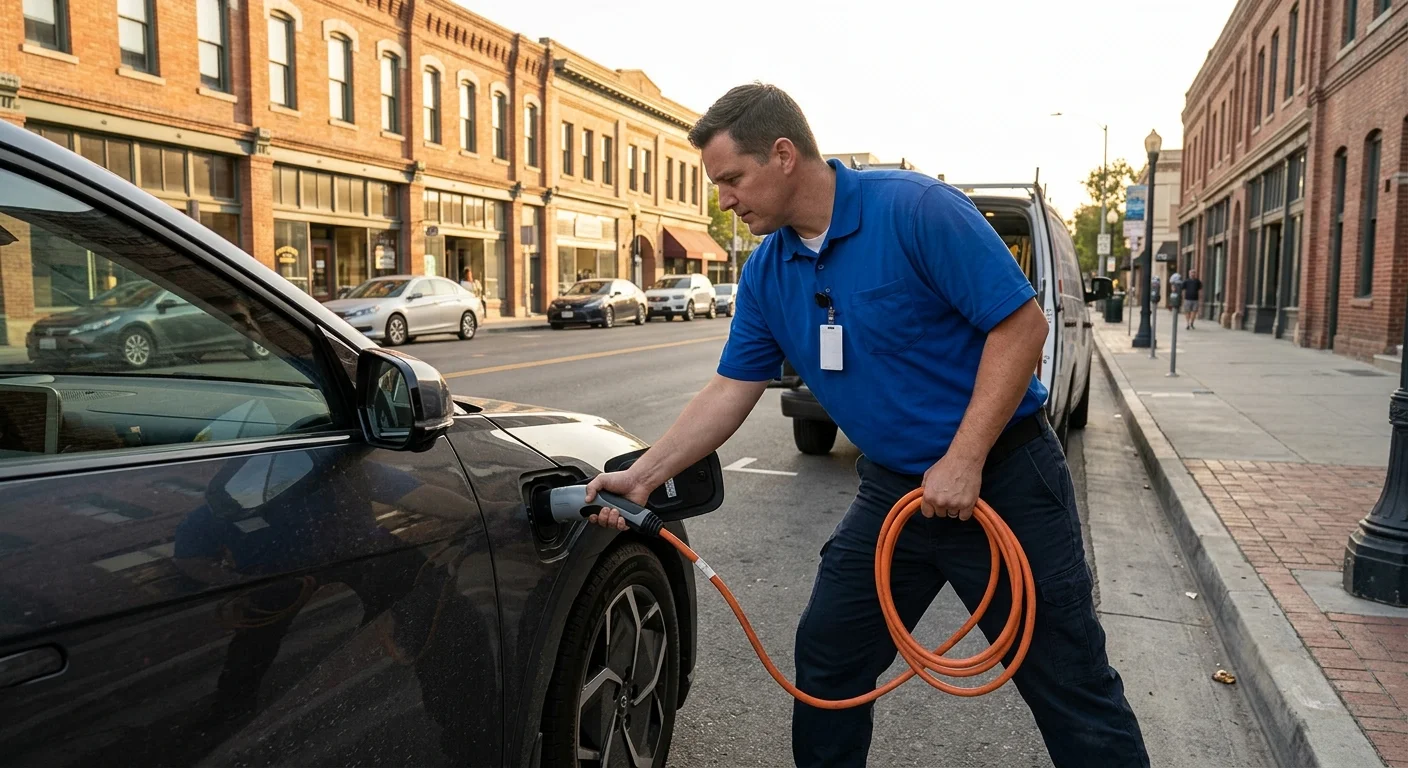
Recovery versus a charge on Santa Ana streets
Recovery in a search box still maps to a hook. That language comes from gas-car towing. An EV sitting quiet on 4th Street or Broadway is a different job if the only problem is an empty pack.
Charge Pro OC is a referral service. It matches stranded drivers with licensed, independent local EV charging professionals. It does not recover vehicles, own a wrecker, or do the work. The operator you are connected with quotes the job and bills you directly. The brand sets no price.
Treat the scene as two questions. Can the car sit where it is without blocking a lane. And does the high-voltage pack only need range. If both answers are yes, a curb charge is the recovery. If the car is in a live lane, leaking, crashed, or the wheels will not roll, you need a tow company. Charge Pro OC does not handle that tow.
A typical rescue charge adds 10 to 20 miles of range in 15 to 30 minutes of Level 2 charging. That figure is charging time on site, not a promise about when anyone arrives. The U.S. Department of Energy explains why EVs store energy in the pack instead of a tank. Once that pack is empty, the car will not crawl to a stall on fumes.
For the empty-pack case, out-of-charge EV recovery is the charge-first path. If you are already boxed in on a downtown block, the stalled downtown Santa Ana EV rescue covers that stall. This page answers recovery intent: wrecker language, charge-first answer.
EV vehicle recovery in Santa Ana is usually range at the bumper when the pack is empty. Orange County had 210,842 registered battery-electric vehicles as of December 31, 2025, per the California Energy Commission. Santa Ana sits on the I-5 and SR-22 spine of that fleet, with two Tesla Supercharger sites inside the city. Plenty of cars, and plenty of ways to run the last miles out on a one-way.
Civic Center, downtown one-ways, and the 5/22 merge
Santa Ana is not a coastal loop and it is not a canyon. It is the county seat. Civic Center Drive, the courthouse blocks, and the one-way downtown grid are tight. Historic brick, short curb cuts, and through traffic on the 5. An EV that dies here is often a few hundred feet from a legal curb and a few miles from a DC stall.
Name the roads. Civic Center Drive. The downtown one-ways around 4th Street, Broadway, and Main. I-5 along the city’s east side. SR-22 along the north. The 5/22 merge is the interchange drivers feel in their shoulders. A dead pack on the shoulder there is a freeway problem. A dead pack on a Civic Center curb is a city-street problem. Do not treat them as the same recovery.
On the freeway, California Vehicle Code 21718 lets a genuinely disabled vehicle stop temporarily when another vehicle has been summoned for help. Hazard lights are mandatory on the roadway under CVC 25251 if the car has a working simultaneous-flash device. CVC 22651(b) lets a vehicle that obstructs traffic or creates a hazard be removed immediately. There is no waiting period for that. CVC 22651(f) says a vehicle stopped more than four hours on a freeway right-of-way, if the driver cannot move it under its own power, may be removed. After four hours it can be towed, and sooner if it is in the way. CVC 21809, the Move Over law as of January 1, 2026, covers any stationary vehicle showing flashing hazards or another warning device. Approaching drivers must change lanes or slow.
Freeway Service Patrol is the free public option on some Orange County freeways. OCTA manages it. CHP dispatches. Call 5-1-1 and select Motorist Aid. For an emergency, call 9-1-1. FSP is free. Drivers may not take payment. Published consumer hours on OCTA’s page are Monday through Friday, 6:00 a.m. to 7:00 p.m., and limited weekend service from 10:00 a.m. to 6:30 p.m. FSP does not operate overnight. It does not operate on listed holidays.
Read the coverage lists with care. OCTA’s web page lists SR-22 from Harbor Blvd to SR-55, which includes the Santa Ana stretch of the 22. Its published I-5 segments start south of Santa Ana, at Sand Canyon Avenue on the web page and south of Alicia Parkway on the fact sheet. Those two OCTA sources disagree on other stretches, including SR-57 and the Express Lanes. This page does not resolve that conflict. Do not assume FSP will roll on Santa Ana I-5 just because you are on the 5. Do not assume the 5/22 merge is fully covered. If you are on a listed segment during listed hours, FSP may help. If you are not, it will not.
FSP’s published service list is jump-starts, flat tires, a gallon of gas, radiator water, taping a hose, and a tow off the freeway to a CHP-designated drop zone. There is no out-of-charge EV category. A jump-start restores a 12V accessory battery, not a depleted traction pack. The listed FSP outcome for a depleted EV is a free tow to a drop zone, during hours, on patrolled segments, and not guaranteed. FSP may only tow to CHP drop zones. That is not a Supercharger. It is not a curb charge.
On a downtown curb, FSP does not apply. Street parking is a city matter. A posted no-parking or street-sweep window for a specific Santa Ana block could not be confirmed from the City of Santa Ana site for this page. Read the signs on that curb. Check the city’s current posted rules before you wait. An empty EV is not a parking pass.
Why a hook is the last move if the pack only needs range
A wrecker solves location. It does not put electrons in the pack. If the car can sit, and the pack is only empty, recovery that leaves the car in your hands is range at the bumper. A hook still has a job. Collision. Locked parking pawl. Fluid on the pavement. A car that cannot stay on that curb. Then a licensed tow company, not Charge Pro OC, should move it.
Charge Pro OC does not recover, tow, or own a wrecker. If a tow is required, the matched operator or a separate tow company handles it. This brand does not. Tow rates are not published here. Confirm the current rate with the tow company before they hook. CHP administers the Tow Service Agreement and rotation program and approves each operator’s rate schedule. That approved rate is also the yardstick for private-property tow charges under CVC 22658.
If you are in a paid lot or a garage, read the entrance sign. CVC 22658 requires a sign not less than 17 by 22 inches, with lettering not less than one inch high, in plain view at all entrances. It must prohibit public parking, state that vehicles will be removed at the owner’s expense, and list local traffic law enforcement plus each authorized towing company’s name and phone. If that signage is missing, the property owner is liable for double the storage or towing charges. If you return after the car is coupled and before it leaves the property, the company may charge not more than half the regular towing charge. Ask for the release if the car is not yet in transit. Failing to release in that window is a misdemeanor.
A Tesla towing service search is the same fork with a brand name on it. Tesla’s roadside policy answers a depleted battery with transportation, not on-site charging. That transport is paid. It is not a financially covered service. Transportation of up to 500 miles to the nearest Service Center is for a warrantable breakdown that leaves the car undrivable. Running out of charge sits outside that list. Tesla’s Santa Ana service page publishes 877-798-3752 for roadside. Use it for Tesla’s own path. Use a local charge operator when the pack only needs range and the car can sit.
Tesla’s Model Y owner’s manual also notes that once range is exhausted, the low-voltage battery can lose support and need an external power supply before the high-voltage pack can charge. That is a 12V problem stacked on an empty pack. A charge-only call may not be enough if the car will not wake. Say that when you call.
A flatbed is the usual method for a dead EV that must move. Do not invent a local tow price. Do not assume insurance treats an empty pack as a covered breakdown. Tesla does not treat it as a warrantable, financially covered transport. Your policy is a separate document. Read it.
EV roadside assistance in Santa Ana is the city guide for Tesla roadside and stall scenes. Use that page for the Tesla-specific stall. Use this page when the search in your head is recovery, and you still want a charge-first answer.
How a matched operator works a downtown curb
You call Charge Pro OC. We connect you with a licensed local operator. That operator comes to the car, not the other way around. The brand does not send a fleet. It does not employ the technician. The operator quotes you, plugs in, and bills you.
On a Santa Ana curb the work is usually Level 2 at the charge port. Public and workplace Level 2 equipment, per the Alternative Fuels Data Center, operates at 40 to 80 amperes and adds about 25 miles of range per hour. The 240-volt, 9.6 kW figure is 240 volts at 40 amps, the bottom of that public band. The approved rescue charge on this site is still 10 to 20 miles in 15 to 30 minutes. That is enough to leave Civic Center Drive and reach a real stall without guessing.
The operator will look for a legal place to stand. Hazards on. They work from the curb side when they can. Downtown one-ways mean traffic comes from one direction. That helps. It also means a bad stop blocks the only lane people can use. If the car is in a live lane, the first move is still to get it out of the way, which may mean a tow, not a plug.
Emergency EV roadside assistance is the service page for that match. Tell the operator the street, the direction of the one-way, the nearest cross street, and whether the car will wake. Tell them if you are on Civic Center Drive, on a downtown block, or on the 5 or the 22. Those are different jobs. Do not promise yourself a time window. This brand does not publish arrival times.
If the 12V is dead, charging the traction pack may wait. The operator you are matched with can sort that on site when the car needs an external supply first. If the car is a Tesla and Tesla roadside is already rolling a transporter, say so. Two recoveries at once is how you pay twice.
Stay with the car if you can do it safely. California’s Move Over law now covers a stationary vehicle with hazards. That does not make a downtown curb safe. If you cannot stay, leave a note with a reachable number and say you have summoned help.
Once you can roll: an honest next stall, not a guess
Ten to twenty miles is not a full pack. It is a path to a stall you can actually use. Santa Ana has two Tesla Supercharger sites in the AFDC data. 1008 17th Street has 28 stalls at a maximum of 325 kW, opened October 6, 2024. 300 East 5th Street has 20 stalls at a maximum of 75 kW, opened November 20, 2020. Those are not the same stop. The 5th Street site is slower. The 17th Street site is the stronger in-city Tesla option if your car can use it.
Non-Tesla drivers should not assume a Tesla stall will take them. Check the car’s connector and the live app before you roll. Orange County as of December 31, 2025 had 7,095 public charging ports, including 1,475 public DC fast ports, per the California Energy Commission. Countywide AFDC counts show 223 public DC fast stations and 1,452 DC fast ports. Tesla holds 59 percent of those DC fast ports. Electrify America, EVgo, EVCS, and ChargePoint fill the rest. Pick a stall that matches the car, then go there. Do not aim at a mall in Irvine on a 12-mile guess.
Tustin’s Superchargers sit just east of the 5. Garden Grove’s Harbor Boulevard site sits west. Those are backup targets if 17th Street is full. Confirm in the app. Do not write yourself a route from memory while the car is still at a thin percentage.
Once you are plugged in at a real stall, stay until you have a margin you trust for the rest of the day. A curb rescue is not a substitute for a home charge. It is how you stop turning an empty pack into a wrecker bill.
If the car will not take a charge at the curb, stop. That is no longer a range recovery. It may be a charge-port, a 12V, or a pack fault. The operator can say what they see. A repair shop is a different call.
When to call us
Call when an EV is dead on a Santa Ana curb, on Civic Center Drive, or near the 5/22 merge, and you want a charge-first recovery instead of a wrecker. If the pack only needs range and the car can sit, a matched operator can add the miles to reach a real stall. Call us at (949) 444-0151 and we’ll connect you with a local EV rescue operator.