Your EV is already stopped in Laguna Hills. The Superchargers on Cabot Road and Moulton Parkway won’t come to you. Each site has sixteen stalls. That still leaves hospital structures, mall-edge lots, and Nellie Gail driveways sitting still. EV roadside assistance in Laguna Hills is a truck at the car. It’s not a stall hunt across town.
Cabot and Moulton are real. Your parking space still wins
Laguna Hills is a small city. The Census puts the population at 30,921. Tesla still built two Supercharger sites here. One is at 23701 Moulton Parkway. The other is at 25248 Cabot Road. Each lists sixteen stalls, up to 250 kW. Federal AFDC records match those stall counts.
For a city this size, that’s a lot of DC fast hardware. Drivers from Laguna Woods often point the nav at those two lots. So do drivers from Aliso Viejo, Coto de Caza, and Las Flores. Some arrive. Some stop short on El Toro Road. Others quit on Alicia Parkway or Paseo de Valencia. That call still lands in Laguna Hills. It doesn’t matter that the driver lives next door.
The sites don’t solve a car that can’t roll. You can’t push a dead EV from a Saddleback structure to Moulton. You can’t coast a Nellie Gail driveway down to Cabot. Mobile EV charging at the bumper is the move that fits those spots.
Saddleback parking, and why the car looks dead
MemorialCare Saddleback Medical Center sits on Health Center Drive. It’s a full emergency room for a wide slice of South Orange County. Multiple parking structures hold cars through twelve-hour shifts. They also hold cars through multi-day stays. That’s 12V failure territory. The main pack can still show miles. The small battery that boots the car can be done.
Staff, patients, and visitors leave cars sitting in those structures. Climate control runs. Hours pass. A dark screen and sticky door handles usually mean the 12V. That’s not an empty traction pack. A Tesla 12V battery jump on site is the first useful check. If the battery won’t hold after a jump, ask for a quote. The operator can replace it on site.
Five Lagunas sits on the former Laguna Hills Mall site. Shoppers circle that mall-edge lot. A car that won’t ready there doesn’t need a cross-town Supercharger search. It needs power where it sits. An operator can work in a parking space. That’s safer than a live arterial. The DMV field office holds cars through appointments. If yours won’t wake after that wait, stay with the car.
Nellie Gail ravines, and the rest of the map
Nellie Gail Ranch is the residential wrinkle. Equestrian lots sit on ravine grades. Private driveways run long. Those ravines are the steepest local grade. Nellie Gail also has equestrian trails. A day on the horse property can end with a thin pack. Then you’re looking at a long driveway and no roll left.
Citywide terrain is still mild by South OC standards. Elevation sits around 360 feet. That’s the low San Joaquin Hills foothills. Aliso Creek cuts the south side. Climate here is inland of the coast, and it’s moderate. Grades aren’t canyon steep except in those Nellie Gail ravines. A thin pack still burns faster on a climb. It didn’t look that way on Paseo de Valencia.
Flatter pockets include Moulton Ranch and Aliso Meadows. Villa Valencia, Laguna Village, and Indian Creek sit in that mix too. So do North Laguna Hills and Cabot Ridge. Overnight 12V failures show up in those driveways. The car sat. The warnings sat ignored. Morning comes and nothing wakes.
I-5 hugs the east border. Exits include Oso, La Paz, Alicia, El Toro, and Lake Forest Drive. SR-73 runs to the southwest. If you stall on a freeway shoulder, stay in the vehicle. Keep the hazards on. Call from there. A dead EV doesn’t roll from the shoulder to a Supercharger stall.
Other arterials that matter include La Paz Road and Ridge Route Drive. Avenida de la Carlota is in that list. Moulton Parkway itself is too. Moulton can put you close to a Supercharger. It can still leave you stuck in a turn lane. Close isn’t the same as plugged in.
What roadside help actually is in this city
Charge Pro OC is a referral line. It matches stranded EV drivers with independent local operators. The brand holds no license. It owns no trucks, no equipment, and no yard. It employs no technicians. It sets no prices. It publishes no hours.
The operator who takes the job quotes you before starting. Then that operator bills you directly. The pros we connect you with are licensed.
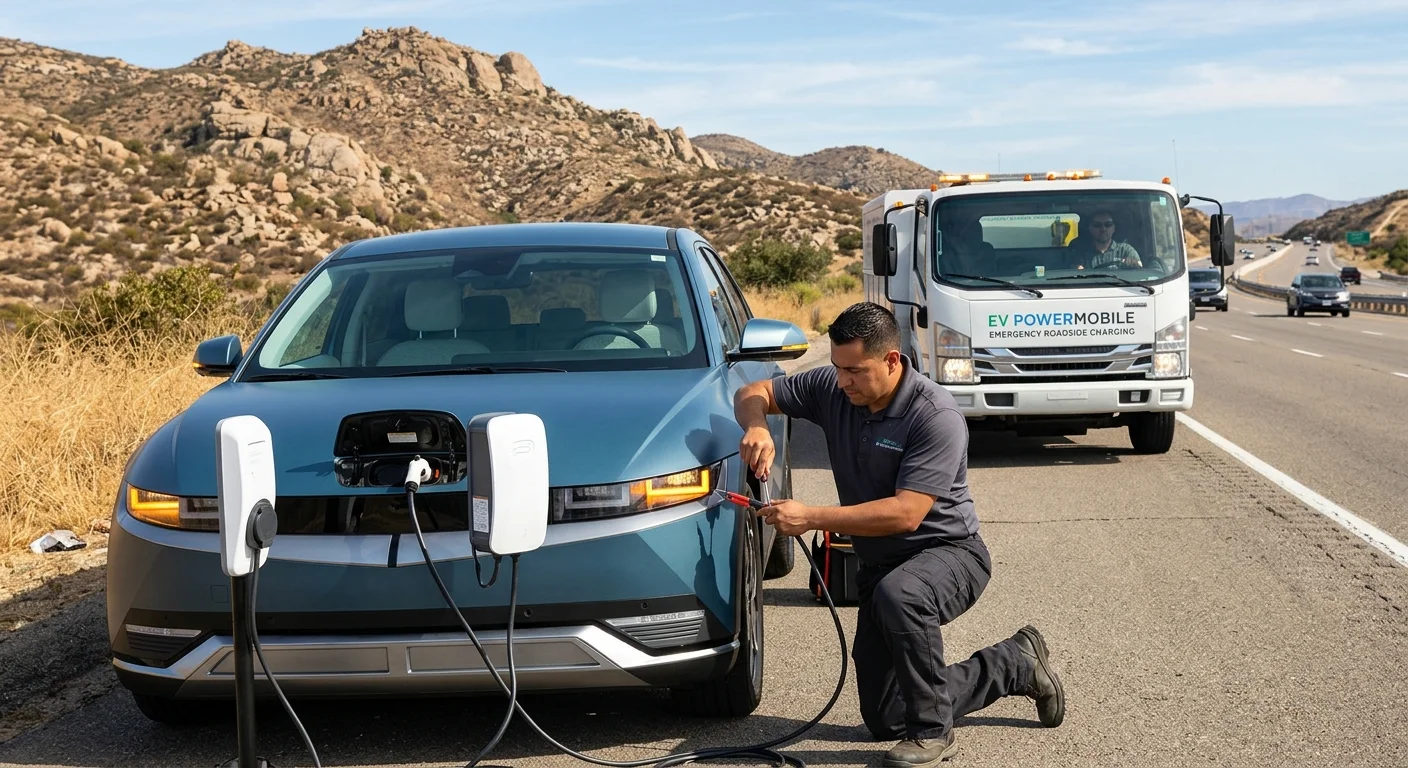
Out-of-charge recovery is a 240V Level 2 source brought to the car. Operators carry a native NACS plug. They also carry a CCS or J1772 adapter for non-Tesla EVs. Typical charging time puts 10 to 20 miles back in 15 to 30 minutes. That clock is charging time at the bumper. It isn’t a promise of when someone arrives.
Tesla and every major EV brand are in scope. Tell dispatch the model so the right connector shows up.
Tesla’s own roadside path for a depleted pack is transportation. It isn’t a charge at the car. Running out of charge isn’t treated as a warrantable breakdown. Tesla’s published roadside number is 877-798-3752. You can still call that line. You can also ask a local operator for range where you sit.
Tesla’s Model Y owner’s manual notes another wrinkle. Once range is exhausted, the low-voltage battery can lose support. The high-voltage pack may then need external power before it will accept a charge. That’s a technical reason a dead Tesla sometimes needs a jump and a charge. It doesn’t need a hook first.
Charge where you sit, or tow it out
If the only fault is an empty pack, charge at the car. A tow still means waiting on a hook. Then you need a second trip. The EV leaves the curb. You don’t. Compare the two paths in our guide to mobile EV charging or a tow.
Skip a tow-first plan when the car simply ran out. A mechanical fault is different. A flat belongs at a shop. So does a stuck charge port. A drivetrain code does too. Rescue doesn’t replace repair.
Operators don’t publish a fee on this page. Confirm the quote before you agree. That’s the figure that matters for your car.
While you wait, stay with the car. Put the hazards on. That includes El Toro, Alicia, and an I-5 shoulder. If you’re already in a Five Lagunas space, stay there. Tell dispatch whether the screen is dark or the pack reads zero. Those are different jobs. One is a 12V jump. The other is a 240V charge.
Why this small city still sees a lot of EVs
The California Energy Commission counted 210,842 battery-electric vehicles in Orange County. That’s the on-road figure as of December 31, 2025. Teslas were 138,121 of them. That’s 65.51% of the county BEV fleet. ZEVs were 10.56% of Orange County’s light-duty fleet. The state figure was 7.54%. Orange County holds 12.02% of California’s battery-electric vehicles. It’s 8.33% of the state’s light-duty fleet.
Public ports are stretched. CEC data show 7,095 public charging ports in Orange County. There were 260,833 ZEVs. That’s 36.8 ZEVs per public port. California’s ratio is 24.4. Laguna Hills still has those two Supercharger sites. Neighborhood and hospital cars still stall away from both lots.
About 49.4% of Laguna Hills housing was built before 1980. That’s a Census figure. It isn’t a verdict on your panel. A licensed electrician can read the garage circuit. Roadside work won’t.
Most of the city sits in ZIP 92653. Small slivers use 92656 and 92677.
New ZEV sales in Orange County were 28.76% of light-duty sales in 2025. California’s share was 22.93%. The 2026 trend isn’t a straight climb. California’s ZEV share of new sales peaked at 25.31% in 2024. Treat the fleet as large and already here. Don’t treat it as a boom story.
Neighboring streets that still end up as Laguna Hills calls
A driver coming from Mission Viejo can stop short of both Supercharger lots. Same for Lake Forest traffic toward Alicia or El Toro. Same for someone dropping in from Aliso Viejo. If the car is already still, stay with it. Don’t spend the last bar on a Cabot or Moulton gamble.
Laguna Niguel traffic on the SR-73 edge can land here too. So can a car that left the Nellie Gail trails. The ravines can take more range than you budgeted. If you stalled at the Civic Center, stay with the car. Use the same plan at the Community Center and Sports Complex.
Coverage notes for this city live on the Laguna Hills page. Charge Pro OC refers operators across Orange County. The brand doesn’t perform the work.
When it’s time to call
Zero on Cabot, Moulton, El Toro, or Alicia is enough. A Tesla that won’t wake in a Saddleback structure is enough. A dark screen in a Nellie Gail driveway is enough. Location and what the car is doing are the useful details.
Call (949) 444-0151 when you want an operator quoted to the car. The quote comes before any charging starts.
Frequently asked questions
Should I try the Cabot Road or Moulton Parkway stalls first?
Try them only if the car still drives and the range is honest. Sixteen stalls at each site won’t roll a stopped EV. If you’re already parked, stay put and ask for 240V at the bumper.
My Tesla won’t start at Saddleback. Is the main battery dead?
Usually the 12V is the failure, not the traction pack. A dark screen and odd doors are the usual tells. A jump on site gets many cars moving. If it won’t hold a charge, the operator can quote a replacement there.
Can a non-Tesla EV get the same on-site charge?
Yes. Operators bring NACS plus CCS or J1772 adapters. That covers Rivian, Ford, Hyundai, Kia, Chevy, Polestar, Nissan, and most other U.S. EVs. Give dispatch the make and model when you call.