The EV that fails in Laguna Woods is usually the one that sat. A short El Toro Road trip isn’t enough work for the 12-volt battery. Geico roadside assistance for an EV still sends a tow. It doesn’t send a 240-volt charge at the stall.
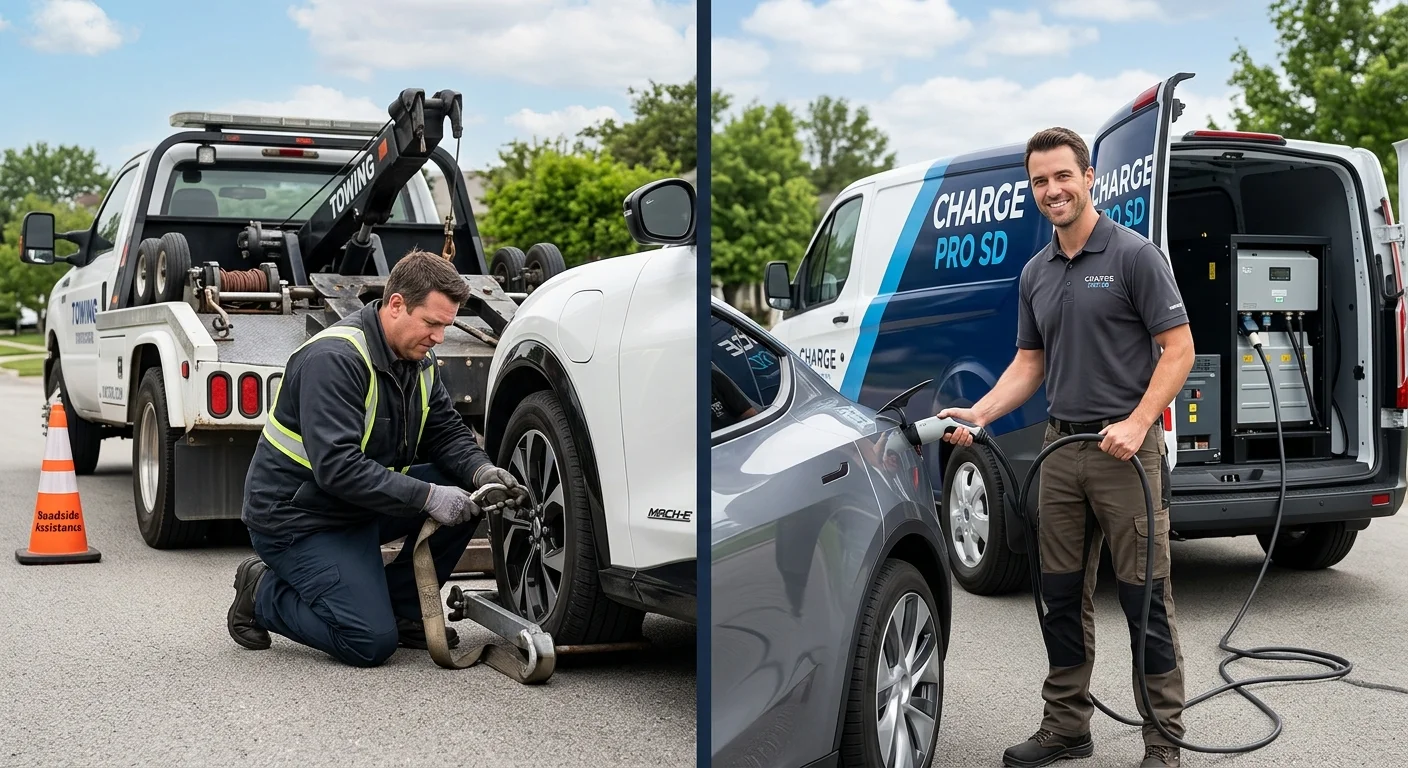
What your Geico benefit actually buys
Geico’s roadside add-on is written for ordinary auto trouble. This research didn’t confirm a Geico page listing mobile 240-volt charging. Pull your declarations, or open the Geico app, and read the roadside lines yourself. Then ask the dispatcher three things, in those words. Ask whether they’re sending a 12-volt jump, a tow, or a 240-volt charger. The third answer is the one that matters for an empty pack.
A jump, a lockout, a flat, or a tow can still be useful. Those are gas-car tools that happen to work on some EV problems. They don’t fill a traction battery while the car stays under the carport.
If a tow is what they offer, ask two more questions. Ask what distance cap your policy lists. Ask whether they can send a flatbed. This piece doesn’t print a mile limit because Geico’s current cap wasn’t confirmed here. Your policy pages set it. A flatbed keeps all four wheels off the ground. Many EV makers want a flatbed so the drive wheels stay off the pavement. Say you want the flatbed. Don’t assume the first truck is that truck.
Why Village cars die in the stall
Census figures put Laguna Woods at 17,342 residents. About 83 percent are 65 or older. That’s the highest share of any incorporated city in Orange County. People here take short trips. Cars sit for days, sometimes weeks. That rest period is what kills a 12-volt battery. The main pack can still show range. The small battery that wakes the computers is the one that goes.
Housing age is part of the same story. 90.7 percent of homes were built before 1980. That’s the highest rate in the county file. Laguna Woods Village, once Leisure World, was laid out as co-ops and carports. United Mutual, Third Laguna Hills Mutual, and Towers 50 Mutual still park that way. Those stalls predate home EV circuits. The car that won’t start is often still in its assigned spot. It isn’t out on Moulton Parkway.
Orange County had 210,842 battery-electric cars as of December 31, 2025. That’s from the California Energy Commission. Teslas make up about two-thirds of that battery-electric fleet. Plenty of them live in ZIP 92637. The local failure is still simple. The car sat. Then it wouldn’t wake.
Towers 50 Mutual is two high-rises. A stall under a tower is tighter than a ground carport. Tell whoever you call which one you’re in. It changes how a van or a wrecker fits.
Getting a truck through the Village gates
A truck can come inside. You have to clear it. Laguna Woods Village has 14 guarded gates, and they’re staffed. Tow drivers and mobile operators don’t talk their way through. You call the gate. You give a name, a company, and a vehicle description. Use the gate number you actually enter, Gate 1 through Gate 14. That’s how people wayfind here.
Inside the gates, streets like Via Puerta and Avenida Sevilla stay low-speed. Golf carts are everywhere. That’s normal Village traffic. Any truck working a carport has to live with it. Around the edge, the arterials are El Toro Road and Moulton Parkway. Santa Maria Avenue, Paseo de Valencia, and Ridge Route Drive complete the grid.
There’s no freeway in the city. I-5 sits about a mile east, reached on El Toro Road. SR-73 passes just southwest. A freeway patrol isn’t coming to a carport on Via Puerta. The job stays local. Staffed gates, carts, and a stall that wasn’t built as a charging bay.
City Hall is at 24264 El Toro Road, on the commercial strip. MemorialCare Saddleback Medical Center is next door in Laguna Hills. Clubhouses 1 through 7 are the usual short drives. So are the Performing Arts Center and the Laguna Woods Golf Course. Gentle San Joaquin Hills slopes cover 3.34 square miles. Laguna Coast Wilderness sits on the southwest line. None of that helps if the car won’t leave the carport.
What a tow from the Village actually involves
A Geico contractor still needs your gate call. The wrecker still threads carts on internal streets. Then it has to exit on El Toro Road or Moulton Parkway. After the hook, you’re sitting at a public stall you didn’t choose. You’re waiting for a charge that could have happened at the carport.
If the pack is empty, the tow only moves a dead car. You still need energy. If the 12-volt battery is the only failure, a tow is a long detour. A jump or a replacement at the stall is the shorter path. That’s the 12-volt job a lot of Village calls actually are.
Geico remains a fair call for a tire or a lockout. For a dead EV, treat the dispatch as a tow. Change that only if someone says they’re bringing a charger. Other insurers run the same pattern. Allstate’s EV roadside help is the same tow-first shape. Ask the same three questions there too.
Dead 12-volt, or an empty pack
Sort this before anyone brings a winch.
A dead 12-volt battery makes the whole car look finished. Screens stay dark. Handles may not present. The traction pack can still hold miles. Sitting in a carport for a week does that, even after easy Village errands. Tesla’s owner’s manual covers what happens once range is gone. The low-voltage battery can lose support. The pack then needs outside power before it will charge. The sitting-car version is even more common here.
An empty traction pack is different. The car woke up. It drove. Then the miles hit zero. A jump on the 12-volt terminals won’t put range back. You need 240-volt power at the charge port.
Ask Geico which of those they can do in the stall. A jump may be on the menu. A Level 2 charge is 240-volt power, like a dryer circuit. This research didn’t confirm that as a Geico roadside benefit. For the jump path, read whether roadside help can jump an EV. For an empty pack, mobile EV charging at the carport is the direct move.
What a 240-volt visit is
Charge Pro OC is a referral line. It doesn’t own trucks, and it doesn’t do the work itself. It matches you with an independent local operator. That operator quotes you before starting, then bills you directly.
The operator brings a 240-volt Level 2 source to the car. Teslas take a native NACS plug. Other brands use a CCS or J1772 adapter. A typical session adds about 10 to 20 miles of range. That takes 15 to 30 minutes of charging time. That’s session time, not an arrival promise. It’s often enough to reach a public stall. It’s also enough to get back to a home plug.
If the 12-volt battery failed, the same stop can be a jump. It can also be a replacement on site. For many Laguna Woods carports, that’s the entire rescue. You don’t need a flatbed for that. You need the gate cleared and someone at the stall.
The Laguna Woods city page maps the local pattern. If a home battery still left the car dead, read the Village power piece. It explains why the EV can sit there anyway.
If the car can still roll
The Tesla Supercharger at 23701 Moulton Parkway in Laguna Hills is a documented AFDC site. It has 16 stalls rated up to 250 kW. Another Laguna Hills site is at 25248 Cabot Road. That one also lists 16 stalls at up to 250 kW. Those plugs are real. They don’t wake a car with a dark screen under a Village carport.
If the displays are off, stay with the car. Clear the gate. Decide jump versus charge. Mobile charging or a tow is the choice that matters inside the gates. Lake Forest, Mission Viejo, and Aliso Viejo are next door. They don’t change a staffed-gate carport problem.
Tesla’s own depleted-battery language answers an empty pack with transportation. It doesn’t send a charger to the car. Confirm that on Tesla’s roadside page before you wait on it. Geico isn’t Tesla. The practical result can look the same. You get a tow, then a plug somewhere else.
How to set up a gate visit
Have the gate number ready. United Mutual, Third Laguna Hills Mutual, and Towers 50 Mutual don’t share one entrance. Tell the operator your gate and the carport row. Name a nearby clubhouse if the guard uses that.
Stay by the phone. The guard will want a live person. If you can’t meet the truck, name a neighbor or a relative. Give the gate a plate and a company name.
Leave room beside the car if you can. Carports are narrow. Carts keep rolling. You’re making the stop easier by standing outside with the charge port unlocked.
If Geico already dispatched a tow, you can still cancel before a hook goes on. Ask what cancellation does to the benefit. Then pick the stall charge if that’s the cleaner path.
When the local match makes more sense
Use Geico if you want the benefit you already bought. Ask jump, tow, or 240-volt. If the answer is a tow, picture the 14 gates. Picture the carts, and a second wait at a stall after you leave town.
For a charge or a 12-volt fix, call Charge Pro OC. It connects you with a local operator. Call (949) 444-0151. The operator quotes before starting. You’re not hiring the brand to do the work. You’re hiring the independent pro they match you with.