The car is on a Las Flores driveway, the dash is dark, and the charging map around you is blank. This unincorporated canyon place has no Tesla Supercharger inside its boundary. The nearest Supercharger is 3.1 straight-line miles away at 25248 Cabot Rd in Laguna Hills, and that gap is road miles plus grade once you leave the cul-de-sac.
Las Flores has no Supercharger of its own
Las Flores EV charging is a map problem before it is a truck problem. This is a Census place on the South County canyon edge, not a city with its own stall inventory. The California Energy Commission publishes Orange County charger counts as a county total. That total is 7,095 public ports as of 2025-12-31. It does not break the figure out for Las Flores. A place-level public-port count could not be confirmed from that file.
What can be confirmed is the Tesla Supercharger inventory. There is no Supercharger inside the Las Flores boundary. The closest site is 25248 Cabot Rd in Laguna Hills. It has 16 stalls, up to 250 kW, and it is logged as 24/7 on AFDC and Tesla’s locator. Straight-line distance from the Las Flores centroid is 3.1 miles. That is not the Supercharger desert used for Trabuco Canyon or Silverado, which sit 7 to 9 miles out. It is still a miss if the pack is already at zero. You cannot spend 3.1 miles you do not have.
Other networks do not fill the street in front of you. The U.S. Department of Energy tracks electric vehicles at the federal level. The Alternative Fuels Data Center is the Supercharger source used here. Live Level 2 and DC fast maps for this canyon pocket stay thin. Confirm any stall on the car’s map before you count on it. A pin that looks close can be a HOA lot, a dead unit, or an app-only stall.
If the car still has a few miles, the next real DC fast options sit off the canyon. Rancho Santa Margarita’s EVgo site at 22351 Antonio Pkwy has 14 DC fast ports. Ladera Ranch has an EVgo site at 27542 Antonio Pkwy with 8 DC fast ports. Those are Antonio Parkway addresses, not Las Flores addresses. They help a driver who can still roll. They do not help a car that already stopped on a private street.
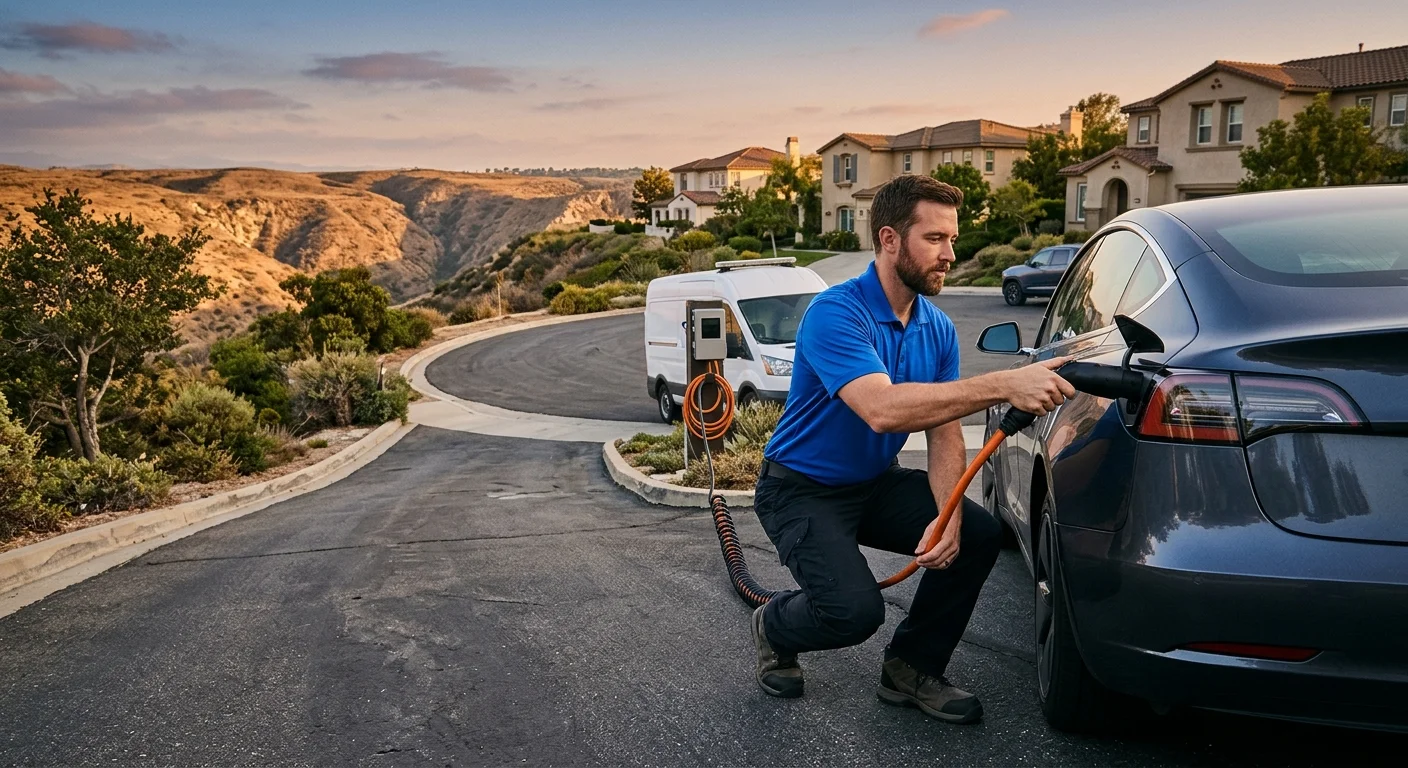
That is why emergency EV roadside assistance in Las Flores is a curb problem. A matched operator brings mobile EV charging to the car. A typical rescue charge is 10 to 20 miles of range in 15 to 30 minutes of Level 2 charging. That is charging time, not a promise about arrival. The operator quotes and bills you. Charge Pro OC does not set a price.
Antonio, Oso, and the drop toward the 241
Las Flores sits at 677 feet, a USGS 3DEP internal-point elevation. The streets that matter here are Antonio Parkway and Oso Parkway, then the drop toward SR-241. Antonio is the spine that ties this pocket to Rancho Santa Margarita, Ladera Ranch, and the rest of South County. Oso is the east-west cut. Neither one is a charging corridor with a Supercharger on the curb.
If the car dies on Antonio, you are on a grade through dry hills, not a flat Irvine lot. Range math that worked on the 5 does not work the same here. Climbing costs more than the dash guessed when you left the garage. Air conditioning on a hot South County afternoon costs more still. AAA’s 2026 dynamometer study found an 8.5 percent loss of range when running air conditioning at 95 F. Canyon sun on a parked car is not that lab. It is the same direction.
The 241 looks like an escape hatch on the map. It is a TCA toll road. If the pack is already at zero, you never reach it. FSP’s published coverage area does not list SR-73, SR-133, SR-241, or SR-261. Do not plan on a freeway patrol truck as the EV charger on the 241. OCTA’s Freeway Service Patrol pages also have no out-of-charge EV category. The listed FSP outcome for a depleted EV, on the segments FSP actually publishes, is a free tow to a CHP drop zone during FSP hours, and it is not guaranteed.
So the 241 is a miss twice. You cannot drive a dead pack onto it. The published motorist-aid net does not list it. If you still have enough range to roll and you want the freeway picture, read out of charge on SR-241. For a Las Flores driveway or an Antonio shoulder, stay with the car. Use hazards if you are on the roadway. Treat the next charge as something that has to come to you.
Rancho Santa Margarita sits next door, and it is a different problem. That city is 5.1 straight-line miles from the same Cabot Rd Supercharger, over hills, which is why it is grouped with the operational Supercharger deserts. Las Flores is closer on paper. The driving is still canyon driving. For the RSM pattern, see EV roadside assistance in Rancho Santa Margarita. Trabuco Canyon EV charging sits farther up the box, 7.3 straight-line miles from the Lake Forest Muirlands Supercharger. This page is the unincorporated pocket in between, on Antonio and Oso.
Home backup that still leaves the car empty
A lot of Las Flores houses have a wall charger in the garage, and some have a home battery for outages. Lights in the kitchen do not put miles in the car. If the EV was not plugged in, or the charger tripped, or the home battery was holding the house and not the vehicle, you still have an empty pack in the driveway.
That split is the local pattern. A home battery can keep the fridge and the Wi-Fi up during a canyon outage. The car is a separate load. If you want the house-versus-car version of this, it is already written as home battery or EV rescue in Las Flores. This page is the roadside version: the car is done, and you need range at the curb.
Do not assume the wall unit will save you once the pack is at zero and the car will not wake. Some cars need 12V support before the high-voltage pack will accept a charge. Tesla’s Model Y owner’s manual is plain on this. Once range is exhausted, the low-voltage battery loses support and needs an external power supply before the high-voltage battery can charge. A quiet garage overnight is enough to get you there if the 12V was already weak.
Tesla’s roadside policy answers a depleted battery with transportation, not on-site charging. That transport is paid. It is not a financially covered service for running out of charge. Transportation of up to 500 miles to the nearest Service Center is for a warrantable breakdown that renders the vehicle undrivable. An empty pack sits outside that list. A matched local operator who can charge at the car is the other path, and you contract with that operator directly.
Gate and HOA access for a matched operator
Much of Las Flores is private streets and gated entries. A specific HOA gate rule for this place could not be confirmed on a public city, HOA, or TCA page. Unincorporated Las Flores does not publish a municipal EV-rescue guide. Do not guess a gate code, a guest-lane rule, or a vendor-list requirement.
What you can do is practical. When you request a match, say you are in a gated Las Flores pocket. Give the operator the entry that actually works: a call box, a resident remote, or a guard. Stay where the car is if it is safe. Meet the truck at the gate only if that is the only way through. The operator still has to reach the charge port. A truck left on Antonio does not charge a car three courts in.
California Civil Code 4745 is about installing and using an EV charging station in a common-interest development. It is not a gate-access statute for a roadside truck. An HOA document that effectively prohibits or unreasonably restricts installing or using a charging station is void. That does not tell a guard to open the arm at night. Treat gate access as a conversation with the operator and the association, not as a right we can assert from here.
Private-property towing is a separate risk if the car is left in a fire lane or a visitor stall. CVC 22658 sets signage rules for private-property tows. The details are on the statute, not on a Las Flores HOA flyer we could verify. If the car is in a driveway, you are usually waiting for the operator, not for a rotation tow.
Charge Pro OC does not send a branded fleet through the gate. It connects you with a licensed, independent local operator. That person quotes the work, drives the truck, and bills you. Give them a working way in. That is the whole access problem.
Dead 12V after a sit versus a truly empty pack
Two failures look the same on a Las Flores driveway, and they are not the same job. The first is a dead 12V after the car sits. The second is a truly empty traction pack. South County canyon owners hit the first one as often as the second. A car that sat in a garage for a week, or sat through a hot afternoon on a steep drive, can refuse to wake even with miles still showing on the last app reading.
A 12V failure kills accessories, the screen, and the switches that let the big pack work. Supporting that 12V can bring the car back without adding range. An empty pack needs energy into the charge port. Mixing those up wastes a trip. If the app still shows range and the car is dark, start with the 12V. If the app shows zero and the car was driven down to empty, plan on a charge at the curb.
Tesla still dominates Orange County’s battery-electric fleet. As of 2025-12-31, Tesla was 138,121 of 210,842 Orange County BEVs, 65.51 percent. Tesla roadside at 877-798-3752 is the factory line. For a depleted pack, Tesla’s published answer is a paid transport, not on-site charging. For a 12V, the factory path and a local match can both be in play. The operator you are connected with handles the on-site work.
Non-Tesla EVs strand here too. The same split applies: 12V versus empty pack. Bring the VIN, the connector type, and whether the charge port will open. A Level 2 rescue still lands in that 10 to 20 mile, 15 to 30 minute charging window. AFDC describes public Level 2 as about 25 miles of range per hour. The shorter rescue window is a partial charge so you can reach Cabot Rd, the Antonio EVgo sites, or your own wall unit.
Stay with the car if you can. On a roadway, California requires hazard lights when the vehicle is disabled and equipped to flash them (CVC 25251). Move Over now covers a stationary vehicle displaying flashing hazard lights (CVC 21809, effective 2026-01-01). That is for other drivers. For you, the next useful mile is the one added at the charge port, not the one you do not have toward the 241.
When to call us
Call when the Las Flores car will not roll and the nearest Supercharger is still 3.1 miles away at Cabot Rd. Call when the 12V died after a sit, or the pack is actually empty on Antonio, Oso, or a gated drive. Call us at (949) 444-0151 and we’ll connect you with a local EV rescue operator.