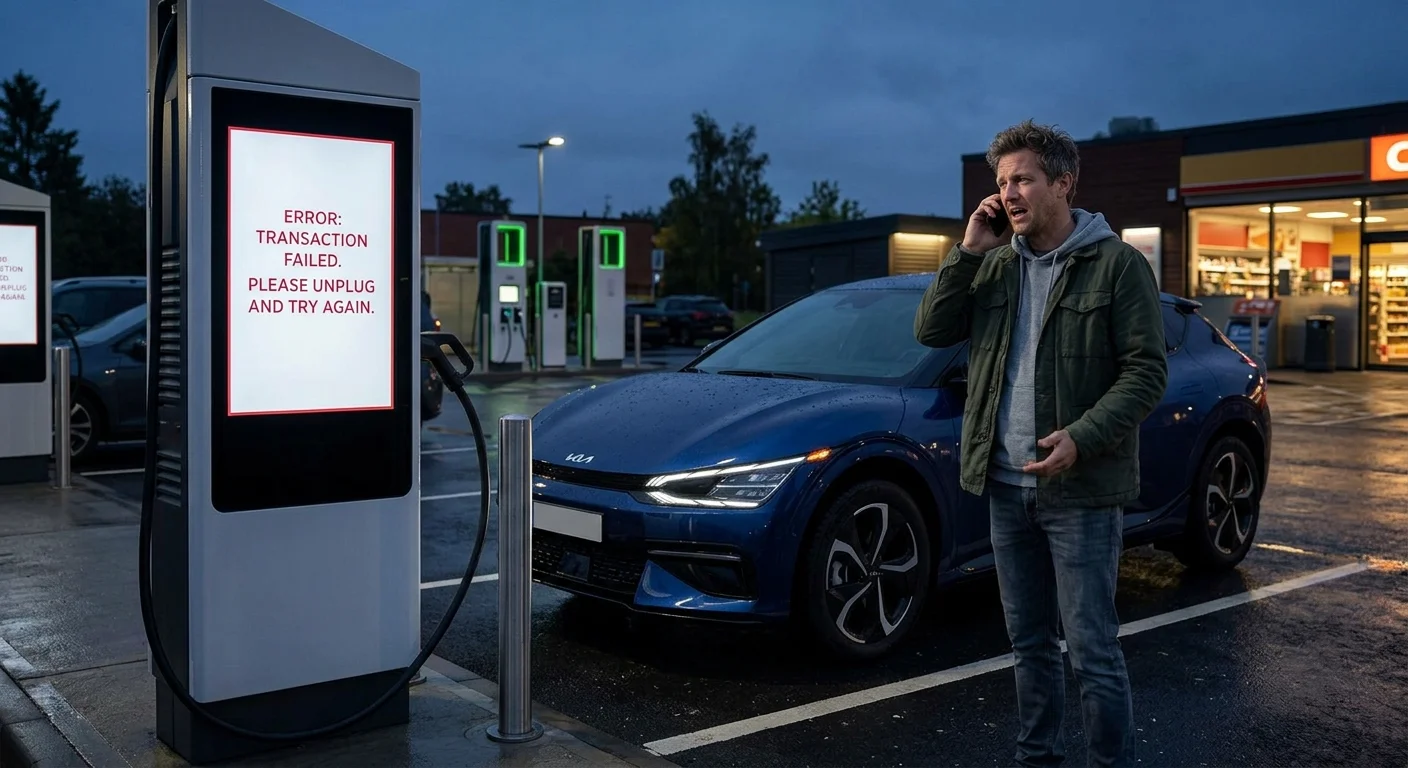
Your Kia EV6 won’t take a charge in Orange County. Start with the stall, the settings, and the 12V, not a ruined pack. Seat the handle, confirm CCS, and try a second network. AFDC counts 591 public DC fast ports in the county that are not Tesla. Tesla holds 861 fast ports, 59 percent of the county’s DC map. When a CCS session fails, you’re working from that smaller set.
Why an EV6 miss hurts more in this county
Orange County had 210,842 battery-electric cars on the road as of December 31, 2025. The California Energy Commission published that count in its vehicle population file. ZEVs are 10.56 percent of the county’s light-duty fleet. CEC’s public charging count for the county is 7,095 ports. That is 36.8 ZEVs per public port. California’s same ratio sits at 24.4 ZEVs per port. More EVs share each stall here than in the state as a whole.
Tesla still holds most of the county’s fast-charge hardware. AFDC lists 48 Tesla Supercharger sites and 861 DC fast ports here. Non-Tesla DC fast is 175 stations and 591 ports. Electrify America accounts for 138 of those ports across 30 sites. EVgo accounts for 131 ports across 30 sites. ChargePoint shows 71 stations and only 76 DC fast ports. That’s about 1.1 ports per ChargePoint site. Most of those are single plugs at offices and dealers. Those single plugs help a parked commuter more than a stranded driver. They’re a thin backup when the EV6 is already low.
A US-spec EV6 takes DC fast on a CCS port. Tesla Superchargers still make the biggest pins on many maps. Apps will send you to them because the stall counts are huge. San Clemente’s Tesla site at 101 W Avenida Vista Hermosa lists 49 stalls. Irvine’s 1920 Main St site lists 40 stalls. Garden Grove’s 12891 Harbor Blvd site lists 32 stalls. Those pads are Tesla-network stalls first, not CCS by default. Confirm a CCS connector before you spend remaining range on that pin.
One Tesla site in the AFDC file lists Magic Dock CCS1 plus NACS. That’s 24372 Rockfield Blvd in Lake Forest, with 16 stalls. Treat that as the documented CCS exception, not a countywide rule. If the stall face does not show CCS, keep driving. Use a named Electrify America or EVgo pad instead.
Start with the handle, then change networks
A charge that never starts is often a lazy latch. Push the CCS or J1772 handle until it clicks and sits flush. A gap at the port can look connected and still do nothing. Watch the station screen after you plug in. A dark display or a frozen spinner is the pad, not the Kia. An error code on the screen is the same story. Move one stall over on the same island. Shared cabinets fail as a group sometimes, but not always. If the neighbor stall also refuses, leave the site. Don’t sit in a dead row hoping the backend wakes up.
Switch networks before you assume the car is at fault. Electrify America, EVgo, EVCS, and ChargePoint don’t share one computer. A payment error in Anaheim doesn’t kill every CCS plug in Santa Ana. If a second network starts a session, you isolated the stall. Use the plugged-in, still-not-charging checks once the handle is seated. Hot weather can slow a session or stop it. The battery computer is protecting the pack in heat. That’s a pause, not proof the traction battery failed. Read the dash, then try another port.
Named CCS pads when the first site is a miss
Skip mystery pins and use the CCS sites AFDC actually lists. Electrify America at Walmart 2242 sits at 440 N Euclid St in Anaheim. It lists 10 DC fast ports on a north-county big-box lot. Electrify America at Fashion Island sits at 401 Newport Center Dr in Newport Beach. It lists 8 DC fast ports. The Fashion Island charging walk-through is for that coastal center. Electrify America Dana Point Station sits at 25825 Las Vegas in Capistrano Beach. It lists 12 DC fast ports. That’s the largest non-Tesla fast site in south Orange County.
EVgo at Plaza Antonio, 22351 Antonio Pkwy in Rancho Santa Margarita, lists 14 DC fast ports. EVgo at Ocean View Plaza, 638 Camino de los Mares in San Clemente, lists 10. EVgo at Westar Mercantile East, 27542 Antonio Pkwy in Ladera Ranch, lists 8. EVgo at 801 Pacific Coast Hwy in Seal Beach lists 4 stalls.
Those pads sit in different traffic and housing patterns. Euclid in Anaheim is inland retail, and Fashion Island is coastal shopping. Plaza Antonio sits inland among south-county housing. Seal Beach is a Pacific Coast Highway lot. Open the app, confirm CCS, and confirm the stall is actually up. A ChargePoint dealer plug is a weak stand-in for a 10-port Electrify America island.
CEC’s port file blends surveys, grant lists, AFDC, PlugShare, and other sources. It isn’t a live status feed. Check the stall in your app before you burn range to reach it.
Home charging that looks dead and isn’t
A charge schedule can fake a failed EV6. Open the Kia charge menu and look for delayed charging. If delayed charging is on, the car is waiting on purpose. Turn the schedule off if you need energy now. A percentage cap can also stop a session you thought would fill.
At a house or condo panel, look at the Level 2 breaker. A tripped breaker is still a common miss after a long session. Reset it once, and stop if it trips again. That’s an electrical problem for a licensed electrician. Charge Pro OC doesn’t install home chargers or own any wall units. This line refers stranded drivers to mobile operators.
If the home plug works and public CCS does not, the car is probably fine. If both refuse, shift to the 12V checks next.
When the small battery blocks the big one
The traction pack can hold range and still refuse a plug. The 12V battery runs the computers that handshake with a charger. If that 12V is low, the EV6 may never wake. The screen stays black, interior lights flicker, and the port ignores the handle.
When the 12-volt dies, the whole car can look finished. That isn’t an empty high-voltage pack. A 12V jump, done to the owner’s manual, can restore the handshake. If the EV6 then takes a charge, the 12V was the block. Get that battery tested and plan a replacement. Another jump next week is a stranding, not a fix.
Independent operators in this network jump or replace a dead 12V on site. They work on Kia and other non-Tesla brands. Don’t guess the jump points on the EV6. The owner’s manual is the map for terminals. If you don’t want to work around a live 12V, skip the DIY step and call.
A reset belongs in Kia’s book, not in guesswork
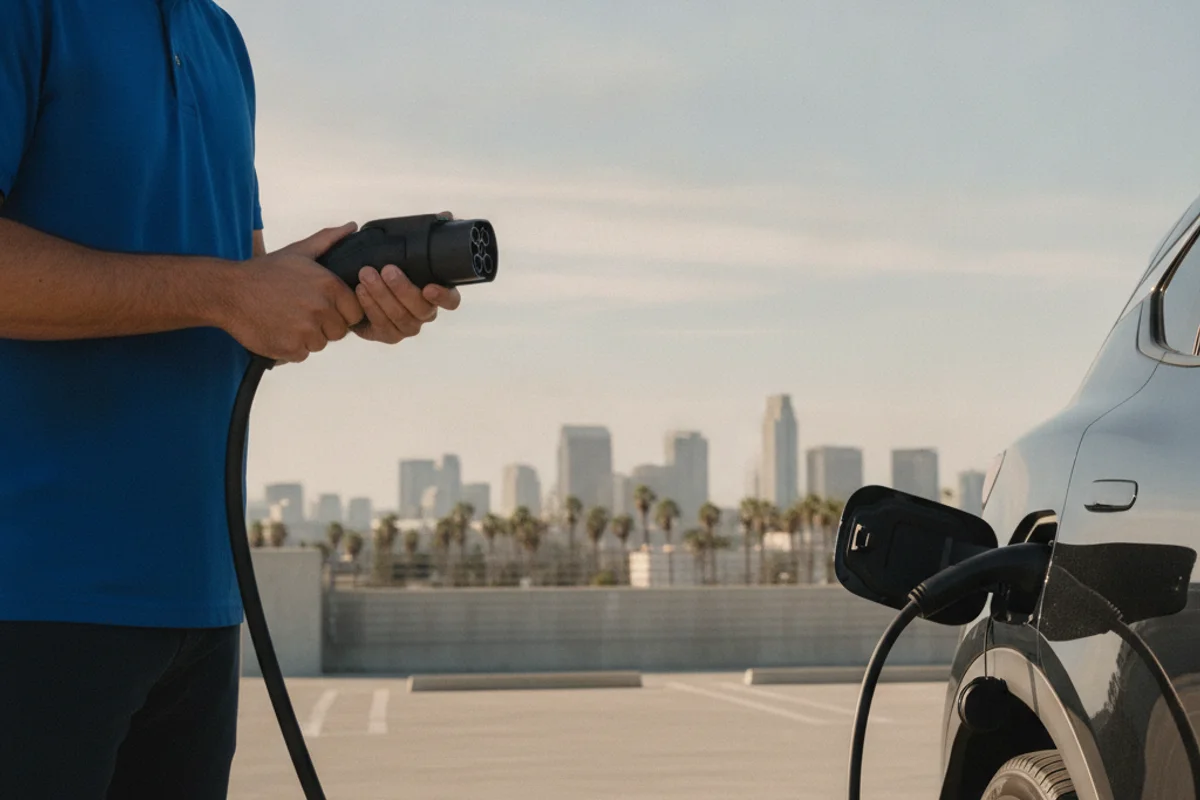
Charging logic can freeze on a glitch. Kia documents the reset path in the owner’s manual. Follow that sequence, or skip the reset. Park, set the brake, and shut the car fully down before you touch anything.
Don’t assume the 12V is under the hood, because some EVs hide it. Confirm the location in the manual first. If the book describes a disconnect wait, use Kia’s order and Kia’s times. If you’re unsure about cables, leave them alone.
A reset that brings the port back was software. A reset that changes nothing points at the stall, the 12V, or a shop-level fault.
Read the dash without inventing a code
A failed charge can throw a battery lamp or an EV system message. Write down the exact words, then match them in the EV6 manual. Clearing a light without fixing the cause just hides it for a mile.
A generic OBD-II reader may pull a stored code. Many charging faults still need Kia tools at a shop. A parts-store scan is a breadcrumb, not a repair. Persistent EV warnings belong at a dealer or a qualified EV shop.
Charge Pro OC doesn’t diagnose high-voltage packs or onboard chargers. Operators can test the 12V and add range at the curb. A failed charge-control unit is shop work, not a curb charge.
When the next CCS stall isn’t a realistic move
You’ve seated the handle and tried a second network. Home Level 2 still sits at zero, and the dash is complaining. If you’re on a freeway shoulder, stay with the car. Then get range brought to you instead of hunting another pin.
Tustin has four Tesla Supercharger sites in the AFDC list. Buena Park has two, including 28 stalls at 8888 Knott Ave. Westminster Mall lists 24 Tesla stalls at 1025 Westminster Mall. Those are easy pins to chase on a map. They still don’t help an EV6 that needs CCS. North county, the coast, and south county all have named CCS pads above. Use those, or bring a 240V source to the car.
Charge Pro OC is a referral line for Orange County. It matches stranded EV drivers with independent local mobile rescue operators. It doesn’t perform the work or own any trucks. It employs no technicians, holds no licence, and sets no prices. The operator quotes you before starting, then bills you directly.
Those operators bring a 240V Level 2 source to the car. Native NACS, plus a CCS or J1772 adapter for a Kia EV6. They typically add 10 to 20 miles of range in 15 to 30 minutes of charging. That window is charging time, not an arrival time. They can also jump a dead 12V on site.
Use non-Tesla EV rescue if the CCS pads are down or occupied. Use it when the connector is the wrong one too. Read non-Tesla rescue in Orange County for the countywide version. If the pack is simply empty, read mobile EV charging.
If the EV6 still won’t take a charge after these checks, call (949) 444-0151. We’ll connect you with a local operator, and that operator sets the quote. This number isn’t a promise of when someone arrives.