The range bar hits zero on the San Joaquin Hills corridor, and the next public charger sits on the far side of a toll plaza. Freeway Service Patrol’s published coverage area does not list SR-73. You are on a South County toll road, and the yellow trucks people expect on the 405 are not named for this stretch.
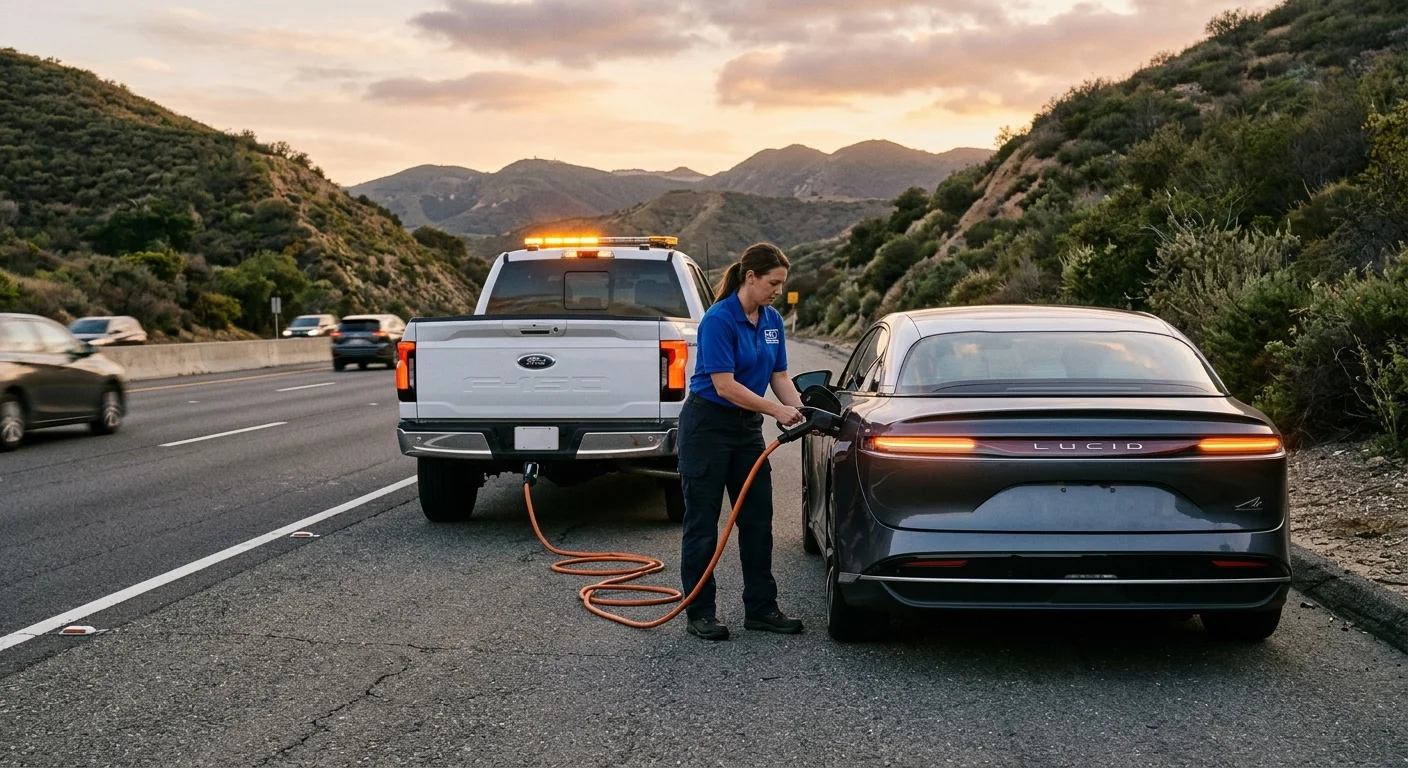
Why an empty pack on the 73 is a different problem
SR-73 is The Toll Roads’ San Joaquin Hills route. It is not I-405. It is not I-5. It climbs between Costa Mesa and San Juan Capistrano, then drops toward the coast cities. Drivers treat it like any other Orange County freeway until the pack dies.
On I-405, OCTA at least names the freeway in its Freeway Service Patrol lists. On SR-73 it does not. The same published gap shows up on the inland Foothill corridor. If you already read our note on running empty on SR-241, the FSP picture is related. The road is not. The 73 is the coastal TCA route through Aliso Viejo and Laguna Niguel. The 241 sits inland, over the hills.
FSP’s listed help for a dead EV is not a charge. Caltrans assist codes include Out of Gas. They do not include an out-of-charge or EV-charging category. A jump-start restores a 12-volt accessory battery. It does not refill a traction pack. On a patrolled segment, during published hours, the listed FSP outcome for a depleted EV is a free tow to a CHP-designated drop zone. That help is not guaranteed. Services may vary based on the vehicle and the help needed. On a road that is not even named in the coverage lists, waiting for a yellow truck is a bet, not a plan.
Tesla’s roadside policy answers a depleted battery with transportation, not on-site charging. That transport is paid. Running out of charge sits outside the warrantable-breakdown list. Tesla’s Santa Ana service page publishes 877-798-3752 for roadside. That is Tesla. It is not a local charge truck.
What you need on the 73 is range, then an exit. A matched local operator can add 10 to 20 miles of range in 15 to 30 minutes of Level 2 charging. That figure is charging time. It is not an arrival window. Charge Pro OC refers that work to a licensed, independent operator. We do not own a fleet, and we do not perform the charge.
Aliso, Laguna Niguel, and the coast drop toward 405
The 73’s west end meets I-405 in the Costa Mesa and Newport Coast area. OCTA’s web page lists FSP on I-405 from I-605 to SR-73. If you still have enough roll to reach that junction, you may be on a named FSP segment. If you are still on the toll road, you are not.
Aliso Viejo sits just inland of the corridor. The nearest Tesla Supercharger, measured straight-line from the city centroid, is 2.7 miles to 23701 Moulton Parkway in Laguna Hills. That site has 16 stalls and a listed max of 250 kW. Close on a map is not close at zero. Drivers looking for EV roadside assistance in Aliso Viejo hit this bind: charging lives in town, and the empty pack is in the toll lanes.
Laguna Niguel follows the same pattern. Its nearest Supercharger is 2.8 straight-line miles to The Shops at Mission Viejo, 555 The Shops at Mission Viejo. Tesla lists 10 stalls there and up to 72 kW per stall. Use Tesla’s figure. Laguna Hills also has a site at 25248 Cabot Road, 16 stalls, up to 250 kW. Those stalls help once you exit. They do not help while you are stopped on the 73. The same split shows up in EV roadside assistance for Laguna Niguel.
Do not aim for Laguna Beach on fumes. Laguna Beach sits 5.3 straight-line miles from the Mission Viejo Crown Valley Supercharger, over hills. That gap is a Supercharger desert. Emerald Bay falls inside it.
Toward Costa Mesa and Newport the inventory is denser. Costa Mesa has Superchargers on Bristol, Coast Drive, and Hyland. Newport Beach has one at 4241 MacArthur Boulevard, 12 stalls, max 250 kW. Electrify America lists 8 DC fast ports at Fashion Island, 401 Newport Center Drive. South of Laguna Niguel, San Juan Capistrano has Superchargers at 26701 Verdugo Street and 31971 Camino Capistrano. San Clemente’s Vista Hermosa West site is the county’s largest at 49 stalls. None of that inventory sits in the toll lanes.
Orange County had 210,842 registered battery-electric vehicles as of December 31, 2025, per the California Energy Commission. South County puts a lot of that fleet on the 73. The public ports are in the cities. The empty-pack problem is on the grade.
Published FSP coverage and what you still have to confirm
OCTA publishes two FSP coverage lists, and they do not match. The web page names I-5 from Sand Canyon Avenue to Cristianitos Road, SR-22 from Harbor Boulevard to SR-55, SR-91 from SR-57 to Green River Road, and I-405 from I-605 to SR-73. The fact sheet dated August 1, 2026 adds SR-57 from Tonner Canyon to SR-22, plus the 91 and 405 Express Lanes. It also describes I-5 as south of Alicia Parkway. Flag the conflict. Do not pick a winner.
Neither list names SR-73, SR-133, SR-241, or SR-261. FSP’s published coverage area does not list the toll roads. That is not the same as OCTA stating that FSP does not cover them. The pages we can cite simply omit them. A different TCA or Caltrans rule could not be confirmed from those lists.
Hours on the OCTA web page, the figure to use here, are Monday through Friday, 6:00 a.m. to 7:00 p.m., and limited weekend service from 10:00 a.m. to 6:30 p.m. The fact sheet starts weekdays at 5:30 a.m. That is another conflict. FSP does not operate overnight. It does not operate on listed holidays, including New Year’s Day, Memorial Day, Independence Day, Labor Day, Veterans Day, Thanksgiving Day, and the day after Thanksgiving.
When FSP is running on a named freeway, the help is free. Drivers may not accept payment or tips. The list is a 12-volt jump, a flat, one gallon of gas, radiator water, a taped hose, and a tow to a CHP-designated drop zone. FSP may only tow to those zones. A collision, leaking fluids, or vehicle weight can block the tow.
Call 5-1-1 and select Motorist Aid. For emergencies, call 9-1-1. Do not email [email protected] for a truck. California does not use #399. CHP’s non-emergency line is 1-800-TELL-CHP (1-800-835-5247).
The Toll Roads publishes customer help on its own site. Current toll rates could not be verified, so they are not quoted here. Confirm how you pay on The Toll Roads’ pages. No public TCA page in our sources states a rescue surcharge for a mobile charge visit. Do not assume there is one, and do not assume there is none. Ask the operator who quotes the job. A TCA motorist-patrol equivalent for SR-73 also could not be confirmed.
Stay in the car, then get range, then leave the toll lanes
Put the hazards on. In California that is mandatory when the car is disabled on the roadway and equipped with a simultaneous-flash device, if that device still works (CVC 25251). Flashing is also permitted if you are off the roadway but within 10 feet of it.
Stay in the vehicle unless you are in immediate danger. A genuinely disabled vehicle may temporarily stop on a freeway when another vehicle has been summoned to render assistance (CVC 21718(a)(4)). Call for help, then wait with the doors locked.
Other drivers have a Move Over duty. As of January 1, 2026, CVC 21809 covers a stationary vehicle displaying flashing hazard lights or another warning device, including cones, flares, or retroreflective devices. Approaching drivers must change to a lane that is not immediately adjacent, or slow to a reasonable and prudent speed if a lane change is unsafe. Violation is an infraction with a fine of not more than $50. That law protects you. It does not make the shoulder safe.
Do not treat the four-hour freeway rule as a grace period. Under CVC 22651(f), a vehicle stopped more than four hours on a freeway right-of-way can be removed if the driver cannot move it under its own power. Under 22651(b), a vehicle that obstructs traffic or creates a hazard may be removed immediately. After four hours it can be towed, and sooner if it is in the way.
If the traction pack is fully exhausted on a Tesla Model Y, the low-voltage battery can lose support. The owner’s manual says the car then needs an external power supply before the high-voltage pack can charge. Tell the operator that detail. A 12-volt-only jump is the wrong first tool for a pack that is actually empty.
Charge first. That is the point of out-of-charge recovery. A Level 2 connection, per the Alternative Fuels Data Center, is roughly 25 miles of range per hour. The rescue figure we can publish is 10 to 20 miles in 15 to 30 minutes of that charging. Get enough range to exit the 73 toward a city charger in Aliso Viejo, Laguna Niguel, Costa Mesa, or San Juan Capistrano. Then leave the toll lanes. If the car cannot take a charge and needs a hook, the matched operator or a separate tow company handles that. Charge Pro OC does not tow.
How a matched operator reaches you on a toll road
Charge Pro OC is a referral service. We match you with a licensed, independent local operator. That operator quotes you, bills you, and does the work. We set no price and we promise no arrival window.
When you call, say you are on SR-73, not “the freeway.” Give direction of travel, the nearest city, and the mile marker or the last exit you saw. Aliso Viejo, Laguna Niguel, Laguna Hills, Costa Mesa, Newport Coast, and San Juan Capistrano are different access problems. A truck coming from inland South County is not the same job as a truck coming off I-405.
The operator has to enter a toll road. How The Toll Roads treats service vehicles on SR-73 could not be confirmed from a public page in our sources. Do not guess at a pass, a transponder rule, or a waived toll. Tell the operator you are on the 73 and let that shop handle access. The same is true of a hook if charging is not possible.
Once there is range, the job is to get you off the toll lanes to a charger you can finish at. Public DC fast and Supercharger inventory in South County is in the cities, not on the 73. Emergency EV roadside assistance is the broader call if you are not sure whether the pack is empty or the 12-volt system has dropped. For the empty-pack case on this road, ask for a charge at the car.
The U.S. Department of Energy explains why EVs still need a roadside plan even in a dense metro. Orange County’s public ports are clustered off the TCA roads. The 73 is the gap between those clusters.
When to call us
Call when the car is already stopped on SR-73, or when the range left will not reach an exit charger in Aliso Viejo, Laguna Niguel, Costa Mesa, or San Juan Capistrano. A matched operator can charge at the car so you can leave the toll lanes. Call us at (949) 444-0151 and we’ll connect you with a local EV rescue operator.