If your EV dies on Laguna Canyon, stay on the shoulder. Don’t hunt a stall on a dying pack. Get a 240V charge at the car, then drive inland to a named Supercharger you can actually reach.
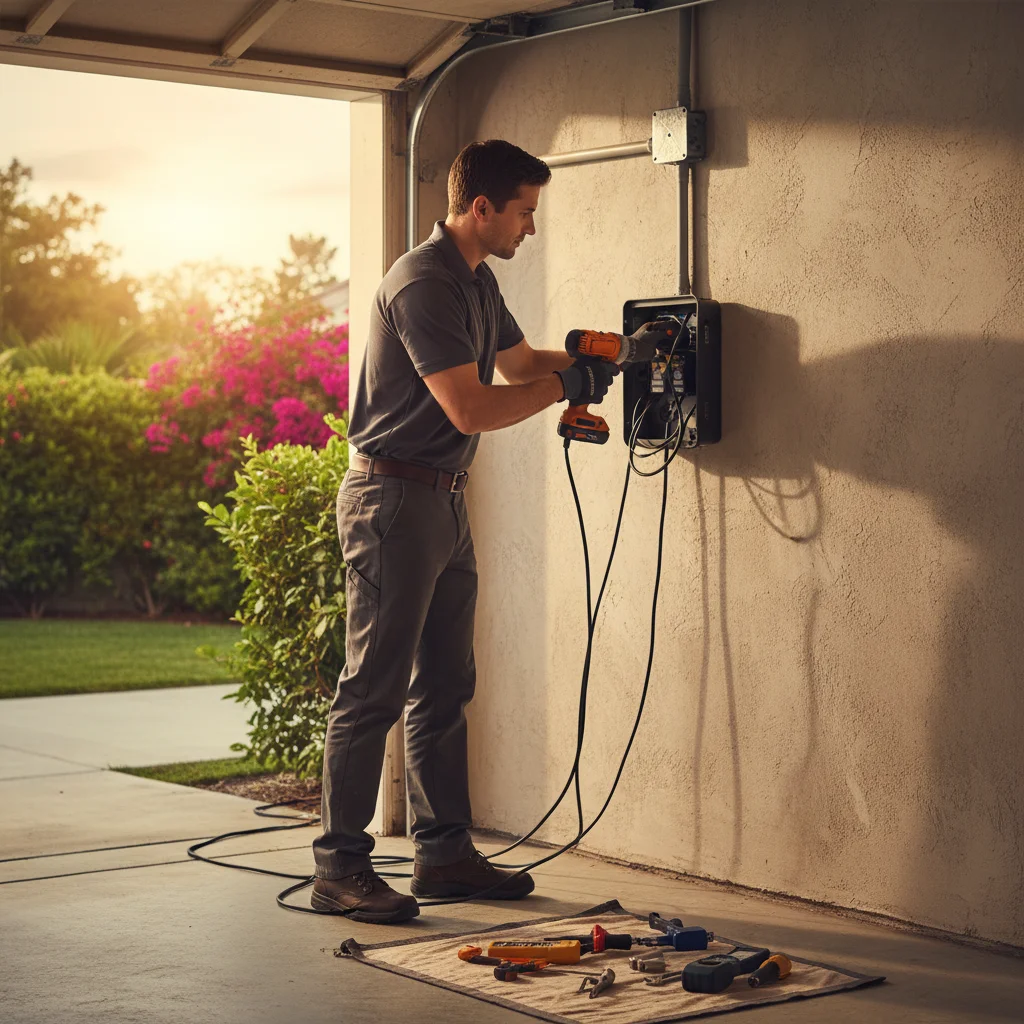
The coastal grade that eats the last bar
Laguna Canyon is the climb between the beach and inland Orange County. You leave Laguna Beach with a range number that looked fine on the flats. Then the road rises toward Irvine. Grades pull more energy than cruising on level pavement. Cabin cooling pulls more on a hot afternoon. A pack that felt comfortable at the water can fade on the way inland.
This is a beach-day pattern, not a math error. You stay later than planned. You sit in a lot with climate on. You add a few extra miles looking for a space. Then you start the canyon with less buffer than the display suggested.
Orange County had 210,842 battery-electric vehicles registered as of December 31, 2025. That’s from the California Energy Commission. Teslas made up 138,121 of those BEVs, or 65.51% of the county’s battery-electric fleet. The county is 6.4 percentage points more Tesla-heavy than California as a whole.
The CEC also counted 7,095 public charging ports in Orange County at year-end 2025. That’s 36.8 ZEVs per public port. Statewide, the ratio was 24.4. Orange County is thinner per EV than the state average. On a grade, that’s why you plan the next plug before the climb, not after the warning hits.
New ZEV sales in Orange County were 28.76% of light-duty sales in 2025, versus 22.93% statewide. The county still runs about 5 to 6 points above California on that share.
Inland Superchargers with addresses you can check
If the car can still move, inland Tesla Superchargers are the usual target. The U.S. Department of Energy Alternative Fuels Data Center listed these as public Tesla DC fast sites. The access date for that pull was September 5, 2026.
Laguna Hills has 16 stalls at 23701 Moulton Parkway, rated up to 250 kW. It also has 16 stalls at 25248 Cabot Road, also up to 250 kW. Tesla’s own Cabot listing matches that stall count and power.
Irvine has several Supercharger sites in the AFDC file. 14346 Culver Drive has 16 stalls at up to 250 kW. 1920 Main Street has 40 stalls at up to 250 kW. 3021 Michelson Drive has 12 stalls at up to 75 kW. 5396 Walnut Avenue has 12 stalls at 250 kW. 5406 Walnut Avenue has 8 stalls at 250 kW. 950 Spectrum Center Drive has 16 stalls at 250 kW.
Mission Viejo has 24 stalls at 27741 Crown Valley Parkway, up to 250 kW. 555 The Shops at Mission Viejo lists 10 stalls. Tesla’s page puts those at up to 72 kW. Use Tesla’s 72 kW figure when AFDC disagrees.
Lake Forest has 24 stalls at 24301 Muirlands Boulevard, up to 250 kW. A site at 24372 Rockfield Boulevard lists 16 stalls at up to 325 kW, with Magic Dock CCS1 and NACS.
San Juan Capistrano has 12 stalls at 26701 Verdugo Street, up to 250 kW. It also has 7 stalls at 31971 Camino Capistrano, up to 125 kW.
Those are real sites with real stall counts. They’re not a promise you can reach them from where you sit. Don’t estimate leftover miles in your head. If the car is already dying, stay where you are.
First moves on the shoulder
Hit the hazards as soon as power starts to drop. Ease right without swinging into a lane. If a legal turnout is right there, take it. Don’t reverse up the grade to hunt a better pull-out.
If you’re on the edge of moving traffic, stay in the seat with the belt on. Standing on a canyon shoulder is a worse risk than sitting still. Kill extra loads if the car is still awake. Save the phone battery for the call.
You still have a percent or two showing. The instinct is to creep toward inland stalls. On a climb, leftover range disappears faster than it did on the flats. Stop while you can still steer into a safe edge. A car that dies in a travel lane is harder to charge and harder to see.
When someone in uniform asks for a plan, have one. You’re adding range at the car, then rolling. That’s clearer than waiting on a friend who may not have a flatbed.
Dead pack or dead 12-volt
A silent EV on Laguna Canyon isn’t always an empty traction battery. A failed 12-volt can freeze the screens, the locks, and the charge port. From the shoulder it looks the same.
Tesla’s Model Y owner’s manual is useful here. Once driving range is exhausted, the low-voltage battery can lose support. The car may need an external power supply before the high-voltage pack will accept a charge. So an empty Tesla can become a 12-volt problem on top of a pack problem.
Tell the operator what you see. Screens on and range at zero means a depleted pack. Completely dark, with no door handle and no charge door, means start with the 12-volt. A car that woke after a jump and died again still needs a real 12-volt check. Don’t treat another jump as the fix.
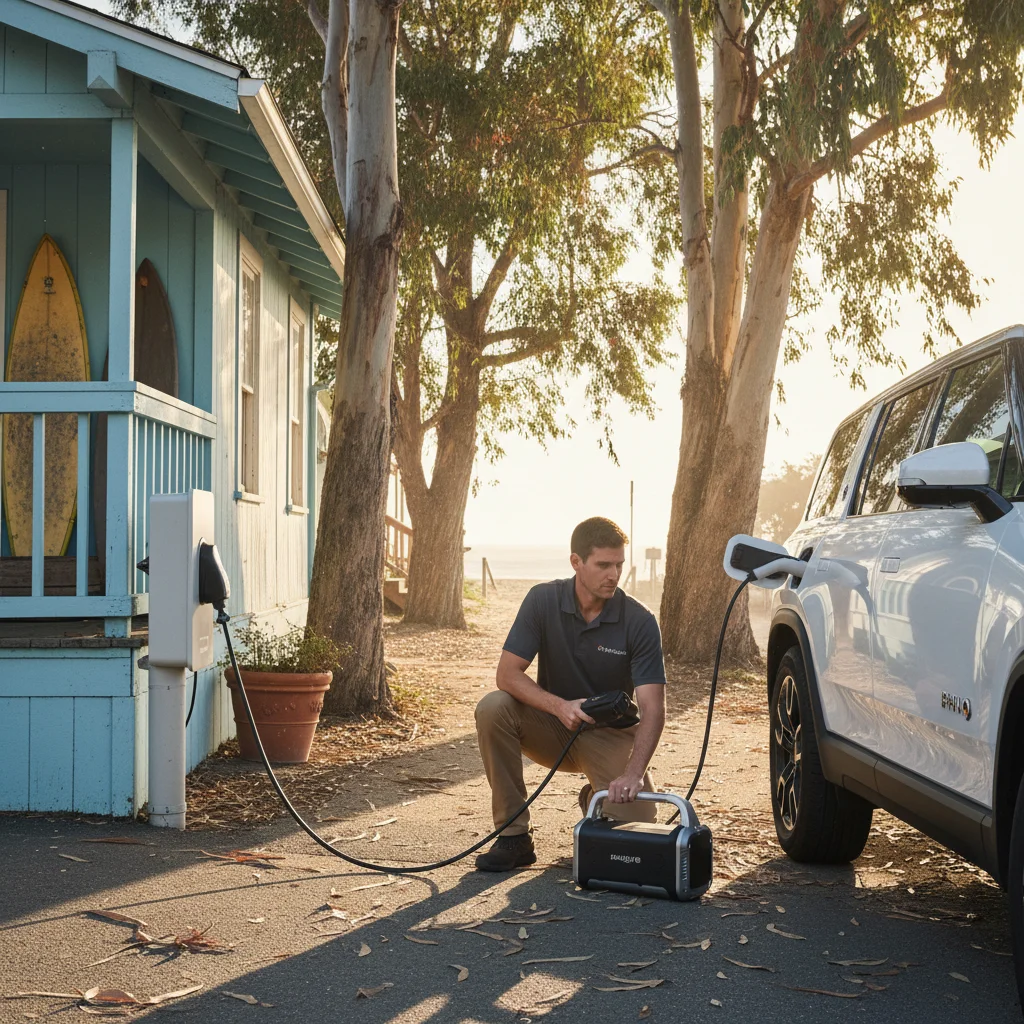
Independent operators in this network jump or replace a dead 12V on site. They also bring a 240V Level 2 source to the charge port. Teslas plug in on native NACS. Non-Tesla EVs use a CCS or J1772 adapter. That covers Tesla and every major EV brand. The pros we connect you with are licensed.
For a depleted pack, a typical session adds about 10 to 20 miles. That takes 15 to 30 minutes of charging. That’s time on the plug. It isn’t a promise of when someone shows up.
What Charge Pro OC is, and what it isn’t
Charge Pro OC is a referral line. We match stranded EV drivers with independent local mobile rescue operators. We don’t own trucks, a yard, or a fleet. We don’t employ technicians. We don’t set prices or publish hours. The operator quotes you before work starts, and bills you directly.
We serve cities across Orange County, including the beach towns and the inland cities on the far side of this canyon. The operator comes to the shoulder, a lot, or a driveway. You don’t have to nurse a dying pack toward a mall.
Tesla roadside is still a number you can call. Tesla’s published roadside policy answers a depleted battery with transportation, not with charging at the bumper. Running out of charge isn’t a warrantable breakdown. Tesla describes covered transport of up to 500 miles to the nearest Service Center. That applies only to a warrantable failure that leaves the car undrivable. An empty pack sits outside that. The Tesla roadside number listed on the Santa Ana service page is 877-798-3752.
If you want miles added where you sit, that’s out-of-charge recovery. Mobile EV charging is the same job. A Level 2 source at the car lets you drive again.
Tow only after the car can’t take a charge
Call for a tow only after the car can’t take a charge. Many EVs need a flatbed so the motors don’t turn. A wheel-lift or a hook in the wrong place can damage the car. A tow also leaves you at a stall, still waiting, still not home.
A charge at the car keeps you in your own vehicle. You drive to a stall you picked, or home if 10 to 20 miles covers it. On Laguna Canyon, that also gets the car off the shoulder under its own power.
This page can’t quote a price. Confirm the current rate with the operator before you approve the work. If the quote isn’t right, you can decline.
Non-Tesla DC fast exists inland and south too. AFDC counted 175 non-Tesla DC fast stations in Orange County, with 591 ports. Tesla Supercharger sites numbered 48, with 861 DC fast ports. Tesla holds 59% of the county’s public DC fast ports. Electrify America at 25825 Las Vegas in Capistrano Beach has 12 DC fast ports. EVgo at 638 Camino de los Mares in San Clemente has 10. Those are extra options once you can drive. They don’t help a car that’s already stopped on the grade.
Same problem on the county’s other climbs
The physics don’t change on the next ridge. The Newport Coast climb strands drivers the same way. We covered that in When your EV dies on the Newport Coast climb. Santiago Canyon has its own empty-pack sequence. Read No charge left on Santiago Canyon Road.
Stay put and get energy to the car, then drive. That’s the playbook on every OC grade.
Call when the canyon already won
Have the basics ready. Say you’re on Laguna Canyon Road, which direction you were headed, and the nearest landmark you can see. Give the make and model. Say whether the screens still work. If you’re in a Tesla, say so, because the plug is NACS. If you’re not, the operator brings an adapter.
If Laguna Canyon took the last bar, don’t keep rolling. Stay on the shoulder. Call (949) 444-0151. We’ll connect you with a local operator who can quote a 240V charge or a 12-volt jump on site.