A Tesla with no power should ride on a flatbed. Transport Mode should be on. Every wheel should be off the pavement. On Orange County freeways, Freeway Service Patrol won’t charge the car. FSP only tows to a CHP drop zone. If the pack is empty, that drop still leaves you stuck. Here’s how to tow a Tesla with no power. Do it without spinning the motors on the asphalt.
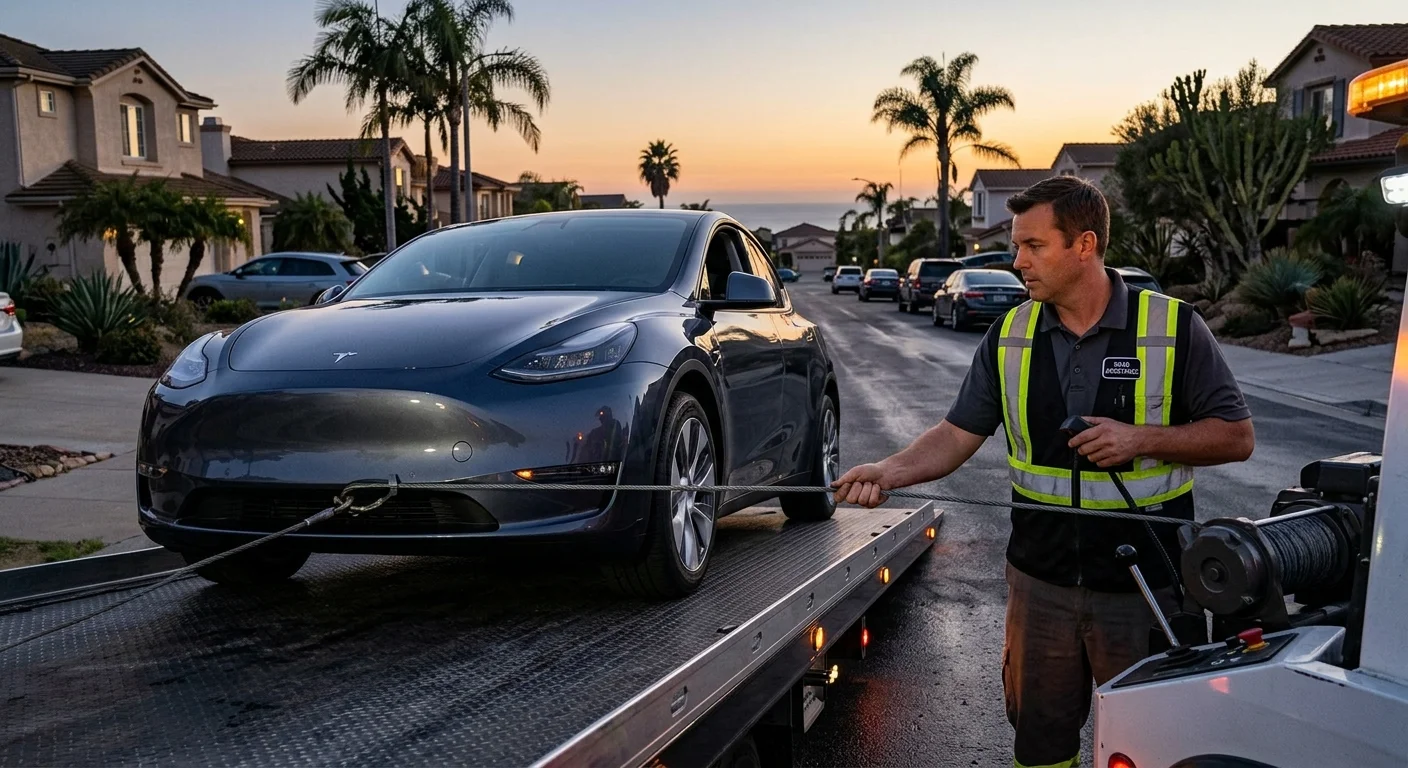
FSP clears the lane. It doesn’t fill the pack.
You’re on the I-5 shoulder south of Irvine. Or you’re stopped on I-405. Or you’re sitting at the Orange Crush on SR-22. A Freeway Service Patrol truck is the free option many drivers expect. That truck’s job is traffic, not Tesla service. It moves a disabled vehicle out of the live lane. It takes the car to a designated CHP drop zone. It doesn’t plug into your charge port. It doesn’t jump the 12V. It doesn’t turn on Transport Mode.
Ask the FSP driver where that drop zone is, and write it down. After you leave the shoulder, you still have a Tesla that can’t drive. You still need a Tesla-safe flatbed, or a charge at the car.
Toll roads sit outside that playbook. Published FSP coverage skips SR-241. If you’re empty there, don’t wait for a patrol. Stay with the car and make a different call. Our note on an empty pack on SR-241 covers that stretch.
Figure out which battery actually failed
A black Tesla screen isn’t a diagnosis. The 12V battery runs the computer, the locks, and the display. When that battery is flat, the car looks fully dead. The high-voltage pack can still hold range. Tesla’s running-out-of-range notes also warn the other case. An exhausted pack can starve the 12V. Then the car needs external 12V power. The pack won’t accept a charge without it.
Don’t order a wrecker until you know which battery failed. A 12V jump can wake the screen. It can let you enable Transport Mode. It can even let you drive to a charger. That’s only if the pack still has energy. Start with our guide on telling a dead pack from a dead 12V.
This mix-up shows up all over Orange County. California Energy Commission data counted 138,121 Teslas in Orange County. The count is as of December 31, 2025. That’s 65.51% of the county’s 210,842 battery-electric cars. Those owners face this same choice on a shoulder or in a lot.
Why the wheels can’t roll during the tow
A gasoline car can often roll in neutral. A Tesla can’t. The motors sit on the drive axles, usually through a single-speed gear. If those wheels spin while the car is shut down, the motors generate current. That current has no managed path. Heat builds in the motor and the inverter. Regenerative braking can also load the drivetrain during a drag.
So the safe tow isn’t a debate. All four wheels leave the ground. A wheel-lift or a dolly leaves two wheels rolling. That’s enough to damage the motors. A bumper flat-tow is worse. Insist on a flatbed before anyone connects a hook.
Transport Mode when the screen stays dark
Transport Mode releases the parking brake. It lets the wheels roll without driving the motors. On a live car you open Controls, then Service, and you enable it. A dead 12V kills that menu.
The usual field fix is a 12V jump at the front terminals. Those posts sit behind the tow-eye cover. That burst of power is only for the low-voltage system. It doesn’t refill the traction pack. Once the screen wakes, turn on Transport Mode before the winch pulls. If the screen stays dark, tell the operator Transport Mode is off. Don’t let anyone drag the car to test the wheels. Operators we refer can handle a Tesla 12V jump on site.
Say this before the winch cable comes out
Keep the briefing short. The operator should hear every line before equipment touches the car.
It’s a Tesla. It rides on a flatbed. No dolly, and no two-wheel lift.
State whether the 12V is dead. State whether Transport Mode is on. Don’t guess.
Point the wheels straight. Use Tesla’s designated tow points. Don’t wrap chains around control arms or the underbody.
If FSP already dropped you at a CHP zone, say that first. The next truck is a recovery from a lot, not a freeway clear.
If the operator hesitates on any of those points, pause the job. The operators we connect you with handle Tesla roadside rescue.
Charge at the bumper when the pack is empty
Towing is the last move when the car only needs energy. Tesla’s own roadside policy answers a depleted battery with transportation. It doesn’t send a charger to the bumper. Running out of charge isn’t treated as a warrantable breakdown. That paid transport still leaves you in a lot. The car still can’t move.
A better path on many Orange County shoulders is a charge where you sit. Charge Pro OC is a referral line. It matches you with independent local operators. It owns no trucks and employs no technicians. The operator quotes you before work starts and bills you directly.
Operators we refer for out of charge recovery bring 240V Level 2 to the car. Teslas take a native NACS plug. Operators typically add 10 to 20 miles of range. That takes 15 to 30 minutes of charging. That window is charging time. It’s not an arrival time. Enough range gets you off the drop zone and onto a Supercharger you choose.
Federal station data listed 48 Tesla Supercharger sites in Orange County. That’s 861 DC fast ports. Irvine at 1920 Main St lists 40 stalls. San Clemente at 101 W Avenida Vista Hermosa lists 49. Santa Ana at 1008 17th St lists 28 stalls. AFDC rates that Santa Ana site at 325 kW. Tustin at 14661 Franklin Ave lists 36. Confirm an open stall in the Tesla app before you leave the curb. The county map lives on our Orange County EV charging hub.
If you’re already on a freeway shoulder, stay with the car and keep hazards on. See our note on mobile EV charging or a tow. Tesla lists Orange County service centers in six cities. They are Costa Mesa, Buena Park, Santa Ana, Irvine, Anaheim, and Aliso Viejo. Street addresses for those shops weren’t confirmed in this research pull. Check Tesla’s own service locator if a shop tow is truly required. An empty pack isn’t a reason to tow to a service bay first.
Frequently asked questions
How do you tow a Tesla with no power?
Use a flatbed, and enable Transport Mode if the screen will wake. Keep all four wheels off the pavement for the whole move.
What does FSP do with a dead Tesla on an OC freeway?
FSP tows to a CHP drop zone to clear the lane. It won’t charge the pack or jump the 12V. Confirm the drop point before they hook up.
Can you skip the tow and charge on site?
Yes, if the high-voltage pack is the only problem. A 12V jump may also restore the screen. You might then drive to a charger on your own. If you still need a person at the car, we can make a referral.
Charge Pro OC doesn’t tow and doesn’t charge cars. We match stranded EV drivers with local mobile rescue operators. Call (949) 444-0151 and we’ll connect you with an independent local operator. Say if you need a 12V jump, a Level 2 charge, or a Tesla-safe flatbed. That operator quotes you before starting and bills you directly.