Your Orange County apartment stall may have no dedicated 240-volt circuit. A home charging station isn’t tonight’s plan in that case. A 240 volt EV charging station is Level 2 power at a stall you control. On the shoulder, that wall box is still at the building. The backup is a mobile 240-volt source brought to the car.
What a 240 volt EV charging station actually is
The US Department of Energy describes residential Level 2 as 240-volt service. Commercial sites may use 208 volts instead. Voltage is only the start of the rate. The circuit, the hardware, and your car’s onboard charger all matter.
Level 1 is a regular 120-volt household outlet, and it adds energy slowly. Our guide to Level 1 charging for OC driving explains the slower option. A 240 volt EV charging station is the faster home path. It only works when the property can support it.
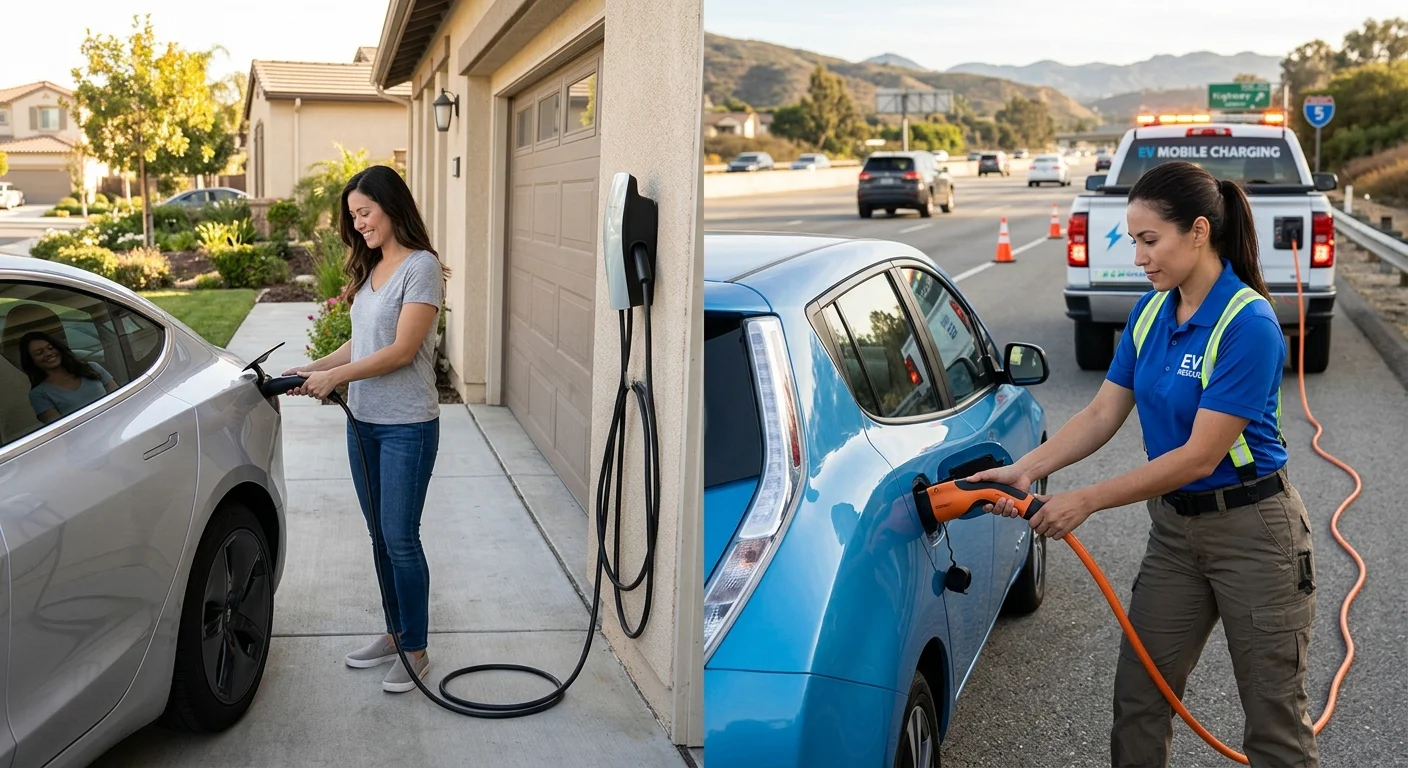
Home Level 2 is a planned session. You park on a known circuit. You pick the car up later with range. Roadside Level 2 is a different job. The car can’t reach a usable stall. An operator brings compatible 240-volt power to that spot.
The operators we connect you with bring a 240-volt Level 2 source to the vehicle. Teslas get a native NACS plug. Other brands use a CCS or J1772 adapter. That session typically adds 10 to 20 miles of range. The 15 to 30 minutes on that figure is charging time. It’s not an arrival time.
Apartment, HOA, and street parking change the math
Orange County has a large battery-electric fleet. The California Energy Commission counted 210,842 battery-electric vehicles here as of December 31, 2025. The ZEV total, including plug-in hybrids and fuel-cell cars, was 260,833. ZEVs were 10.56% of the county’s light-duty fleet.
The county held 12.02% of California’s battery-electric vehicles. It was 8.33% of the state’s light-duty fleet. In 2025, 28.76% of new light-duty sales in Orange County were ZEVs. California sat at 22.93% that year. Don’t read that as a climb that never stops. CEC’s 2026 figures sit below the 2024 peak. The agency also changed its sales method in 2023 and again in 2025.
Tesla accounted for 138,121 of those 210,842 Orange County BEVs. That’s 65.51% of the battery-electric fleet. A Model 3 or Y on a garage circuit can treat 240 volts as routine. An Irvine renter in a shared garage may not control the panel. A Santa Ana street-parker is in the same bind. A Yorba Linda HOA stall may be assigned without a 240-volt feed.
A Huntington Beach or Newport Beach lot is where you parked for the day. The 240-volt station is still at home. An Anaheim theme-park structure can hold the car for hours. South County HOAs in Mission Viejo and Lake Forest may control the garage.
Charge Pro OC doesn’t hang wall stations. We don’t own trucks or equipment. We match stranded drivers with independent local operators. The operator quotes you before work starts, and they bill you directly.
Weigh a wall install against help at the car. Read home charger install versus mobile rescue. One job is electrical work on the property. The other is range where you sit.
Public Level 2 still has to be a stall you can reach
CEC counted 5,600 public Level 2 ports in Orange County as of December 31, 2025. Public DC fast ports were 1,475. Public ports totaled 7,095. The Orange County charging hub is the map for those city pages.
The ratio to keep is simple. Orange County had 36.8 ZEVs per public port. The state had 24.4. More EVs share each public plug here than in California as a whole. An Irvine apartment charger that’s taken is a stop, not a theory. A workplace unit that’s offline is the same problem. Our Irvine roadside guide covers that apartment-stall case.
Tesla Superchargers are on the public map. AFDC listed 48 Tesla Supercharger sites in Orange County. Those sites hold 861 DC fast ports. Irvine has 40 stalls at 1920 Main St. Garden Grove has 32 stalls at 12891 Harbor Blvd. San Clemente has 49 stalls at 101 W Avenida Vista Hermosa. Those sites help if the car can still drive there.
Tesla holds 59% of the county’s public DC fast ports in AFDC data. Electrify America, EVgo, and ChargePoint fill in other sites. Newport Beach’s Fashion Island has 8 Electrify America DC fast ports. That site is at 401 Newport Center Dr. Rancho Santa Margarita’s Plaza Antonio has 14 EVgo DC fast ports. Name the site you can actually reach.
Tesla’s published roadside policy answers a depleted pack with transportation. It doesn’t send charging to the car. Running out of charge isn’t treated as a warrantable breakdown. Tesla’s Model Y manual notes a further catch. Once range is gone, the low-voltage battery can lose support. The high-voltage pack may need external power before it can charge. Confirm the current roadside wording on Tesla’s site before you rely on it.
A home 240-volt station is a property project
A home 240 volt EV charging station needs a space you control. It needs hours on the circuit, not a quick curb stop. It needs a licensed electrician to judge the panel. A dryer outlet in the garage isn’t a plan by itself. The branch circuit, the panel, and household load all have to fit the equipment.
No single Orange County permit path was confirmed in this research. Cities write their own rules. Confirm forms with the building department that serves your address. Anaheim, Irvine, Santa Ana, Costa Mesa, and Huntington Beach don’t share one counter. Ask the city that has the parcel, because requirements change.
A panel conversation belongs to an electrician. A stranded car belongs to a rescue operator. Don’t mix those calls, because tonight’s empty pack doesn’t wait on a permit window.
When the car is already stopped
A wall station stays on the house. It can’t reach a car on the 91, I-405, I-5, or SR-22. A cord on a nearby building isn’t yours to use. You need the owner’s okay, a matching plug, and a sound circuit.
Stay with the vehicle if you can do that safely. Keep people away from traffic. Then call for an operator who can assess a charge on site.
Tell them the make, model, and year. Note remaining range and the connector on the car. Say whether it can shift or steer. Say whether you’re on a shoulder, in a garage, or behind a gate. Access changes the job in Lake Forest, Coto de Caza, and Ladera Ranch.
A dark car isn’t always an empty pack. Teslas and other EVs still run a 12-volt system for computers and contactors. If the car is silent but last night’s charge looked fine, say so. Operators can jump or replace a dead 12-volt battery on site.
Don’t assume adding 240 volts will clear a fault. The car may reject charge or show a warning. Check the owner’s manual for the exact message. Report that wording to the operator.
Smoke, fire, or a crash is a 911 call first. Don’t treat that as a charging job.
Mobile 240 volts, or a tow
Mobile 240-volt charging fits when the car can accept power where it sits. The goal is enough range to reach a fixed stall. It isn’t a full overnight fill. Read EV charging levels when you’re stranded for that roadside breakdown.
Mobile EV charging is the referral path for an on-site Level 2 session. If the pack is empty and the car can’t roll, start with out-of-charge recovery. Charge Pro OC makes the introduction. The matched operator does the physical work.
Towing may be the better move if the car rejects charge. It may also fit if the stop is too exposed for a session. The operator can talk through a public stall or a Tesla site. Tesla Service Centers operate in Costa Mesa, Buena Park, and Santa Ana. Others sit in Irvine, Anaheim, and Aliso Viejo. Confirm the current address on Tesla’s findus list before you send a car there.
Ask what plug they’ll use. Ask what range they expect, and what they’ll bill. No countywide price was confirmed. The operator and the stop set the number, so confirm it before they start.
When to call
Call when the car can’t reach a usable stall. You need an operator to assess a charge or a tow. We connect Orange County drivers with licensed, independent local rescue operators. Call (949) 444-0151 and we’ll connect you with a local EV rescue operator.