If your EV sits on an Orange County shoulder, charging levels decide the next useful move. You need Level 2 miles at the car, not a Level 1 trickle. DC fast charging is the Supercharger-class stall you still have to drive to. The level, the plug, and whether the car can accept power all matter.
What each level can do when you can’t move
Rank the three levels by whether they can get you moving.
Level 1 is a household trickle
Level 1 uses 120-volt AC from a common outlet. The Department of Energy treats it as the slowest home and public option. The California Energy Commission counted 20 public Level 1 ports in Orange County. That’s as of December 31, 2025. That’s overnight parking math, not a shoulder plan. DOE planning figures often cite about five miles of range per charging hour. Eight hours might cover a short local hop in a midsize EV. Battery size, charge state, and temperature still change the result. Those are planning numbers, not a promise for your car. A shoulder is the wrong place to wait on that pace. If you’re weighing a wall plug at home, start with our Level 1 charging guide.
Level 2 is the 240-volt range you can use
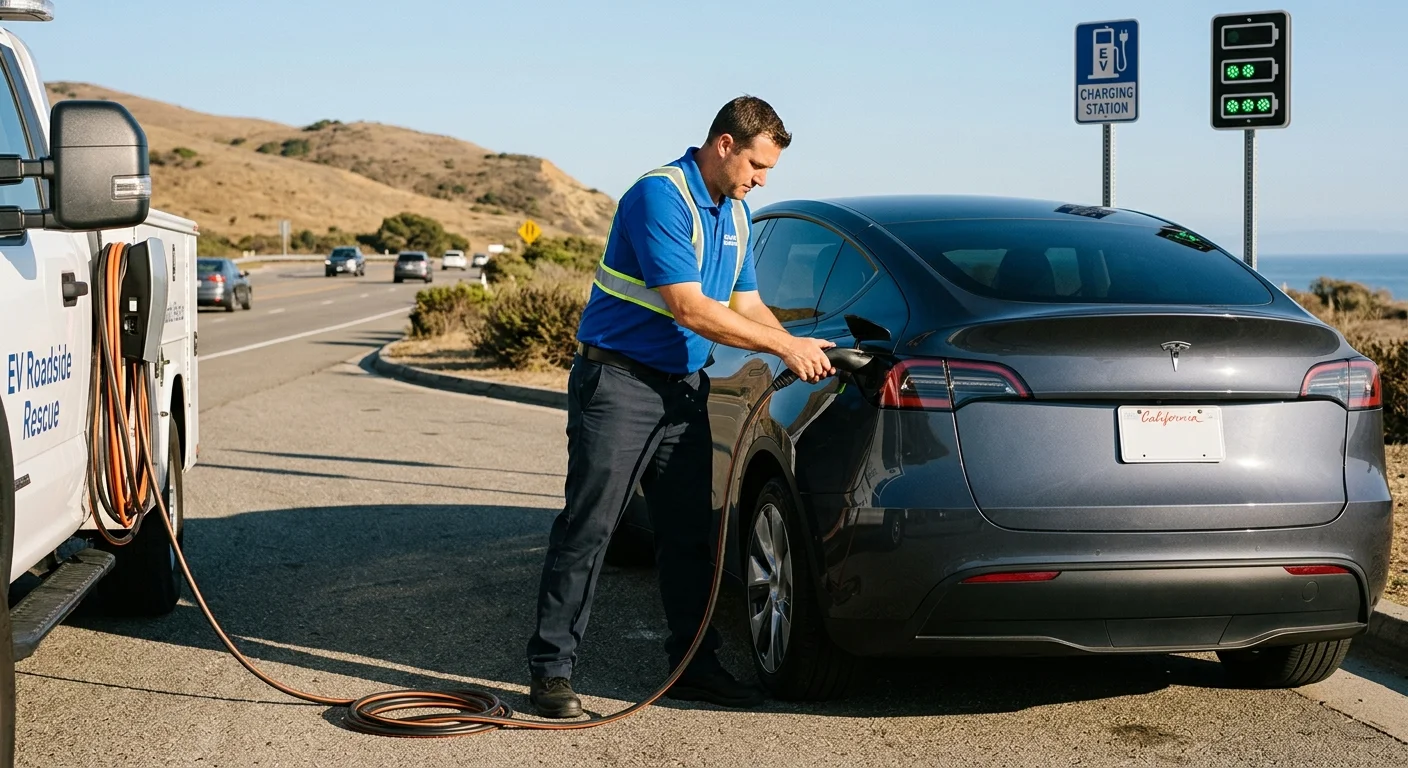
Level 2 uses 240 volts at a house. Many commercial buildings use 208 volts. It’s still AC, and the car converts it onboard. This is the level that matches a stranding. The Energy Commission counted 5,600 public Level 2 ports in Orange County. That’s year-end 2025. Independent operators we connect you with bring a 240-volt Level 2 source to the bumper. They typically add 10 to 20 miles of range. That’s in 15 to 30 minutes of charging. That window is charging time, not an arrival time. Native NACS covers Tesla, and CCS or J1772 adapters cover most other EVs. You’re not filling the pack. You’re buying enough miles to reach a stall you already chose. Home Level 2 is a separate decision. See 240-volt charging at home, or on the shoulder.
DC fast charging is a stall you have to reach
DC fast charging feeds high-power DC straight into the pack. Tesla Superchargers sit in this class. So do Electrify America, EVgo, and the other public networks. The Energy Commission counted 1,475 public DC fast ports in Orange County. That’s as of December 31, 2025. Federal AFDC data shows 48 Tesla Supercharger sites in the county. Those sites list 861 Tesla DC fast ports. Tesla holds 59% of Orange County’s public DC fast ports. The Irvine Supercharger at 1920 Main St has 40 stalls. San Clemente’s site at 101 W Avenida Vista Hermosa has 49. Garden Grove’s Tesla stalls at 12161 Valley View St list 500 kW as max connector power. The Supercharger at 555 The Shops at Mission Viejo is Tesla-listed at 72 kW. It has 10 stalls. A kW label on a map is not your session. The car and the stall still negotiate. Charge state, weather, and pack size change the result. None of that DC power arrives as a portable Supercharger. If you can’t drive to the stall, DC fast doesn’t help yet.
Why Orange County’s mix makes this choice feel local
Orange County had 210,842 battery-electric vehicles on the road as of December 31, 2025. ZEVs totaled 260,833. That’s 10.56% of the county’s light-duty fleet. Orange County holds 12.02% of California’s battery-electric vehicles. It’s 8.33% of the state’s light-duty fleet. Public ports totaled 7,095. That’s 36.8 ZEVs per public port. Statewide, the same math is 24.4. More cars share each plug here. A busy Supercharger row can leave you sitting. So can a stall that won’t start. That happens when the plan assumed you’d roll in. Tesla accounts for 138,121 of those BEVs, or 65.51% of the county’s battery-electric fleet. Connector talk has to start with NACS, then everyone else.
Coastal stalls and inland stalls are the same equipment class. They still don’t help if the car can’t roll. Huntington Beach has a Supercharger at 6913 Warner Ave with 24 stalls. Yorba Linda has two smaller Tesla sites on Yorba Linda Blvd, eight stalls each. Newport Beach has an Electrify America site at 401 Newport Center Dr with eight DC fast ports. Those are places you drive to after you have miles. For the county overview, use EV charging in Orange County.
The plug still has to match the car
A charging level doesn’t prove a fit by itself. The inlet, the cable, and the car’s charging system have to agree.
J1772 is the older AC plug on many non-Tesla EVs. J3400, also called NACS, is Tesla’s AC and DC family. CCS adds DC contacts to an AC inlet. CHAdeMO still appears on some older Nissan packs. Adapters exist, and they’re not universal. Tell the operator your make, model, and port. The operator confirms equipment before a cable goes in. Don’t treat a familiar-looking plug as approved. Check the owner’s manual.
Tesla’s share of new Orange County ZEV sales was 44.7% in 2025. It was 56.4% in the first half of 2026. Plenty of Hyundai, Kia, Ford, Rivian, and Chevy packs share the same lots. EVgo at 801 Pacific Coast Hwy in Seal Beach has four DC fast ports. Electrify America at 440 N Euclid St in Anaheim has ten. Those are stalls you drive to. They don’t replace a truck at the bumper.
What a mobile truck is, and isn’t
A mobile EV rescue truck is Level 2 on wheels. It’s not a DC fast island. The operators we refer bring 240-volt power to the car. They can jump or replace a dead 12-volt battery on site. They handle Tesla and every major EV brand. Charge Pro OC doesn’t own trucks. We don’t employ technicians. We don’t hold a contractor license for the work. We match stranded drivers with independent local operators. The operator quotes you before starting, then bills you directly. The pros we connect you with are licensed.
What’s an EV charging truck, and how mobile rescue works here walks through the gear. For a charge at the car, start with mobile EV charging.
An empty traction pack needs energy. A silent 12-volt can look identical and need a jump instead. Dashboard text and the manual beat guessing. Tesla’s Model Y owner’s manual notes that once range is gone, the low-voltage battery can lose support. It may need external power before the high-voltage pack can charge. That’s a technical limit, not a service promise.
If you’re already on a freeway shoulder, stay with the car in a safe spot. Out of charge on an Orange County freeway covers that sequence. Don’t walk cables across live lanes. If the car is a traffic hazard, call the agency that handles that stretch.
When a Level 2 session at the car fits
Mobile Level 2 fits when the traction battery is empty. The car also has to accept the operator’s connector. The operator needs a safe working position. Driveways, surface lots, and garages are usually simpler than a narrow shoulder. Anaheim theme-park structures add access rules. So do Buena Park auto-row lots and Costa Mesa garages. Tell the operator the gate, the structure, and whether you can stay with the car.
Give the make, model, displayed battery state, and exact location. Mention a charge-port type if you know it. Ask the operator to confirm method, connector, and the miles they expect to add. Charge Pro OC doesn’t set prices. We don’t warrant the work. Terms come from the operator you hire.
Public Level 2 at a mall is still a stall you have to reach. Same for a workplace plug. Tustin’s Superchargers at 14661 Franklin Ave list 36 stalls. That’s a destination once you have range. It doesn’t help a car that already stopped. The DOE Alternative Fuels Data Center keeps the primary charging-level specifications used in this explainer.
When the car may still need a tow
Transport enters when the car won’t accept a charge. It also fits when the port won’t release, or the operator can’t reach it safely. A 500 kW stall rating doesn’t wake a car that refuses to charge. Follow that model’s tow points in the manual. Don’t copy another EV’s loading method. Out-of-charge recovery is the referral path. Use it when charging and a tow both have to stay in play.
If a spec can’t be confirmed from your manual, say so on the call. Ask the operator to check it against the vehicle. That’s safer than treating a generic level chart as model-specific advice.
If the pack is empty and the car is reachable, use Level 2 at the bumper. That’s the tool that matches an Orange County shoulder. Call (949) 444-0151 and we’ll connect you with a local operator. The operator confirms fit, quotes the job, and handles the charge.