The Ioniq 5 is at 12 percent in a Westminster lot, and the J1772 charger near me pin is a stall you cannot use. Someone is already on the handle, or the screen is dark, or the only free cable is a Tesla NACS plug. Range is still falling while you sit there.
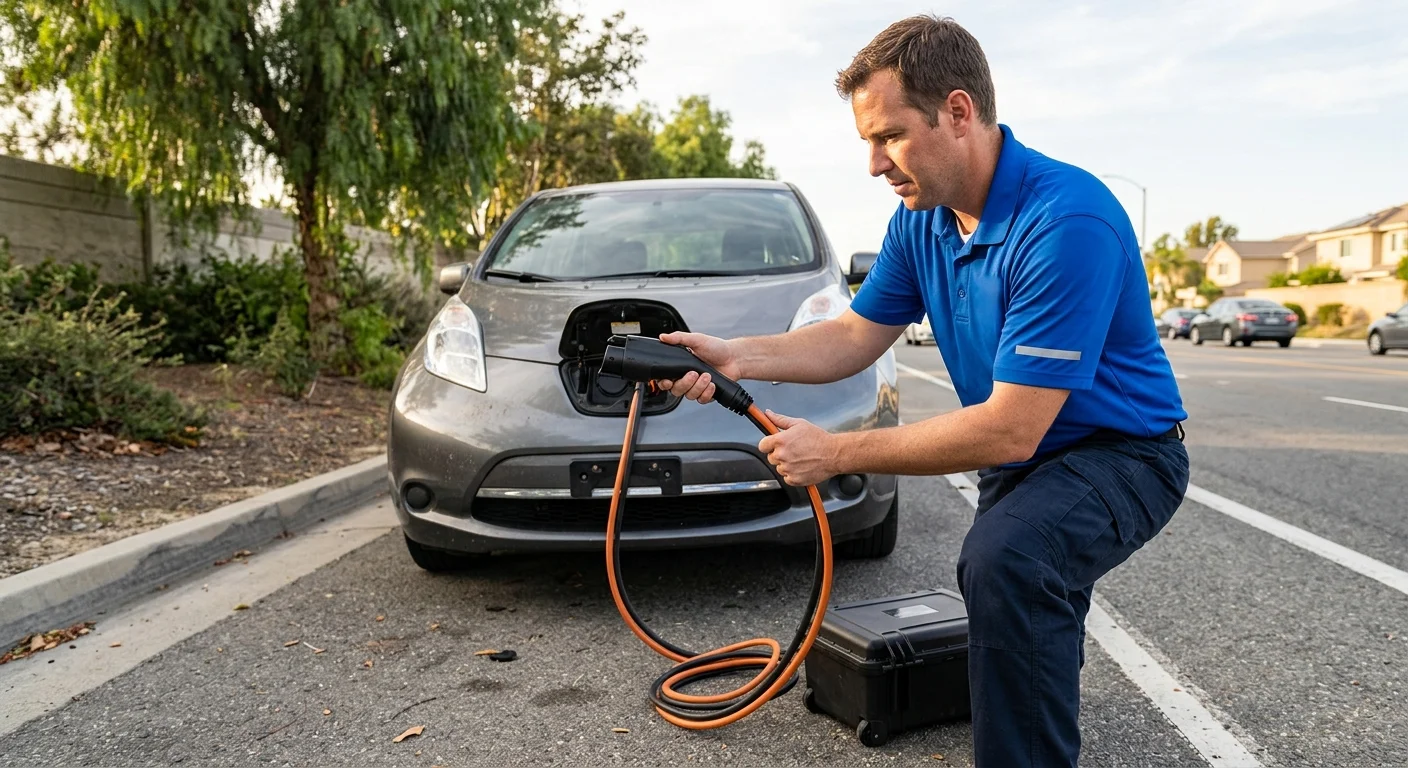
What a J1772 plug is on Orange County stalls
J1772 is the round Level 2 AC plug on most public and workplace stalls in the United States. It is not a Tesla Supercharger handle. It is not CCS by itself, though CCS Combo 1 uses the same J1772 face and adds two DC pins below. If you drive a Hyundai Ioniq 5, the Ioniq 5 charger port is usually that combo inlet: J1772 for AC, CCS for DC fast. A Kia EV6, Ford Mustang Mach-E, and Nissan Ariya follow the same pattern unless the car was built or converted for NACS.
On Orange County shopping-center islands, that J1772 handle is the slow, common cable. The California Energy Commission counted 5,600 public Level 2 ports in the county as of December 31, 2025, plus 1,475 public DC fast ports, for 7,095 public ports in all. Those Level 2 numbers are the layer a J1772 search actually hits. The Commission does not publish a J1772-only breakout in the figures we can stand behind. Treat PlugShare and the car’s own map as the live check. A screenshot from this morning is not.
Tesla Superchargers here are a different plug. The U.S. Department of Energy’s Alternative Fuels Data Center lists 48 Tesla Supercharger sites and 861 DC fast ports inside Orange County, all Tesla network. Tesla holds 59 percent of the county’s public DC fast ports. A search for ev chargers near me that lands on a Supercharger pin is the wrong connector unless you already have a working adapter and a stall that accepts it. Superchargers do not become J1772 stalls because an app grouped them under one pin.
Workplace and grocery Level 2 posts are where the J1772 handle still lives. They also sit occupied for hours. The Alternative Fuels Data Center describes public and workplace Level 2 as about 25 miles of range per hour, with output from 2.9 to 19.2 kW. A 240-volt, 40-amp session is 9.6 kW, the bottom of that public band. That helps when you have a free stall and time. It is not a five-minute fill during a grocery run.
J1772 is not obsolete. It is the Level 2 language most non-Tesla cars still speak on AC. NACS is the plug conversation on a lot of new DC gear. Mixing those two problems is how you burn the last 15 miles hunting the nearest charging station that cannot accept your port.
CCS, NACS, and adapters when you’re already low
CCS is the DC fast half of that combo inlet. NACS is the Tesla plug, the one on a Supercharger stall and on newer cars that shipped with it. J1772 is not Tesla. If the car in front of you is on a Supercharger cable, you are not looking at a spare J1772 handle. You are looking at a different standard.
Orange County still has a Tesla-heavy battery-electric fleet. As of December 31, 2025, Tesla accounted for 138,121 of 210,842 registered battery-electric vehicles here, 65.51 percent of that fleet. The rest of those cars are the Ioniq, EV6, Mach-E, Ariya, and similar pack that still need J1772 for Level 2 and CCS for most public DC. Searching super charging station near me from that driver’s seat is a Tesla map, not your map.
One Orange County exception is worth naming because it is real. Tesla’s Lake Forest Magic Dock at 24372 Rockfield Blvd is logged as CCS1 plus NACS, 16 stalls, max 325 kW, AFDC open date August 28, 2026. That site is a CCS door on Tesla hardware. It is not a countywide J1772 network. It also does not help you if you are already too low to climb Moulton or the 5 to reach it.
Adapters belong in the trunk before the gauge is in the teens. Once you are already low, an adapter you do not have is not a plan. An adapter you have never tested is not a plan either. Do not spend the last miles driving to a Supercharger on the hope that a handle, a Magic Dock, or a borrowed dongle will appear. Confirm the connector on PlugShare. Confirm it again in the car’s own map. Then decide whether that pin is still in range.
DC fast in this county is also split by network, not by wish. Excluding Tesla, AFDC counts 175 DC fast stations and 591 DC fast ports. Electrify America, EVgo, EVCS, ChargePoint, and the smaller networks sit in that remainder. Those CCS stalls fill too. A CCS pin that is three miles farther and actually open beats a J1772 pin you are staring at while it stays occupied. The U.S. Department of Energy explains the connector families. Your car’s screen tells you which one you can use tonight.
Full, offline, or the wrong connector: the usual miss
The usual miss is not that Orange County has no plugs. It is that the pin and the handle disagree. The stall is full. The unit is offline. The free cable is NACS and your inlet is CCS. Or the J1772 handle is free and you needed DC because you only have 20 minutes, not two hours.
Start with the live apps, not a memory of this lot from last month. Open PlugShare. Open the car’s own map. If they disagree, believe the more pessimistic one until you are looking at the handle. Manufacturer apps lag. Third-party maps lag. A ChargePoint stall at a dealership can show available while the screen is dark. That dead-unit path is a different problem, covered in our note on a public charger that will not start. This page is the connector miss: the hardware in front of you is the wrong shape, or it is the right shape and someone else is on it.
Pressure on those stalls is not a vibe. It is arithmetic. Orange County had 260,833 zero-emission vehicles and 7,095 public ports as of December 31, 2025, or 36.8 ZEVs per public port. California sat at 24.4. More cars share each public handle here than the state average. Level 2 sessions also last. A grocery J1772 can hold a car for the whole shop. You will not talk that driver off the cable.
Do not idle in the lane waiting for courtesy. If you are on a freeway shoulder, California Vehicle Code 25251 requires hazard lights when the vehicle is disabled on the roadway and equipped to flash them. CVC 21718 lets a genuinely disabled vehicle stop on a freeway when help has been summoned. CVC 22651(b) still allows immediate removal if the car obstructs traffic or creates a hazard. After four hours on a freeway right-of-way, CVC 22651(f) allows a tow even if you are sitting there. That is permission to tow, not a grace period.
OCTA’s Freeway Service Patrol will not charge the pack. FSP can jump a 12-volt accessory battery, change a tire, or tow to a CHP-designated drop zone, during published hours, on patrolled segments, and not guaranteed. Caltrans FSP assist codes include out of gas. They do not include out-of-charge EV charging. A jump restores 12-volt accessories. It does not fill a traction battery. Sitting at a full J1772 island in a mall is not an FSP call. It is a connector and occupancy problem.
If the next CCS or J1772 pin is still in range, go there. If it is not, stop spending range on a maybe. The choice between hunting a rapid stall and calling for a charge at the curb is the other half of this, and we wrote that split as rapid charger near me or mobile rescue. Stay on the plug you actually have.
A matched operator for a non-Tesla at the curb
When the stall is full, offline, or the wrong connector, and the next pin is out of range, the car needs energy where it sits. Charge Pro OC is a referral service. We connect you with a licensed, independent local operator. We do not charge the car, own the truck, or set the price. The operator quotes and bills you directly.
That visit is a Level 2 rescue charge, not a Supercharger session and not a tow as the first move. A typical rescue puts 10 to 20 miles of range on the pack in 15 to 30 minutes of Level 2 charging. That window is charging time, not a promise about when someone arrives. Ten to 20 miles is enough to reach a confirmed open J1772 or CCS stall, or to get home if home is the closer plug. It is not a full pack.
The operator has to match the car you actually drive. A Tesla-only plan does not help an Ioniq 5 inlet. Non-Tesla EV rescue is the path for that inlet, and the longer local read is non-Tesla EV rescue in Orange County. Mobile EV charging is the charge-at-the-curb service itself. Tell the operator the make, the inlet, and what the stall in front of you actually is. J1772 occupied, CCS dark, NACS only, or no public handle in sight. That detail is the job.
Do not wait for a manufacturer roadside program to invent a plug. Tesla’s roadside policy answers a depleted battery with transportation, not on-site charging, and that transport is paid when the car simply ran empty. Hyundai, Kia, Ford, and Nissan each have their own roadside rules. None of them turn a full grocery J1772 into an open stall. If you already know the next public handle is full, calling for a matched operator is the recovery, not another loop around the lot.
Keep hazards on if you are stopped in a travel lane. If you are in a private lot, read the tow signage. CVC 22658 sets the sign rules for private-property tows. A car occupying a charging stall without charging can still be treated as parked. Move to a lawful space if you can still roll. Then stay with the car until the operator you were connected with takes over the charge.
Thin maps: Stanton, Placentia, and the canyons
A J1772 search assumes the next pin is close. In parts of Orange County it is not, or the close pin is a Tesla Supercharger that does not take your inlet.
Stanton has no Supercharger inside town. The nearest Supercharger is 2.3 straight-line miles to Garden Grove at 12161 Valley View St, a Tesla site. That is geography, not a slight. For an Ioniq or Mach-E already low on Beach or Katella, a Tesla pin 2.3 miles away is still the wrong connector. Check PlugShare for a J1772 or CCS handle you can actually use. If that handle is full or out of range, you are in the same curb problem as a mall stall downtown. Local notes for that grid sit on our Stanton EV roadside page.
Placentia is the same shape on the north-county side. No Supercharger sits inside town. The nearest is 2.4 straight-line miles to Yorba Linda Boulevard, again Tesla hardware. A search for the nearest charging station from a low Ariya on Chapman can look dense on a Tesla-weighted map and still leave you without a J1772. Confirm the plug. Then decide. The Placentia-specific roadside read is here.
The canyon box is thinner still. Operational Supercharger deserts in this county are the canyons at 7 to 9 miles, plus Laguna Beach, Coto de Caza, and Rancho Santa Margarita at 5-plus miles over hills. Silverado is 9.0 straight-line miles to the Irvine Walnut Superchargers. Trabuco Canyon is 7.3 miles to Lake Forest Muirlands. Modjeska is 7.0 miles to the same Lake Forest site. Those miles are straight-line from Census place centroids, not road miles, and the road miles climb. Silverado sits at 1,672 feet, Trabuco Canyon at 1,422, Modjeska at 1,313, USGS 3DEP. A J1772 grocery stall in Lake Forest does not help you if you cannot make the grade with what is left in the pack.
Heat takes more of that pack. AAA’s 2026 dynamometer study found an 8.5 percent loss of range when running air conditioning at 95 F. Inland north county runs hotter than the coast. Anaheim’s NOAA 1991 to 2020 July normal is 86.8 F, August 88.8 F. A low Ioniq 5 on a Saturday in August does not have spare range for a second wrong pin.
If you are already in Stanton, Placentia, or the canyons with a full or dead J1772 and no CCS in range, stop the scavenger hunt. Stay with the car. Call for a matched operator. The next map pin is not a plan once you cannot reach it.
When to call us
Call when the J1772 or CCS stall in front of you is full, offline, or the wrong plug, and the next confirmed handle is out of range. That is a curb charge for a non-Tesla, not another loop around the lot. Call us at (949) 444-0151 and we’ll connect you with a local EV rescue operator.