You typed nacs ev charger near me because a pin looked close. In Orange County that pin is often a Tesla Supercharger, and the handle is the slim NACS plug. If the stall is full, offline, or built for an inlet you do not have, the next move is a live map check, then a charge at the car.
What a NACS plug is on OC public stalls
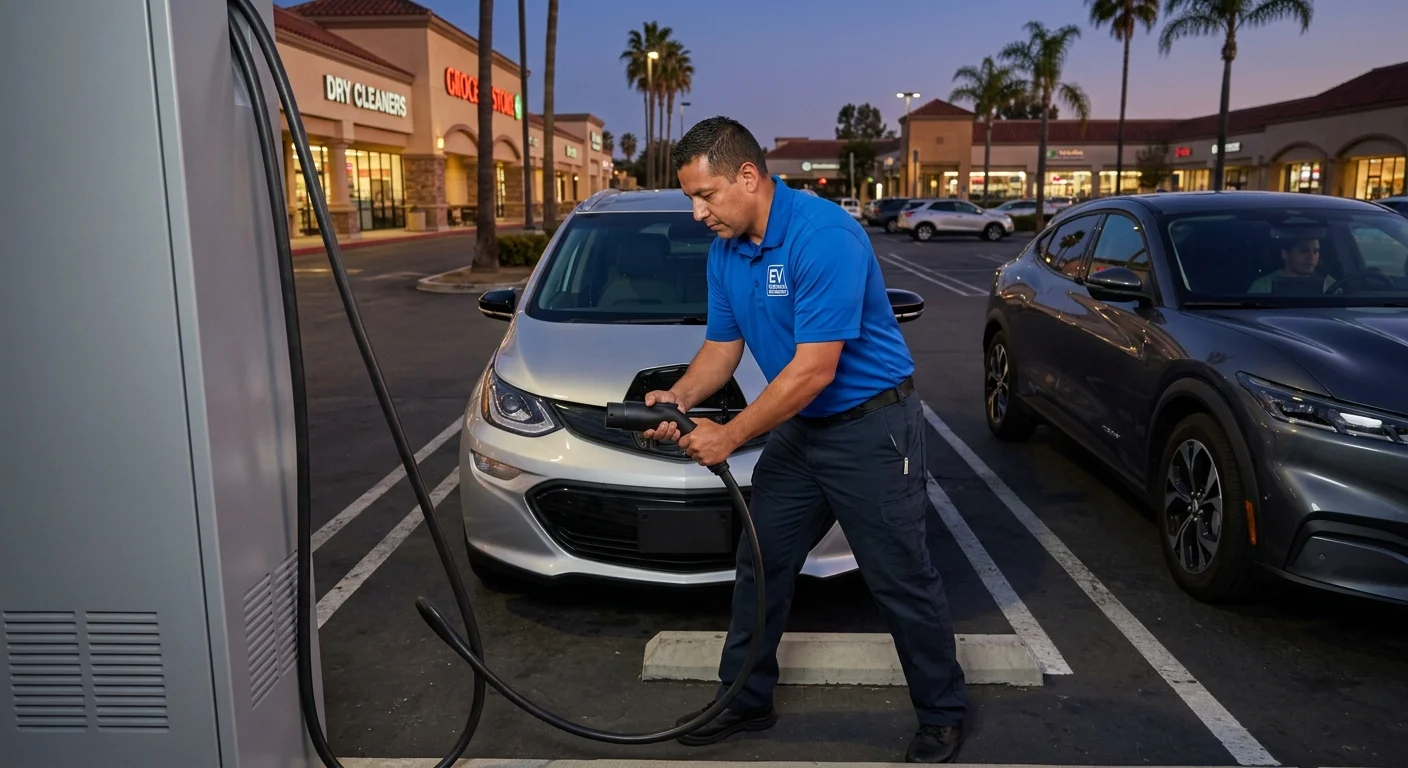
NACS is Tesla’s North American Charging Standard plug. Superchargers use that connector. A search for a Tesla charger and a search for a NACS charger usually mean the same handle on the same stall. A Supercharging station near you in Irvine or Anaheim is that Tesla network.
Orange County is a Tesla county. As of 2025-12-31, Tesla accounts for 138,121 of 210,842 battery-electric vehicles registered here. That is 65.51 percent of the county BEV fleet, per the California Energy Commission. Teslas are 5.59 percent of all Orange County light-duty vehicles. The county sits 6.4 percentage points more Tesla-concentrated than California as a whole.
Public DC fast charging follows that fleet. AFDC counts 223 public DC fast stations and 1,452 DC fast ports in the county. Tesla Superchargers make up 48 sites and 861 of those ports. Tesla holds 59 percent of Orange County’s public DC fast ports. The rest of the DC fast map is 175 stations and 591 ports.
Anaheim has seven Supercharger sites, the most of any Orange County city. Irvine has six. Irvine Main at 1920 Main St lists 40 stalls. San Clemente’s west Vista Hermosa site lists 49, the largest Tesla stall count AFDC shows here. Those figures describe density. They leave open which cable is free at 6 p.m. on a Friday.
A NACS handle on a Supercharger is DC fast. A public Level 2 pedestal is a slower job. AFDC puts public and workplace Level 2 at roughly 25 miles of range per hour. Supercharger power in AFDC is a maximum connector kW, with no Tesla generation label. Treat the map’s kW as a ceiling, and confirm speed at the stall.
Confirm the plug and the status on three live tools: Tesla’s map, PlugShare, and your car’s own map. Yesterday’s screenshot is stale. For how Level 1, Level 2, and DC fast differ once you are already low, see EV charging levels when you are stranded. The U.S. Department of Energy keeps a plain overview of how electric vehicles charge.
Adapters, Magic Dock, and mixed lots
Tesla Superchargers were built around NACS. Some sites add Magic Dock hardware so a CCS1 car can latch without a stick adapter. AFDC lists a Magic Dock Supercharger at 24372 Rockfield Blvd in Lake Forest: CCS1 plus NACS, 16 stalls, max 325 kW, open date 2026-08-28. Check Tesla’s map before you aim at Rockfield. Hardware and access rules change. AFDC is an inventory, not a live occupancy feed.
Check Tesla’s map and your carmaker’s charging page for that site and that car. Tesla publishes access on its own NACS and Supercharger pages. Your carmaker publishes which adapter, if any, that model may use. If that page does not name a CCS-to-NACS adapter for your car, the rule could not be confirmed here. Skip a forum photo as proof.
Mixed lots are common along the 405 and the 5. A mall pad may sit next to a Supercharger, an EVgo island, and a ChargePoint post. EVgo has 30 stations and 131 DC fast ports in the county. Electrify America has 30 stations and 138. ChargePoint’s DC fast footprint is 71 stations and 76 ports, often a single plug at a dealership or office. Those are separate networks with separate apps. A NACS charger near me pin and a CCS charging near me pin can share a parking field and still refuse each other’s cars.
South of Irvine, a CCS driver who cannot use a Tesla-only row has a large non-Tesla option at Electrify America in Capistrano Beach, 25825 Las Vegas, 12 DC fast ports. That is the largest non-Tesla DC fast site AFDC lists in south Orange County. It still needs a live-map check.
If you drive a non-Tesla and the only open fast stalls are Tesla NACS with no Magic Dock, the bind is the inlet. Non-Tesla EV rescue is the path when the lot will not take your plug.
When the stall is NACS and your car is not
You found the Supercharger. The handle is NACS. Your port is CCS, or J1772 on a Level 2 car. The metal in your hand still has to match the metal on the car.
For DC fast, CCS and NACS are different shapes. Some cars now ship with a NACS inlet. Many still use CCS. Tesla’s access program and Magic Dock exist because of that split. Confirm in the Tesla app or Tesla’s map that your make is accepted at that site. Confirm in your car’s app that the car will start a session on that network.
J1772 is the older AC plug on public Level 2. If the open stall is J1772 and you expected NACS DC fast, the session will crawl. That wrong-plug, stall-full problem has its own write-up: how OC drivers recover when a J1772 stall is full. The NACS version of the same night is a Tesla row with every cable in a Model Y, or a NACS-only post your CCS car cannot use.
Stay out of a long circle of the lot as the car goes dark. If range is already gone on a Tesla Model Y, the owner’s manual notes that the low-voltage battery can lose support and need external power before the high-voltage pack will charge. That is a Tesla note. Other brands publish their own dead-pack behavior. Read the manual you have.
A CCS car in a NACS-only row has three honest options. Use an adapter your carmaker documents, at a site Tesla says will take it. Roll to a CCS network stall you can actually reach. Or stop hunting pins and charge at the bumper. Searching CCS charging near me on the same block can surface EVgo or Electrify America. Those sessions still need the right app, a working stall, and enough range to get there.
If you cannot roll to the next pin, stay with the car. Switch the job from find a NACS stall to charge here.
Full or offline: the usual miss
The usual miss is a stall that looked open on the 5 and is occupied, faulted, or gated when you arrive.
As of 2025-12-31, Orange County had 7,095 public charging ports, per the California Energy Commission: 20 public Level 1, 5,600 public Level 2, 1,475 public DC fast. The county also had 260,833 zero-emission vehicles, about 36.8 ZEVs per public port. California sits at 24.4. Irvine Main, Tustin Franklin at 36 stalls, Garden Grove Harbor at 32, and Santa Ana 17th at 28 stalls still queue on peak evenings. Public ev chargers near me on a Saturday at the Spectrum still mean a wait.
Some places have no Supercharger inside the city line. Laguna Beach is 5.3 straight-line miles from the Mission Viejo Crown Valley Supercharger, over hills. Coto de Caza and Rancho Santa Margarita sit 5.1 miles from Laguna Hills Cabot Rd. Silverado is 9.0 miles from Irvine Walnut. Trabuco Canyon is 7.3 miles from Lake Forest Muirlands. Those are operational Supercharger deserts. Orange to Anaheim Katella is 1.7 miles, a short hop. Inside Rancho Santa Margarita, AFDC lists EVgo at 22351 Antonio Pkwy with 14 DC fast ports, the meaningful fast option inside that Tesla gap.
Garden Grove’s Valley View Supercharger lists a 500 kW max connector and 16 stalls. AFDC’s kW field is a maximum. Treat PlugShare check-ins, Tesla’s in-app status, and your car’s map as the live check. If two of the three say offline, believe them.
A full Supercharger is the same decision as a full rapid stall anywhere else. You can wait. You can aim at the next site with enough range. Or you can stop hunting pins. That comparison is rapid charger near me, or mobile rescue. If you are stopped in a travel lane, hazards on. California’s Move Over law, CVC 21809, covers a stationary vehicle showing flashing hazards. On a freeway, a genuinely disabled car may stop while help is summoned under CVC 21718, and it can be towed sooner if it blocks traffic under CVC 22651.
A matched operator for a curb charge
Charge Pro OC is a referral service. It matches you with a licensed, independent local operator. The brand owns no truck, holds no trade license, and does not plug in your car. The operator quotes you, bills you, and does the work.
Mobile EV charging at the curb is a Level 2 rescue charge. The typical rescue adds 10 to 20 miles of range in 15 to 30 minutes of Level 2 charging. That is charging time. It is silent on when someone arrives. AFDC’s roughly 25 miles of range per hour is the same class of equipment.
Use it when the NACS row is full, the Magic Dock is down, your adapter is unlisted, or you cannot reach the next pin. Tesla roadside assistance answers a depleted battery with transportation. That transport is paid. Running out of charge sits outside Tesla’s warrantable breakdown coverage. Tesla’s Santa Ana service page lists roadside at 877-798-3752. OCTA’s Freeway Service Patrol can jump a 12V and tow to a CHP drop zone on patrolled segments during published hours. FSP has no out-of-charge EV charging category. A jump-start restores a 12V accessory battery. The traction pack stays empty.
A curb charge keeps the car where it died. A Costa Mesa structure. A Huntington Beach lot after a beach day. A canyon shoulder you should leave if you can do it safely. The matched operator’s price is theirs. The brand does not set it.
If the pack is empty and the car will not wake, say that when you call. A Tesla may need 12V support before the high-voltage pack will take a charge. The operator on the other end of the referral decides what they can do on site.
When to call us
When the live map still shows a NACS stall you cannot use, and range will not cover the next CCS or Supercharger pin, stop hunting pins. That is a curb-charge job for a matched local operator. Call us at (949) 444-0151 and we’ll connect you with a local EV rescue operator.