When an electric car died on an Orange County road, name the failed battery first. A dead 12-volt system and an empty traction pack look alike from the curb. They’re not the same job, so the next call has to match the failure. On listed county freeways, the published freeway service patrol can jump a 12V. That truck doesn’t refill an empty pack.
The word died hides two different cars
One driver still has screens and a 0% warning. Another has dark glass, dead locks, and a silent app. Both cars sit still, but only one of those stories is an empty driving battery.
The California Energy Commission published the 2025 fleet count. Orange County had 210,842 battery-electric vehicles as of December 31, 2025. Teslas were 138,121 of them, or 65.51% of the county’s BEV fleet. Tesla’s own roadside policy answers a depleted pack with transport. It doesn’t send a charger to the car.
Read the dash as written, then report it without a guess. If a percent is showing, say that number. If a warning is on screen, read it word for word. If the screens are black, say that too. Note whether the car quit while moving, or refused to wake after a park.
Our guide to a dead pack versus a dead 12V helps you sort the clues. Your owner’s manual still rules the actual steps.
FSP can jump a 12V, not refill a pack
Orange County publishes a freeway service patrol on listed freeway stretches. On those shoulders, that truck can jump a 12V. That’s a real option when the small battery is the problem.
It’s the wrong wait when the traction pack is empty. FSP doesn’t bring a 240-volt source, and it doesn’t add range. A current beat-by-beat list wasn’t confirmed. Check the published FSP map for your stretch before you wait. Don’t assume the next truck is a charger. Published FSP coverage skips the toll roads. If you’re empty on SR-241, a patrol truck still won’t refill it. See our note on what the freeway patrol is for. There’s a separate empty-pack note for SR-241 too.
Name the direction if you’re on I-405, I-5, or the 91. Do the same on SR-22 at the Crush, and add the nearest exit. Westbound 22 at the Crush is a usable report. A vague inland pin isn’t. Stay out of live lanes. If the scene is unsafe, call emergency services first.
Santiago Canyon Road, Ortega Highway, and Laguna Canyon Road aren’t freeway shoulders. Grades eat range on those climbs. Patrol coverage is a published freeway product. Don’t assume the same truck on a canyon two-lane.
Charge the car when the pack is empty
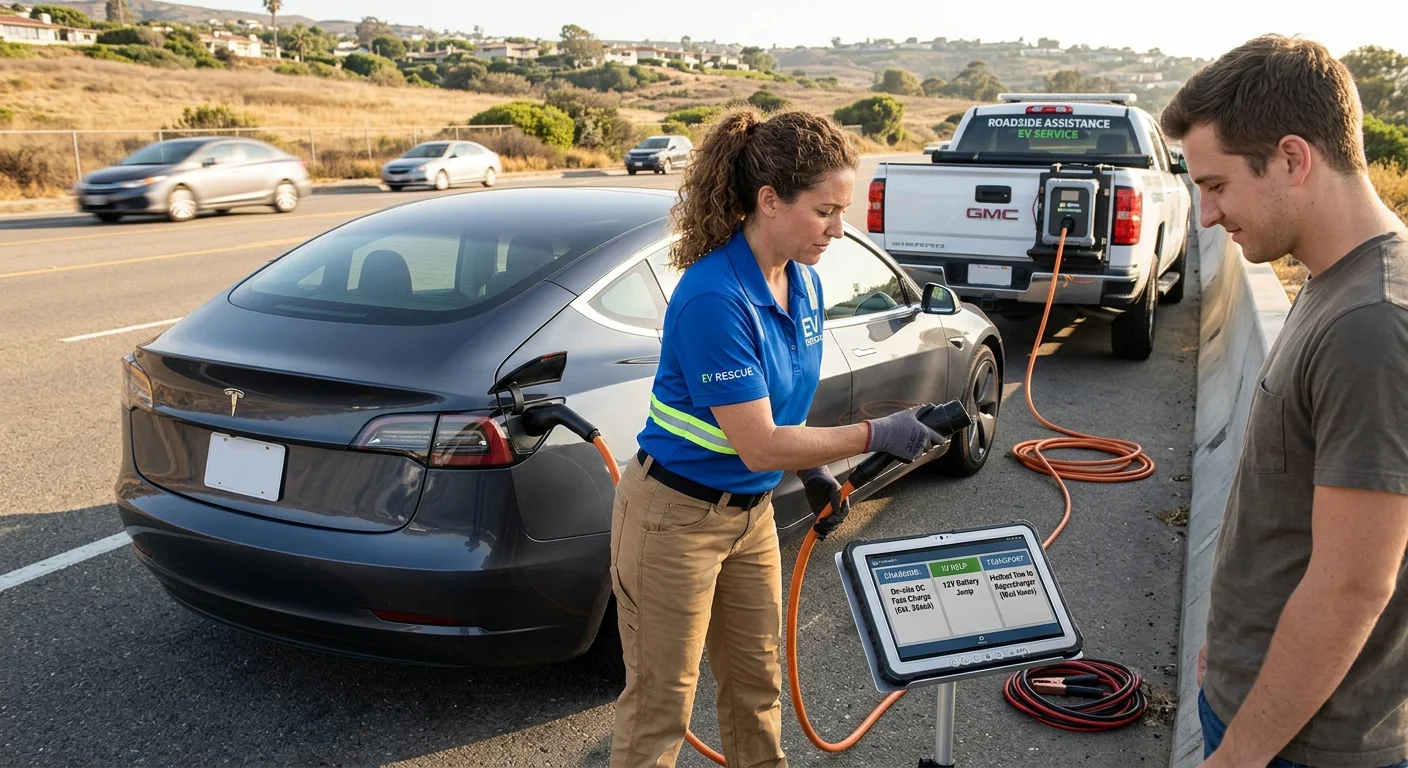
A displayed empty-pack warning points toward charging at the bumper. The independent operators we connect you with bring a 240V Level 2 source. Tesla cars take a native NACS plug. Other EVs use a CCS or J1772 adapter. A typical session adds 10 to 20 miles of range. That takes 15 to 30 minutes of charging. Count that as charging time, not an arrival time.
The county’s public plug map isn’t the same as range in your seat. CEC counted 7,095 public ports in Orange County as of December 31, 2025. That includes 1,475 public DC fast ports. Statewide, the ratio is 24.4 ZEVs per public port. Here it’s 36.8 ZEVs per public port. A stall across town doesn’t move a car already sitting on the 91.
Tesla Superchargers still hold most local DC fast plugs. AFDC records show 48 Tesla sites and 861 DC fast ports in the county. San Clemente has a 49-stall site at 101 W Avenida Vista Hermosa. Garden Grove has 32 stalls at 12891 Harbor Blvd. Anaheim has several Lincoln and Katella Superchargers. Those stalls help once you can drive. They don’t help a car that already sat down.
If the pack is confirmed empty, start with out-of-charge recovery. Don’t open with a hook. The playbook for an empty pack on an OC freeway covers that shoulder choice.
Mobile charging still has to fit the spot. A gated HOA in Yorba Linda can block a truck. So can a structure in Costa Mesa. A beach lot in Huntington Beach can change the plan too. Tell the operator about gates, height bars, and whether the charge port still opens.
Jump only when the 12-volt side failed
Dark screens and dead locks often point at the 12-volt battery. That small battery runs computers, contactors, and the charge port. Tesla’s Model Y owner’s manual covers this point. The low-voltage battery can lose support once range is exhausted. An external supply may be needed before the high-voltage pack can charge. Other makes have their own 12V layouts. Don’t copy a jump procedure from a different model.
Don’t pop a cover from a gas-car habit. Don’t clip on cables from a forum photo. The operator reviews the manual for your year and make. Then they decide whether a 12V jump is the right on-site step.
FSP can be that 12V path on a listed freeway shoulder. A driveway, a beach lot, or a canyon road is different. That patrol truck isn’t the unit that shows up there. That’s when an independent operator handles the stop.
Coastal lots and inland hills fail for different reasons. A Huntington Beach or Newport Beach car may sit for hours after a beach day. Then it refuses to wake. That’s often the 12V, not a drained pack. Hillside driveways in Yorba Linda and North Tustin can go dark after a short trip. Report what the dash showed before it went black. Guessing the cause wastes the first conversation.
Tow when on-site work can’t finish the job
Transport is the last move, not the first. Use it when the cause is unknown. Use it when the car can’t accept a charge. Use it when the maker requires a flatbed for the displayed fault. Collision damage belongs in that first call too.
Tesla’s roadside policy treats a depleted pack as paid transport. That’s not a warrantable breakdown. The covered transport Tesla describes is for a warrantable failure. That failure has to leave the car undrivable. Running out of charge sits outside that. Confirm the current policy with Tesla before you assume a free tow.
The tow itself has to follow the current manual. Wheel lift, parking-brake release, and transport mode are model-specific. Share the manual with the driver. Don’t coach a wrecker from a generic post. Our guide to towing a dead EV in Orange County covers that choice. Charging first is the better path when the pack is simply empty.
A car that won’t go into transport mode needs that said up front. So does a stall a wrecker can’t enter. Parking structures in Santa Ana, Costa Mesa, and Orange can block a standard bed. A narrow canyon pull-off can do the same.
What to say so the right truck is discussed
Make, model, and model year come first, then the exact dash text. Then say whether the car died in motion or after a park. Then give the place, with a road name and a direction.
Useful Orange County reports name a road and a direction. Northbound I-5 south of Irvine is usable. So is westbound SR-22 at the Crush, or the 91 through Anaheim. Laguna Canyon Road on the climb is a real local report. So is Santiago Canyon Road east of Orange. Ortega Highway in the south county hills is another. Name the nearest exit or cross street. Say whether you’re on a shoulder, a surface lot, a structure, or a driveway.
Mention access limits that would stop a service vehicle. A gate, height bar, or parking level changes which truck can reach you. Say if emergency personnel are already on scene. Their directions come first.
If you don’t know which battery failed, say you don’t know. Guessing sends the wrong conversation.
Charge Pro OC is the referral, not the truck
Charge Pro OC is a referral line. We match stranded EV drivers with independent local mobile rescue operators. We don’t own trucks, employ technicians, or set prices. We don’t promise an arrival window. The operator quotes you before starting and bills you directly.
The pros we connect you with are licensed. They handle Tesla and every major EV brand. They can jump or replace a dead 12V on site. They can also bring that 240V source to the car when the pack is empty.
Call when the car won’t move and you can’t classify the message. Share the details above with the operator. The operator decides whether a charge, a 12V jump, or a tow fits.
Call (949) 444-0151 and we’ll connect you with a local EV rescue operator.