Your EV just hit zero on an Orange County freeway. Stay on the right shoulder with the hazards on. Don’t try to limp to a stall you can’t reach. Orange County’s Freeway Service Patrol doesn’t list EV charging. It doesn’t run overnight. Published coverage also skips the toll roads. Get a mobile top-up at the bumper. Call for a flatbed if the car has locked up.
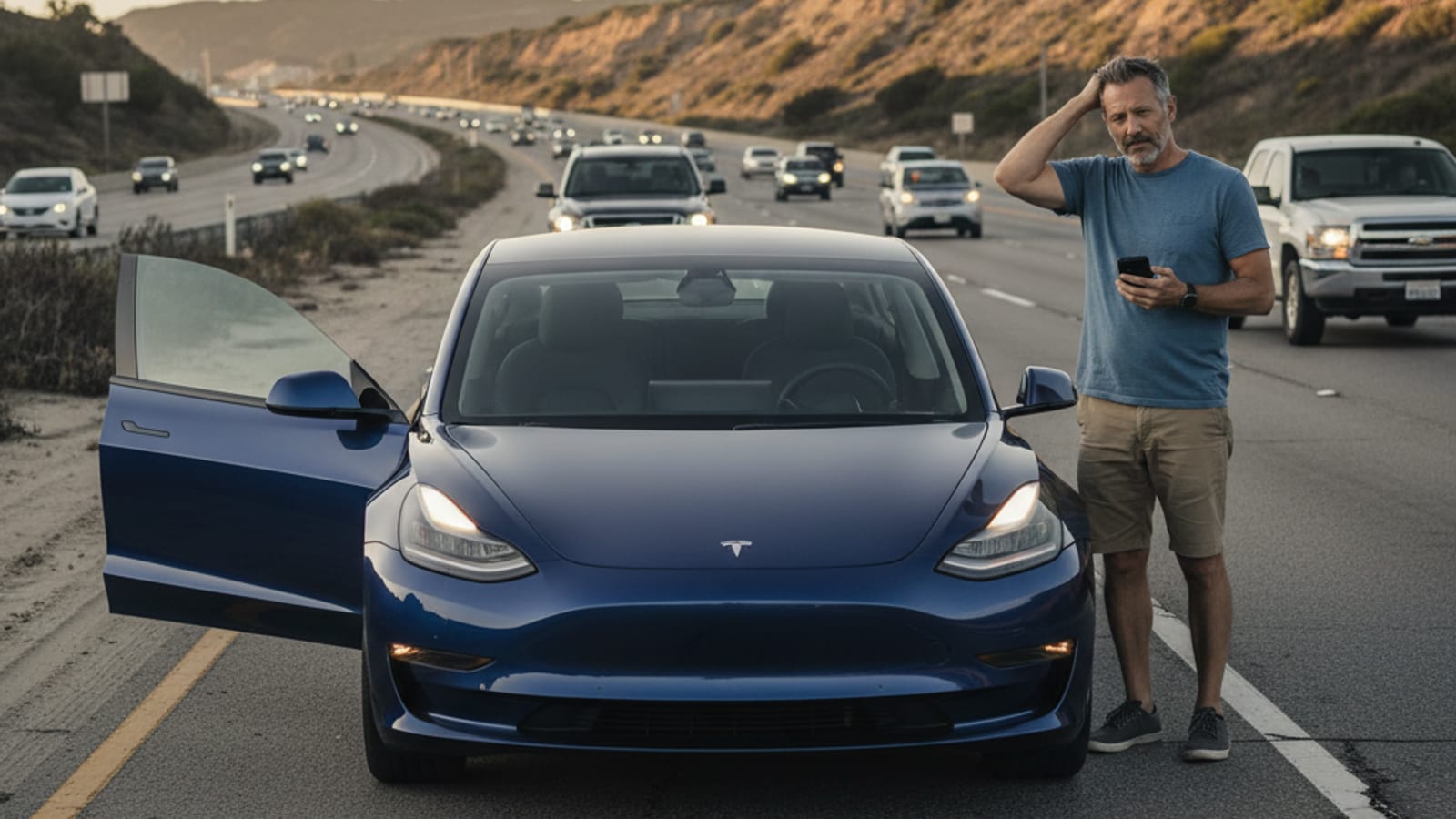
FSP doesn’t charge an empty EV pack
Orange County still has a Freeway Service Patrol. On a covered freeway it can get a stalled car out of a live lane. The published service list doesn’t include charging an electric pack.
That gap hits a big fleet. The California Energy Commission counted 210,842 battery-electric cars in the county. That’s the figure as of December 31, 2025. They’re 8.54% of the light-duty fleet. Teslas are 138,121 of those BEVs, or 65.51%. A lot of shoulder stops here are Teslas, Rivians, Hyundais, and Fords. Those cars can’t take a gas can.
FSP also doesn’t run overnight. If the pack died after the evening commute, that free truck isn’t coming. Published FSP coverage omits the toll roads as well. Empty on SR-241 is not the same problem as empty on I-5. Read Empty on SR-241: published FSP coverage skips the toll roads for that stretch.
Call 911 if you’re stuck in a live lane. Do the same on a bridge, in a tunnel, or in a work zone. CHP can hold traffic off you. That’s scene protection. It isn’t a charge.
Pull over while steering still works
The miles-to-go number is a guess from recent driving. It isn’t a tank. At zero, most EVs still have a thin reserve. Then they cap speed, cut climate, and stop driving the wheels.
A Tesla starts warning while the guess still shows miles. At zero it enters limp mode. Below that, you coast. Rivian, a Ford Lightning, an Ioniq 5, and an EV6 all plead, then quit.
Don’t play for one more exit on I-5, I-405, the 91, or SR-22. Move to the shoulder while power steering and brake assist still help.
- Hit the hazards the second you know you’re in trouble.
- Take the right shoulder and get past the white line.
- Use a wide dirt berm if one is there.
- Turn the wheels away from traffic once you stop.
- Stay in the car unless you can cross a barrier or stand on a wide berm. The live lane is the danger, not the empty pack.
A downhill roll to an exit you can already see is a maybe. Try it only from the right lane. Neutral will let the car glide. Steering gets heavy when assist fades. Brakes work for a few pumps, then they go firm. If the pack shuts down hard, the parking pawl can lock at a stop. Then you need a flatbed, not a nudge. Stopping early is the calmer call.
A dead pack and a dead 12V feel different
Tesla’s Model Y owner’s manual flags the follow-on failure. Once the high-voltage pack is exhausted, the low-voltage battery loses support. Screens can go dark. Handles can freeze. The charge port may not wake. The 12V side needs an external supply before the big pack will take energy.
If the dash is still lit and the car just won’t roll, you’re in a range stop. If nothing wakes, tell the operator both systems are down. The pros we connect you with jump or replace a 12V on site. Then they feed the pack.
City stalls don’t reach a car that can’t move
Orange County has a lot of public ports on paper. The Energy Commission counted 7,095 public ports as of December 31, 2025. Of those, 1,475 are DC fast. The county still sits at 36.8 ZEVs per public port. California’s ratio is 24.4. Each stall here is shared by more EVs than the state average.
Tesla Superchargers sit on the city grid, not on the shoulder. Irvine’s 1920 Main St site has 40 stalls. Tustin’s 14661 Franklin Ave site has 36. Garden Grove has 32 stalls at 12891 Harbor Blvd. San Clemente has 49 at 101 W Avenida Vista Hermosa, the county’s largest Tesla site. Santa Ana has 28 at 1008 17th St. Anaheim has Lincoln and Katella sites. Those addresses matter once you can drive.
They don’t matter while you’re sitting on I-405. Same on I-5 south of Irvine. Same on the 91 through north county, or in the Orange Crush on SR-22. You need range first. The I-405 playbook is in Empty on I-405: stay on the shoulder and get a charge.
Tesla holds 59% of the county’s public DC fast ports. Non-Tesla drivers still have Electrify America and EVgo in the federal AFDC file. Fashion Island in Newport Beach is one of those sites. So is Walmart at 440 N Euclid St in Anaheim. Dana Point Station at 25825 Las Vegas in Capistrano Beach is another. Same rule: you have to arrive under power.
Tow networks, Tesla transport, or a charge at the car
AAA covers EVs. Many contractors still bring gas-car tools. A 120V outlet on a service truck won’t refill a traction pack. The usual next step is a flatbed to a charger, a wait, then a drive. That’s useful for a tire or a 12V. For a pack at zero, it’s a tow. Weigh that path in AAA or mobile EV charging when your pack is empty.
Tesla roadside is 877-798-3752. Tesla’s own policy answers a depleted battery with transportation, not with charging at the car. Out-of-charge help isn’t treated as a financially covered service. The long free transport window is for a warrantable breakdown that leaves the car undrivable. Running out of energy sits outside that. Confirm the current wording on Tesla’s roadside page before you assume a tow is free.
Mobile rescue is the other fork. Charge Pro OC is a referral line. We match stranded drivers with independent local operators. We don’t hold a trade license, and we don’t do the work. The operator quotes you before starting and bills you directly.
Operators bring a 240V Level 2 source to the car. Teslas take a native NACS plug. Other EVs use CCS or J1772 through an adapter. Typical charging time is 15 to 30 minutes for about 10 to 20 miles of range. That’s plug time, never an arrival window. Level 2 on a shoulder is the safe version. A DC fast cabinet on a live freeway isn’t the setup. See mobile EV charging for how that dispatch works.
Use this while you’re sitting there.
| Where you are | Better first move |
|---|---|
| Safe on the shoulder, pack empty | Stay put. Get a Level 2 top-up, then roll to a stall. |
| In a lane, on a bridge, in a tunnel | 911 first. Then charge or tow once you’re protected. |
| Screens dark, handles dead | 12V jump plus a pack charge on site |
| Smoke, fluid, airbags, or a hit | Tow only. Don’t charge a damaged car. |
| Overnight, or on a toll road | FSP isn’t the answer. Call for a mobile match or a flatbed. |
Stay buckled on a live shoulder. Keep the hazards on. Wait inside unless you’re over a barrier.
Give the operator a pin they can actually use
A useful call names the freeway, the direction, and the nearest exit or marker. “I-5 south, past Irvine, before the San Clemente stretch” works. “The 91 west, east of Anaheim” works. “SR-241, and FSP doesn’t cover this road” works.
Then the car: year, make, model. The cable changes. Then the state of the car: pack empty, 12V dead, warning lights, or a collision.
North county stops on the 91 don’t look like a coast run on I-405. The Crush on SR-22 doesn’t look like I-5 south of Irvine. Tell the operator which of those you’re on.
Once you’re rolling, don’t trust the guess the same way. Hills, wind, and a cold cabin eat the number faster than a flat, warm cruise. Build more buffer than the dash suggests on canyon grades and the long I-5 run. County maps sit at EV charging in Orange County. The recovery path is out-of-charge recovery.
If you’re stranded now, call (949) 444-0151. We match you with a local operator who covers your stretch. The operator quotes before the plug goes in.