Apps for EV charging are a pre-drive tool, not a last-minute fix. Open them before a Laguna Beach day or a canyon run. Do it while the pack still has room to reroute. Confirm the pins against real Orange County Supercharger addresses. Then keep a second option if the first stall is busy or offline.
Pin Superchargers to the drive you’re actually taking
The California Energy Commission counted 210,842 battery-electric cars in Orange County as of December 31, 2025. Public charging ports stood at 7,095. That’s 36.8 ZEVs per public port, versus 24.4 statewide. Orange County holds 12.02% of California’s battery-electric fleet. That’s on 8.33% of the state’s light-duty fleet. The county is Tesla-heavy too: 138,121 Teslas, or 65.51% of local BEVs. Many drivers will open Tesla’s map first. That still isn’t a substitute for checking the sites on your route.
AFDC records show 48 Tesla Supercharger sites in Orange County, with 861 DC fast ports. Tesla holds 59% of the county’s public DC fast ports. Irvine and Anaheim dominate that list. Laguna Beach and the canyons sit on a different kind of trip. You still need to match pins to street addresses before you go.
For a Laguna Beach outing, start with Mission Viejo at 27741 Crown Valley Pkwy. AFDC lists 24 stalls there, up to 250 kW. Laguna Hills has two Supercharger sites. One sits at 23701 Moulton Pkwy, and the other at 25248 Cabot Rd. Each lists 16 stalls, up to 250 kW. San Juan Capistrano has Superchargers at 26701 Verdugo St and 31971 Camino Capistrano. San Clemente’s site at 101 W Avenida Vista Hermosa lists 49 stalls, up to 250 kW. Newport Beach has 12 stalls at 4241 MacArthur Blvd. Put those addresses in the app. Don’t trust a city-name pin alone.
Canyon trips toward Silverado, Trabuco Canyon, or Modjeska need the same address check. Lake Forest’s Supercharger at 24301 Muirlands Blvd lists 24 stalls, up to 250 kW. A second Lake Forest site sits at 24372 Rockfield Blvd. It lists 16 stalls, up to 325 kW, with Magic Dock CCS1 and NACS. Irvine Superchargers include 5396 Walnut Ave and 5406 Walnut Ave. Confirm the street, then the stall count.
Cross-check non-Tesla networks on the same corridor
Tesla’s map isn’t the whole picture. AFDC counted 223 public DC fast stations in the county, and 1,452 DC fast ports. Remove Tesla and you still have 175 stations and 591 DC fast ports. Electrify America, EVgo, EVCS, ChargePoint, ROVE, and others split that remainder.
Newport Center traffic is a good example. Electrify America lists 8 DC fast ports at Fashion Island, 401 Newport Center Dr. Check that site in the network’s own app. Our Fashion Island charging notes cover the local layout. South county has Electrify America’s Dana Point Station at 25825 Las Vegas, Capistrano Beach. It lists 12 DC fast ports. Rancho Santa Margarita has EVgo at Plaza Antonio, 22351 Antonio Pkwy, with 14 DC fast ports. Ladera Ranch has EVgo at 27542 Antonio Pkwy, 8 DC fast ports. Seal Beach has EVgo at 801 Pacific Coast Hwy, with 4 stalls.
ChargePoint leads the county in DC fast sites, with 71 locations. It only has 76 DC fast ports. Most are single-plug dealership and office units. A ChargePoint pin isn’t a Supercharger plaza. Read the port count, not just the logo.
For a county inventory, use the Orange County charging hub with the DOE station locator. AFDC is a government list built from reported data. It’s not a live stall-open feed. Use it to see what exists. Then open the network app for status.
Let the vehicle app sketch the trip, then distrust it
Start with the app your automaker tied to the car. It can read your pack’s real state. A third-party map usually can’t. That’s the one advantage worth using first.
We won’t name a brand’s app or walk through its screens. Menus change with software, so we can’t verify every model this month. Your owner’s manual, or the maker’s site, is the current source.
Use that app to sketch a route. Then stop treating the sketch as a reservation. It can suggest a stop. It can’t confirm a free, working plug at the minute you arrive. Spend the miles only after a second source agrees the site is plausible.
Open the networks you might actually plug into
Each network’s app or site is the usual source for its own hardware. Tesla’s view won’t tell you an Electrify America stall is offline. EVgo won’t speak for a Supercharger on Muirlands. If your day might use more than one network, open more than one app. Do it while the battery is still comfortable.
Two or three network checks beat one leftover icon on your home screen. We’re not ranking those apps. Features move, and we won’t guess at them. The network’s own site is the accurate answer for what it shows today.
Treat combined maps as a catalog, not a guarantee
Aggregator apps fold many networks into one view. Some add driver notes from the last person who plugged in. That can surface a site a single-network app never showed you.
A catalog is still a catalog. A stall can be occupied, broken, or pulled since the listing updated. A note from last month is one visit, not today’s status. The app didn’t install the hardware. It can’t stand behind it.
If the percentage is already sliding, switch problems. Our guide on what to do before you’re stranded is for that moment. Keep hunting apps only while a reachable, verified site is still in range.
Save a second address before you drop elevation or miles
Apps locate stations. They don’t repair a stall that refuses a session. They also don’t wake a car that won’t take a charge.
If you reach a listed plug and nothing starts, it’s no longer a mapping task. Work through a public charger that won’t charge first. Then use the second address you saved.
On a Mission Viejo and Laguna Hills loop, that’s straightforward. Crown Valley, Moulton, and Cabot are three separate Supercharger addresses. The Shops at Mission Viejo, 555 The Shops at Mission Viejo, lists 10 Superchargers. Tesla’s own figure for that site is 72 kW. If your app implies a faster session there, check the power before you count on it.
North and central county have more plazas. Garden Grove at 12161 Valley View St lists 16 stalls, up to 500 kW. Huntington Beach has 24 stalls at 6913 Warner Ave. Yorba Linda has two Supercharger sites on Yorba Linda Blvd, 8 stalls each. Those sites help a local errand. They don’t automatically sit on a Laguna Beach or canyon itinerary. Check the path you’re driving.
A Santiago Canyon day is the same habit. Save a Lake Forest or Irvine address before you climb. Our Santiago Canyon empty-pack notes cover what to do if the pack runs out on that road.
When the maps no longer offer a stall you can reach
When every app shows the same dead end, close the app drawer. More icons won’t create range. The job becomes getting energy to the car where it sits. Don’t gamble the last miles on a stale pin.
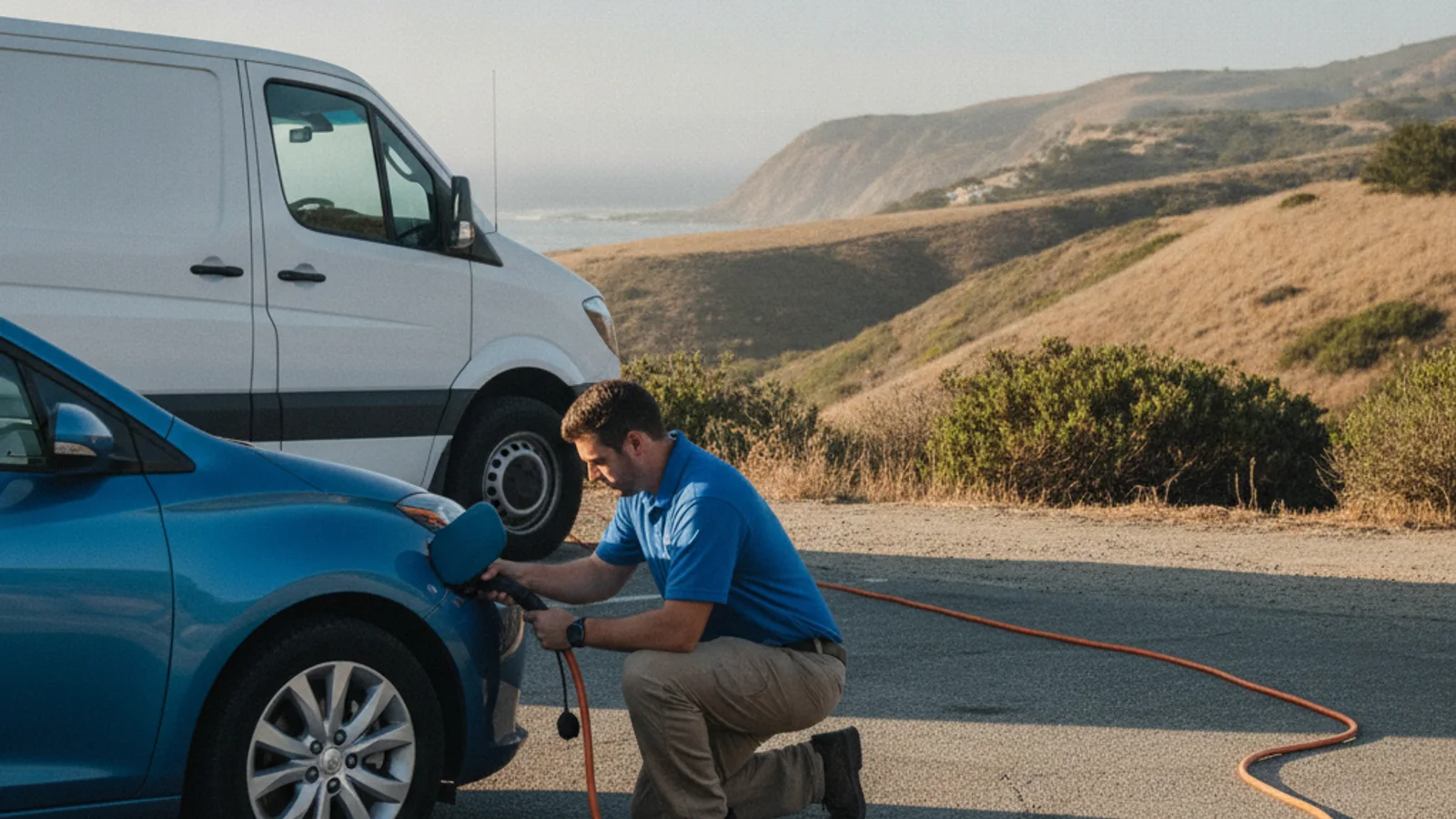
Mobile EV charging matches you with an independent local operator. The pros we send bring a 240V Level 2 source to the car. They use a native NACS plug, or a CCS or J1772 adapter for non-Tesla EVs. Typical charging time is 15 to 30 minutes for about 10 to 20 miles of range. That’s charger time on scene, never an arrival window. The operator quotes you before any work starts, and bills you directly.
Stay with the car in a safe spot. Don’t spend the last few percent chasing a pin that never confirmed.
When planning is over, call
If the apps haven’t produced a working stall you can actually reach, call Charge Pro OC. The number is (949) 444-0151. We’ll connect you with a local mobile rescue operator. Charge Pro OC is a referral line. We don’t own trucks, and we don’t set prices. The operator on scene decides what the car and the street allow.