You came into Santa Ana for a public DC stall, and the Rove row is dark, occupied, or the wrong plug. Range is already thin, and downtown one-ways leave little room to hunt. This is the next-step map for a CCS or NACS car that cannot wait for that stall to come back.
What drivers mean by Rove Santa Ana
Rove is a public DC fast network. Drivers typing “rove santa ana” want that plaza, in this city, with a plug their car can use. They are usually in a Hyundai, Kia, Ford, Chevy, BMW, Audi, or another non-Tesla, and they planned this stop as the CCS or mixed-head option inside central Orange County.
The verified county inventory is thinner than the search. The U.S. DOE Alternative Fuels Data Center lists 2 Rove stations and 32 DC fast ports in Orange County. That figure is countywide. A live Santa Ana street address for Rove is not in that verified set, and a BTC Power Santa Ana pin is not in it either. Before you idle in a lot, open PlugShare and Rove’s own map. Confirm the pin, the plug type, and whether the stall is listed as available. If the apps disagree, trust the stall in front of you over a cached listing.
Santa Ana does have Tesla Superchargers you can name from the same inventory: 1008 17th St, 28 stalls, max 325 kW, and 300 E 5th St, 20 stalls, max 75 kW. Those stalls sit on Tesla’s network. A CCS car needs a matching head or a confirmed adapter stall. The 5th Street site is also a slower Tesla row. It is a poor last-mile bet if your car is already hunting CCS.
The mix around you is why this search exists. As of 2025-12-31, Orange County had 210,842 registered battery-electric vehicles, and Tesla made up 138,121 of them, 65.51% of the county’s BEV fleet. Tesla also holds 59% of Orange County’s public DC fast ports: 48 stations and 861 ports. Strip Tesla out and the rest of the county is 175 DC fast stations and 591 ports, split across Electrify America, EVgo, EVCS, ChargePoint, Rove, and smaller networks. When a Rove stall in Santa Ana is down, you are competing for that thinner public slice.
The California Energy Commission counted 7,095 public charging ports in Orange County as of 2025-12-31, including 1,475 public DC fast ports. Those charger counts combine CEC surveys, grant data, AFDC, PlugShare, and other listings, updated twice a year. That is another reason to refresh PlugShare in the lot. A stall can change between the last statewide pull and the hour you arrive.
If you searched “btc power santa ana” on the way in, treat it the same way. Hardware brands show up on cabinets and in apps. The street pin still has to match a live map. Unconfirmed addresses waste the last 10 miles.
When the stall is down, occupied, or the wrong plug
These are three different failures. Treat them as three different decisions.
A down stall is dark, locked, or throwing a session error after the handle clicks in. Occupied means every CCS or mixed head has a car on it, and the queue is already eating your buffer. The wrong plug is a NACS-only head, a CHAdeMO leftover, or a Tesla-network stall your car cannot start. CCS and NACS mix is the Santa Ana problem more than a Tesla-only map. Newer cars often wear NACS. Older Ioniq 5, EV6, Mach-E, Bolt, and many German models still present as CCS. Confirm the head before you commit the last miles.
Start with the stall, then the app, then the car. Reseat the handle. Try the second cable on that cabinet if there is one. Check the network app for an error code. If the session never starts, move on. Cycling a dead cabinet until the pack is empty turns a bad stall into a curb recovery. For the stall-side checks, use the same sequence as a public charger that will not start.
Idle fees, posted hours, and lot rules at a Rove site were not confirmed in our verified inventory. Read the screen and the signs in front of you. If a no-parking or street-sweep rule is missing from the City of Santa Ana site and missing from the post in that lot, treat it as unconfirmed and stay legal on the pavement you can see.
A stall that starts, then dies at 12% or 40%, is a different failure. Unplug once. Try a neighboring cabinet. If the second stall repeats the drop, the car or the site is done for this stop. Sitting in a charging stall with a finished session can draw a ticket or a boot in a private lot. California’s private-property tow rules under Vehicle Code 22658 require specific entrance signage. If those signs are up, a lot can remove a car at the owner’s expense. Get the car into a lawful space, then decide the next charge.
If you still have enough range to reach a second confirmed live stall inside Santa Ana, go there with the app open. If you do not, stay put. Hunting a second plaza through downtown one-ways is how a 12-mile buffer becomes a 5/22 shoulder.
Civic Center, downtown one-ways, and the 5/22 merge
Downtown Santa Ana is a grid of one-ways around Civic Center Drive, Broadway, Main, 4th Street, and 5th Street. Court traffic, bus lanes, and metered blocks stack up against the I-5 and SR-22 pinch on the north edge of the city. SR-55 sits to the east. A dead EV on that grid is in moving traffic, even if you aimed for a charging plaza.
If the car stops on a one-way with no shoulder, hazards go on first. California Vehicle Code 25251 requires flashing the turn-signal lamps as warning lights when a vehicle is disabled on the roadway and equipped with a simultaneous-flash device, if that device still works. Off the roadway but within 10 feet, flashing is permitted. On a freeway, a genuinely disabled vehicle may temporarily stop when another vehicle has been summoned for help under Vehicle Code 21718. After four hours on a freeway right-of-way, the car can be towed under 22651(f), and sooner if it is blocking traffic.
The 5/22 merge is a bad place to discover the stall was down. OCTA’s Freeway Service Patrol covers I-5 and SR-22 on published maps, with a source conflict on extra segments. The consumer hours on OCTA’s web page are Monday through Friday, 6:00 a.m. to 7:00 p.m., and limited weekend service from 10:00 a.m. to 6:30 p.m. FSP does not run overnight or on listed holidays. Call 5-1-1 and select Motorist Aid, or 9-1-1 for an emergency. FSP is free, and drivers cannot take payment.
FSP’s listed help is a jump-start of a 12V battery, a gallon of gas, a tire change, radiator water, hose tape, or a tow off the freeway to a CHP-designated drop zone. No OCTA or Caltrans FSP page offers EV charging. A jump restores the accessory battery. The listed FSP outcome for a depleted EV pack is that free tow to a drop zone, during FSP hours, on patrolled segments, and it is not guaranteed. From a drop zone you still need a charge or a private tow. Local parking rules can still apply once you are off the freeway.
Street-sweep calendars and specific no-parking hours for the curb outside a Rove lot could not be confirmed on the City of Santa Ana site for this page. Read the posted signs on that block. Civic Center enforcement is real around court hours. A car sitting “just for a minute” on a red curb is already in the tow window if it is a hazard.
If you still have a few miles, get off the one-way and into a lawful space before the pack hits zero. A quiet side street near the Civic Center is a better recovery point than the merge. Then make the charge-in-place call instead of threading Broadway on fumes.
Charge where you sit versus hunting another lot
The fork is simple. Either you have a confirmed live stall inside the range you actually have, or you charge where the car sits.
Range on the dash is optimistic once you add AC, downtown speeds, and a climb onto I-5. AAA’s 2026 dynamometer study found an 8.5% loss of range with air conditioning at 95 F. Santa Ana summer afternoons sit in that band more often than coastal lots do. If the display says 14 miles and the next CCS pin is 11 miles through the 5/22, you do not have a spare.
A typical rescue charge from a matched operator is 10 to 20 miles of range in 15 to 30 minutes of Level 2 charging. That is charging time at the car, enough to reach a live public DC stall you have already confirmed. Public Level 2, on the AFDC spec, is roughly 25 miles of range per hour at the common 240V band. Neither figure is a price, and neither is an arrival window. The operator who shows up quotes and bills you directly.
Hunting Tustin, Garden Grove, or Anaheim from a Santa Ana curb only works if the pack can absorb a wrong turn. Tustin’s Tesla sites at Red Hill, Franklin, Kensington, and Flight Way are Tesla-network stalls. Garden Grove has Tesla density at Harbor and Valley View. Electrify America at the Anaheim Walmart on Euclid is 10 DC fast ports, a real CCS bank if you can get there. Those hops are for a car that still drives. They are a trap for a car already parked at a dark Rove cabinet.
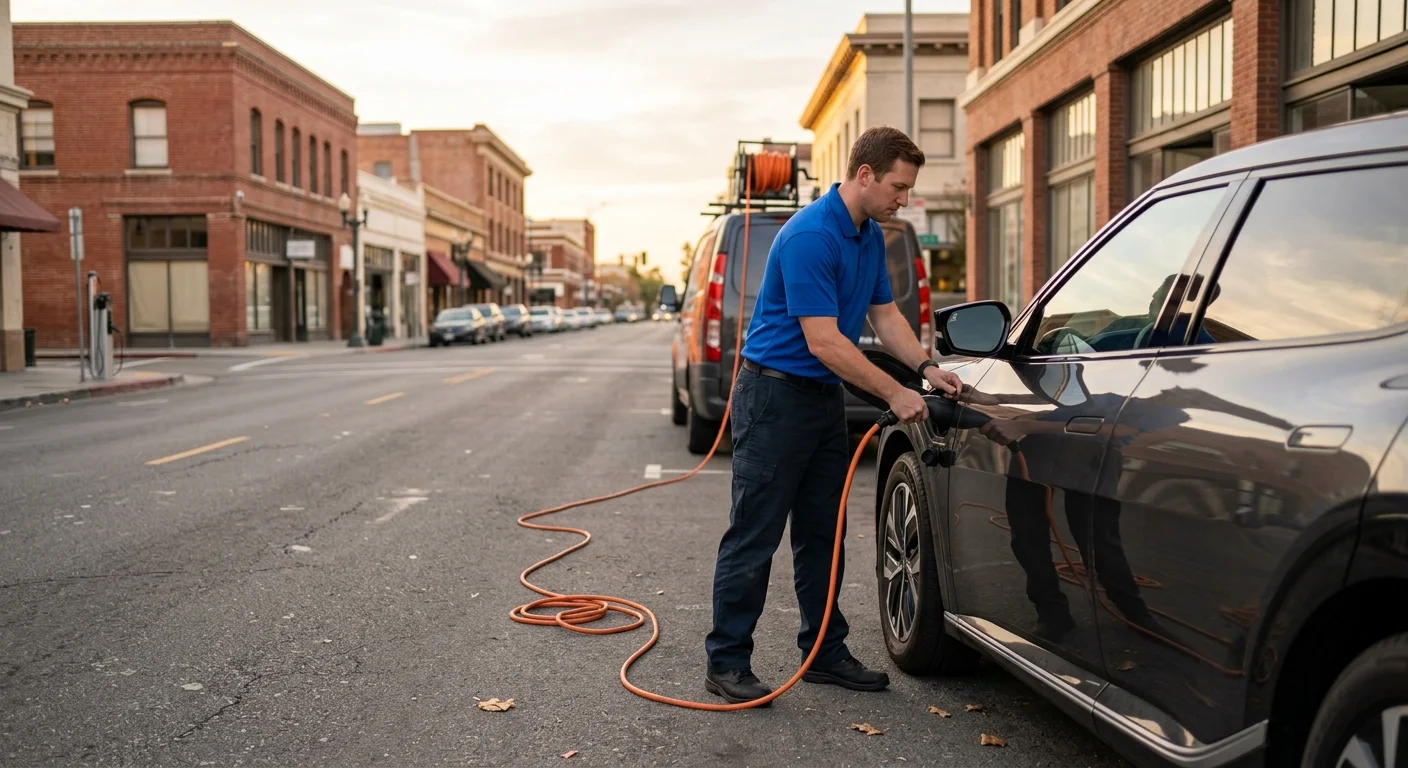
Stay with the car if you are below a safe hop. Put it in a lawful space. Hazards as required. Then request out-of-charge recovery or a non-Tesla EV rescue so a licensed local operator can bring Level 2 to that curb. Charge Pro OC is the referral. The operator does the physical work, sets the price, and bills you.
A second public stall is still the right move when PlugShare shows it open, the pin is close, and your car can use the head. Walk that decision with the remaining miles, the one-way pattern, and the 5/22 traffic, not with hope.
For U.S. charging basics while you wait, the Department of Energy’s electric vehicle pages stay current on plugs and public equipment. Use them for the plug language. Use PlugShare for the stall in this lot.
How a matched non-Tesla operator works this curb
Charge Pro OC matches you with a licensed, independent local operator. The brand holds no trade license, owns no trucks, and performs no charging. You contract with the operator. The operator quotes, charges the car, and bills you.
On a Santa Ana curb the operator’s job is the CCS or NACS head your car actually has, at the car, in a lawful stop. Tell the matcher the make, the plug, the street, and whether you are on a one-way, in a private lot, or already on the 5/22. A downtown pin near Civic Center is a different staging problem than a stall inside a charging plaza. One-ways and bus lanes change where a service vehicle can sit.
The operator brings Level 2 equipment to restore enough range to roll to a live DC stall. The 10 to 20 miles in 15 to 30 minutes figure is the approved rescue window for that charge, charging time only. If the 12V has already dropped because the pack is empty, say so on the call. A depleted traction pack and a dead 12V are two jobs, and the car may need the accessory battery supported before the high-voltage pack will take a charge.
This is the same family of help covered in EV roadside assistance in Santa Ana, aimed at the public-network miss: Rove down, BTC Power unconfirmed, CCS head busy, NACS head on a car that still wants CCS. Tesla roadside, for a Tesla, answers a depleted pack with paid transport, not on-site charging. That policy is why a non-Tesla driver at a dark public stall should not wait on a Tesla playbook.
No arrival window belongs on this page. No brand price belongs on this page. If an operator quotes you, that quote is theirs. If the lot is private, the operator still has to work inside posted rules. If you are on the freeway, FSP and CHP come first for the lane, then the charge once the car is in a legal place.
Stay with the car when you can do so safely. Have the network app, the plug type, and the nearest cross street ready. Civic Center, 17th, 5th, and the 5/22 ramps are all easier to dispatch from a named corner than from “near Rove.”
When to call us
Call when the Rove stall in Santa Ana is down, full, or the wrong plug, and you lack the range to reach a confirmed live CCS or NACS bank without dying on a one-way or the 5/22. Call when PlugShare and the cabinet in front of you already disagree, and the pack is too low to keep hunting. Call us at (949) 444-0151 and we’ll connect you with a local EV rescue operator.