EV charging in Coto de Caza starts at a home 240-volt plug, then a stall you pick after you leave the gates. This is an unincorporated canyon community in Orange County, not a city, and the useful map sits on Oso Parkway, Antonio Parkway, and the Superchargers listed for Laguna Hills. Inside, two guarded entries plus canyon grades decide whether you make it home. If the car dies on Vista del Verde, the next move is a truck at the curb, after you clear the gate.
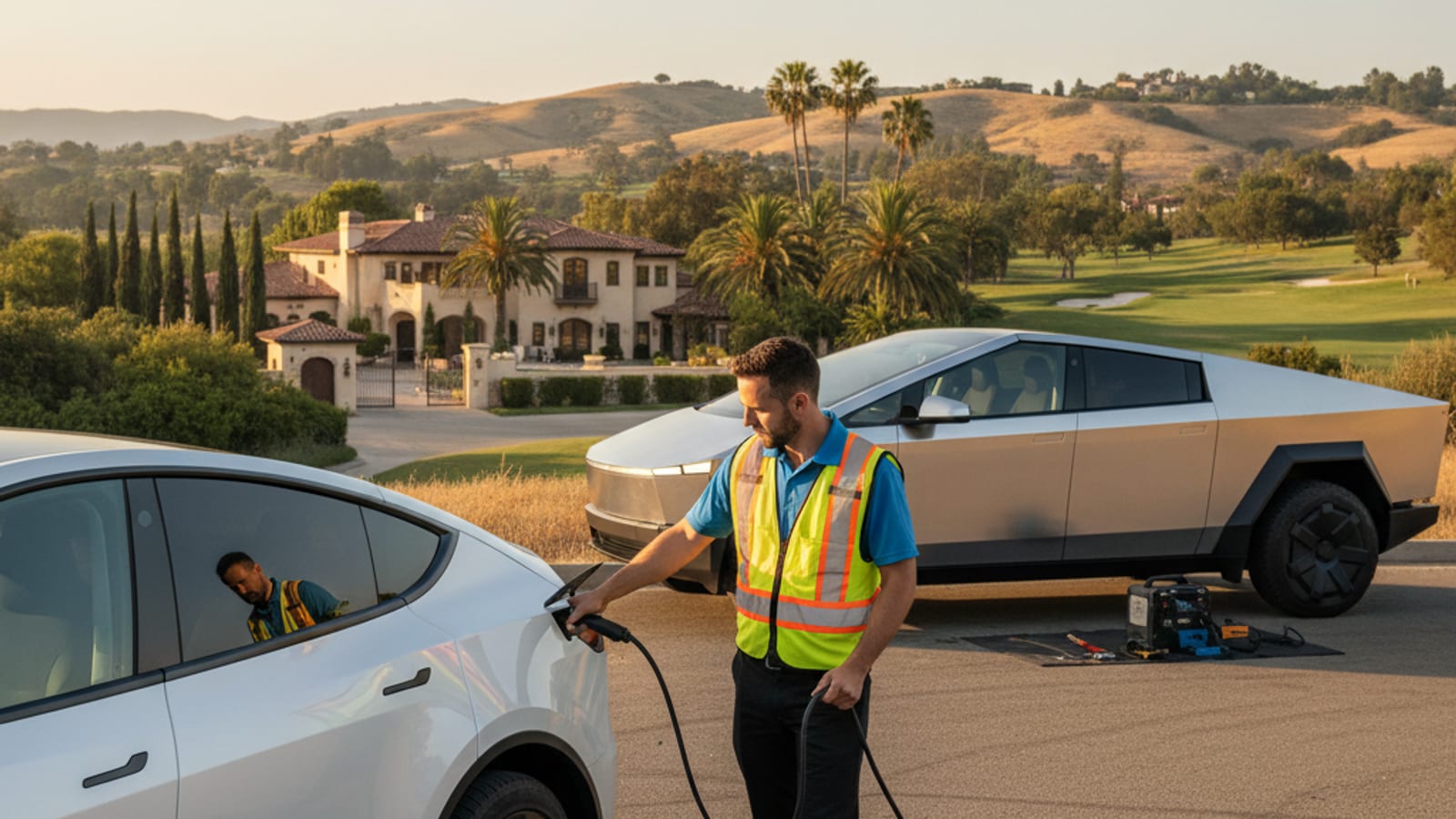
Coto de Caza is a canyon place, not a city grid
Coto de Caza is a Census Designated Place. The County of Orange Housing Element lists it that way. About 15,363 people live here in ZIP 92679. There’s no City of Coto de Caza. There’s no freeway and no state highway inside the gates.
Coto de Caza Drive is the spine. It meets Oso Parkway at the north gate. It meets Antonio Parkway and Plano Trabuco at the south. SR-241 is the freeway most residents actually use. I-5 is a further hop on Oso Parkway or SR-74.
Named interior roads are Coto de Caza Drive, Vista del Verde, and Robinson Ranch Road. They wind through Wagon Wheel Canyon against the Santa Ana foothills. The walls are steep. The bottom is oak and a riparian creek. Horse-trail crossings sit on the same pavement you’ll drive after dark.
Thomas F. Riley Wilderness Park wraps the community east, north, and south. Wagon Wheel Canyon staging area is the park edge people know. Inside the private map you’ll also find the Coto de Caza Golf and Racquet Club, The Lodge at Coto de Caza, Coto Valley Country Club, and the Coto de Caza Equestrian Center. Those are real local trips. They’re not a substitute for a plan if the pack is already low.
Neighborhoods stack behind the same two entries. Los Ranchos Estates sits behind a second interior gate, with roughly 75 custom homes. The Village, Canyon Estates, Grand Coto Estates, Silver Creek, Summerfield, Spring Hill, Oak Ridge, Villa Serena, and The Woods fill the rest of the canyon. A Coto de Caza charging hub is the local directory page for this same map.
Two guarded entries control the whole community. Add that third gate at Los Ranchos, and any rescue has to be announced. You call the gate. You give a name. Then the operator can roll.
Canyon grades rewrite the number on the dash
This pocket is the hottest, most sheltered stretch in South Orange County. There’s no marine layer to blunt a summer afternoon. High-fire-risk canyon weather is the climate here, not a slogan. Cabin cooling on a long grade between the north and south gates pulls energy the brochure never budgeted.
The last mile home is the trap. You’ve been on Oso or Antonio. The estimate still looks fine. Then Coto de Caza Drive climbs, winds, and slows for a horse crossing. Regenerative braking gives some of it back on the descents. The net still runs hotter than a flat loop through Mission Viejo.
Orange County had 210,842 battery-electric cars on the road as of December 31, 2025, per the California Energy Commission. ZEVs were 10.56% of the county’s light-duty fleet. Tesla made up 65.51% of those battery-electrics. Orange County also holds 12.02% of California’s battery-electric vehicles, while being 8.33% of the state’s light-duty fleet. This community sits at the top of South County incomes, which usually means more than one car in the garage. The daily driver stays plugged in. The third car sits. Sitting is how a 12V dies.
Countywide, the CEC counted 7,095 public charging ports at the end of 2025. That’s 36.8 ZEVs per public port. The statewide figure was 24.4. Those ratios don’t tell you which stall you’ll use tonight. They do tell you why a home plug, and a backup plan, matter on gated canyon streets.
Don’t treat the window sticker as a Wagon Wheel Canyon budget. Heat, grade, and a slow gate line all spend the same pack.
Stalls people use after they leave the gates
When you head out for errands, you can plan around named Tesla DC fast sites that AFDC lists in Laguna Hills. One is at 25248 Cabot Road, 16 stalls, up to 250 kW. The other is at 23701 Moulton Parkway, also 16 stalls at 250 kW.
Mission Viejo has two Tesla sites many south-county drivers already know. 27741 Crown Valley Parkway has 24 stalls at 250 kW. The Shops at Mission Viejo, at 555, has 10 stalls. Tesla’s own listing puts those at 72 kW. That’s the figure to trust when AFDC and Tesla disagree.
Lake Forest sits on the same loop. 24301 Muirlands Boulevard has 24 stalls at 250 kW. 24372 Rockfield Boulevard is a Magic Dock site with 16 stalls at 325 kW, and it lists CCS1 plus NACS.
If you’re not in a Tesla, Plaza Antonio in Rancho Santa Margarita is the EVgo site drivers actually name. AFDC lists it at 22351 Antonio Parkway with 14 DC fast ports. Ladera Ranch has another EVgo at 27542 Antonio Parkway, Westar Mercantile East, with 8 DC fast ports.
The north gate points you toward Oso Parkway, then Laguna Hills and Mission Viejo. The south gate points you toward Antonio Parkway, then Plaza Antonio and Ladera Ranch. Pick the gate that matches the stall, and leave with enough range to finish that drive. A low pack plus a long grade is how a Coto errand turns into a driveway job.
Countywide, Tesla holds 59% of public DC fast ports. That’s 861 of 1,452, across 48 Supercharger sites, from AFDC station data filtered to Orange County. Non-Tesla DC fast still exists: Electrify America, EVgo, ChargePoint, and others. ChargePoint has many sites and few ports per site, often a single dealership or office plug. That’s not a rescue-grade network.
Open a charging app while you still have miles. The car’s nav, Tesla’s map, and PlugShare all help you see a stall that’s busy or offline. Confirm the stall before you depend on it. Getting to Cabot or Plaza Antonio still means a gate, a grade, and a pack that has to last that far.
Orange County’s new ZEV share of light-duty sales was 24.77% in 2026 Q2, against 19.09% for California, per the CEC. The longer trend isn’t a straight climb. The state’s ZEV share of new sales peaked in 2024, and 2026 Q1 was the weakest quarter in that series. Don’t plan as if tomorrow’s map will add a stall on Robinson Ranch Road.
Home charging is the daily system
Most Coto drives start in a garage, not at a mall stall. A 120-volt wall outlet will trickle. It won’t rebuild a large pack after a canyon day. A 240-volt Level 2 wall unit is the overnight setup these estate streets are built around.
We don’t publish a home-electricity rate for this community. Confirm the current kWh price, and any EV time-of-use schedule, with your utility before you program overnight charging. A number copied from a blog is already stale.
Placement is a property decision. Garage, detached workshop, or a covered bay off the circular drive all show up here. The electrician you hire should pull the permit the county requires. Charge Pro OC doesn’t install chargers, own inventory, or hold a contractor license. We connect you with mobile rescue operators when the car is already stuck.
If a home unit trips a breaker at 9 p.m., the practical next step is a driveway charge. Don’t spend the last miles on a night run to Cabot Road. A mobile EV charge at the house keeps the car where it already sits.
HOA rules and gate hours are local. We couldn’t confirm a published visitor-charging policy for the community association. Ask the gatehouse and your HOA office how they treat a service vehicle. Write that answer down before you need it.
Trabuco Canyon, Las Flores, and Ladera Ranch share this foothill weather. A home battery can keep lights on in a fire-corridor outage. It still doesn’t move an EV that’s already empty.
A dead 12V looks like a dead EV
Coto garages hide a second failure mode. Households here often keep a second or third EV. The car that sits for weeks still has a small 12-volt battery running computers, locks, and the contactors that wake the pack.
When that 12V dies, the car won’t unlock, start, or take a charge. Tesla’s Model Y owner’s manual notes that once range is exhausted, the low-voltage battery can lose support. It may need external power before the high-voltage pack can charge. That’s a technical sequence, not a quirk of one driveway.
Tesla 12V jumps are a separate job from filling an empty pack. The operators in this network jump or replace a dead 12V on site for Tesla and other major EV brands. A tow to a Supercharger does nothing if the car can’t close its contactors.
Heat in this sheltered canyon is hard on that small battery. You won’t get a verified local failure rate from public files. What you can do is treat a car that sits as a 12V maintenance item, not a parked sculpture.
If the dash is dark and the pack still shows miles, start with the 12V. If the car is awake and the range is zero, that’s a charge at the curb. Mixing those two calls wastes a night.
The gate is the rescue step people skip
Coto de Caza is dual-gated and private. Two guarded entries, plus Los Ranchos Estates. An independent operator can’t guess the code. You have to clear the visit.
Call the gate. Give the operator’s name and vehicle description. Say which street: Coto de Caza Drive, Vista del Verde, Robinson Ranch Road, or a named neighborhood. If you’re in Los Ranchos, say that too, because it’s another stop.
There’s no published arrival clock from Charge Pro OC, because we don’t run the trucks. The operator quotes you before any work starts, then bills you directly. Stay with the car if you can. A quiet estate street is easier than a freeway shoulder. A gate that hasn’t heard your name still stops the job.
Tesla roadside is a different path. Tesla’s published roadside language treats a depleted pack as transportation, not a covered on-site charge. The 500-mile transport Tesla describes is for a warrantable breakdown that leaves the car undrivable. Running out of charge sits outside that. Tesla’s roadside number, printed on the Santa Ana service page, is 877-798-3752. Confirm the current policy on Tesla’s roadside page before you assume coverage.
A local Coto de Caza EV roadside write-up covers the gated-street version of that call. For the truck itself, how mobile rescue trucks work is the equipment picture.
Rural fire-corridor roads and horse crossings also slow a night response. Tell the operator about a trailer, a gate arm, or a narrow turnout. The Lodge, the golf club, and the equestrian center are easy to describe as landmarks. They’re not a public charging plan by themselves. We couldn’t confirm published guest-stall counts at those private clubs, so check with the club before you count on a plug there.
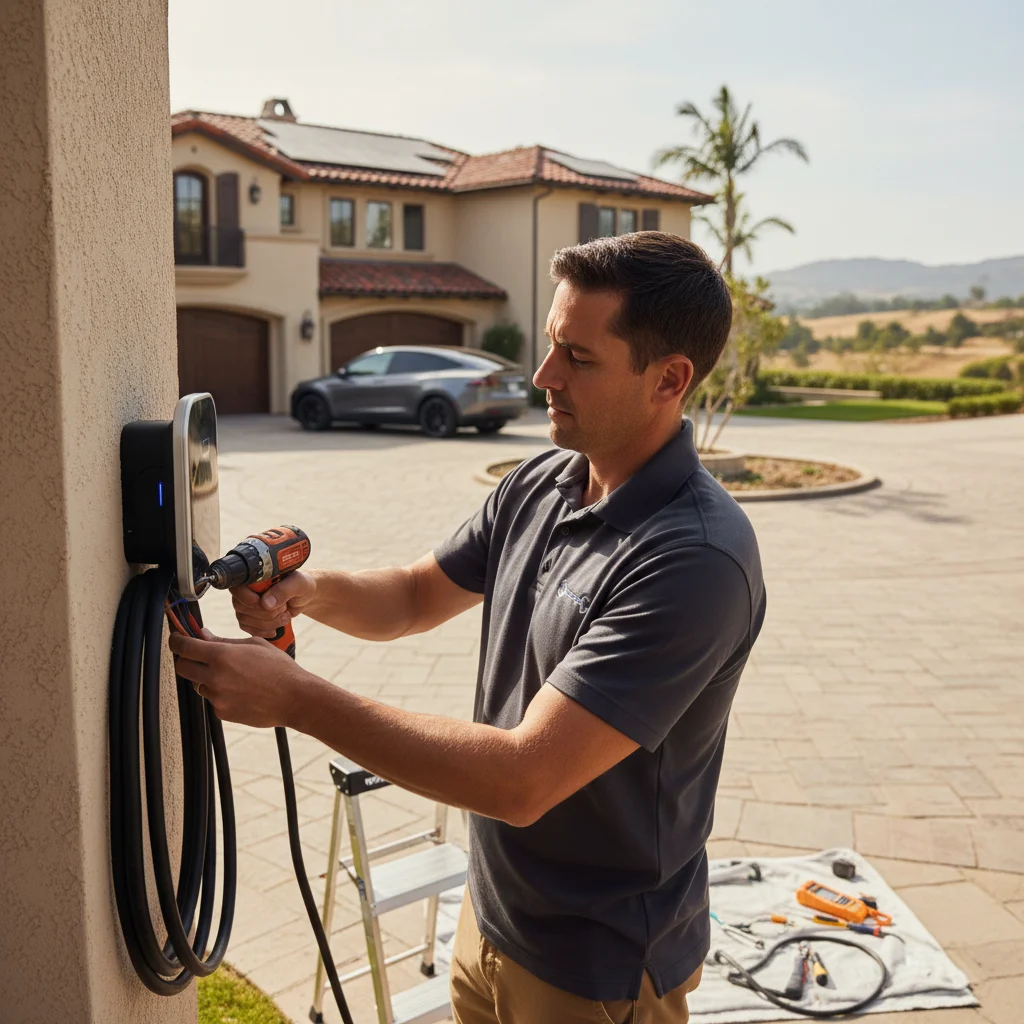
What shows up in the driveway
Charge Pro OC is a referral line for Orange County. We match stranded EV drivers with independent local mobile rescue operators. We don’t own trucks, yards, or parts. We don’t employ technicians. We don’t set prices or promise a clock. The pros we connect you with are licensed.
The operators in the network bring a 240-volt Level 2 source to the car. Tesla owners get a native NACS plug. Other brands get CCS or J1772 through an adapter. A typical session adds 10 to 20 miles of range in 15 to 30 minutes of charging. That’s charging time, not a promise of when someone arrives.
Ten to twenty miles is often enough to reach a Cabot Road stall, a Crown Valley Supercharger, or your own garage if the home unit still works. It isn’t a full pack. Don’t plan a long SR-74 run off a driveway charge. Plan the next plug.
They also handle a dead 12V on site. Tesla, Rivian, Lucid, Hyundai, Ford, Chevy, and the rest of the major EV list. If the car needs a shop, that’s a different call. Rescue first. Then a Tesla service appointment if the car can roll. Tesla lists Orange County service centers in Costa Mesa, Buena Park, Santa Ana, Irvine, Anaheim, and Aliso Viejo. Confirm the live address on Tesla’s findus pages before you drive there, because some of those listings were only confirmed from search snippets in this research pass.
Providence Mission Hospital Mission Viejo is the ER this community uses. That’s geography, not a charging stop. If someone is hurt, that’s 911, not a referral line.
Neighboring foothill towns share the same weather
Rancho Santa Margarita sits on Antonio Parkway, with Plaza Antonio as the named EVgo stop. Trabuco Canyon, Las Flores, Ladera Ranch, and Mission Viejo share the Santa Ana foothill heat. Each has its own gate and HOA story. Coto’s version is the dual gate plus the interior Los Ranchos gate, on roads with no freeway through-line.
If you empty out on SR-241, that’s a toll-road problem, not a Coto driveway problem. If you empty on Santiago Canyon or Ortega, stay on the shoulder and treat it as a canyon stranding. This page is for the streets inside the community: quiet, gated, steep, and horse-crossed.
We serve every city in the county, and this unincorporated place too. The operator still needs that gate call. Keep the gatehouse number in your phone next to the car’s app. When the pack is already low, don’t wait until you’re between the north gate and the south gate with nowhere to pull out.
Frequently asked questions
Can a mobile charger come through the Coto de Caza gates?
Yes, if you clear the visit. This is a dual-gated private community, with a third gate at Los Ranchos Estates. Call the gatehouse, give the operator’s name, and stay reachable. Charge Pro OC doesn’t hold a gate code or a property roster.
Where do Coto drivers actually fast-charge after they leave?
Named Tesla Superchargers in Laguna Hills sit at 25248 Cabot Road and 23701 Moulton Parkway. Mission Viejo has Crown Valley Parkway and The Shops. EVgo lists 14 DC fast ports at Plaza Antonio, 22351 Antonio Parkway, in Rancho Santa Margarita. Confirm stall status in an app before you depend on one.
What if the car won’t start in the garage, but the pack isn’t empty?
Treat it as a 12V problem first. The small battery wakes the car. Operators in this network can jump or replace it on site. If the high-voltage pack is actually at zero, that’s a charge at the driveway, not a jump.
If the car is already silent on a Coto street, call Charge Pro OC at (949) 444-0151. That’s the referral line. The operator who takes the job quotes you first, bills you directly, and still needs you to clear the gate.