The car is quiet on Coto de Caza Drive. The gate is already behind you. Or the pack hit zero on the grade toward The Village. EV roadside assistance in Coto de Caza starts at the car. You want a 240V charge or a 12V jump. Keep it on your street. A wrecker through two guarded entries is the backup.
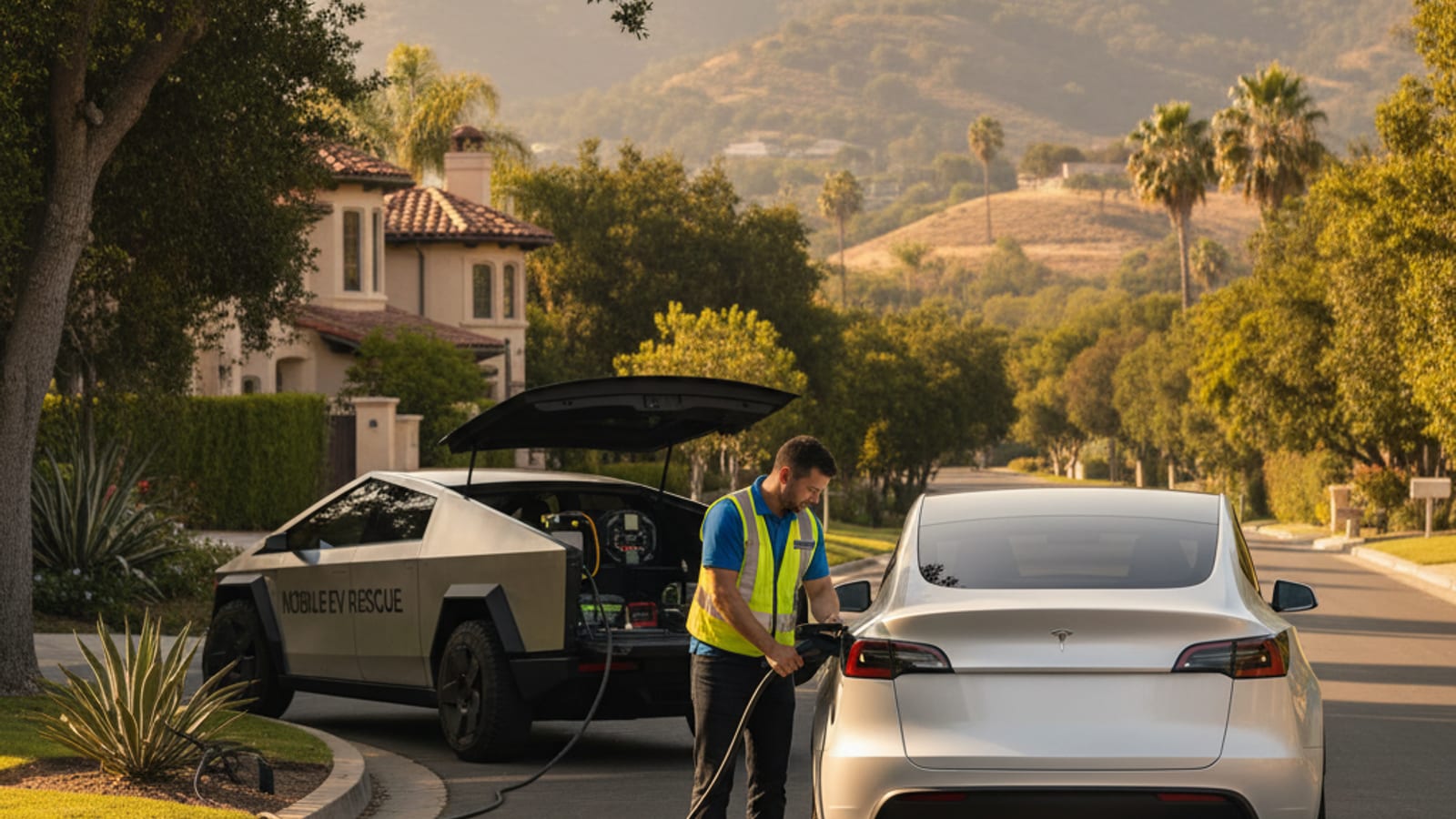
Coto de Caza isn’t a city, and the booths run the map
There’s no City of Coto de Caza. It’s an unincorporated census-designated place in Orange County. The County of Orange Housing Element lists it with the other unincorporated CDPs. About 15,363 people live here. The ZIP is 92679. Write that on a gate pass or a tow slip. Don’t invent a city hall.
There’s no freeway inside the community. There’s no state highway either. SR-241 is the nearest freeway. I-5 is reached on Oso Parkway or on SR-74. The private spine is Coto de Caza Drive. Vista del Verde and Robinson Ranch Road feed the interior. Two guarded entries control the whole place. The north gate meets Oso Parkway. The south gate meets Antonio Parkway and Plano Trabuco.
Los Ranchos Estates adds a third gate. Roughly 75 custom homes sit behind that inner booth. If your car died there, clearing Coto de Caza Drive isn’t enough. Put the inner gate on the list too.
The operators Charge Pro OC refers can’t bluff the booth. Add them as a guest before they roll. Give the guard a name. Stay on the phone. That’s how a quiet on-site charge stays quiet.
Wagon Wheel Canyon spends range the dash didn’t budget
This community sits in Wagon Wheel Canyon. That’s against the Santa Ana foothills. The walls are steep. The internal roads are narrow and winding. An oak riparian creek holds the bottom. Long grades run between the north gate and the south gate. Horse-trail crossings appear with little warning. Rural fire-corridor conditions are normal here. They’re not a special event.
It’s the hottest, most sheltered pocket in South Orange County. Marine air never arrives. Heat sits in the canyon. High-fire-risk brush lines the park edge. Thomas F. Riley Wilderness Park wraps the community east, north, and south. The Wagon Wheel Canyon staging area is the park access most residents use.
Remaining-miles estimates come from flatter Orange County driving. The climb from the south gate toward Canyon Estates isn’t that drive. Neither is the pull from Oso toward The Lodge. Arrive at 8% with the garage uphill. You can still strand in the driveway.
Name the pocket when you call. Try The Village or Canyon Estates. Grand Coto Estates and Silver Creek work too. So do Summerfield, Spring Hill, and Oak Ridge. Villa Serena, The Woods, and Los Ranchos Estates are the rest. The Coto de Caza Golf and Racquet Club has 36 holes. The Lodge at Coto de Caza is another pin. So are Coto Valley Country Club and the Coto de Caza Equestrian Center. A dispatcher can use any of those.
If the garage charger didn’t finish the job, stay with the car
Most trips here start at a wall unit. Long private streets make that the default. Then the breaker trips. The cable won’t latch. Or the car sat until the 12V quit. Walking Coto de Caza Drive for a random outlet is a bad plan. Horse crossings and fire-corridor shoulders aren’t a hunting ground.
Mobile EV charging brings a 240V Level 2 source to the pad. You get enough miles to go where you meant to go. The operator quotes before any work starts. You accept or you don’t. Charge Pro OC doesn’t set the price. It doesn’t bill the session. The operator does.
A typical charge adds 10 to 20 miles of range. That takes 15 to 30 minutes of plug time. That’s charging time only. It isn’t a promise about when someone arrives.
For the local map after you can roll, start here. Use the Coto de Caza charging page. Then read EV charging in Coto de Caza.
Empty pack: you need energy at the inlet
You spent the last miles on the grade. Oso Parkway crawled. You looped Robinson Ranch Road once more than the buffer allowed. The app shows dashes. The car won’t pull to Antonio Parkway.
That’s a high-voltage miss. A 12V jump won’t fill the pack. A tow through the north gate only relocates an empty car.
Tesla’s published roadside path for a depleted battery is transportation. It isn’t a charge at the bumper. Confirm the live wording on Tesla’s roadside page before you assume a free rescue. Tesla Roadside Assistance, as listed on the Santa Ana service page, is 877-798-3752. An empty pack is a different job from a mechanical breakdown.
The Model Y owner’s manual adds a catch. Once range is gone, the low-voltage battery can lose support. You may need external power first. Then the high-voltage pack can take a charge. A car at zero can mimic a 12V brick. The operator at the curb sorts which failure you actually have.
Teslas take a native NACS plug. Other brands use CCS or a J1772 adapter. Lucid Air, Rivian, Mercedes EQS, Porsche Taycan, Hyundai, Ford, Chevy: same truck format, different inlet.
Dead 12V: full pack, no Ready, same silent driveway
Every EV still runs computers on a small 12V battery. Latches and contactors use it too. When that battery dies, the big pack can be full. The car still won’t wake. Screens stay black. The app hunts. Ready never comes.
Second and third cars sit. Coto has the highest median household income in South Orange County. Multiple vehicles per house is the usual pattern. The car that rested in Oak Ridge for three weeks is the Saturday brick.
Tesla 12V battery jumps show up often. Teslas are most of the county’s battery-electric fleet. The same 12V death hits a Rivian or a Lucid. It hits a Mercedes EQS, a Porsche Taycan, a BMW, or a Hyundai. Operators in the network can jump on site. If the battery is finished, they quote a replacement before they pull it.
Don’t throw gas-car clips on unmarked posts. Jump-start steps for an EV exist if you try anything while you wait. Newer Model 3 and Model Y cars use a lithium 12V. That isn’t the old lead-acid brick. The wrong procedure can strand you twice.
DC fast sites South County drivers already have in the nav
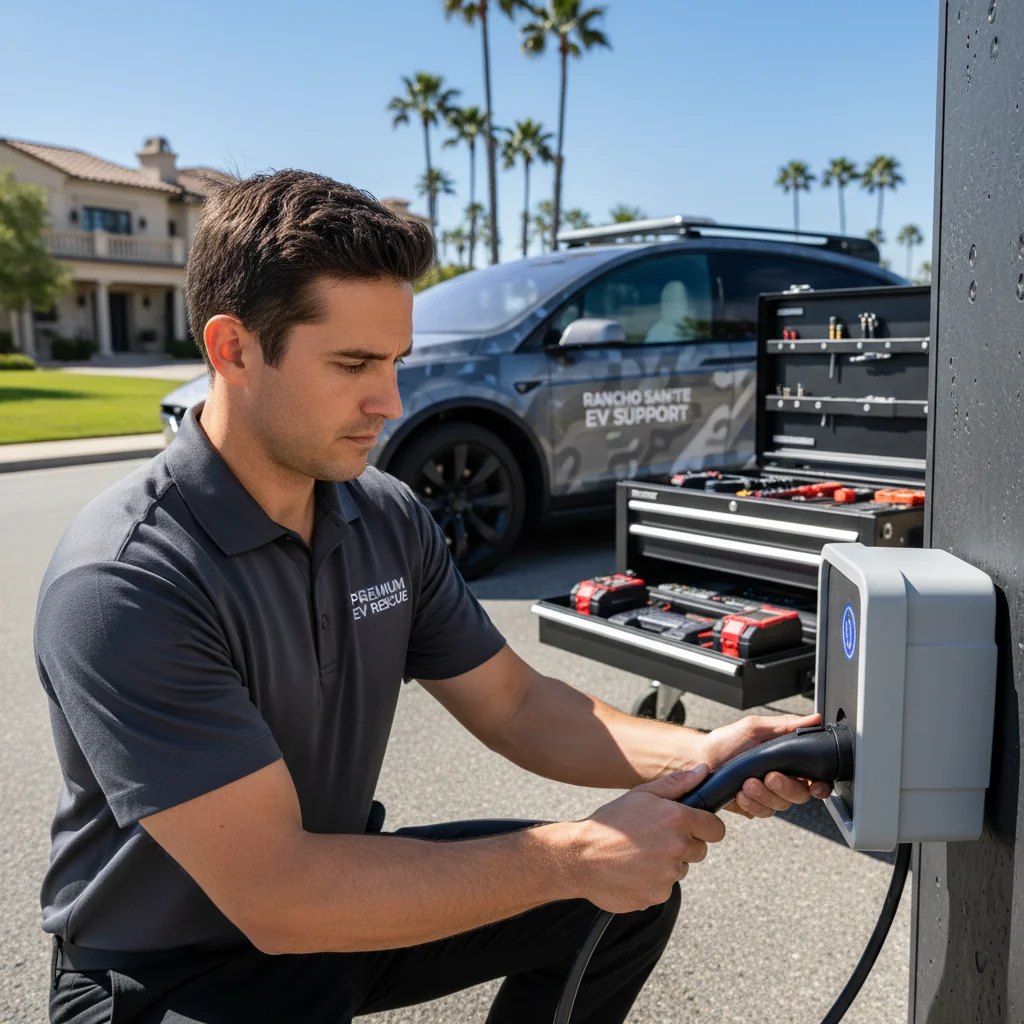
After you have a buffer, these are named, verified public sites. Laguna Hills has Tesla Superchargers at 25248 Cabot Road. That’s 16 stalls, up to 250 kW. Also 23701 Moulton Parkway, 16 stalls, up to 250 kW. Mission Viejo has 27741 Crown Valley Parkway, 24 stalls at 250 kW. Also 555 The Shops at Mission Viejo. That’s 10 stalls at 72 kW on Tesla’s listing. Rancho Santa Margarita has EVgo at Plaza Antonio, 22351 Antonio Parkway, with 14 DC fast ports. Ladera Ranch has EVgo at Westar Mercantile East, 27542 Antonio Parkway, 8 DC fast ports. Lake Forest has Tesla at 24301 Muirlands Boulevard, 24 stalls at 250 kW. Also 24372 Rockfield Boulevard, Magic Dock, 16 stalls at 325 kW, CCS1 and NACS.
Check the stall in your app before you spend the new miles. AFDC records lag. In-car maps lag too. Ten to twenty miles is a buffer you choose a destination with. It isn’t a claim about any one drive.
What the California Energy Commission file says about this county
As of December 31, 2025, Orange County had 210,842 battery-electric vehicles on the road. Plug-in hybrids: 47,567. Fuel cell: 2,424. ZEV total: 260,833. The CEC light-duty universe was 2,469,737. ZEVs are 10.56% of that fleet. BEVs alone are 8.54%.
California in the same file: 1,754,366 BEVs and 2,236,896 ZEVs. That’s 7.54% of the state light-duty fleet. Orange County holds 12.02% of California’s battery-electric vehicles. It’s 8.33% of the state’s light-duty fleet.
Tesla share is higher here than statewide. 138,121 Teslas out of 210,842 BEVs, 65.51%. California’s Tesla share of BEVs is 61.34%. Orange County is 6.4 points more Tesla-concentrated. Tesla’s share of new Orange County ZEV sales was 56.9% in 2023. It was 47.2% in 2024 and 44.7% in 2025. In the first half of 2026 it was 56.4%.
Orange County’s ZEV share of new light-duty sales was 28.76% in 2025. California’s was 22.93%. In 2026 Q2 it was 24.77% here and 19.09% statewide. That’s 5 to 6 points above the state, consistently. Don’t call it acceleration. California’s ZEV share of new sales peaked at 25.31% in 2024. 2026 Q1 was the weakest quarter in the series at 15.76%. CEC changed new-sale methodology in 2023 and again in 2025. Year-over-year reads across those breaks aren’t clean.
Public charging in Orange County as of December 31, 2025 ran like this. 20 Level 1 ports. 5,600 Level 2. 1,475 DC fast. 7,095 public ports in all. Shared private: 4,685. Grand total public plus shared private: 11,780. Orange County holds 7.75% of California’s public ports. 260,833 ZEVs on 7,095 public ports is 36.8 ZEVs per public port. Statewide the ratio is 24.4. Orange County is thinner per EV than the state average.
Tesla operates 48 Supercharger sites in the county, 861 DC fast ports. Countywide DC fast charging: 223 stations, 1,452 ports. Without Tesla: 175 stations, 591 ports. Tesla holds 59% of public DC fast ports. ChargePoint has the most sites and about 1.1 ports per site, mostly dealership singles.
Those figures explain the county. They don’t open the south gate. They do explain why a gated canyon still needs on-site help.
Charge Pro OC is the match, not the crew
Charge Pro OC is a referral line. It serves stranded EV drivers in Orange County. It matches you with independent local mobile rescue operators. It performs no work. It owns no trucks. It owns no equipment. It employs no technicians. It holds no license. It sets no prices. It promises no arrival window. It publishes no hours.
The operator quotes before starting. The operator bills you directly. They bring a 240V Level 2 source. They bring a native NACS plug, plus CCS or J1772 adapters. They jump or replace a dead 12V. They handle Tesla and every major EV brand.
That’s the product on these streets. Quiet energy at the car, or a 12V wake-up. If you’re weighing a hook, read mobile EV charging or a tow. Charge first when the car is intact. Do that in a driveway or on a safe internal shoulder.
North gate, south gate, then the inner booth
Use the resident line for the correct entry. North gate: Coto de Caza Drive at Oso Parkway. South gate: Coto de Caza Drive at Antonio Parkway and Plano Trabuco. Los Ranchos Estates needs the inner gate after you’re already inside.
Give the guard a window and a vehicle description. Oak cover along the creek drops GPS. Add a neighborhood, a cross street, and the house number in 92679. Vista del Verde and Robinson Ranch Road look close on a map. They don’t feel close on the grade.
If you’re in a staff lot at the Golf and Racquet Club, say that landmark. Same for The Lodge, the equestrian center, or Coto Valley Country Club. Member lots still need a host to clear a visitor.
Stay with the car on narrow segments. Don’t stand in a blind curve. Don’t block a horse crossing. Fire-corridor roads need a lane. Hazards on if you’re stopped on Coto de Caza Drive.
When the operator arrives, hear the quote again. 240V goes in your inlet. You wait through the charge. You don’t need a second scene at the booth on the way out.
If you died on the public side of the booth, say so. Oso Parkway and Antonio Parkway aren’t the private drive. The gate script changes. The charge at the bumper doesn’t.
Same rim, different maps
Rancho Santa Margarita sits west, with Plaza Antonio on Antonio Parkway. Trabuco Canyon and Las Flores follow the same foothill pattern. Ladera Ranch sits down toward I-5. Mission Viejo holds Crown Valley and The Shops. If you recovered enough range to leave, those are the usual next maps. If you stranded before the gate, don’t drive the car dead toward them.
Providence Mission Hospital Mission Viejo is the ER for this corner. That’s for people. The car stays where it is.
Why a wrecker is a poor first call on these streets
A wheel-lift on an all-wheel-drive EV can damage a drive unit. A locked car with a dead 12V may not enter tow mode. Two gated entries plus Los Ranchos make a wrecker a production. Use a flatbed only if the car must move with no power. Use it after a charge or jump can’t happen where you sit.
Wrong jacking points on a low EV crease a pack cover. That’s a shop visit you didn’t have at dinner. The operators this line refers are there for energy and 12V. They’re not a full mechanical shop in your driveway.
What to say in the first minute
Give make, model, and year. Say Tesla or not. Name the inlet if you know it: NACS, CCS, or J1772. Say empty pack, or a car that won’t wake. Give the neighborhood and the gate. North, south, or Los Ranchos. Say whether the car is in a garage, on a shared drive, or on Coto de Caza Drive. Say whether a home charger is present and whether it failed.
VIN helps if the 12V is so dead the app is useless. Don’t promise the operator a code at the booth you haven’t requested. Don’t leave the car on a blind uphill with no hazards.
Frequently asked questions
What if the pack is empty behind Coto’s gates?
Stay with the car. Clear the north or south gate for a guest. Ask for mobile EV charging. The operator brings 240V Level 2 to your inlet. You typically gain 10 to 20 miles in 15 to 30 minutes of charging. Then you drive. Tesla roadside, if you call them, is built around transport on a depleted pack, not a curb charge. Confirm their current policy on their site.
Can an operator jump a Tesla 12V in a Coto driveway?
Yes. Operators in the network jump a dead 12V. They can quote a replacement if you want that. Tesla and the other major EV brands use the same small battery for wake-up. A full pack with a dead 12V still looks like a brick. Don’t assume you need a tow.
Do the operators handle non-Tesla EVs inside the community?
Yes. They carry NACS plus CCS or J1772 adapters. Rivian, Lucid, Mercedes, Porsche, Hyundai, Ford, Chevy, and the rest follow the same on-site pattern. Charge Pro OC doesn’t do the work. The operator at your curb does.
If you want that referral, call Charge Pro OC at (949) 444-0151. You’ll get an operator quote before any cable goes in.