A dead EV in a Disneyland parking garage creates two problems. The car needs help, but an outside operator first needs permission and an exact location. Gather those details before arranging a charge, jump, or tow.
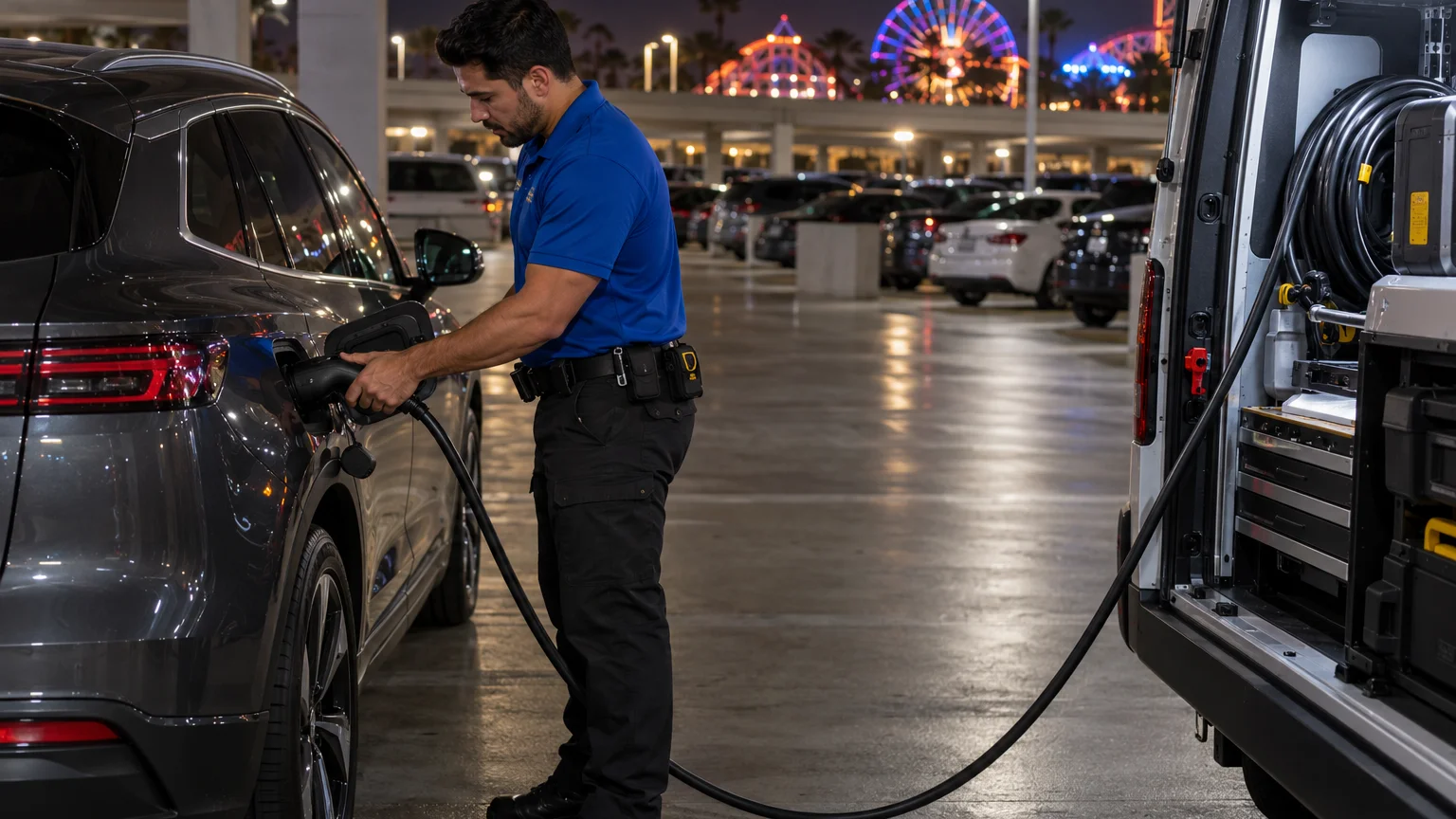
Confirm the structure, level, row and nearest marker
Start by recording the location as if the operator has never visited the property. “Disneyland parking garage” isn’t precise enough. Large resort parking areas can contain repeating rows, ramps, pedestrian routes, and several possible entrances.
Write down every identifier visible near the EV:
- The structure or parking-area name shown on nearby signs
- The level or floor
- The row, section, or character marker
- The nearest pillar, wall, or elevator marker
- The parking-space number, if one appears
- Whether the EV is near a ramp, corner, elevator, or pedestrian path
- The direction the vehicle faces
- The entrance you used
Take wide photos showing the car and surrounding markers. Then take close photos of each sign. A dropped map pin can help, but concrete structures can weaken location accuracy. Treat the pin as supporting information, not the full location report.
Share the vehicle’s color, make, model, and license plate. Mention anything that makes it easier to spot, such as a roof box. Don’t rely on “near the elevators” when several elevator areas may look alike.
The Anaheim resort district sits near I-5, but freeway proximity won’t guide an operator through a private parking structure. The usable location is the structure, level, row, and nearest posted marker. Our broader Anaheim EV roadside assistance guide covers citywide breakdowns. Inside this property, access details matter more than the nearest public road.
Tell a sleeping 12V battery from an empty pack
Don’t order a particular service based only on “the car is dead.” An EV can become unresponsive because its low-voltage system isn’t waking the car. It can also stop because its high-voltage traction battery has no usable range. Those problems call for different equipment.
Report what happened before the EV stopped responding. Useful observations include:
- The last range or battery percentage you saw
- Any low-charge or low-voltage warning
- Whether the displays, locks, lights, or app still respond
- Whether the charge port opens
- Whether the vehicle shifts into gear
- Whether it shut down while driving or stayed parked
- How long it remained parked before the problem appeared
- Whether it’s connected to a charger
A dark screen alone doesn’t prove which battery is responsible. An empty range display before shutdown points toward a depleted traction pack. Working cabin electronics with no usable driving range also gives the operator helpful context. An entirely unresponsive vehicle may involve the low-voltage system, but it still needs diagnosis.
For a Tesla, the distinction matters even more after the displayed range is exhausted. Tesla’s Model Y guidance says the low-voltage battery can lose support after range exhaustion. An external power supply may then be needed before the high-voltage battery can accept a charge. That means an empty Tesla could need more than one step.
Our guide to a dead Tesla pack versus a 12V problem gives more diagnostic context. If the Tesla won’t start at Disneyland, report symptoms instead of guessing. The matched operator can decide what equipment fits them.
Contact parking staff before arranging outside access
Contact parking staff before sending an outside service provider toward the property. Staff control the parking area. They can tell you where to wait, which entrance to use, and whether an outside vehicle may enter the structure.
Current outside-service access rules couldn’t be confirmed from the approved research for this page. The research also didn’t confirm a dedicated parking-assistance phone number, access fee, or service schedule. Don’t rely on an old forum post or an unrelated search result. Ask on-site parking staff and check Disneyland’s current official parking guidance.
Tell staff that the EV can’t move under its own power. Give them the structure, level, row, marker, and vehicle description. Then ask these direct questions:
- May an outside mobile charging or roadside vehicle enter?
- Which entrance should the operator use?
- Does the operator need to meet a staff member first?
- Are there vehicle-size or equipment restrictions?
- Can a tow truck enter this level?
- Is there another approved pickup or recovery point?
- Should the driver remain with the EV?
Record the instructions exactly. Get the staff member’s location or department if they provide it. Don’t claim that permission has been granted until staff actually confirms it.
Charge Pro OC is a referral service. We connect drivers with licensed, independent local operators. We don’t control property access, and we can’t authorize entry. Parking staff decide whether an outside provider may enter. The matched operator then decides whether its vehicle and equipment can safely use the approved route.
For problems elsewhere in the city, emergency EV roadside assistance may involve fewer property-access steps. A Disneyland structure adds a separate layer of coordination.
Share the posted clearance and entrance instructions
Garage clearance can determine whether mobile charging or towing is possible. Don’t use a generic online answer for “most parking garages.” The only useful figure is the clearance posted at the actual entrance and along the approved route.
No verified clearance for a Disneyland parking structure was available in the approved research. Don’t estimate it. Ask parking staff which entrance applies, then photograph its clearance sign. If the route passes under another height marker, photograph that sign too. A lower restriction inside the structure may matter more than the first entrance sign.
Send the matched operator:
- A clear photo of each posted clearance
- The exact entrance approved by parking staff
- Any lane, ramp, or turn restrictions staff provided
- The vehicle’s level and position
- Whether the EV is nose-in or backed-in
- The space available beside and behind the EV
- Any low overhead pipes, signs, or barriers nearby
Also describe the route from the entrance to the car. Mention tight turns, sloped ramps, narrow aisles, ticket equipment, and controlled gates when visible. Don’t state that any feature will block service. Give the operator the facts and let that operator evaluate its equipment.
A tow vehicle may need different clearance and turning space than a smaller service vehicle. Even if an operator can enter, reaching the EV may still be impractical. Parking staff may direct the recovery toward another location. That possibility should be resolved before the operator travels to the structure.
The California Energy Commission tracks charging infrastructure across California. Those records don’t establish current access rules for a privately controlled parking area. Posted signs and current instructions from parking staff govern this specific visit.
Choose a charge, jump or tow after diagnosis
Choose the service only after sharing the symptoms and access details. The right outcome may be a low-voltage jump, a mobile charge, or a tow. Parking staff and the matched operator both have a role in that decision.
A low-voltage jump may fit when the traction pack still has usable energy but the EV won’t wake. The operator needs the make, model, model year, warnings, and current behavior. Don’t connect equipment based on a generic online diagram. Access points and procedures vary by vehicle.
A mobile charge may fit when the traction battery is depleted and suitable equipment can reach the car. A typical rescue charge can add 10 to 20 miles of range during 15 to 30 minutes of Level 2 charging. That figure describes charging time, not arrival time. Actual range gained depends on the vehicle and conditions.
A tow may be needed when charging can’t solve the fault, the vehicle can’t accept power, or approved access prevents an operator from reaching it. A powerless EV can also require specific loading steps. Tell the operator whether the car can shift, steer, unlock, or release its parking brake.
Tesla’s roadside policy handles a depleted battery through transportation rather than on-site charging. That transportation isn’t financially covered as a warrantable breakdown. Drivers seeking another local option can review our Tesla roadside rescue referral service.
If the vehicle becomes drivable after a small charge, confirm the next charger before leaving the property. Anaheim has several verified Tesla Supercharger locations, but availability at arrival isn’t assured. Our guide to Anaheim Superchargers when they’re full explains how to prepare a backup.
When to call us
Call when parking staff has confirmed the access path and your EV needs a mobile charge, low-voltage jump, or operator assessment. Charge Pro OC makes the referral, while parking staff and the independent operator decide whether garage access is possible.
Call us at (949) 444-0151 and we’ll connect you with a local EV rescue operator.