You left the car in Mickey and Friends before the park opened. You walk back after fireworks, and nothing wakes. The traction pack still has range, but the 12-volt sat all day and died. That’s EV roadside assistance in Anaheim more often than an empty pack. The same structures fill for Disneyland Resort and Disney California Adventure. They also fill for an Angels game, a Ducks night, or a Convention Center show.
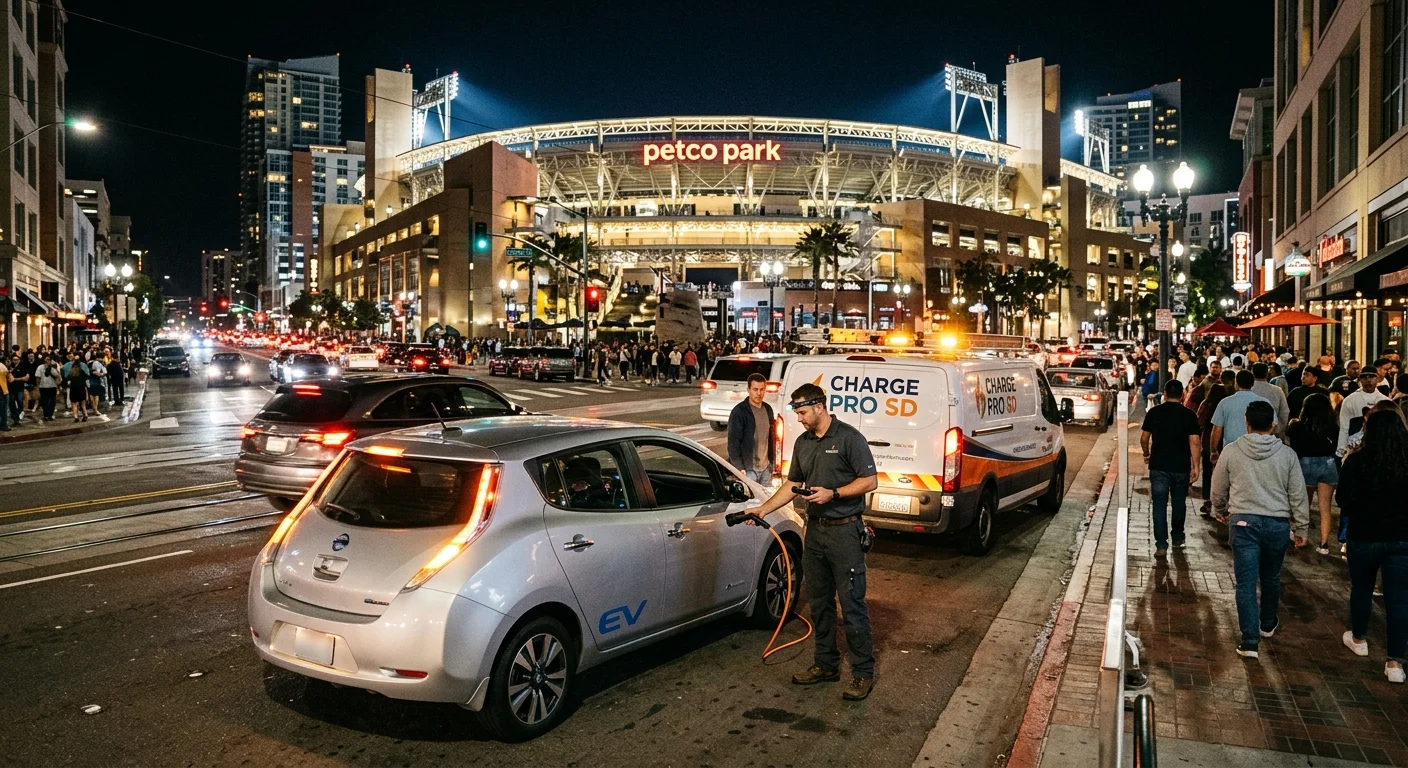
Why park and stadium lots kill the 12-volt
Anaheim is Orange County’s largest city, with 344,553 people. It also produces more long-dwell parking than any other city in the county. Long dwell is what kills a 12-volt battery. A family parks at Mickey and Friends or Pixar Pals in the morning. They come back after close. A Ducks crowd or an Angels crowd empties a garage in one wave. Trade-show cars sit at the Convention Center for three days. The high-voltage pack can still be fine, but the low-voltage battery isn’t. The screen stays black, and the door won’t open. You’re locked out of a car that still has miles in it.
The western resort side is flat, around 150 feet. You’re not on Weir Canyon after a park day. You’re in a structure off Harbor Boulevard or Katella Avenue. The car simply won’t boot in that garage.
Dead screen or empty pack
A 12-volt battery runs the computers, locks, and wake logic. Teslas and most other EVs still need that small battery. The big pack can be healthy and the car still sits dark. Tesla’s owner’s manual says that once range is gone, the low-voltage battery can lose support. It then needs an outside supply before the pack can charge. The park-lot version is more common here. The pack isn’t empty, and the 12-volt just quit.
A black screen and a silent door usually means the 12-volt. A car that wakes, shows zero miles, and won’t roll is a depleted pack. If you need that fork spelled out, use this 12-volt versus pack check.
Charge Pro OC is a referral line. It matches stranded drivers with independent local operators. It owns no trucks and does no work. The operator quotes you before starting and bills you directly.
The Anaheim Resort, then the Platinum Triangle
Harbor Boulevard and Katella Avenue feed Disneyland Resort and Disney California Adventure. Those structures are built for all-day stays. That’s the opposite of a short errand. Long hours in a parked EV are a 12-volt setting, not a Supercharger setting.
The Platinum Triangle is the night-game version. Angel Stadium of Anaheim and Honda Center sit there. ARTIC and the Convention Center sit on that same knot. You parked early and sat through extra innings or overtime. You came back to a brick, with a crowd behind you. EV roadside assistance in that garage is a jump or an on-site 12-volt replacement. It’s not a hunt for an open stall.
Convention Center weeks run slower and last longer. The car can sit Friday through Sunday. A 12-volt that seemed fine on Thursday is dead on Sunday night.
Katella stalls won’t wake a dead 12-volt
Anaheim has seven Tesla Supercharger sites, the densest cluster in the county. East Katella at 2404 E Katella Ave has 16 stalls. Lincoln Avenue has three sites: 1128 W Lincoln Ave, 1734 W Lincoln Ave, and 2270 E Lincoln Ave. Euclid Street has 16 stalls at 680 N Euclid St. Santa Ana Canyon Road has 20 stalls at 8148 E Santa Ana Canyon Rd. Imperial Highway has 16 stalls at 156 N Imperial Hwy. Electrify America has 10 DC fast ports at Walmart, 440 N Euclid St. It also lists DC fast charging at 1685 E Katella Ave.
Those sites matter when the car can drive. They don’t help when the 12-volt won’t wake the high-voltage system. Walking toward Katella with a brick in a structure wastes the night. If the pack is actually empty and the car still wakes, stay put. A mobile 240-volt charge at the space you already occupy is the other path. Operators bring a Level 2 source with a native NACS plug. They carry CCS or J1772 adapters for non-Tesla EVs. Typical charging time is 15 to 30 minutes for about 10 to 20 miles of range. That’s charging time, never an arrival time.
Tesla’s roadside policy answers a depleted pack with transportation, not an on-site charge. Running out of charge isn’t a warrantable breakdown. Tesla’s published free transport is for a covered failure. An empty pack sits outside that. Local operators handle the jump, the 12-volt replacement, or the curb charge instead.
If the Katella Superchargers are packed after a game, start with what to do when Anaheim Superchargers are packed.
Stay with the car
Don’t creep toward an exit on a dying 12-volt. Don’t join the post-game queue on Katella if the car’s already throwing low-voltage warnings. Stay where you’re legal and visible. If you’re locked out, don’t pry the handles. A Tesla 12-volt jump on site is what the operators we send try first.
Give the operator the structure name, the level, and the nearest row you can read. Mickey and Friends and Pixar Pals are private lots. So are Honda Center, Angel Stadium, and the Convention Center garages. We could not confirm those lots’ access rules for a rescue truck. The operator has to work with whatever the lot actually allows. Charge Pro OC can’t promise a truck onto private property. The person who shows up will say what access they can use.
Heat on the drive home, and the 91
August’s mean maximum at Anaheim’s NOAA station is 88.8 F. That’s about 15 degrees hotter than Newport Beach Harbor in August. AAA’s 2026 dynamometer study measured range at 95 F with the air conditioning running. It found an 8.5% loss of driving range. You may not be climbing Anaheim Hills after a park day. Cabin AC on Katella in August still spends range you wanted for the ride home.
The freeway knot is the other Anaheim stranding. I-5, SR-91, SR-57, and SR-55 all meet inside or at the city’s edge. Eastbound 91 is the commuter pipe toward Corona. A driver who stretched the last bar after fireworks ends up on that shoulder, not in the structure. Stay off the travel lanes. Ask for a charge or a 12-volt jump first, unless the car is in danger.
Santa Ana Canyon Road and Weir Canyon are the hill version. An EV showing twelve miles at the bottom doesn’t always have twelve miles of grade in it. That’s the climb east of the 55, not Harbor Boulevard.
Older housing, and who sells you power
About 65.7% of Anaheim’s homes were built before 1980. Apartments along Beach Boulevard and Lincoln Avenue are dense. A lot of that stock has no assigned charging. Those drivers live on public stalls. They have no driveway buffer when a park day runs long. An Anaheim house gets power from Anaheim Public Utilities, the city-owned municipal utility, not from SCE. Home EV rates and any rebates are an APU question. It doesn’t help at close in Pixar Pals.
If you’re weighing a jump, a mobile charge, and a hook, read charge, jump, or tow. A tow through a packed resort garage still leaves you needing power at the other end.
How the Anaheim referral works
Call Charge Pro OC when the car won’t wake in a resort or stadium structure. Call the same line if the pack is too low to reach a usable stall. We connect you with an independent operator. That operator handles Tesla and every major EV brand. The quote comes before any work starts, and you pay the operator.
The Anaheim charging and rescue map is here: EV charging in Anaheim. Fullerton, Buena Park, Garden Grove, Orange, and Yorba Linda sit next door. They see the same North County pattern on smaller lots.
For a dead car in a park structure or a Honda Center garage, call (949) 444-0151. We match you with a local operator. That operator quotes you before starting.