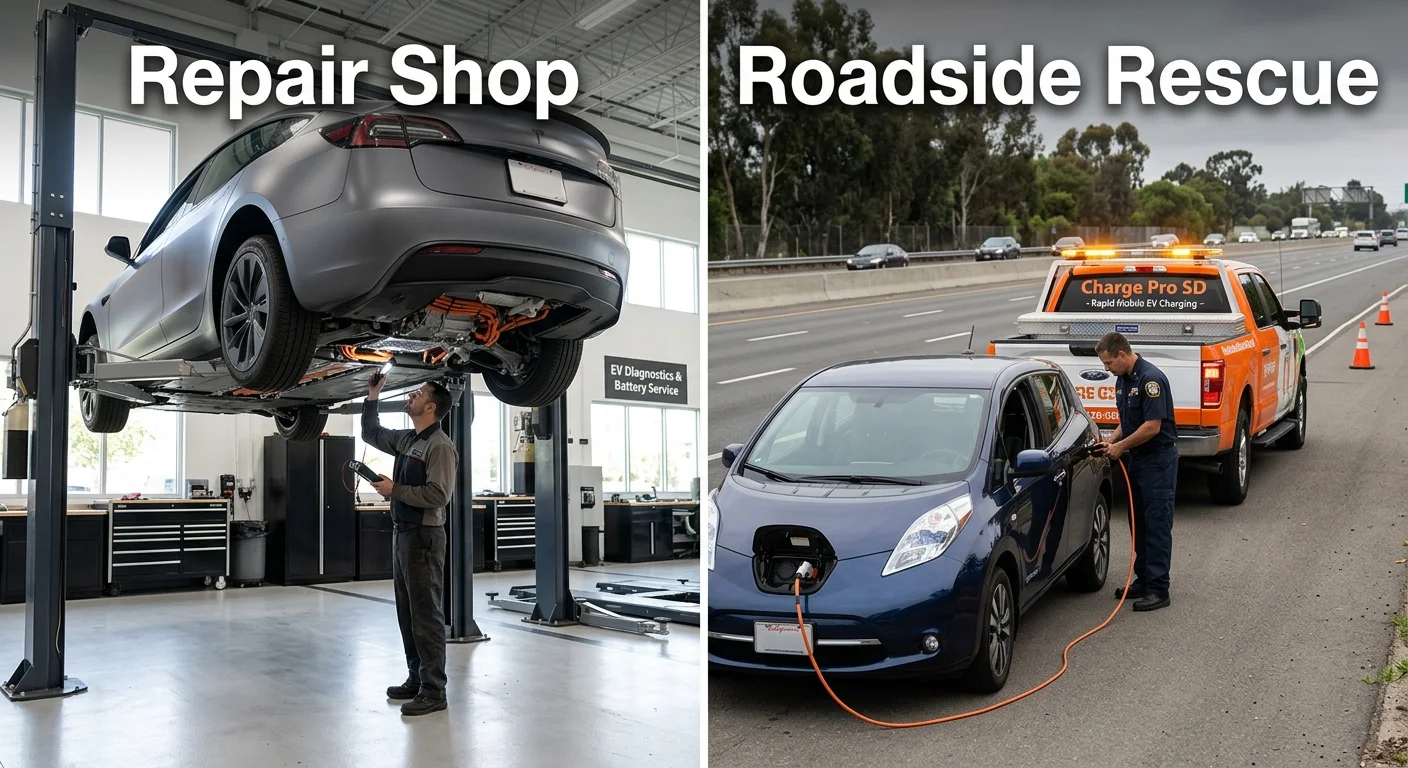
Searching “ev service orange county” usually hides a fork. One path is a booked bay at a Tesla Center or a brand dealer. The other is a car that already won’t roll. Tesla lists service in Costa Mesa, Buena Park, and Santa Ana. Irvine, Anaheim, and Aliso Viejo are on that list too. Confirm the current street address on Tesla’s find-us list before you drive. Those shops are built for diagnostics, warranty work, and scheduled repairs. A pack at zero isn’t a shop ticket. It needs a charge where the car sits.
Why the search term points at two jobs
Most owners type “EV service” when a light stays on. Some type it when range feels off. Others type it after a recall letter. That’s shop work, not a shoulder rescue. It needs a lift, a parts counter, and time on the books.
CEC counted 210,842 battery-electric vehicles in Orange County. That’s the on-road figure as of December 31, 2025. Teslas were 138,121 of them, 65.51 percent of the battery-electric fleet. Tesla’s share of all Orange County light-duty vehicles was 5.59 percent. The county holds 12.02 percent of California’s battery-electric cars. It’s only 8.33 percent of the state’s light-duty fleet. When two-thirds of local EVs are Teslas, “service” defaults to a Tesla Center. That’s the right call for a noise, a software visit, or a warranty claim. It doesn’t wake a car that’s already dead.
CEC charger files from the same date list 7,095 public ports in the county. That includes 5,600 public Level 2 ports and 1,475 public DC fast ports. Orange County has 36.8 ZEVs per public port. The statewide ratio is 24.4 ZEVs per public port. The county has more EVs per public port than California as a whole.
AFDC station data shows 48 Tesla Supercharger sites inside the county. Those sites host 861 DC fast stalls. Irvine’s site at 1920 Main Street lists 40 stalls. San Clemente’s site at 101 West Avenida Vista Hermosa lists 49. Garden Grove’s Harbor Boulevard site lists 32. Tustin’s Franklin Avenue site lists 36. Those stalls help once you can drive. They don’t replace a charge at the bumper.
What belongs in a service bay
Book a service center when the car still drives. Persistent alerts belong in that bay. So do odd noises, recall work, and warranty diagnostics. Brake fluid, cabin filters, and tire wear still matter on an EV. Software that needs a dealer tool belongs in a bay, not on a shoulder. If the onboard charger won’t accept a home plug, that’s a shop diagnosis. Climate control that died while the car still rolls is shop work too. Suspension faults, motor faults, and high-voltage pack inspection need a lift.
The operators Charge Pro OC refers don’t do that work. They don’t stock parts or run a warehouse. They don’t perform licensed repair work. Charge Pro OC is a referral line. It matches stranded drivers with independent mobile operators. It holds no trade license and owns no trucks.
Tesla Collision is a different map from Tesla Service. Collision sites handle body work, not roadside charging.
For a model-by-model sense of scheduled items, start with your owner’s manual. A county overview of intervals is in our EV maintenance guide. None of that schedule applies while the car is already stuck.
A dead pack isn’t a shop ticket
If you can’t move the car, you aren’t shopping for a bay. You’re shopping for energy at the bumper. Tesla’s published roadside language treats a depleted pack as transport. It isn’t framed as a covered breakdown. Confirm the current wording on Tesla’s roadside page. Also open Tesla’s North America roadside policy PDF before you rely on it. The honest read of what Tesla publishes is simple. An empty pack isn’t a warrantable failure. Tesla can arrange a move to a shop. That move is framed as transportation, not as charging at the car.
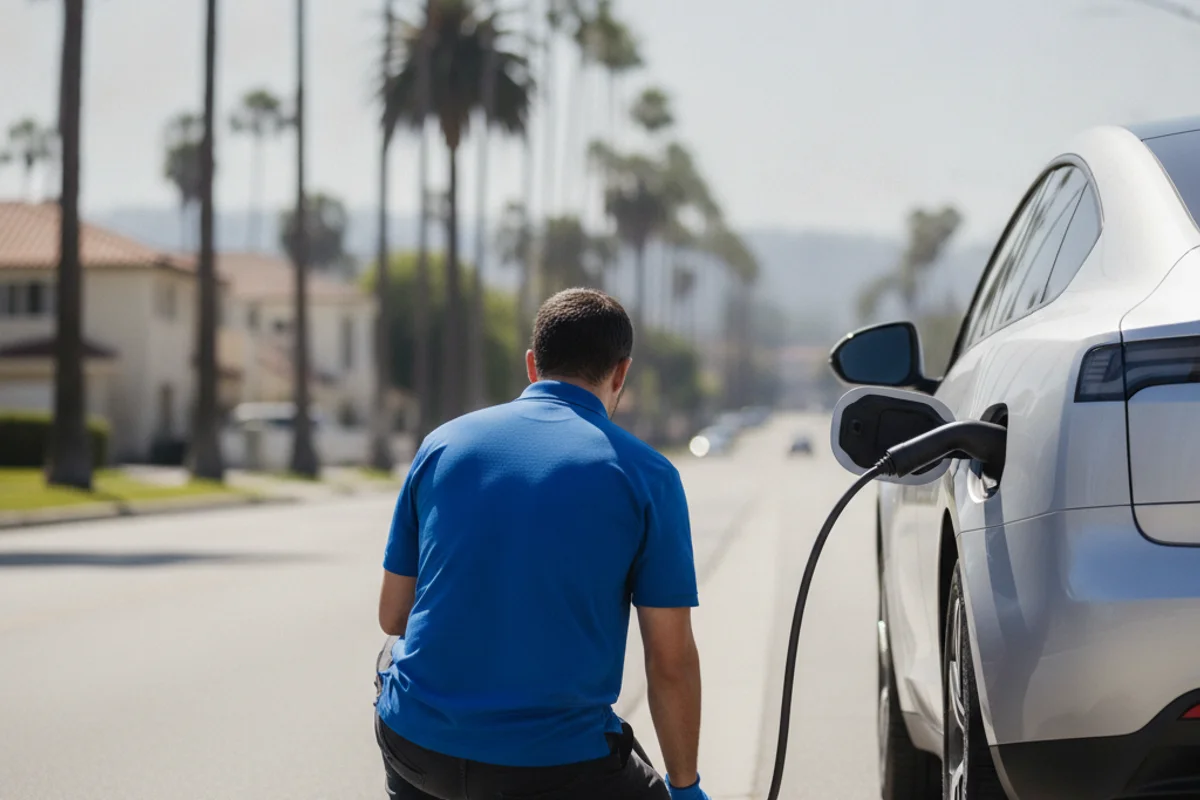
That’s the gap local mobile EV charging fills. An independent operator brings a 240-volt Level 2 source to the car. Teslas take a native NACS plug. Other brands use a CCS or J1772 adapter. Typical sessions add about 10 to 20 miles of range. That’s 15 to 30 minutes of charging time. It isn’t a promise of when anyone arrives. The operator quotes first, then bills you directly.
Use out-of-charge recovery when the high-voltage pack hit zero. Use EV roadside assistance when you’re stuck and need the right next step. Don’t request a tow first if a curb charge will reach a stall. A shop can’t start until the car is on its lot. Rolling it empty usually means a flatbed before any diagnosis.
12-volt failure can look like a dead EV
Many “won’t start” calls aren’t an empty pack. They’re a dead 12-volt battery. Tesla’s Model Y owner’s manual notes a related sequence. Once range is gone, the low-voltage battery can lose support. The high-voltage pack then needs an external supply before it will charge. Lights that won’t wake often point at 12-volt. So do doors that won’t release, and a silent screen. A full-looking main battery with a car that won’t ready is the same clue.
Operators can jump or replace a 12-volt on site. That covers Tesla and every major EV brand they’re sent to. If you’re unsure which battery failed, start with the 12-volt checks. Our dead-pack versus 12V guide walks through that fork. A Tesla 12V jump is still roadside work. It isn’t a Tesla Center visit.
How the county’s shop map actually sits
Tesla publishes service in six Orange County cities. Costa Mesa has two Tesla Service listings in Tesla’s find-us paths. Buena Park, Santa Ana, and Irvine each have one listing. Anaheim and Aliso Viejo round out Tesla’s county service set. Street numbers in third-party writeups go stale. Tesla’s United States service list is the live source.
Those shop cities also have Superchargers you can use after a rescue charge. Costa Mesa has stalls on Bristol Street, South Coast Drive, and Hyland Avenue. Anaheim has sites on Lincoln, Katella, Euclid, and Santa Ana Canyon Road. Irvine’s Main Street array lists 40 Tesla stalls. Santa Ana has stalls on 17th Street and East 5th Street. Buena Park has Beach Boulevard and Knott Avenue sites. Lake Forest has a Magic Dock Supercharger on Rockfield Boulevard. It lists CCS1 and NACS on the same site.
South county is a different housing pattern. Aliso Viejo’s Tesla Service listing sits in a planned-community grid. San Clemente’s Vista Hermosa Superchargers include a 49-stall site. Dana Point has a 12-port Electrify America site in Capistrano Beach. Rancho Santa Margarita has a 14-port EVgo site at Plaza Antonio. Fashion Island in Newport Beach has an 8-port Electrify America site. Those plugs help once you can still roll into the lot. They don’t help a car already dark in a structure. The same split shows up in Irvine office-park garages. A workplace charger that’s taken is a stall problem. A car at 0 percent is a rescue problem.
Non-Tesla DC fast charging exists countywide. AFDC counts 223 public DC fast stations and 1,452 DC fast ports in Orange County. Without Tesla, that’s 175 stations and 591 ports. Tesla still holds 59 percent of the county’s public DC fast ports. ChargePoint sites are often a single dealership plug, not a rescue network.
How to choose in one pass
If the car drives, even poorly, book the brand. Take it to Tesla Service or your dealer while it still moves. If a light is on and you’re still rolling, don’t wait for a shoulder. If the car is immobile, skip the shop queue. Ask whether the 12-volt is dead or the pack is empty. Then request a jump or a Level 2 charge at the bumper.
Don’t call a referral line for a rattle. Operators won’t lift the car for a noise. Don’t call a service center hoping they’ll charge you in a parking structure. That isn’t what those bays do. Anaheim Katella lots and Buena Park auto-row lots fill with all-day parking. A dead 12-volt there is still a curb job.
When a referral line is the right call
Call Charge Pro OC when the car can’t move. Empty pack, dead 12-volt, or a session that won’t start at the curb. The operators we connect you with handle Tesla and the major non-Tesla brands. They bring the 240-volt source. They don’t replace a high-voltage pack, update firmware, or inspect a motor. After a charge, drive to a Supercharger if you still need a stall. Take a dealer bay if the car still needs eyes on it.
Confirm Tesla policy yourself if you’re weighing Tesla Roadside against a local operator. Tesla’s roadside number, as published on the Santa Ana service page, is 877-798-3752. Tesla’s transport language ties covered transport to a warrantable breakdown, not an empty pack. Running out of charge sits outside that frame, per Tesla’s published roadside wording. Open the policy PDF before you assume coverage.
When you want a local operator instead, call (949) 444-0151. You’ll get a quote from the operator before anything starts. Charge Pro OC doesn’t dispatch a branded fleet. It refers the job. Stay with the car if you’re on a shoulder, and keep hazards on. Let the operator reach the bumper, not a shop across town.