The EV maintenance schedule for Orange County is short. The missed item is still the 12-volt battery. The California Energy Commission counted 210,842 battery-electric cars here. That snapshot is as of December 31, 2025. Those cars don’t need oil. They still need a small battery that can wake the pack.
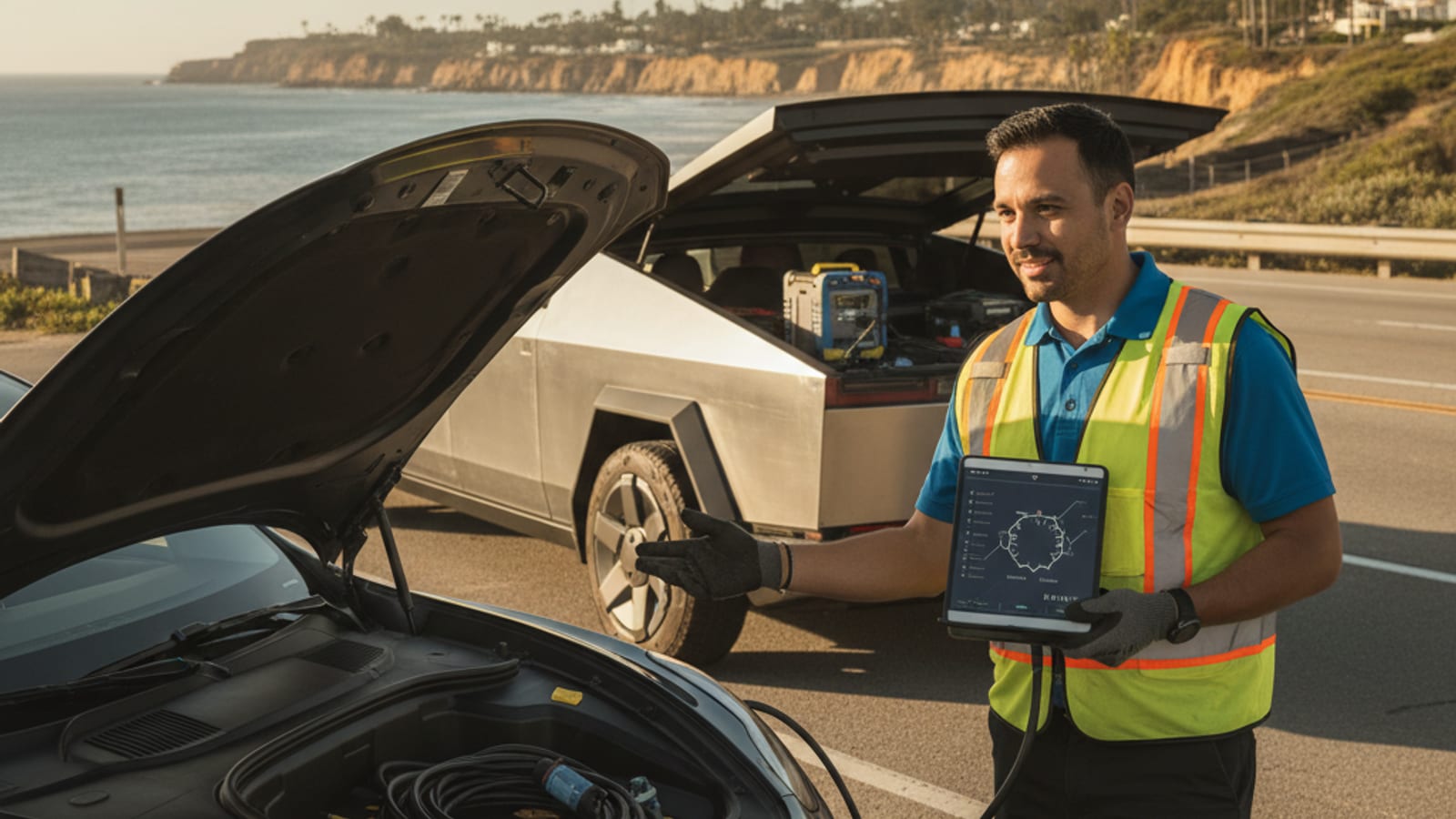
The big pack gets the attention. The 12V does the quiet work. It runs locks, screens, and the computer that brings the high-voltage system up. If that little battery is dead, the car looks fully dead. Range on the app can still look fine. Tesla’s Model Y owner’s manual describes the low-voltage battery losing support once range is exhausted. The car then needs external power before the pack can charge. The same no-start happens in a garage with a full bar. That’s why the 12V belongs on the schedule.
Skip oil. Don’t skip the small list.
An EV has no engine oil. Spark plugs are gone too. There’s no fuel filter. There’s no timing belt. Many models use a single-speed drive unit. A traditional transmission flush isn’t a regular stop. That’s the shorter list. It’s true. It isn’t the whole job.
What remains is smaller. Skipping it strands you faster than a late oil change ever did. Tires still wear. Brake fluid still ages. Coolant still moves heat. The charge port still has to latch. The 12V still has to hold. Orange County’s fleet makes that last item common, not rare. Battery-electric cars were 8.54 percent of the county’s light-duty fleet. Zero-emission vehicles were 10.56 percent. Teslas were 138,121 of the 210,842 BEVs. That’s 65.51 percent of the battery-electric fleet. A dead Tesla 12V is the pattern operators see most.
Put the 12V on the short visit
Treat the 12V as a scheduled test. Don’t wait for a dark dash. Have it checked when tires or filters are already due. Early signs are slow screens and weak locks. The car may not wake at all. If it won’t wake, look at the app. A healthy pack percentage with a dead car points at 12V, not an empty pack.
Your owner’s manual sets replacement timing. This page won’t invent a year count. Confirm 12V coverage in the booklet that came with the car. Don’t assume it rides with the pack. A shop can load-test it before it fails. If you’re already stuck, ask for a 12V jump at the car. The pros we connect you with jump Tesla 12V batteries on site. For the signs before that day, keep the 12V replacement guide.
Empty pack is a different failure. Tesla’s published roadside language answers a depleted battery with transport. It doesn’t treat that as a covered breakdown. Tesla publishes transport of up to 500 miles. That figure is for a warrantable breakdown that leaves the car undrivable. Running out of charge sits outside that. Know which problem you have before you call.
Long sits are where the 12V quits
Anaheim theme-park garages park cars for a full day. Buena Park auto-row lots do the same. Huntington Beach and Newport Beach beach lots add sun and a long wait. Fullerton campus lots and Tustin office parks sit cars through a workday. A 12V that was weak at breakfast can be silent at dusk. Irvine and Mission Viejo HOA garages show another pattern. The car sits on a charger. The pack is fine. The 12V still dies. Costa Mesa airport structures produce the same no-start. So do Santa Ana office decks.
You don’t need a freeway shoulder for this. Most 12V strandings are in a stall you already used. That’s why the test belongs next to tire rotation.
Tires and brakes still take a slot
Instant torque changes how tires scrub. A heavy pack adds load. Rotation still matters. Your manual sets the miles. Most EV schedules put rotation on a short cycle. Alignment matters more on a heavy car. Santiago Canyon Road and Ortega Highway add grade. So do the Newport Coast and Laguna Canyon climbs. Those edges wear first. Check pressures before those drives. Don’t copy the interval from the last gas car.
Regenerative braking saves pads. It doesn’t keep calipers from sticking. It doesn’t stop brake fluid from taking on moisture. A look at pads, rotors, and lines still belongs on the short visit. Fluid replacement is usually a calendar item. Follow the manual, not pad thickness alone.
Filters, wipers, and the dull list
Cabin filters still clog. Coastal air carries pollen and marine moisture. Inland north air carries more dust. Wipers still streak. Washer fluid still runs out. None of that’s unique to EVs. Skipping it still leaves you blind on I-5 or I-405 in the rain. Put those on the same short visit as the tires.
The traction pack isn’t a driveway service
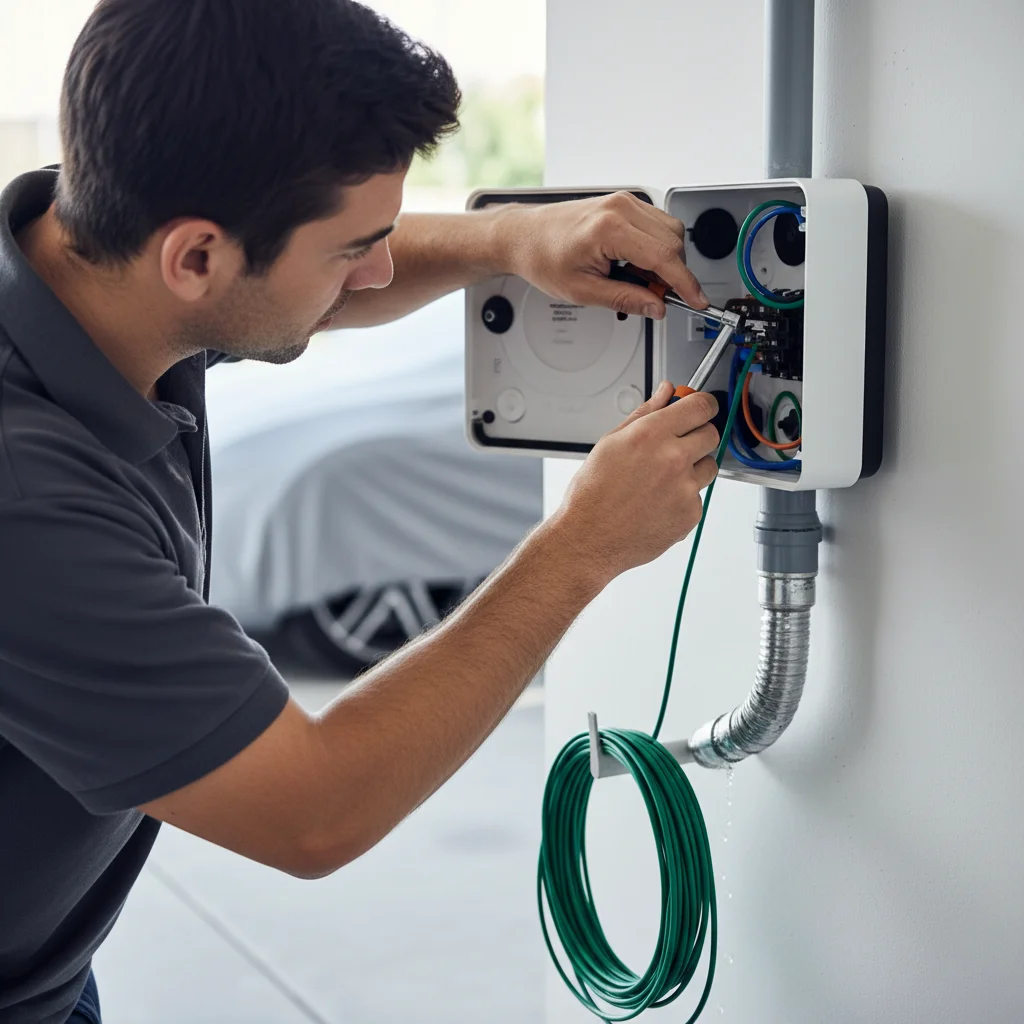
The high-voltage pack is the expensive part. It’s also the part you don’t service like oil. You manage heat, charge habits, and software. Daily charge targets live in the app and the manual. This page won’t invent a percent for your car. If the maker wants a daily cap, the car will say so.
Thermal systems work harder inland than on the coast. Yorba Linda, Anaheim Hills, and the canyon towns run warmer than Huntington Beach. Shade parking helps. Preconditioning while plugged in helps. We couldn’t confirm a countywide summer temperature figure. No published range-loss percent turned up for Orange County. Your display and the owner’s guidance are the authority.
Pack coolant isn’t washer fluid. Some loops are sealed. Some have a long inspection window. The manual decides which you have. Drive-unit fluid, on models that use it, is a high-mileage item. Don’t buy a lifetime story without opening the glovebox. Software updates change how the pack is managed. Install them. That’s maintenance too.
For mixed county conditions, see how to care for an EV battery across Orange County. Brand-by-brand intervals are in the Tesla, Rivian, Ford, Hyundai, and Chevy schedule.
A cadence map, then the stamped page
Use this as a map. The schedule in the car wins.
Short cycle: tires, 12V, filters
Most makers group these on a frequent visit. Rotate the tires. Inspect tread and sidewalls. Look at the brakes. Check coolant reservoirs. Check brake fluid and washer fluid. Replace the cabin filter if it’s due. Note any wake-up lag. Ask for a 12V test if the car feels sleepy. Replace wipers if they chatter. Fob batteries die on their own clock. None of this needs a high-voltage specialist.
Medium cycle: fluids and the heavy hardware
Brake fluid is often due by age. Battery coolant may be inspect-only. It may be due for service. Read the book. Suspension bushings and ball joints carry extra weight. Have them inspected. This is a smart time for a documented 12V load test. Commuting on I-5, SR-91, and SR-22 beats up alignment. Get that checked on a heavy EV.
Long cycle: pack health and drive-unit fluid
High-mileage visits are diagnostics. They’re not a backyard flush. A state-of-health read on the traction pack is a shop job. Drive-unit fluid, if your model calls for it, shows up here. A full coolant service, if specified, shows up here too. Don’t invent a mileage. Open the manual.
Plug-in hybrids are a different book
Battery-electric maintenance is the short list above. Plug-in hybrids still have an engine. Orange County had 47,567 PHEVs in that same CEC file. If that’s your car, you still change oil. You still have plugs on many models. Don’t use a BEV checklist as a PHEV pass. This article is for the 210,842 BEVs.
What to decline at the counter
Shops built around gas cars will offer engine flushes. Decline those on a BEV. You don’t have that hardware. Cabin filters and tire rotations are real. So is brake fluid. A fuel-system cleaning isn’t. Ask to see the manual line for any 12V claim. If the advisor can’t point to it, wait.
You also don’t need a high-voltage tune-up as a seasonal extra. Software and coolant inspections are the real pack-side items. They sit on the medium or long cycle. They’re not a monthly add-on.
What Orange County driving does to that list
The county isn’t one climate. Coastal north sits in marine air. Inland north around Fullerton, Brea, and Buena Park runs hotter and drier. Santa Ana and Garden Grove sit in the basin. East County canyons add grade. South County mixes Irvine’s planned streets with harbor parking in Dana Point and San Clemente.
Tires and brakes feel those differences first. A Laguna Hills to Santa Ana run on I-5 is stop-and-go. A Silverado errand on Santiago Canyon Road is grade. The 12V doesn’t care about the view. It cares about rest time, heat, and drain from cameras and apps.
North county miles stack on SR-91 and I-5 through Anaheim and Fullerton. Central county stacks on SR-22 through Garden Grove and Orange. South county stacks on I-405 and I-5 through Irvine and Mission Viejo. Those miles are stop-and-go, then fast. Tires cup. Alignment drifts. Regenerative braking does a lot of the slowing. Pads still need a look because they aren’t used enough. Seized hardware shows up on cars that barely use the friction brakes.
Canyon miles are fewer and harder. Grades on Santiago Canyon Road heat the brakes. That happens when regen can’t take all of the load. Ortega Highway does the same. That’s when pad and rotor checks earn their keep, even on an EV.
As of December 31, 2025, the CEC counted 7,095 public ports in Orange County. That’s 20 Level 1, 5,600 Level 2, and 1,475 DC fast. Shared-private ports bring the combined total to 11,780. The ratio is 36.8 ZEVs per public port. Statewide it’s 24.4. The county held 12.02 percent of California’s BEVs. It held 8.33 percent of the state’s light-duty fleet. Port counts didn’t match that BEV share.
That ratio is about daily charging. It isn’t a reason to skip service. A busy Supercharger doesn’t rotate your tires. AFDC data showed 48 Tesla Supercharger sites in the county. That’s 861 Tesla DC fast ports. Tesla held 59 percent of public DC fast ports. Irvine’s 1920 Main St site has 40 stalls. Tustin’s Franklin Ave site has 36. Garden Grove’s Harbor Blvd site has 32. San Clemente’s 101 W Avenida Vista Hermosa site has 49. Electrify America lists 12 DC fast ports in Dana Point at 25825 Las Vegas. It lists 8 at Fashion Island. EVgo lists 14 DC fast ports at Plaza Antonio in Rancho Santa Margarita.
Use those sites when you plan a trip. Don’t treat them as a 12V test. A car that won’t wake can’t take a stall.
Home charging still covers most garage miles. Apartment chargers in Irvine and Costa Mesa get contested. A failed wall unit is a different night than a skipped oil change. Mobile EV charging is how operators add range at the curb. They typically add 10 to 20 miles of range. That takes 15 to 30 minutes of charging. That’s charging time, not an arrival time. The operator quotes you before starting. They bill you directly.
Charge Pro OC matches you with those independent operators. It doesn’t own trucks. It doesn’t do the work.
Ports, coolant, and other easy misses
Look at the port when you plug in. Watch for debris and a sticky latch. If the cable won’t release, stop pulling. Dry the port if you see water before you plug in. Coolant on the battery loop isn’t a gas-station top-off. Use the spec in the manual. A/C refrigerant is a sealed-system job. Weak cooling in inland heat is comfort and pack thermal management. It isn’t a cabin-filter-only fix.
Motors themselves are mostly sealed. They aren’t a lube appointment. If a drive unit has fluid, the interval is long. Check the brand page. Don’t pay for engine-style services the car doesn’t have.
When the schedule didn’t get there first
Maintenance cuts strandings. It doesn’t erase an empty pack on SR-22. It doesn’t save a 12V that died overnight. If the car won’t move, decide what you need. You may need a jump. You may need a charge. You may need a shop. When the 12-volt dies walks through that fork. For a county map of plugs, start at EV charging in Orange County.
If you need an operator, call (949) 444-0151. Charge Pro OC refers the job. The operator on scene quotes before they start.