Your Costa Mesa EV sat through a long plaza afternoon. Now it won’t move. That’s the usual ev roadside assistance Costa Mesa call. The traction pack may still show range on the screen. The 12-volt pack is what often failed in the lot. Charge Pro OC is a referral line for Orange County. We match you with an independent operator who brings 240V to the stall. The operator quotes you before any work starts. You pay that operator directly.
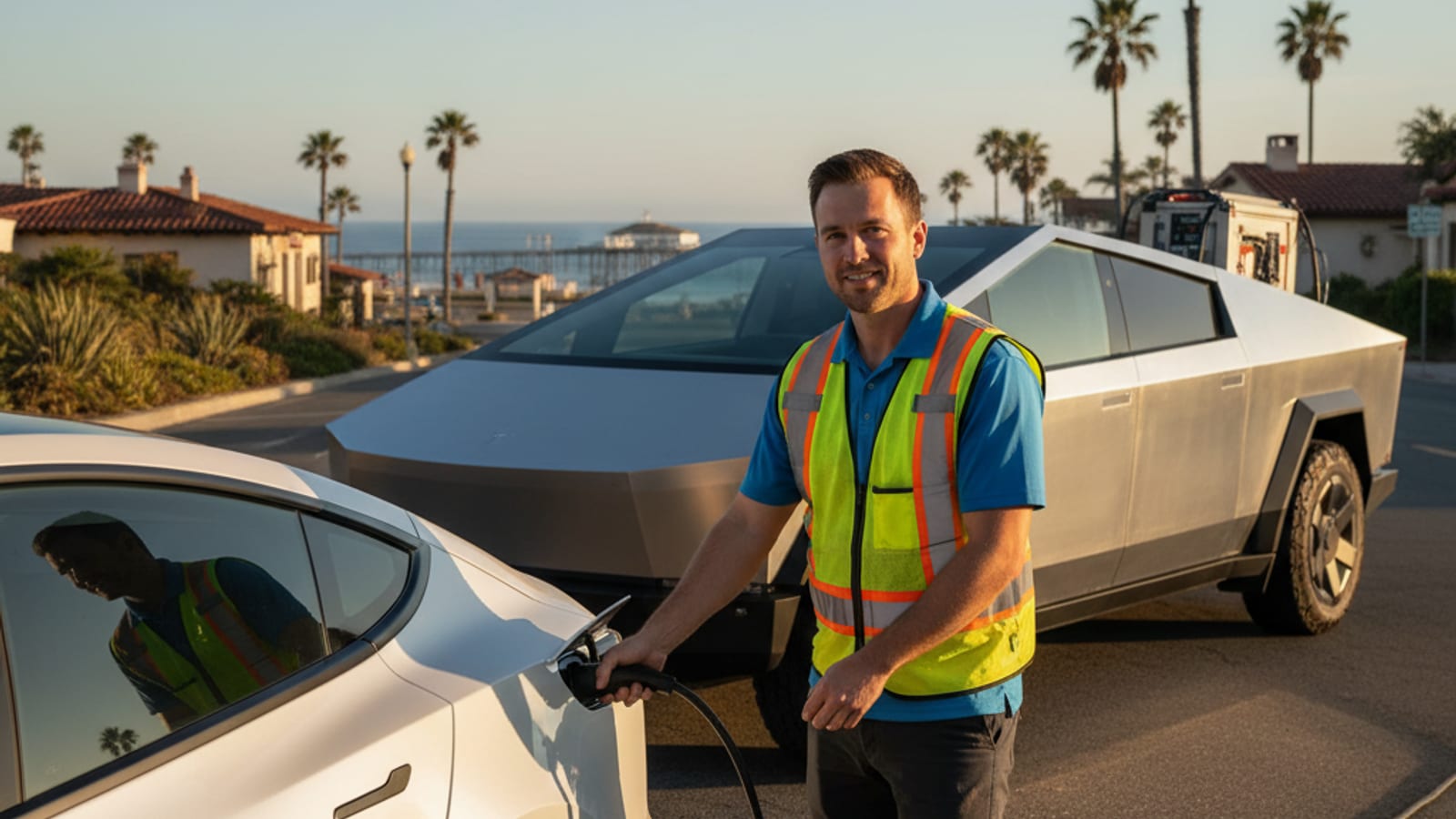
Long stays are the Costa Mesa pattern
Costa Mesa concentrates more long-dwell parking than anywhere else on the Orange County coast. South Coast Plaza holds cars for four to eight hours at a time. It’s one of the highest-grossing shopping centers in the United States. Shoppers leave a modest buffer on the gauge. They come back to a car that sat in a hot structure. Then they ask it to join Harbor Boulevard or Bristol Street in traffic.
The Segerstrom Center for the Arts empties three thousand cars after a performance. That exit dump hits South Coast Metro all at once. The OC Fair and Event Center runs twenty-three days every summer. Those lots fill with cars that sit through a hot afternoon. MemorialCare Orange Coast Medical Center on Fairview Road adds structured hospital parking. Hoag Health Center Costa Mesa follows the same long-stay pattern. Orange Coast College adds class-block parking on top of that. The LAB Anti-Mall, The CAMP, and Triangle Square hold evening cars in SoBeCa.
None of that’s a missing-charger story. Costa Mesa has Superchargers and garage plugs. The failure is time in the stall. Accessory loads keep ticking while you’re inside. Computers, locks, and climate control still draw the small battery. When that 12-volt pack is flat, the car won’t even open.
Why the car looks fully dead
An EV still uses a 12-volt battery. It runs locks, computers, and the wakeup circuit. If that pack is dead, the car acts like a brick. Screens stay black. Handles may not present. The high-voltage pack can still hold a useful charge. You can’t command it until the small battery is alive again.
Tesla’s Model Y owner’s manual describes a related bind. Once range is exhausted, the low-voltage battery can lose support. The car then needs an external power supply. Only after that can the high-voltage pack take a charge. A Costa Mesa lot sit is a cousin of that problem. The pack wasn’t empty. The 12-volt still quit from the hours parked.
Operators in the referral network jump or replace that 12-volt battery on site. They also handle Tesla and every major EV brand. A Tesla 12V battery jump is often the whole job. You don’t need a tow for a silent cabin. You need the small battery restored. Then you may need a short 240V top-up if range is thin.
Read the longer 12-volt sequence in when the 12-volt dies on the road. The Costa Mesa version of that failure usually starts in a garage. It doesn’t start on a freeway shoulder.
Mesa streets, traffic, and the lots between them
Costa Mesa sits on a mesa above the Santa Ana River floodplain. That’s what the name means. Westside bluffs drop toward the river channel and Talbert Marsh. Fairview Park holds vernal-pool terraces. Most of the city is otherwise gentle. Range loss here is rarely a mountain grade. It’s idling on Bristol Street and Harbor Boulevard around South Coast Plaza. Those arterials are among the busiest in the county. The I-405 and the SR-55 both run heavy through town. SR-55 is the Costa Mesa Freeway until it becomes Newport Boulevard. The SR-73 Corona del Mar Freeway clips the south side. Pacific Coast Highway is the south edge.
Baker Street, Fairview Road, 19th Street, Adams Avenue, Sunflower Avenue, and Placentia Avenue fill in the grid. South Coast Metro sits against the plaza and the arts center. Eastside and Westside hold denser older multifamily. Mesa Verde, Mesa del Mar, College Park, and Halecrest are quieter overnight. Freedom Homes, Wimbledon Village, and Canyon Park are too. SoBeCa takes the evening crowd. A pin that only says Costa Mesa isn’t enough for a rescue. Garage level, row, and stall number matter in these structures.
The climate is close enough to the coast for real moderation. The range story is traffic, not frost. A buffer that looked fine at noon can look thin after Harbor traffic at dusk. That’s true whether you parked at the plaza, the fair, or the Fairview hospital garage. It’s also true on the 405 shoulder if you left the lot already low.
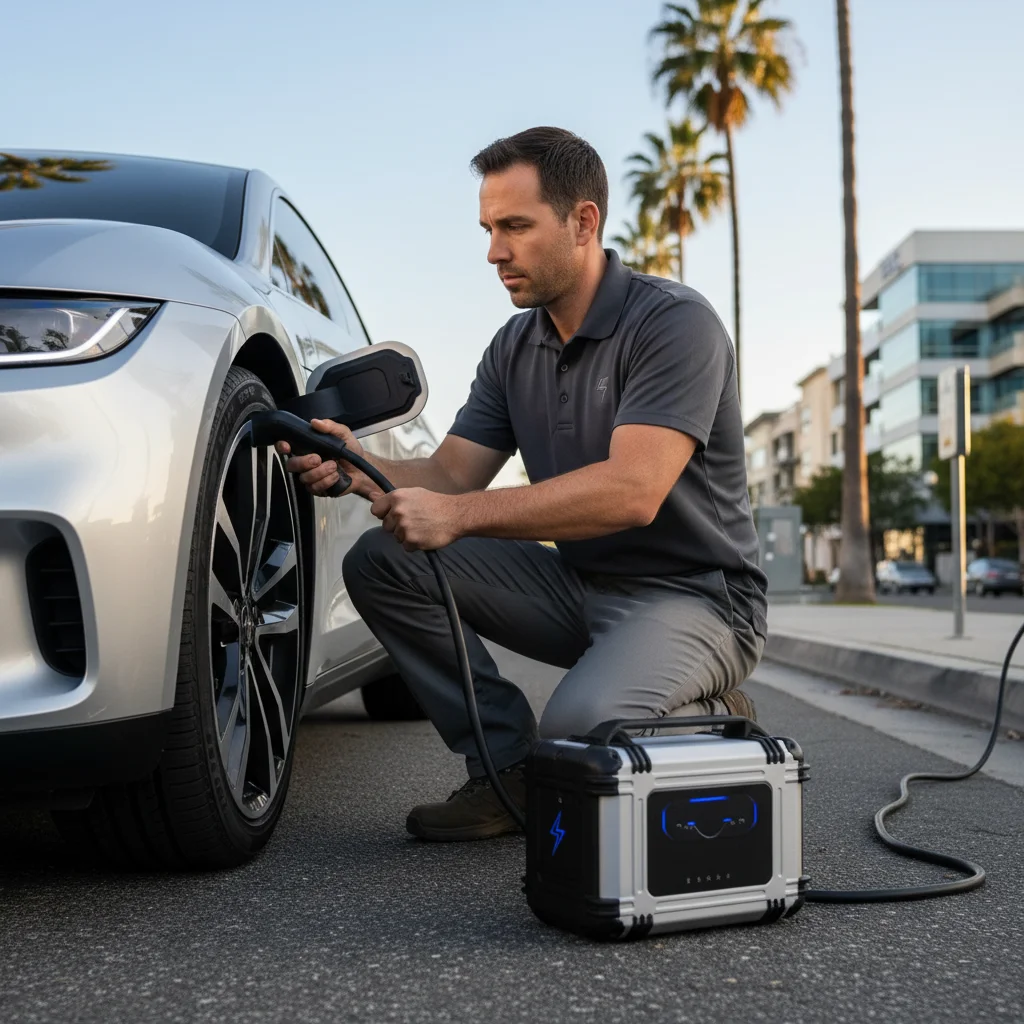
Older housing next to the retail core
Census ACS 2023 figures put 69.2 percent of Costa Mesa’s 43,684 housing units before 1980. That’s a very large no-home-charging population. People park on the street or in a shared garage. They live next to the county’s most affluent retail district. Hispanic or Latino residents are 36.4 percent of the city. That’s the highest share in Coastal Orange County. Spanish is spoken at home by 26.7 percent, also the coastal high. The Westside and Eastside carry much of that older housing.
If the overnight plug was never there, the public stall and the lot sit become the daily plan. Zips 92626 and 92627 cover almost all of that map. 92628 is PO boxes. The car that needs help is often a commuter EV from those older blocks. It sat at South Coast Plaza or the fair. It was asked to get home on what was left. When the 12-volt is the failure, the doors stay shut in the structure.
Costa Mesa’s population is 110,538. Three of the county’s biggest traffic generators sit inside that same small footprint. That mix of older housing and long-stay destinations is the local stranding pattern. It isn’t a generic coastal-city template.
Superchargers that are actually in Costa Mesa
Costa Mesa has three Tesla Supercharger sites in federal AFDC station data. 1400 Bristol Street has 12 stalls at up to 250 kW. 1475 South Coast Drive has 20 stalls at up to 250 kW. 3303 Hyland Avenue has 8 stalls at up to 250 kW. The Hyland site is the tight one. Hyland has eight stalls in a city of 110,538. The plaza, the fair, and the arts center sit nearby. That site is a known backup. South Coast Plaza garages also carry Level 2 and DC charging. Confirm which garage level is in service before you trust a pin.
A full stall doesn’t mean the city lacks charging. It means you may wait. If the car won’t wake, a queue at Hyland doesn’t help anyway. You can’t drive to Bristol Street with a dead 12-volt. The operator comes to the structure. That’s the Costa Mesa parking-structure playbook in practice.
Nearby cities have their own sites if you can still roll. Newport Beach has 12 stalls at 4241 MacArthur Boulevard. Fountain Valley has 16 stalls at 17940 Newhope Street. It also has 12 stalls at 9430 Warner Avenue. Santa Ana has 28 stalls at 1008 17th Street. It has 20 stalls at 300 East 5th Street. Huntington Beach has 24 stalls at 6913 Warner Avenue. Irvine’s 1920 Main Street site is 40 stalls. Use those only if the car still drives. Don’t hunt a stall on a dying 12-volt.
Costa Mesa also has two Tesla Service Centers on Tesla’s locator. They’re listed at 3020 Pullman Street and 3565 Cadillac Avenue. Confirm both on tesla.com before you navigate. A service appointment isn’t roadside rescue. If the car is silent in a plaza garage, a service center across town doesn’t open the door.
What the 240V stop actually is
Charge Pro OC doesn’t own trucks. We don’t employ technicians. We don’t set prices. We don’t publish hours. We don’t promise an arrival window. We connect stranded drivers with independent local operators. The pros we connect you with are licensed. Charge Pro OC itself holds no license and performs no work.
The operator who takes the job brings a 240V Level 2 source to the car. Teslas take a native NACS plug. Other brands use a CCS or J1772 adapter. The session isn’t a full fill. Typical charging time adds about 10 to 20 miles of range in 15 to 30 minutes. That’s charging time at the car. It isn’t a travel-time claim.
That amount is usually enough to leave the structure and reach a Supercharger or a home plug. Mobile EV charging is the name for that visit. If the 12-volt is the only failure, a jump or a replacement may be the entire stop. The operator talks through the quote first. You accept or you don’t. Billing is between you and that operator.
Keep your exact garage level, row, and stall number ready. Plaza and fair lots are easy to describe wrong. Fairview hospital structures are the same. College lots and SoBeCa street parking are no better. A map pin that says Costa Mesa isn’t enough.
Towing is the last tool, not the first
Traditional clubs still default to a hook. Many EVs need a flatbed so the drivetrain isn’t dragged. That moves a dead car. It doesn’t give you range. It also doesn’t wake a 12-volt. Tesla’s published roadside language treats a depleted pack as transport, not as on-site charging. Tesla says that help is available, and that it isn’t a financially covered service. Covered transport of up to 500 miles goes to the nearest service center. That applies to a warrantable breakdown that leaves the car undrivable. Running out of charge sits outside that. Tesla Roadside Assistance is 877-798-3752. Confirm the current policy on Tesla’s roadside page before you assume a free truck.
A local operator who charges or jumps on site is a different job. See charge, jump, or tow for the decision order. Stay in the stall if you’re already parked. On the I-405 shoulder, stay in the car with hazards on. Don’t walk Newport Boulevard or the Costa Mesa Freeway lanes.
County EV numbers that explain the call volume
Orange County had 210,842 battery-electric vehicles on the road as of December 31, 2025. The source is the California Energy Commission. Plug-in hybrids added 47,567. Fuel-cell vehicles added 2,424. The ZEV total was 260,833. That’s 10.56 percent of the county’s light-duty fleet. Battery-electrics alone were 8.54 percent. California’s ZEV share was 7.54 percent in the same file. Orange County held 12.02 percent of California’s battery-electric vehicles. The county is 8.33 percent of the state’s light-duty fleet.
Teslas were 138,121 of those 210,842 Orange County BEVs, or 65.51 percent. The state Tesla share of BEVs was 61.34 percent. Costa Mesa’s two service centers sit inside that Tesla-heavy county. New ZEV sales still run above the state. In 2026 Q2, ZEVs were 24.77 percent of new Orange County light-duty sales. Statewide the share was 19.09 percent. Don’t read that as acceleration. California’s ZEV share of new sales peaked at 25.31 percent in 2024. 2026 Q1 was the weakest quarter in the CEC series at 15.76 percent. CEC also changed new-sale methods in 2023 and 2025. Year-to-year comparisons across those breaks aren’t clean.
Public charging is thinner per car than the state average. Orange County had 7,095 public ports as of December 31, 2025. That’s 36.8 ZEVs per public port. Statewide the ratio was 24.4. Tesla held 59 percent of the county’s public DC fast ports, 861 of 1,452. Those figures describe the county, not a hole in Costa Mesa. Costa Mesa still has the three Supercharger sites named above. The county ratio still matters here. A long plaza sit produces rescue calls even with stalls on Bristol and South Coast Drive.
If the car won’t move, do this
Get to a safe stop if you’re still rolling. A garage stall, a fair lot row, or a curb on Adams is better than a live lane. Turn on the hazards. Don’t keep creeping toward Hyland on a dying 12-volt. Check whether the screens wake. Check whether the charge port will open. If nothing answers, treat it as a 12-volt failure until an operator says otherwise.
Call Charge Pro OC when you want a local match. We’ll ask for the city, the lot name, the level, and the make. Name the lot when you call. South Coast Plaza and the OC Fair lots are common. Segerstrom parking and the Fairview hospital structures are too. Tell the operator if you’re in Mesa Verde, SoBeCa, or a Westside street. They quote the work. You decide. Stay with the car if the structure is quiet and legal.
If you can still drive a short distance, a Supercharger is the self-rescue. Confirm live stall status in your car’s nav. The Bristol and South Coast Drive sites are the larger Costa Mesa options. Hyland is the small one. If the car is already silent, skip the hunt. Have the operator bring 240V to the stall.
Newport Beach, Santa Ana, Huntington Beach, Fountain Valley, and Irvine surround this mesa. A trip that started at the plaza often ends in one of those cities. Plan the last miles before you park for a four-hour sit. See the Costa Mesa charging page for the local map context.
Before you lock it in a Costa Mesa structure
Leave more buffer than the drive home seems to need. Harbor and Bristol can erase that margin in stop-and-go. Fair days and Segerstrom curtain times are the long sits. Hospital structures on Fairview are the same pattern on a weekday. Pre-1980 housing often has no home plug. Don’t treat a plaza stall as overnight storage on a thin pack. The 12-volt doesn’t care that the traction battery still shows miles.
If you’re heading out on the 405 or the 55, check range before you enter the ramp. A car that barely left the fair lots is a poor candidate for that merge. Stay put in the lot and get a charge there instead.
Frequently asked questions
Can an operator help a Tesla and a non-Tesla in Costa Mesa?
Yes, the operator can help both. Operators bring a native NACS plug for Tesla. They carry CCS or J1772 adapters for other brands. That covers the cars that park on Bristol and Harbor. Rivian, Hyundai, Ford, Chevrolet, BMW, and the rest are in that adapter set. Confirm your inlet type when you call. The operator will confirm the inlet when they quote.
How much range does a mobile 240V session add?
Typical charging time adds about 10 to 20 miles. That window is 15 to 30 minutes at the car. It isn’t a promise about when someone arrives. The goal is enough range to leave the lot. A full pack is a Supercharger job, not a structure job.
What if a jump doesn’t wake the car?
Then the 12-volt may need a replacement on site. The high-voltage pack may be empty instead. The operator checks both. An empty pack gets the 240V session once the low-voltage system can accept it. A mechanical failure is outside a charge stop. In that case the honest next step is a flatbed to a shop you choose. We don’t repair cars. We only connect you with roadside charging and 12-volt help.
Get a charge where the car already sits
Costa Mesa’s problem is rarely a missing map pin. It’s a car that sat too long at South Coast Plaza, the fair, Segerstrom, or a Fairview structure. The small battery quits. The doors stay shut. An independent operator can jump that 12-volt pack and add a short 240V charge at the stall. Charge Pro OC matches you with that operator. Call (949) 444-0151 when you want that match. Confirm the quote with the operator before any cable goes in.