Your EV died in Fullerton. The Superchargers on Harbor and Orangethorpe don’t move the car. Charge Pro OC connects you with a local mobile rescue operator. That operator brings 240V to the bumper. They can also jump a dead 12V. Then they bill you directly.
North OC’s 91-edge hub, not a coastal grid
Fullerton is the inland North OC city on the SR-91 edge. I-5, SR-57, SR-90 Imperial Highway, and SR-39 Beach Boulevard all touch this map. Harbor Boulevard and Orangethorpe Avenue are the fast-charge streets. Euclid, Brookhurst, State College, Chapman, and Commonwealth carry the daily miles. Bastanchury, Nutwood, and Malvern feed campus, hills, and the Target lot.
The city counts 141,278 residents. Census figures show 72.3% of housing was built before 1980. Spanish is spoken at home in 25.2% of households. The ground isn’t a flat basin. Sunny Hills, Raymond Hills, Golden Hill, and Coyote Hills all rise here. They sit on the north and west. The Brea Dam basin sits in the north. City elevation is 274 feet. The climbs still tax a low pack. Fullerton Municipal Airport sits on the west side. The Muckenthaler Cultural Center sits up the hill from Downtown. Those landmarks tell you which way the grades run.
Heat here is inland. NOAA 1991 to 2020 normals come from Fullerton Municipal Airport. July’s mean maximum is 84.4 F. August sits at 86.7 F. A car that sat in a campus structure all afternoon runs warm. The drive home starts from that heat.
The stalls you can name, if the car can roll
AFDC lists two Tesla Supercharger sites in the city. 1475 S Harbor Blvd has 12 stalls. AFDC lists a max of 325 kW. The open date is October 29, 2025. 220 E Orangethorpe Ave has 16 stalls, up to 250 kW. That site opened October 6, 2022. Electrify America is at Target, 1893 W Malvern Ave.
Those sites are real. They’re useful when you can still drive. They can’t help a car that’s already dark in a CSUF structure. Same for a Sunny Hills driveway. The Fullerton charging page is the local map for the stalls that exist.
Countywide, each public port serves more ZEVs than the state average. CEC data as of December 31, 2025 puts 260,833 zero-emission vehicles in Orange County. Public ports totaled 7,095. That’s 36.8 ZEVs per public port. Statewide, the ratio is 24.4. Battery-electric cars in the county number 210,842. Tesla holds 65.51% of that BEV fleet. A native NACS plug on a rescue truck matches how most of those cars charge.
Why Fullerton cars sit still
The pattern here is dwell, rentals, and hills.
Campus structures that hold cars all day
Cal State Fullerton is the largest campus in the CSU system by headcount. Its structures hold thousands of cars for full days. Nutwood Avenue and State College Boulevard are the approaches. Students and staff overwhelmingly rent. Renters in Fullerton’s older stock don’t have a plug at home. They arrive already low. They park through class. They leave lower.
Fullerton College sits in the same inland grid. So do Hope International University and the Fullerton Arboretum. Downtown Fullerton and the Fullerton Transportation Center add all-day Metrolink and Amtrak parking. Cars sit for hours. Then they don’t wake.
Hospital shifts at St. Jude
Providence St. Jude Medical Center is the second pattern. Hospital structures hold cars through twelve-hour shifts. They also hold them through multi-day admissions. That dwell is when a weak 12V battery fails. Lights stay off. Handles don’t pull. The pack may still have miles. The small battery is what’s dead.
Hills on the north and west
Sunny Hills and Raymond Hills are steeper than visitors expect. The climb home from Harbor or Chapman uses range you thought you still had. Amerige Heights, Golden Hill, Coyote Hills, Ladera Vista, and Bastanchury repeat the same grade. West Fullerton and Fullerton Creek sit lower. Downtown does too. Once you turn toward the hills, the estimate drops.
Most of this housing predates 1980. A dedicated charger circuit in that stock usually means a panel upgrade first. That’s not a job for tonight. A wall outlet won’t get a stranded pack moving tonight.
Pack at zero, or a 12V that quit
Sort the failure before you call for a hook.
If you rolled to a stop and the display read empty, the pack is depleted. Tesla’s roadside policy answers a depleted battery with transportation. It doesn’t send a charge to the bumper. Running out of charge isn’t treated as a financially covered service. A warrantable breakdown that leaves the car undrivable is a different category. An empty pack isn’t that category.
Tesla’s running-out-of-range note adds a catch. Once range is gone, the low-voltage battery can lose support. The high-voltage pack then needs that 12V side restored. Only then will it accept a charge. A jump, then a 240V feed, is the sequence that actually wakes the car.
If the car never moved and the screen stayed black, check the 12V. Indicated miles can still be sitting there. The operators we connect you with jump or replace that battery on site. They cover Tesla and every major EV brand. The sister post on a stalled Fullerton EV walks the same fork in a driveway.
The referral, then the truck
Charge Pro OC doesn’t own a fleet. It doesn’t employ technicians. It doesn’t set rates. You call the line. We match you with an independent local operator. That operator quotes you before a cable goes in. Then they bill you directly.
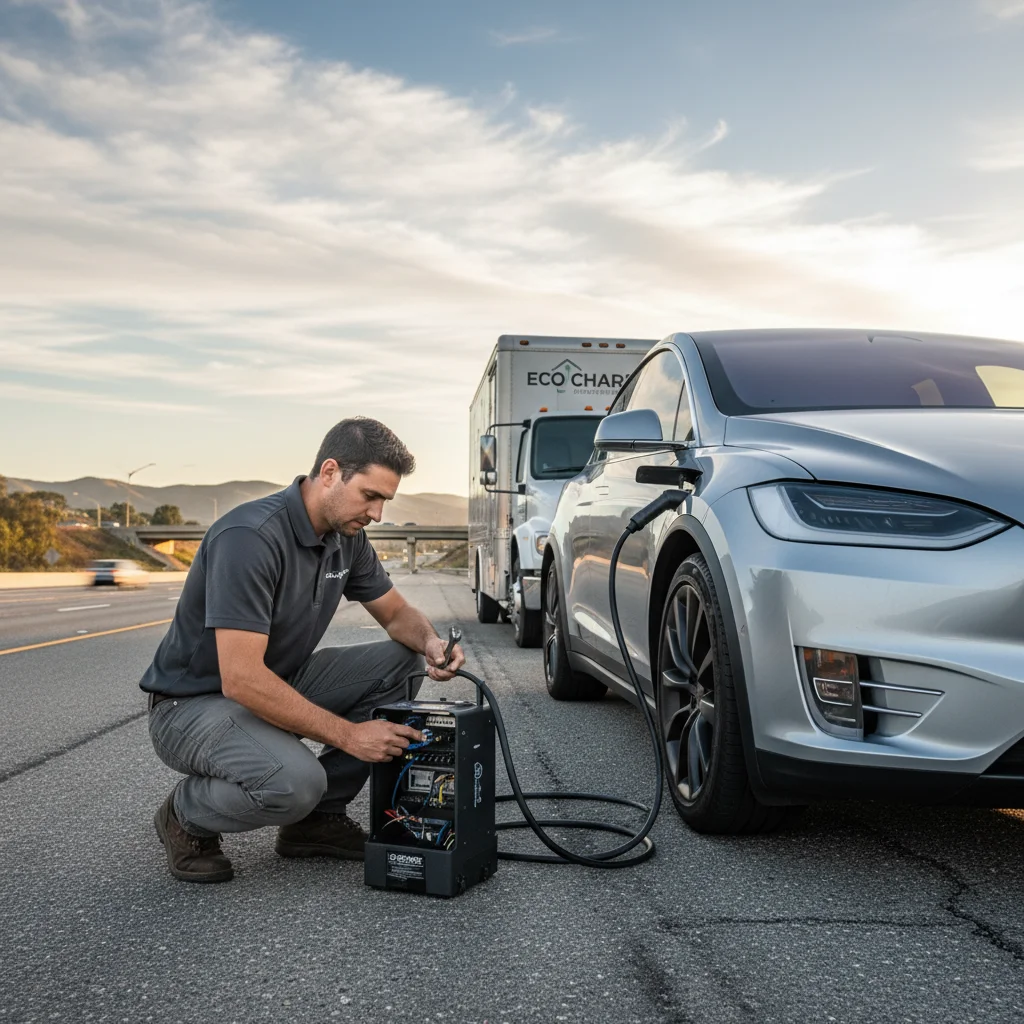
What shows up is mobile EV charging, not a tow truck. The operator brings a 240V Level 2 source to the car. Teslas take a native NACS plug. Other EVs take a CCS or J1772 adapter. Typical charging adds 10 to 20 miles of range. That’s 15 to 30 minutes on the cable. It isn’t an arrival window.
An empty pack is out-of-charge recovery. A dark 12V is a jump or a replacement at the curb. Either way, EV roadside assistance here means the work happens where you sit.
Pin the car. Fullerton is too big as a label. Harbor at the Supercharger is one pin. Orangethorpe at the 16-stall site is another. Nutwood at CSUF, the St. Jude structures, and Commonwealth downtown all differ. A SR-91 shoulder is its own call. Stay with the vehicle on a freeway. Keep people behind the barrier.
Anaheim sits south of this grid. Brea, Placentia, Buena Park, and La Habra wrap the rest of North OC. You’re still in the same county. The car just isn’t rolling to the stall.
Charge here, tow only if it won’t take power
A flatbed is the last move. It still leaves you hunting a stall after the hook. If the only fault is an empty pack, skip the hook. A Level 2 feed at the bumper gets you back onto Harbor, Chapman, or the 91. A tire, a stuck port, or a drivetrain fault is different. The operator will say so. Then a shop tow may be the honest next step.
Don’t walk the SR-91 shoulder looking for a plug. Confirm Harbor, Orangethorpe, or the Malvern Electrify America site in your map. A charging app works too. If the car can’t get there, the truck comes to you. The freeway version of this is out of charge on the 91. Fullerton is the city on that North OC edge. Anaheim traffic stacks the same corridor. The operator still works from behind your bumper.
When to pick up the phone
Call after the pack hits zero on Harbor, Euclid, or Orangethorpe. Call when a CSUF lot goes quiet at the end of a class day. Call when a St. Jude structure holds the car through a shift. A weak 12V is the failure that shows up there. Call when Sunny Hills or Raymond Hills eat the last miles on the climb home. Downtown, Amerige Heights, the airport side, and West Fullerton use the same line.
Charge Pro OC serves every city in Orange County. Fullerton is the North OC hub on the 91. Call (949) 444-0151. The operator quotes you before any charging starts.