After a long Huntington Beach day, your EV can die on a side street. You sat in a beach lot from morning until sunset. Climate control ran hard on the PCH drive down. Then the trip home wasn’t in the remaining range. EV roadside assistance here means a charge or a 12V jump at the curb. Charge Pro OC connects you with an independent operator who quotes you before starting.
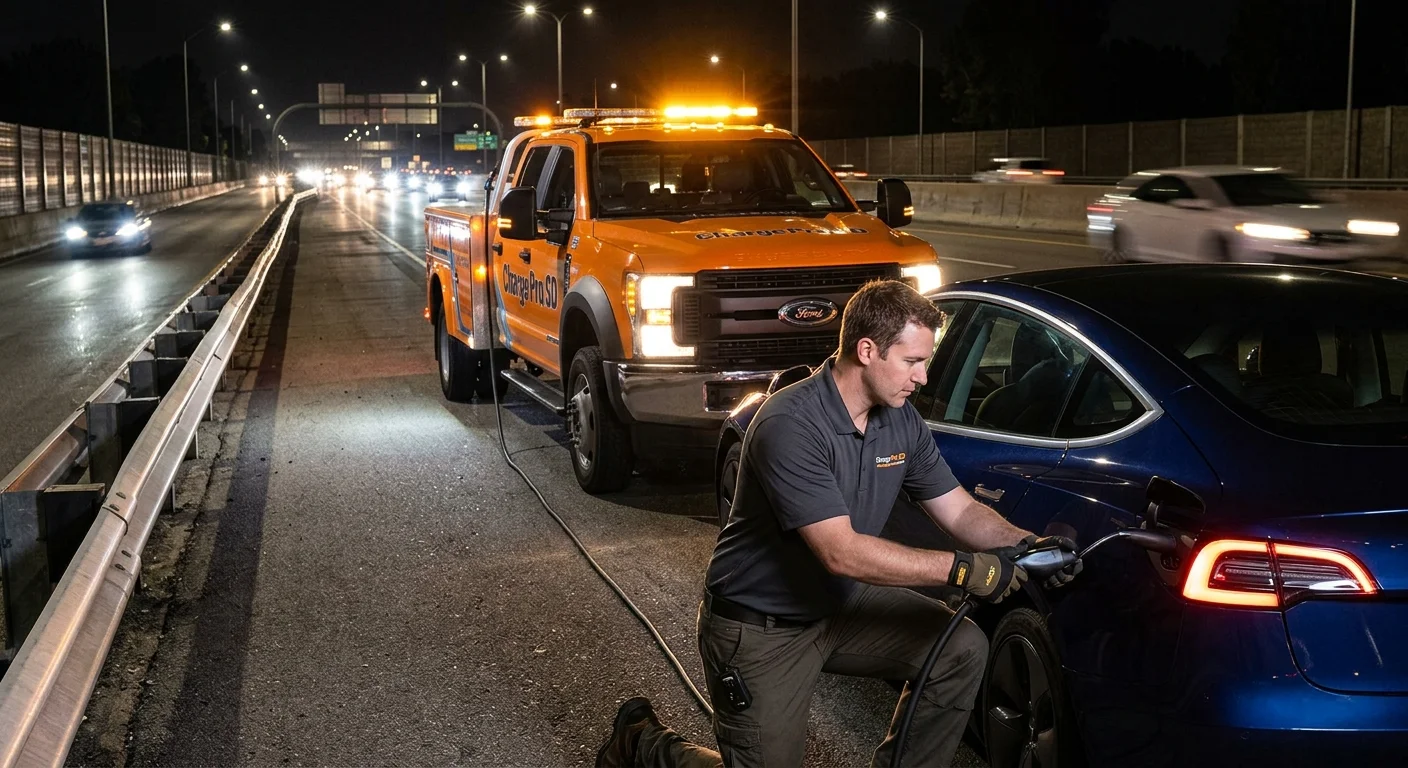
A beach day empties a pack in a Huntington Beach way
Huntington Beach holds 196,010 people and ten miles of coastline. That stretch carries Orange County’s heaviest beach-lot parking. Bolsa Chica State Beach, the pier, and Pacific City all draw all-day stays. You leave sand on the floor and less range than you planned. Surf contests and the Fourth of July parade make those lots even tighter. The stall often happens after you exit, on a quiet block off PCH.
The shoreline looks flat from the water’s edge. The city still has real relief behind the lots. Huntington Mesa and Bolsa Chica Mesa rise above the wetlands. The Seacliff and Goldenwest bluff line adds a short climb after the lot. A pack that felt fine along SR-1 can sag on that rise. Inland of Beach Boulevard, 1960s and 1970s tracts are the norm. Census figures show 68.8 percent of 81,812 housing units were built before 1980. Older panels and street parking shape how people charge at home. They don’t explain a car that already died after the beach.
Huntington Harbour is the second local stall pattern. It’s a waterfront neighborhood on islands linked by bridges. Boat storage often takes the garage at those homes. Visitors park on those island streets after a day on the water. Sunset Beach is part of Huntington Beach, annexed in 2011. The ZIP there is 90742, and a stall still counts as in-city. Nearby Fountain Valley, Costa Mesa, Westminster, Seal Beach, and Newport Beach share this coast traffic. Your car is in Huntington Beach if it’s on Warner, Edinger, Adams, or Magnolia. The Huntington Beach charging page maps those streets and the public plugs.
Empty pack versus a 12V that quit in the lot
A low gauge and a dead car are different problems. Low range still lets you limp toward a stall. Many EVs keep a short reserve after the gauge hits zero. You may still roll slowly to a safer curb. A true empty pack is a much harder state. The high-voltage pack is spent, and the 12V can drop with it. Doors, hazards, and shift-to-neutral can all fail. Tesla’s Model Y manual notes the 12V can lose support once range is gone. The high-voltage pack then needs external power before it will accept a charge.
A long beach sit creates a second failure. Accessories ran, the car slept for hours, and the 12V sagged. The traction pack may still hold unused miles. The car just won’t wake for the drive home. Hoag Hospital Huntington Beach on 17th Street produces that long-dwell 12V call. So does Huntington Beach Hospital on Beach Boulevard. Structured parking and a long visit drain the small battery. You had range this morning, so start with the 12V. The Huntington Beach lot 12V guide walks through that stall. If you’re still rolling, use the steps for an EV that’s running low. Don’t wait for zero on Adams or Goldenwest.
Get the car somewhere you can wait
If you’re still moving, coast to a curb or a legal shoulder. Hit the hazards while any 12V power remains. Stay belted inside on I-405 or PCH when traffic is close. The cabin protects you better than the pavement. Don’t try to push that much weight yourself. An EV is far heavier than a similar gas model. If you’re blocking a lane, call 911 so officers can hold the scene. That’s a safety call, not a charging call.
Side streets off Brookhurst, Goldenwest, and Warner are calmer than the freeway. Downtown blocks near the pier get tight after dark. Harbour island streets are quiet, but they’re a long way from Beach Boulevard. If you’re already on I-405, stay on the shoulder. Use the I-405 empty-pack playbook from there. Springdale and Bolsa Chica Street see typical side-street stalls after the sand. So does the Franklin and Adams area after a long dwell.
Public plugs in town, if the car will still roll
You can still use a public plug if the car will roll. Huntington Beach has a Tesla Supercharger at 6913 Warner Avenue. The federal AFDC inventory lists 24 stalls, up to 325 kW, open since September 2025. There’s an EVgo site at 21190 Beach Boulevard with three stalls. Electrify America is listed at 5922 Edinger Avenue. Open your charging app and confirm a stall before you spend the last miles. A busy Warner Avenue site won’t help a car that already died on PCH.
Orange County had 210,842 battery-electric vehicles as of December 31, 2025. CEC data puts 36.8 ZEVs on each public port here. California’s ratio sits at 24.4 ZEVs per public port. Teslas are 65.51 percent of the county’s battery-electric fleet. Those figures don’t set your next move tonight. They do explain why beach-day stalls keep happening even with real plugs in town.
When the car won’t roll, bring 240 volts to the port
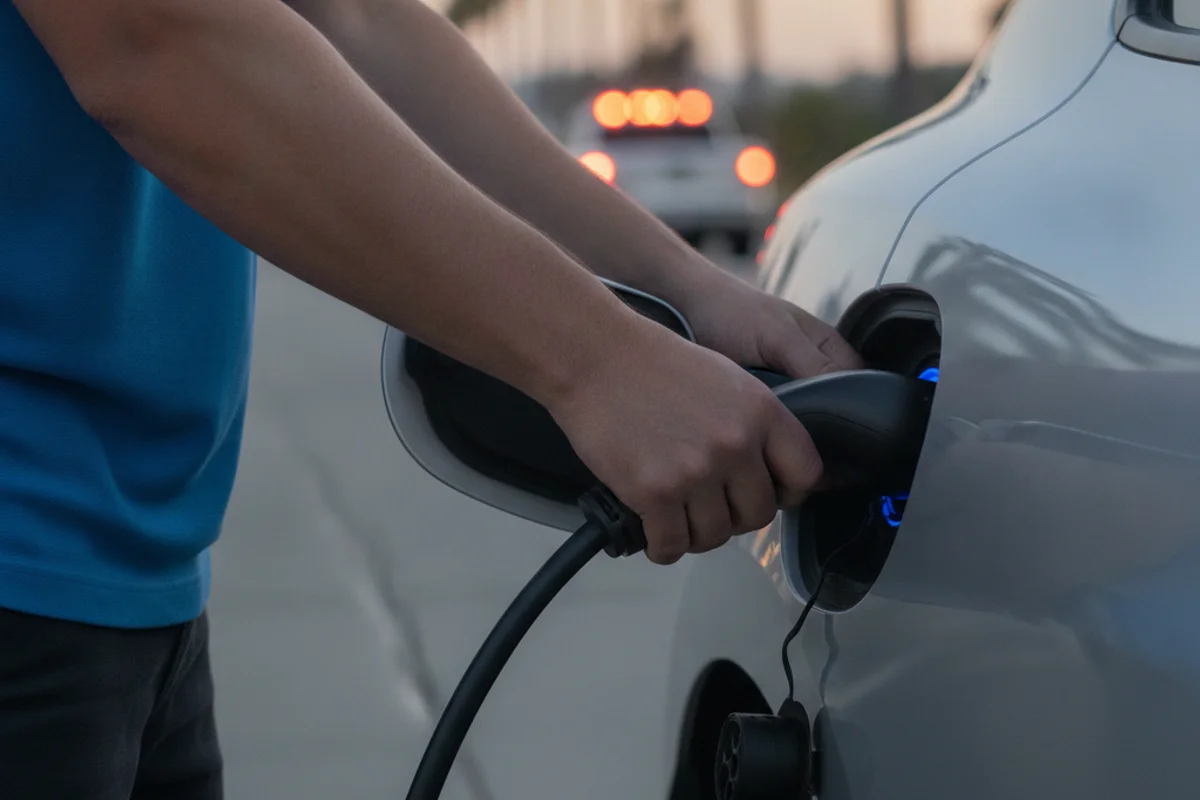
Hunting a stall is wasted motion when the car is dark. Mobile EV charging brings a 240V Level 2 source to you. Operators in this network use a native NACS plug on Teslas. They carry CCS or J1772 adapters for other brands. They also jump or replace a dead 12V on site. The charge is a boost, not a full pack. Typical charging time adds 10 to 20 miles in 15 to 30 minutes. That’s session time on the plug, not travel time. It isn’t a promise of when a truck shows up.
Tesla’s roadside policy answers a depleted pack with transportation. Running out of charge isn’t treated as a warrantable breakdown. Tesla’s published roadside number is 877-798-3752 for that path. That conversation is usually about a tow, not a curb charge. Out-of-charge recovery is the local charging path. An operator quotes you, then bills you directly. Charge Pro OC doesn’t own trucks or set prices. We match stranded drivers with independent mobile rescue operators across Orange County.
A tow still has a place in this mix. Use it when the car sits in a live lane and must move now. Use it when the pack or 12V will not take a charge. A flatbed is the safe method when the car won’t go into neutral. On a quiet Huntington Beach side street, charging first is the cleaner path. That’s what ev roadside assistance in Huntington Beach looks like after a beach day.
Oak View, the inland belt, and all-day city lots
Oak View in ZIP 92647 is denser and older than the harbour. Multifamily blocks there rarely include a garage charger. Citywide, 9.3 percent of residents speak Spanish at home. Oak View sits well above that citywide share. A stall on those streets is a curb job. Edwards Hill, Northwest HB, and Meredith Gardens sit farther from the sand. Huntington Central Park produces the same all-day parking pattern as the beach. The Central Library adds another long dwell inland. Bolsa Chica Ecological Reserve lots sit beside the wetlands inland of PCH. International Surfing Museum visitors add another downtown dwell. If the car won’t move, the operator comes to the pin you send.
Call when the car is a dark object on the curb
If the EV is dark on a Huntington Beach curb, pick up the phone. Don’t wait on the curb hoping the pack wakes up. A standard tow may not know how to get an EV into neutral. Charge Pro OC is a referral line for Orange County. We match you with a local mobile rescue operator. The operator quotes before any work starts, then bills you directly. Call (949) 444-0151 and we’ll connect you.