Your EV just hit empty on I-405. Stay on the right shoulder, then get a charge brought to the car.
Orange County’s I-405 mixes beach traffic, airport traffic, and weekday commute lanes. If the pack is at zero, don’t hunt a stall from a live freeway. A local operator can add range at the car. You then roll to a charger under your own power.
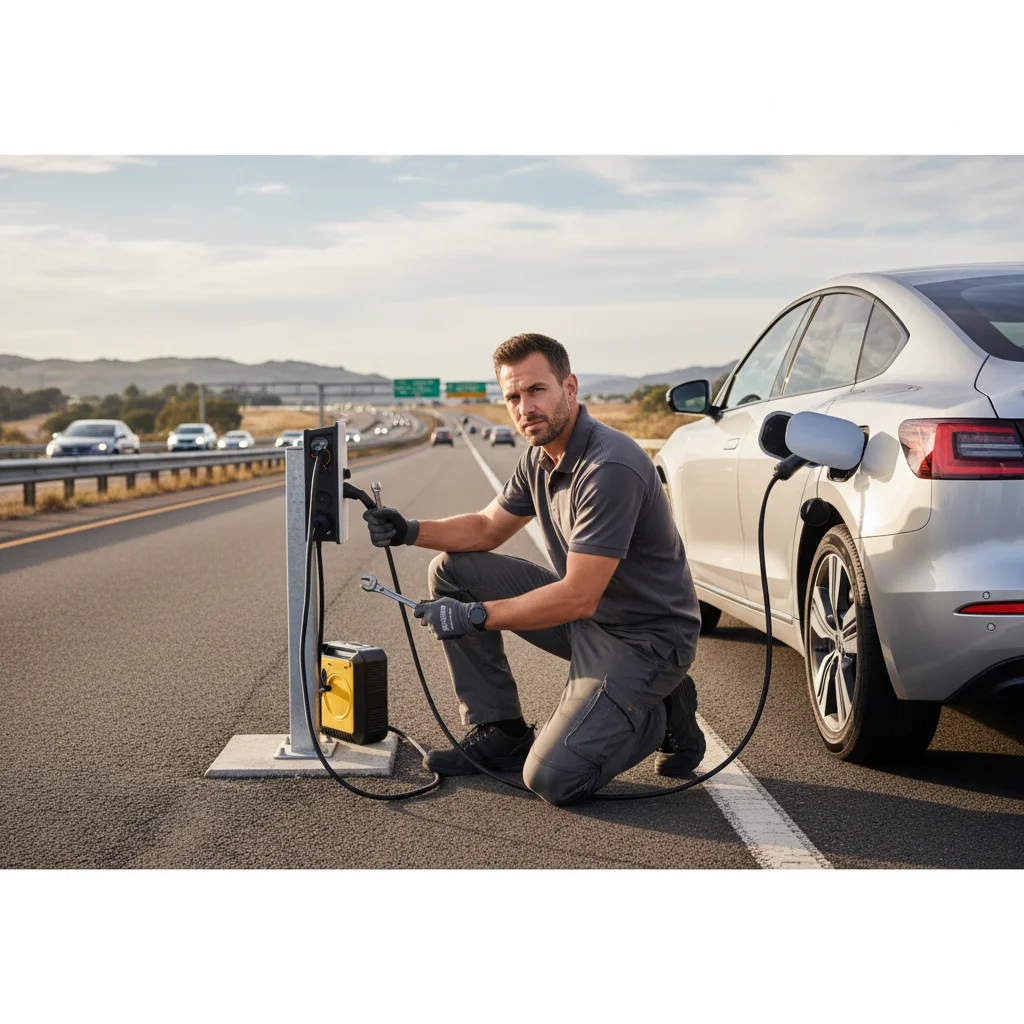
Why this freeway is a hard place to stop
I-405 is the county’s busiest north-south freeway. It ties the coast cities to Costa Mesa’s airport district and Irvine’s job centers. Beach days, flight drop-offs, and office commutes share the same shoulder.
A stalled EV here isn’t a quiet rural stop. Motorists close at freeway speed on your left. Sunday beach traffic still uses these ramps. Weekday airport vans and office commuters do too. The shoulder is one strip of pavement for all of it.
Orange County had 210,842 battery-electric cars on the road as of December 31, 2025. The source is the California Energy Commission. BEVs are 8.54% of the county’s light-duty fleet. Teslas are 138,121 of those BEVs, or 65.51%. Orange County is 6.4 percentage points more Tesla-concentrated than the state.
The county holds 12.02% of California’s battery-electric vehicles. It’s only 8.33% of the state’s light-duty fleet. Public charging hasn’t matched that share. CEC counts 7,095 public ports in Orange County against 260,833 ZEVs. That’s 36.8 ZEVs per public port. Statewide the ratio is 24.4. Orange County is worse served per EV than the state average.
In 2026 Q2, ZEVs were 24.77% of new light-duty sales in Orange County. The statewide figure that quarter was 19.09%. The county runs about five to six points above the state on that measure. The trend isn’t a straight climb. California’s ZEV share of new sales peaked at 25.31% in 2024. CEC changed its new-sale methodology in 2023 and again in 2025. Year-to-year comparisons across those breaks aren’t clean.
More EVs on this commute still doesn’t send you walking toward a mall. Stay with the car. Work the shoulder. Then get range delivered.
Coastal north county and the Irvine job belt aren’t the same drive. Huntington Beach and Seal Beach ramps carry beach traffic. Costa Mesa stacks airport and office traffic. Irvine’s south end is commute traffic onto I-5. East County grades and canyon roads are a different problem. This page is the I-405 shoulder.
Northbound on this freeway leans toward Seal Beach, Los Alamitos, and Westminster. Southbound leans toward Irvine and the merge with I-5. You don’t need a perfect city name. You need the last exit sign and a safe shoulder.
What empty on I-405 actually means
Two failures look identical from the seat. The traction pack can be at zero. Or the 12-volt battery can be dead while the pack still holds energy. Either way the car won’t ready itself.
A dead 12-volt can look like an empty pack. Lights don’t come on. The app may not latch the doors. The high-voltage pack can still hold miles. That’s why the operator asks whether the dash still wakes. A jump or a 12-volt replacement on site can end the stop without a pack charge. An empty pack still needs the 240V session.
Tesla’s Model Y owner’s manual notes that once range is exhausted, the low-voltage battery can lose support. The car then needs an external power supply before the high-voltage pack can charge. A 12-volt jump can restore lights and locks. It doesn’t fill the pack.
Tesla roadside assistance will still pick up the phone if you run out of charge. Tesla’s published policy treats a depleted pack as paid transport, not a warrantable breakdown. Covered transport of up to 500 miles is for a warrantable failure. That failure has to leave the car undrivable. Running out of charge sits outside that. Tesla’s Santa Ana service page lists roadside at 877-798-3752.
Charge Pro OC is a referral line. We match stranded EV drivers with independent local mobile rescue operators. We don’t perform the work. We own no trucks. We employ no technicians. We set no prices. We promise no arrival time. The operator quotes you before starting, then bills you directly.
The operator brings a 240V Level 2 source to the car. Tesla owners plug in on native NACS. Other brands use a CCS or J1772 adapter. A typical session adds 10 to 20 miles of range. Charging time is usually 15 to 30 minutes. That window is charging time. It’s never an arrival time.
The operator isn’t trying to fill the pack on the shoulder. The job is enough range to exit and reach a public stall you choose.
Chargers you can drive to once you can move
Once you can move, you can aim at named sites. AFDC lists a Tesla Supercharger at 6913 Warner Ave in Huntington Beach. That site has 24 stalls and a reported max of 325 kW. Fountain Valley has a Supercharger at 17940 Newhope St with 16 stalls. Another Fountain Valley site sits at 9430 Warner Ave with 12 stalls.
Costa Mesa has three Supercharger sites on the AFDC list. 1400 Bristol St has 12 stalls at 250 kW. 1475 S Coast Dr has 20 stalls at 250 kW. 3303 Hyland Ave has 8 stalls at 250 kW.
Irvine has several Supercharger sites. 1920 Main St has 40 stalls at 250 kW. Other Irvine sites include 14346 Culver Dr, 950 Spectrum Center Dr, and 3021 Michelson Dr. Walnut Avenue has Supercharger locations at 5396 and 5406 Walnut Ave.
Westminster Mall has 24 stalls at 1025 Westminster Mall. Cypress has 16 stalls at 4959 Katella Ave. Newport Beach has 12 stalls at 4241 MacArthur Blvd.
Non-Tesla DC fast charging exists in the same cities. Electrify America lists 8 DC fast ports at Fashion Island, 401 Newport Center Dr in Newport Beach. Countywide, AFDC counts 223 DC fast stations and 1,452 DC fast ports. Excluding Tesla, that’s 175 stations and 591 DC fast ports.
Tesla holds 48 Supercharger sites and 861 DC fast ports in Orange County. That’s 59% of public DC fast ports. Electrify America has 30 stations and 138 ports. EVgo has 30 stations and 131 ports. ChargePoint has 71 stations and 76 DC fast ports, often a single dealership or office plug.
Seal Beach has an EVgo site at 801 Pacific Coast Hwy with 4 stalls. That site is on PCH. It isn’t a reason to walk from the I-405 shoulder. If you can’t exit under power, get the charge at the car.
AFDC power ratings are the reported maximum connector power. They aren’t Tesla generation labels. Use a stall as a destination after you can drive. Don’t treat a listing as a reason to limp through a merge.
For the county-wide empty-freeway playbook, see out of charge on an Orange County freeway.
Stay on the shoulder first
When the range number drops, move right while the car still rolls. Don’t hold a travel lane and hope the next ramp is close.
Pull fully onto the right shoulder. Put as much pavement as you can between metal and live lanes. If a concrete barrier is there, sit close to it. Don’t straddle the line.
Turn hazards on before you finish the stop. Other drivers need that cue while you’re still slowing. Beach-weekend traffic and airport-hour traffic both punish a dark, slowing EV.
Leave through the passenger door when you can. The driver’s door opens into traffic. Stay on the barrier side of the car. Never stand between the car and the lane.
Don’t walk the shoulder toward an exit. Stay near the vehicle, behind the rear tire. If anyone is hurt, call 911. For a disabled car on a California freeway, CHP logs the stop. Give northbound or southbound. Add the last exit you passed. Add a short description of the car.
If you still have a couple of miles, an off-ramp lot is safer than a shoulder. Take that exit only if you’re sure you’ll make it. A stall in a merge lane is worse than a stall fully on the shoulder.
Charge on the shoulder, then roll
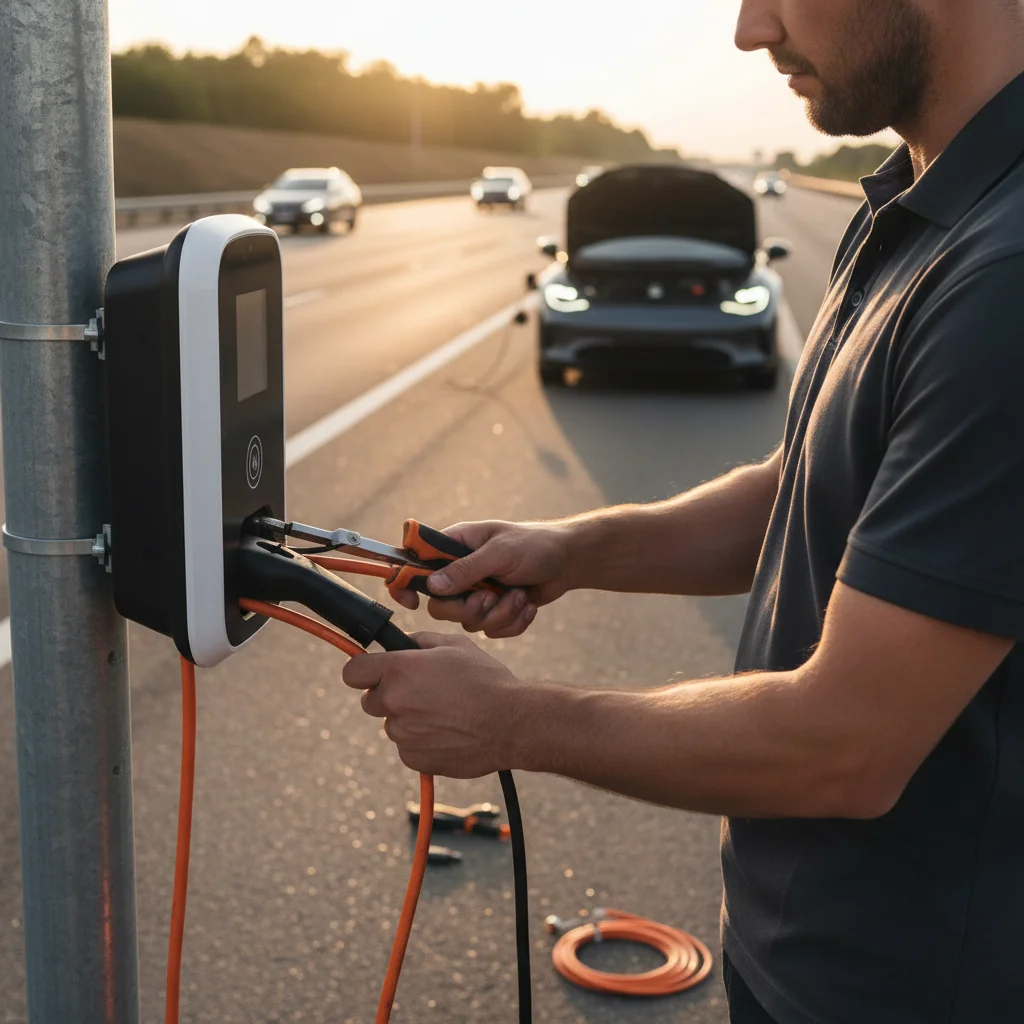
A tow off I-405 still leaves you with an empty pack. Most EVs need a flatbed, because a dolly can stress the drivetrain. The truck also needs a legal, clear place to work next to live traffic. After the drop you still have to find a plug.
Don’t assume a tow is the cheaper path. Operators set their own prices and quote before they start. Charge Pro OC doesn’t publish fees. A tow also doesn’t put energy in the pack. Confirm current towing and charging prices with the company that will actually do the work.
Towing a dead EV in Orange County is the last move, not the first. Mobile EV charging puts energy into the pack where you sit. Out-of-charge recovery is the service built for a zeroed pack.
Operators in the network handle Tesla and every major EV brand. The rig carries a native NACS plug plus CCS and J1772 adapters. If you’re not in a Tesla, you still belong in this call. See non-Tesla EV rescue in Orange County.
Traffic on I-405 changes by hour. Beach weekends stack Huntington Beach and Seal Beach ramps. Airport hours stack Costa Mesa. Irvine’s job peak stacks the south end toward I-5. None of that is an arrival promise. It’s why the operator quotes from your actual pin, not from a script.
What to tell the operator from I-405
Have this ready.
Direction of travel, northbound or southbound. The last exit sign you passed. Year, make, model, and color. Whether the dash still wakes. Pack percent, if the screen still shows it. Whether this feels like a 12-volt failure or a true empty pack.
If the 12-volt is the problem, a jump or on-site replacement can restore the car without a pack charge. If the pack is at zero, you need the 240V session. Tell the operator what the car is doing.
Huntington Beach and Costa Mesa sit on different stretches of this same freeway. If you already crawled into town, the city pages help. See EV charging in Huntington Beach and EV charging in Costa Mesa. If you’re still on the shoulder, stay there.
Fountain Valley sits between those beach and airport stretches. Irvine sits at the south end. You don’t need a perfect city name for dispatch. Direction plus last exit is enough.
Frequently asked questions
What should I do first if my EV dies on I-405?
Get fully onto the right shoulder with hazards on. Tell CHP your direction and last exit. Then call for a mobile 240V charge at the car. Walking toward a mall stall from a live freeway isn’t the plan.
Tesla roadside or a local operator, which call?
Tesla will talk to you about a depleted pack. Tesla’s published policy answers that with transportation, not an on-site charge. Tesla also says that help isn’t a financially covered service. A local operator brings Level 2 power to the shoulder. If you want to roll to a Supercharger under your own power, that on-site charge is the difference.
What if I still have a few miles left?
Call before the pack hits zero. If the next exit is realistic, get off and wait in a lot. If traffic or remaining miles make that a gamble, take the shoulder while you still control the car. An operator can meet you in a lot or on the shoulder. Don’t dash to a charger you can’t reach.
If you’re already stopped on I-405, stay with the car. Call (949) 444-0151 and we’ll connect you with a local operator who quotes before any charging starts.