If your EV dies in Silverado, skip the charger hunt. ZIP 92676 returns zero public electric stations in the DOE locator. EV roadside assistance here means a 240V charge at the bumper.
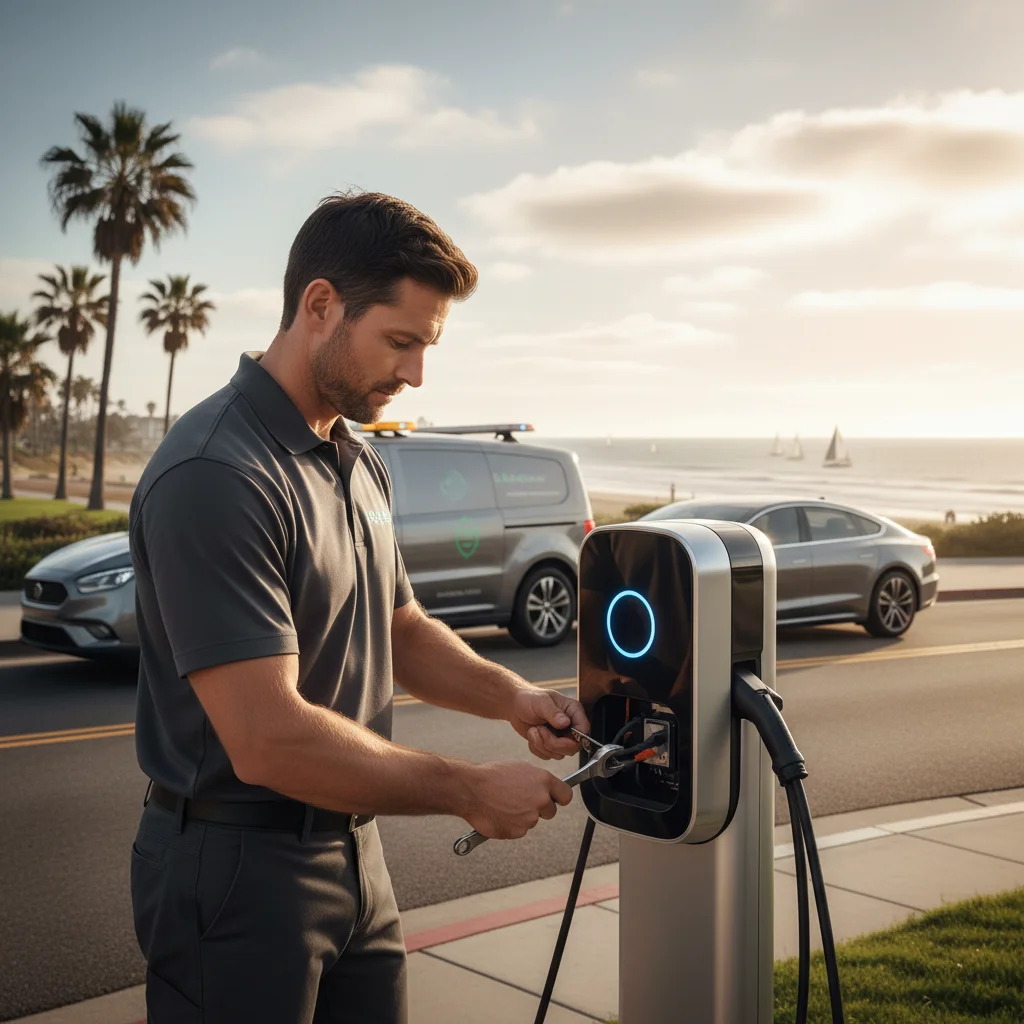
Silverado Canyon is a dead-end, not a loop
Silverado is an unincorporated canyon community in East County. It’s not a city, and it doesn’t have extra exits. The ACS 2020 to 2024 5-year count puts population at 972. The margin of error is plus or minus 184. The 2024 Census Gazetteer lists 5.719 square miles of land. The Census internal point sits at 1,672 feet.
You get here on Silverado Canyon Road. It peels off Santiago Canyon Road, County Route S18. SR-241 is the nearest freeway-class road. East of the village, the canyon road dead-ends into the Cleveland National Forest. There’s no through route out that way.
Santiago Peak stands at 5,668 feet above the village. Modjeska Peak shares that same crest. The Santiago Canyon approach passes Irvine Lake, also called Santiago Reservoir. Who operates that reservoir couldn’t be confirmed. The Serrano Water District site had no page on it. The IRWD page returned a 404 when we checked.
A visitor from Irvine with twenty miles left is doing canyon math. The grade eats range on the way in. The same road is the only way back out.
ZIP 92676’s vehicle file, and why the wall unit is the plan
As of December 31, 2025, Orange County had 210,842 battery-electric light-duty vehicles. That’s 8.54% of the CEC light-duty fleet. ZIP 92676 had 1,888 light-duty vehicles in the same file. Of those, 146 were battery-electric and 51 were plug-in hybrids. That’s a 7.7% BEV share, under the county rate.
A Silverado household with an EV charges at home, or it doesn’t charge. When the wall unit fails, the canyon has no public fallback. That’s why home charging versus a rescue is the local question.
Countywide, CEC counts 7,095 public ports against 260,833 ZEVs. That’s 36.8 ZEVs per public port, against California’s 24.4. Orange County is worse served per EV than the state. This canyon is the far edge of that squeeze.
Superchargers that sit outside the place boundary
Tesla has 48 Supercharger sites in Orange County, with 861 DC fast ports. That’s AFDC data, Tesla network, public and available, clipped to the county. None of those sites sit inside Silverado’s Census place.
The closest Tesla Supercharger, measured straight-line from Silverado’s centroid, is Irvine at Walnut Ave. That’s about 9.0 miles. It’s the longest Supercharger distance of any populated place in Orange County. AFDC lists 5396 Walnut Ave with 12 stalls at 250 kW. That site opened August 1, 2023. 5406 Walnut Ave has 8 stalls at 250 kW. That one opened December 3, 2020. Straight-line miles understate the drive. The road drops out of the canyon, and the return climbs the same grade.
Lake Forest holds the other named cluster. 24301 Muirlands Blvd has 24 stalls at 250 kW. AFDC shows it opened February 28, 2023. 24372 Rockfield Blvd has 16 stalls at 325 kW. That’s Magic Dock, CCS1 plus NACS, opened August 28, 2026.
The nearest public DC fast record for this canyon is TAE Power Solutions. The address is 19631 Pauling, Lake Forest 92610. It has two DC fast ports, about 5.1 miles away. You still have to finish Silverado Canyon Road to use it.
Modjeska measures 7.0 straight-line miles to Muirlands. Trabuco Canyon measures 7.3 to the same Lake Forest site. Silverado at 9.0 is the county’s deepest Supercharger desert. Canyon road miles run longer than those centroid figures. The method uses Census TIGER 2024 place boundaries, not a driving app.
Teslas, adapters, and the Lake Forest Magic Dock
As of December 31, 2025, Tesla made up 138,121 of Orange County’s 210,842 BEVs. That’s 65.51% of the county’s battery-electric fleet. Orange County is 6.4 points more Tesla-concentrated than California. ZIP 92676’s make mix wasn’t in the file we used. Don’t assume the canyon matches the county.
If you’re not in a Tesla, the Walnut Ave Superchargers need a NACS adapter. The Rockfield Magic Dock lists CCS1 plus NACS. TAE Power Solutions is still the closest named public DC fast pin. The operators in this referral network bring a native NACS plug, plus CCS or J1772 adapters. The car in the canyon doesn’t have to match a stall down the hill.
Grade, fire, and the one road out
Range loss here is a grade story first, and heat is second. The village sits at 1,672 feet, and the crest climbs toward 5,668. The road is steep and narrow. One way in, and one way out.
Silverado sits in a Very High Fire Hazard Severity Zone. The 2020 Silverado Fire burned 12,469 acres. The 2007 Santiago Fire burned 28,430 acres. Evacuation uses the same Silverado Canyon Road. An EV with a thin pack on that road isn’t a lifestyle worry. It’s arithmetic on a single exit.
If you’re already fading on Santiago Canyon Road, stay on a safe shoulder. Don’t try to stretch a low buffer to Walnut Ave.
Empty pack versus a dead 12V
An empty traction pack and a dead 12-volt battery look alike from the sidewalk. The car won’t wake, and the screens stay dark. They’re different jobs for the operator who shows up.
Tesla’s roadside policy answers a depleted battery with transportation, not with on-site charging. Warrantable breakdowns can include transport of up to 500 miles to a Service Center. Running out of charge sits outside that covered list. Tesla’s Model Y owner’s manual also notes a technical catch. Once range is gone, the low-voltage battery can lose support. It may need external power before the high-voltage pack will take a charge.
The operators Charge Pro OC refers can jump a dead 12V on site. They can replace it there too. They can also bring a 240V Level 2 source to the car. Teslas get a native NACS plug. Other brands use a CCS or J1772 adapter. A typical session adds 10 to 20 miles of range. That takes 15 to 30 minutes of charging. That’s charging time, not a clock on when anyone arrives. The operator quotes you before work starts, and they bill you directly.
Charge Pro OC is a referral line. It doesn’t own trucks, and it doesn’t send staff of its own. It matches stranded EV drivers with independent local mobile rescue operators. Those operators serve Orange County, including Silverado Canyon. The Silverado hub is the local page. How a rescue truck works covers what they roll with.
When the miles hit zero on Silverado Canyon Road
Pull off as far as the narrow road allows, and keep your hazards on. Don’t roll toward Irvine on fumes and hope.
Call for mobile EV charging while you still have a pin to share. Ask for out-of-charge recovery if the pack is the problem. The operator quotes the job before they start. If the 12V is the failure, say so. If the pack is at zero, say that too. Either way, the car stays where it sits.
Visitors from Orange or Irvine should treat the climb as a planned charge event. A leftover commute buffer isn’t a canyon plan. Residents should treat a failed home charger as a stranding. There’s no public plug in the canyon to cover that gap.
Frequently asked questions
Is there public EV charging in Silverado Canyon?
The DOE station locator returns zero public electric stations for ZIP 92676. The nearest named DC fast site is TAE Power Solutions in Lake Forest. It has two ports, about 5.1 miles away. The nearest Tesla Supercharger is Irvine, Walnut Ave, about 9.0 straight-line miles. That’s the longest Supercharger gap of any populated place in Orange County.
What does EV roadside assistance in Silverado actually do?
An independent operator comes to the car with 240V Level 2 charging. Teslas use NACS, and other EVs use CCS or J1772. A typical charge adds 10 to 20 miles. That takes 15 to 30 minutes of charging time. They can also jump or replace a 12V battery. Charge Pro OC refers the call, and the operator quotes and bills you.
Should you tow out of the canyon before you charge?
A tow still has to run Silverado Canyon Road. The stall you’re aiming for is in Lake Forest or Irvine. Charging on site puts miles back without leaving the village. Tesla treats an empty pack as paid transport, not a covered mobile charge. Stay with the car unless you’re in an unsafe spot.
Charge Pro OC refers Silverado Canyon drivers to local operators. Those operators bring the charge to the car. Call (949) 444-0151 when the pack is empty. There’s no stall in the canyon to hunt.