A home EV charger in Silverado Canyon is a 240-volt circuit. An electrician runs it to the spot where you park. That’s the job behind ev charger installation silverado canyon. Charge Pro OC doesn’t hang that box or pull that permit. We’re a referral line. We match stranded EV drivers with independent local mobile rescue operators. This page covers the canyon facts that change a home install. It also covers the permit and price figures this research couldn’t confirm. It covers how to keep driving while that circuit is still a quote. Silverado is a steep inland canyon with one road in and out.
Silverado is a canyon village, not a city hall
Say Silverado or Silverado Canyon. It’s an unincorporated CDP in ZIP 92676, not a city. The ACS 2020 to 2024 5-year estimate puts about 972 people here. The margin of error is plus or minus 184. The 2024 Census Gazetteer lists 5.719 square miles of land. The CDP internal point sits at 1,672 feet. Santiago Peak stands at 5,668 feet on the same crest. Modjeska Peak sits on that crest too.
Silverado Canyon Road is the street that actually reaches the village. You get onto it from Santiago Canyon Road, County Route S18. SR-241 is the nearest freeway-class road. There’s no through route east. Silverado Canyon Road dead-ends into the Cleveland National Forest. A historic mining-era village sits in that fold of the Santa Ana Mountains.
You’ll pass Santiago Reservoir, also called Irvine Lake, on the S18 approach. This research didn’t confirm current ownership or operating status. Treat it as a landmark on the drive in. Neighbors in this drainage include Modjeska, Trabuco Canyon, Orange, Irvine, and Lake Forest.
Lots drop away from the road. Parking is often a tight pad or a carport, not a wide coastal garage. The panel may sit far from where the car sleeps. Wire length still changes a quote, even when nobody publishes a figure here.
Visitors roll in from Orange or Irvine with a thin range buffer. They often don’t budget the climb on Santiago Canyon Road. The same grade spends range again on the way back toward the 241.
Range loss here is a grade story first and a heat story second. This is a hot, dry, inland mountain canyon. It’s a Very High Fire Hazard Severity Zone. The 2020 Silverado Fire burned 12,469 acres. The 2007 Santiago Fire burned 28,430 acres. Evacuation uses that same single road. A low pack on a warning day is a genuine problem. A working home charger is how most residents start any drive out.
What a Level 2 install actually is
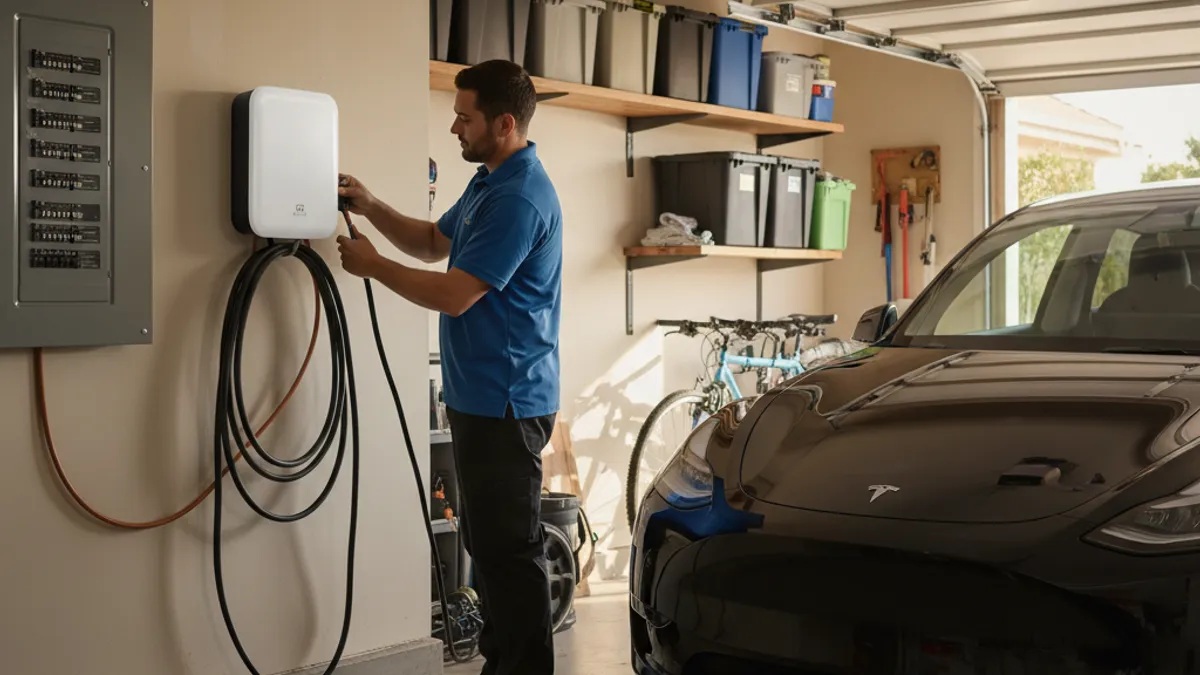
People picture a small box on stucco, but the work is the circuit behind it.
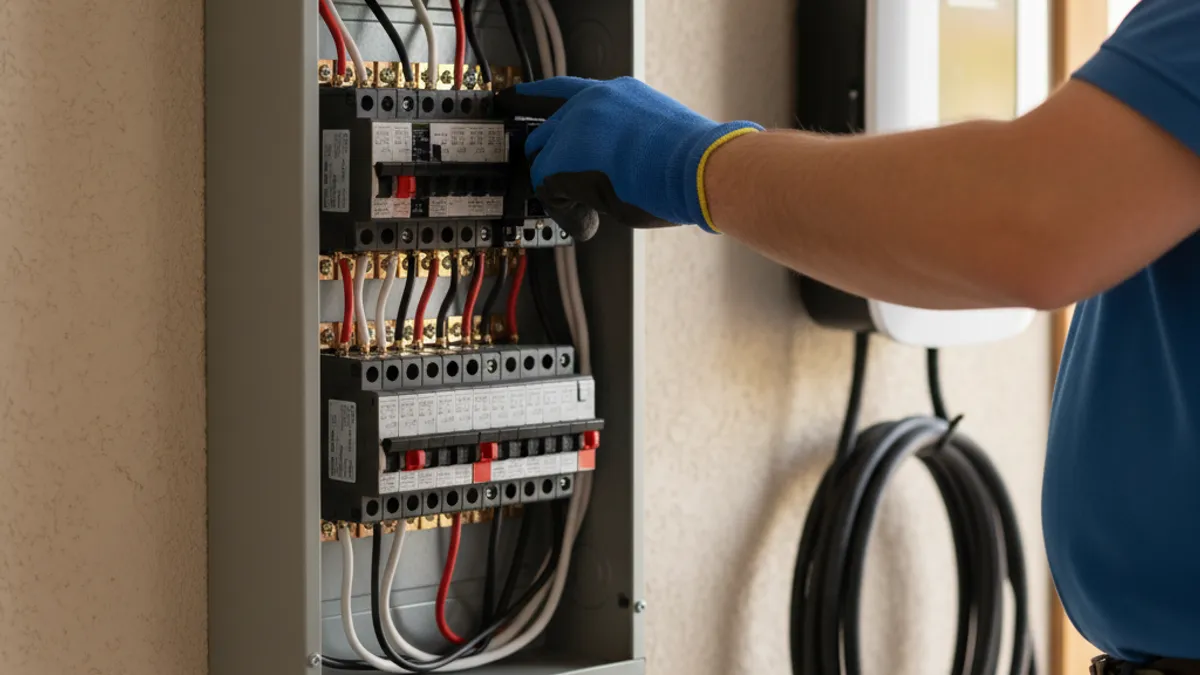
A Level 2 home charger uses 240 volts, like a dryer circuit. The electrician adds a dedicated breaker in the panel. Then they run new wire to the parking spot. Three things set the difficulty on a canyon lot. The first is spare panel capacity. The second is wire-run length. The third is whether a permit has to be pulled first.
Charge Pro OC doesn’t do electrical contracting. We don’t own trucks, a warehouse, or parts inventory. The operators we connect you with bring 240 volts to a stranded car. That’s a rescue, not a permanent wall circuit. If you want a home charger, you hire an electrician. The pros we connect you with are licensed. Your installer is a separate hire.
A load calculation is the honest first move. The electrician adds up the house’s existing demand. Then they check whether a 240-volt charger still fits. If the math is tight, they may propose load management. They may share an existing high-draw circuit. Or they may talk about a panel upgrade. This file doesn’t publish a target amperage. That’s a site decision. Ask them to show the calc in writing.
Don’t assume every Silverado house has a small old panel. Housing built before 1980 wasn’t verified at this geography. Two neighbors can still get very different quotes. Lot shape, panel location, and feeder length vary on a steep street.
What this research could not confirm
This research didn’t turn up a verified permit fee. That includes a residential Level 2 charger in unincorporated Silverado. It didn’t turn up a published wait time. It didn’t turn up a named over-the-counter rule. It didn’t confirm a labor or hardware dollar figure for ZIP 92676. It didn’t confirm a utility EV rate or a rebate. It didn’t confirm a panel-upgrade price.
Silverado is unincorporated Orange County. The county is the government that covers this CDP. Confirm the current electrical permit path with the county office that handles ZIP 92676. Do that before anyone opens a panel. Ask who pulls the permit. Ask who calls the inspection. If a quote skips that conversation, keep calling.
Rebates come and go. This file couldn’t confirm an active charger or panel rebate tied to Silverado Canyon. Check the county, state energy programs, and your utility’s current EV pages. Don’t subtract a discount you haven’t verified.
Time-of-use rates change too. This research didn’t verify a published off-peak window for canyon homes. Overnight charging is still how most owners keep a pack full. It also keeps you out of a hot garage at midday. Confirm the current schedule with your utility. Don’t treat a blog’s hours as a tariff.
The local fleet, in government numbers
ZIP 92676 had 1,888 light-duty vehicles as of December 31, 2025. That’s the California Energy Commission vehicle population file. 146 were battery-electric. 51 were plug-in hybrids. The BEV share is 7.7 percent. Orange County’s BEV share is 8.54 percent.
Countywide, Orange County had 210,842 battery-electric vehicles on that same date. The ZEV total was 260,833. The light-duty total was 2,469,737. ZEVs are 10.56 percent of the county light-duty fleet. BEVs alone are 8.54 percent.
Orange County holds 12.02 percent of California’s battery-electric vehicles. It’s 8.33 percent of the state’s light-duty fleet. Teslas are 138,121 of those 210,842 county BEVs. That’s 65.51 percent, and 6.4 points above the state Tesla share of BEVs.
New sales still run ahead of California, with a caveat. In 2025, ZEVs were 28.76 percent of new Orange County light-duty sales. Statewide that share was 22.93 percent. In 2026 Q2 the county figure was 24.77 percent. California’s was 19.09 percent. The trend isn’t a straight climb. California’s ZEV share of new sales peaked at 25.31 percent in 2024. 2026 Q1 was the weakest quarter in that series at 15.76 percent statewide.
As of December 31, 2025, Orange County had 7,095 public charging ports. That’s 20 Level 1, 5,600 Level 2, and 1,475 DC fast. The ratio is 36.8 ZEVs per public port. Statewide it’s 24.4. The county is thinner per EV than California as a whole. Canyon residents feel that when they leave the village and look for a stall.
Named stalls canyon drivers actually use
Federal station data names sites in nearby cities. You can plan around those names. This page doesn’t guess the road miles from your driveway to those plugs.
In Lake Forest, TAE Power Solutions lists two DC fast ports. The address is 19631 Pauling, ZIP 92610. Tesla Superchargers in Lake Forest include 24301 Muirlands Blvd. The AFDC record shows 24 stalls at up to 250 kW. Another Lake Forest Tesla site is 24372 Rockfield Blvd. That record shows 16 stalls at up to 325 kW. It includes Magic Dock CCS1 and NACS.
Irvine’s Walnut Ave cluster is a Tesla pair. 5396 Walnut Ave shows 12 stalls at up to 250 kW. 5406 Walnut Ave shows 8 stalls at up to 250 kW.
A commute toward Irvine or Lake Forest can pick up a stall after the descent. A guest coming up S18 from Orange may arrive thinner than the nav promised. The home wall remains the daily plan. Silverado’s place page is the Silverado charging hub.
Questions that separate a real electrician from a cheap box quote
Use this list when you call. You’re hiring an installer, not Charge Pro OC.
- Will you run a load calculation, and can I see it in writing?
- Does this panel have headroom, or are we talking a panel upgrade?
- Is the electrical permit in the price, and who schedules the inspection?
- What amperage are you sizing the circuit for?
- How long is the wire run, and is that in the bid?
- Can the charger schedule off-peak once you confirm the utility rate?
An installer who answers those is easier to trust. A bid that only prices the wall unit is incomplete. The low bid that skips the load calc often becomes a change order. Get at least two quotes. Compare the circuit, not just the hardware brand.
If the job turns into a panel upgrade, pause before you wait. Read panel upgrade or roadside help tonight for that fork. The wall work and the stranded-car work run on different clocks.
How to keep the car moving while the circuit is still a quote
Installers rarely mention this gap. You already have the EV, and the panel work isn’t done. You still have to leave the canyon.
A 120-volt outlet is slow. On Santiago Canyon grades it rarely keeps up with a real day. Public DC fast and Supercharger stalls in Lake Forest and Irvine are named above. They still require enough range to get out Silverado Canyon Road. Then you still have S18 and the surface streets. If you misjudged the climb, you’re not hunting a stall. You’re sitting on a narrow canyon road.
That’s when a mobile Level 2 charge at the bumper matters. Charge Pro OC refers you to independent operators. They bring a 240V Level 2 source to the car. They use a native NACS plug. CCS or J1772 adapters cover non-Tesla EVs. Typical charging time adds 10 to 20 miles of range. That takes 15 to 30 minutes of charging. That’s charging time, not an arrival promise. The operator quotes you before starting and bills you directly. We don’t set the price. We don’t own the truck.
If you’re already on S18 with a dying pack, stay put. Then read no charge left on Santiago Canyon Road. For the install-versus-truck choice, see home charger install vs mobile rescue. The mobile EV charging page covers how the referral works across Orange County.
Tesla roadside is a different path. Tesla’s published roadside policy answers a depleted pack with transportation. It doesn’t answer with charging at the car. Confirm the current wording on Tesla’s own roadside page. Don’t assume a free truck. Tesla roadside publishes 877-798-3752.
When the new wall charger fails anyway
Installs don’t always hold, from tripped breakers to GFCI faults. The car can wake low after a night on the wall.
That’s an electrical callback and a mobility problem at once. If the EV won’t wake at all, start with the 12-volt battery. You may not have an empty traction pack. Teslas and most other EVs still use a low-voltage battery to close contactors. Tesla’s owner’s manual notes a further wrinkle. Once range is exhausted, the low-voltage battery can lose support. It may need external power before the high-voltage pack can charge. The operators we connect you with can jump a dead 12V on site. They can replace it on site too. They can also add that short Level 2 session when the pack is the problem.
Don’t wait in the driveway if you need to move. Get enough range to leave the canyon. Sort the wall-unit warranty on your own clock.
Wildfire days raise the stakes. Keep the pack high when the canyon is under a warning. If the home charger is dark, use a mobile 240V session at the house. Towing a dead EV on Silverado Canyon Road is the last move.
Frequently asked questions
What does EV charger installation cost in Silverado Canyon?
This research couldn’t confirm a published labor, permit, or hardware figure for unincorporated Silverado. A simple 240-volt circuit with panel headroom is one job. A panel upgrade is another. Ask for a written load calculation and a line-item quote. Then confirm current permit fees with the county office that covers ZIP 92676. Anyone citing a round number without seeing your panel is guessing.
Do I need a permit for a Level 2 charger here?
This file didn’t verify a published permit rule, fee, or inspection timeline for Silverado Canyon. Silverado is unincorporated. The county is the authority that covers this CDP. A reputable electrician should tell you whether they pull the permit. They should also say who meets the inspector. Confirm it with the county before work starts. Don’t take a handshake as the code.
Can I charge before the installer finishes?
Yes, you can drive while you wait, with limits. A 120-volt outlet is slow on this grade. Named public stalls in Lake Forest and Irvine are listed above. If you can’t make those addresses, stay with the car. Don’t hunt a stall from a dead stop on Silverado Canyon Road. The operators Charge Pro OC refers can bring 240 volts to the car. They quote first. They bill you directly.
Keep the wall job moving, and keep a backup
A Level 2 charger in Silverado Canyon is worth doing if this is home. The circuit, the panel, and the county permit are the real project. Get two quotes. Insist on the load calc. Confirm the permit path with the county. Set charging for whatever off-peak window your utility actually publishes.
While that work is open, keep a backup for the car. The same is true if the new charger dies on a fire-weather morning. Call (949) 444-0151 for a referral. That’s on-site charging or a 12V rescue. We’ll connect you with a local operator who quotes before they start. For canyon roadside context, use the Silverado EV roadside guide.