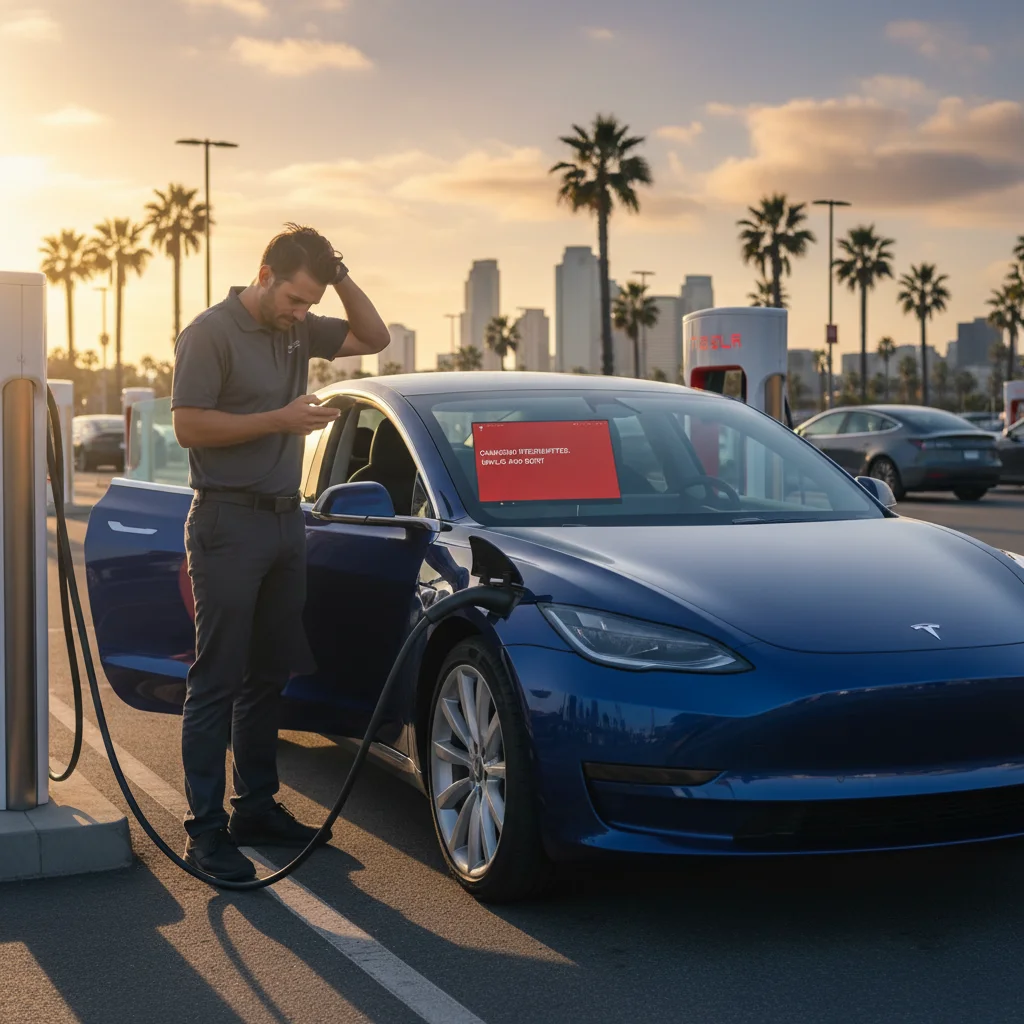
You pull into a Garden Grove Supercharger already low. Every stall is taken, or the cabinets are dark. That tesla supercharger down garden grove search is a real bind. It hits Harbor Blvd and Valley View the same way. A 32-stall site can still leave you sitting. A 500 kW site can do the same. The next useful move is range at the car.
Two Tesla sites in town, and why they still leave you low
Garden Grove isn’t short on Tesla Supercharger hardware. Tesla lists 32 stalls at 12891 Harbor Blvd. They sit at Harbor Town and Country, at up to 250 kW. The newer site at 12161 Valley View St sits at a Starbucks. It has 16 stalls at up to 500 kW. AFDC treats that Valley View array as one of the county’s newest Supercharger sites. Electrify America also runs DC fast charging at 12075 Euclid St.
Those listings don’t mean a stall is open when you need it. Harbor Boulevard’s hotel strip is the city’s defining EV pattern. Thousands of Disneyland visitors sleep in Garden Grove instead of Anaheim. They arrive from Arizona, Nevada, or Northern California already low. They assume the hotel has a working destination charger. Often it has two plugs, both taken, or one already offline. Then they aim at the Harbor Supercharger next. So does everyone else on the hotel strip.
West Garden Grove and Little Saigon along Bolsa Avenue feed the same two Tesla sites. The Chapman and Harbor resort district feeds them too. Great Wolf Lodge and Christ Cathedral sit in the same mid-county grid. The Asian Garden Mall and the Bolsa corridor straddle the Westminster line.
The city sits at about 83 feet of elevation. It’s uniformly flat, with no hills in town. The range drain here is congestion, not grade. The SR-22 runs the full length of the city. I-405 clips the southwest corner of the city. Harbor, Garden Grove Blvd, Chapman, and Katella clog at Supercharger hours.
Orange County had 210,842 battery-electric cars on the road as of December 31, 2025. That’s per the California Energy Commission vehicle file. Teslas were 138,121 of those BEVs, 65.51% of the county’s battery-electric fleet. The county also runs 36.8 ZEVs per public port, versus 24.4 statewide. Garden Grove’s Superchargers sit inside that squeeze, not outside it.
Why the stalls fill, or go dark
A full site is usually a timing problem. Weekday peaks on the SR-22 stack Teslas at both cabinets. Weekend park traffic on Harbor does the same. Holiday travel adds another wave from the inland side. The in-car map still shows live stall counts. Those counts can flip from open to a wait in minutes. Westminster Mall and Cypress on Katella feel that same crush. Anaheim’s Katella and Lincoln Superchargers fill too.
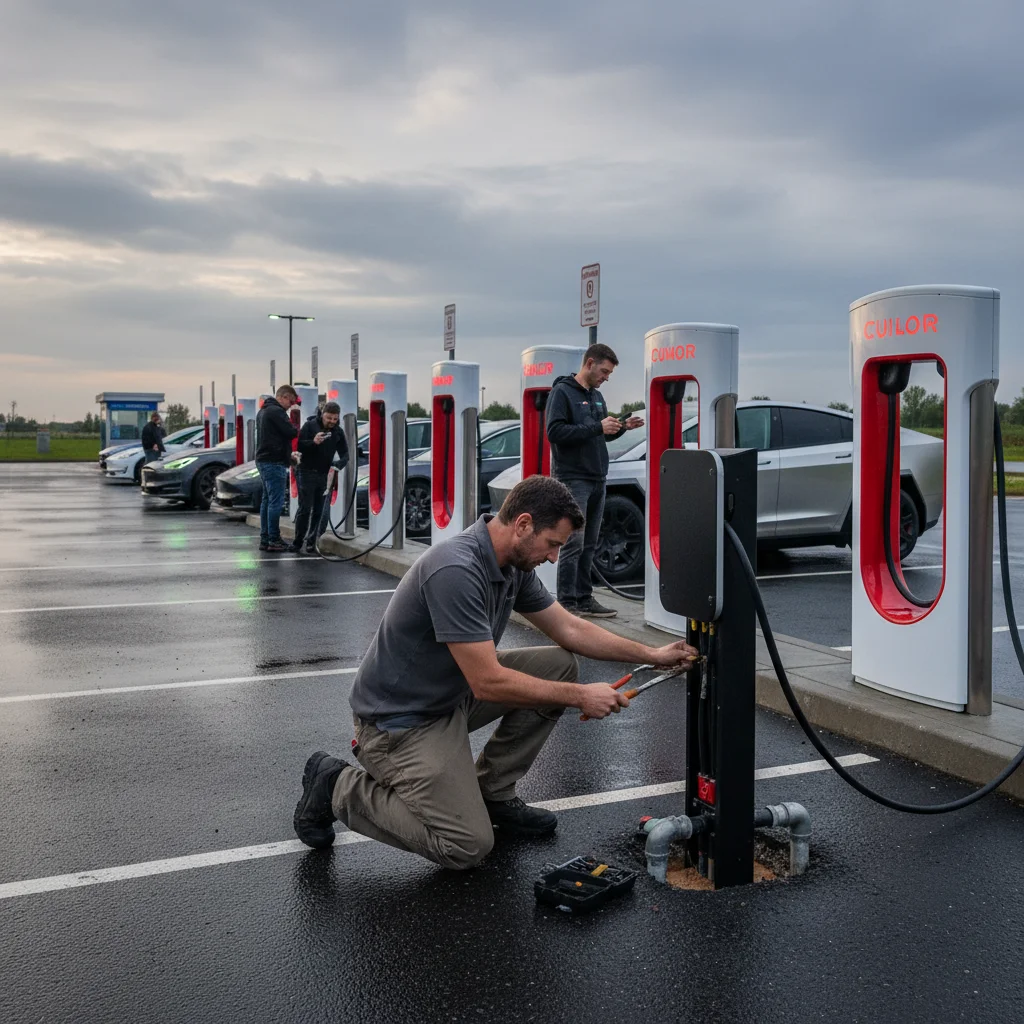
An offline site is a different kind of problem. Cabinets, cooling loops, cables, and connectors fail under heat and heavy use. A station also needs Tesla’s network to authorize the car and bill the session. A network drop can leave stalls powered and still unusable. Local grid trouble can take a whole site down. Which utility owns that circuit could not be confirmed here. Confirm the site in the Tesla app before you spend range. Check Tesla’s findus page before you drive over.
Public cabinets also take hits in busy lots. A bent cable or knocked pedestal can kill part of a site. It stays down until Tesla can repair it. Repair time isn’t a figure this page can cite. Don’t wait on a number Tesla didn’t publish.
The third Garden Grove pattern is the SR-22 itself. The freeway runs the whole city, so a Supercharger miss can become a shoulder call. Stay on the shoulder if you’re already there. Don’t try to limp to Harbor or Valley View on a few percent. The Garden Grove Freeway is the wrong place to learn the cabinets are still dark.
Harbor Blvd when the 32 stalls are taken
The Harbor Town and Country Supercharger is the one hotel guests hunt first. If those 32 stalls are packed or dark, don’t assume Valley View is empty. Check it in the car before you spend the last miles. Check Electrify America on Euclid too, if you carry a CCS adapter.
Anaheim’s Superchargers along Katella, Euclid, and Lincoln sit on the same resort edge. They fill hard on the same park-day clock. The Anaheim Supercharger guide covers that nearby cluster. Westminster Mall lists 24 Supercharger stalls on Tesla’s map. Tesla rates that site at 75 kW, so it’s slower than Harbor. Fountain Valley has Superchargers at 17940 Newhope St and at 9430 Warner Ave. Santa Ana has 28 stalls at 1008 17th St at up to 325 kW. It also has 20 stalls at 300 E 5th St at 75 kW. Cypress has 16 stalls at 4959 Katella Ave. Treat those as listed sites, not open stalls. Confirm they’re working before you leave the lot you’re in.
Buena Clinton, Garden Park, and Woodbury sit a short hop from Harbor. A dead Supercharger there still leaves you in a dense, lit grid. That’s better than rolling onto the SR-22 to chase a maybe.
Valley View at 500 kW, still a queue
The Starbucks Supercharger on Valley View is fast. Fast doesn’t mean a stall is open. Sixteen stalls at 500 kW draw local drivers and through-traffic off I-405. Beach Boulevard and Valley View feed it from west Garden Grove and from Westminster. If that site is down, Harbor is the in-town Tesla backup. It’s not a sure thing on a park Saturday.
Stay in a lit lot while you decide. A hotel driveway on the Harbor strip is safer than a shoulder guess. Historic Main Street and the Civic Center lots work the same way. Garden Grove EV rescue is the local playbook when you’re too low to shop.
If you arrive with almost no range
Arriving around 30% is a wait-or-reroute problem. Arriving at 5% is a stay-put problem. Trust the car’s range estimate, then add a margin for Harbor traffic and SR-22 slowdowns. The nav doesn’t feel a stopped lane on the Garden Grove Freeway. If the next working charger is a coin-flip arrival, stay where you are.
Open the Tesla app and read the site note. A short software restart might be worth sitting out. A power loss with no restore time isn’t. How long Tesla will take to repair a cabinet isn’t published here.
Limp-driving on a near-empty pack can cut power. You can end up on the SR-22 with no stalls and no margin. Those shoulders are for emergencies, not charger shopping. Running low before you strand is the calm sequence. If you’re already in a hotel lot with a dark dash, call from there. Don’t hunt Euclid or Valley View on fumes.
A public charger that’s plugged in and still dead has its own checks. Public charger dead checks walk through that before you spend the last miles. Sometimes the stall is fine and the car isn’t. A weak 12V can block charging, door handles, and the screen. If the Supercharger never starts a session, check the 12V first.
Shared stalls, NACS, and a CCS adapter
Superchargers aren’t a Tesla-only club in 2026. Tesla has been opening stalls to other brands. Some sites use Magic Dock, an integrated adapter for CCS cars. In Orange County, AFDC lists a Magic Dock Supercharger in Lake Forest. It’s at 24372 Rockfield Blvd, with CCS1 and NACS. Lake Forest isn’t Garden Grove, but the stall mix is the point. It’s a reminder that non-Tesla EVs now compete for Tesla cabinets countywide.
Keep a CCS adapter in the car if your Tesla needs one. Electrify America on Euclid becomes a real backup when Tesla cabinets are dark. Tesla already makes up 65.51% of Orange County’s BEV fleet. Tesla still holds 59% of Orange County’s public DC fast ports. Shared access only adds pressure at the same two Garden Grove sites. The rest only help if you can plug into them.
Hotel lots, 1950s panels, and 240V at the bumper
Garden Grove’s housing stock explains a lot of these calls. Census figures show 77.8% of the city’s homes were built before 1980. A striking 36.8% went up in the 1950s. Those houses often have small panels and carports, not a ready Level 2 plug. Little Saigon’s apartment blocks along Bolsa often have none.
Charge Pro OC is a referral line, not a shop. It matches stranded EV drivers with independent local mobile rescue operators. It doesn’t own trucks, employ technicians, or set prices. The operator quotes you before any work starts and bills you directly. What those operators bring is a 240V Level 2 source to the car. They use a native NACS plug, plus CCS or J1772 adapters for other EVs. Typical charging time adds about 10 to 20 miles of range. That takes 15 to 30 minutes of charging. That’s session time, not an arrival time. They can also jump or replace a dead 12V on site.
Tesla’s roadside language treats a depleted pack as help that isn’t covered. Confirm that on Tesla’s roadside-assistance page before you assume coverage. Tesla can arrange transportation, not an on-site charge. Running out of charge sits outside warrantable breakdown coverage. Once range is gone, the low-voltage battery can lose support. It may need external power before the high-voltage pack will charge.
When staying put beats another Supercharger
Stay and request a mobile charge when you can’t reach a working stall. Stay if you’re in a Harbor hotel lot with a park day in the morning. Stay if it’s late on the SR-22 and the last percent looks thin. Nearby cities include Westminster, Santa Ana, Anaheim, Stanton, and Fountain Valley. Listed isn’t the same as open from where you sit.
A flatbed from a hotel lot still leaves you hunting a stall. Mobile EV charging is the on-site version of that help. An operator comes to the bumper with a 240V source. That can put enough range in the pack to reach a working cabinet. Tesla roadside rescue is the Tesla-specific matching path. Garden Grove’s charging map is on the Garden Grove EV charging page.
If the car won’t wake at all, treat it as a 12V check first. Lights, screens, and dead door handles often point to the 12V.
When you need a local operator, call (949) 444-0151. Charge Pro OC connects you with an independent pro who quotes the job before starting. You stay with the car while they work. The operator brings the 240V to the bumper.