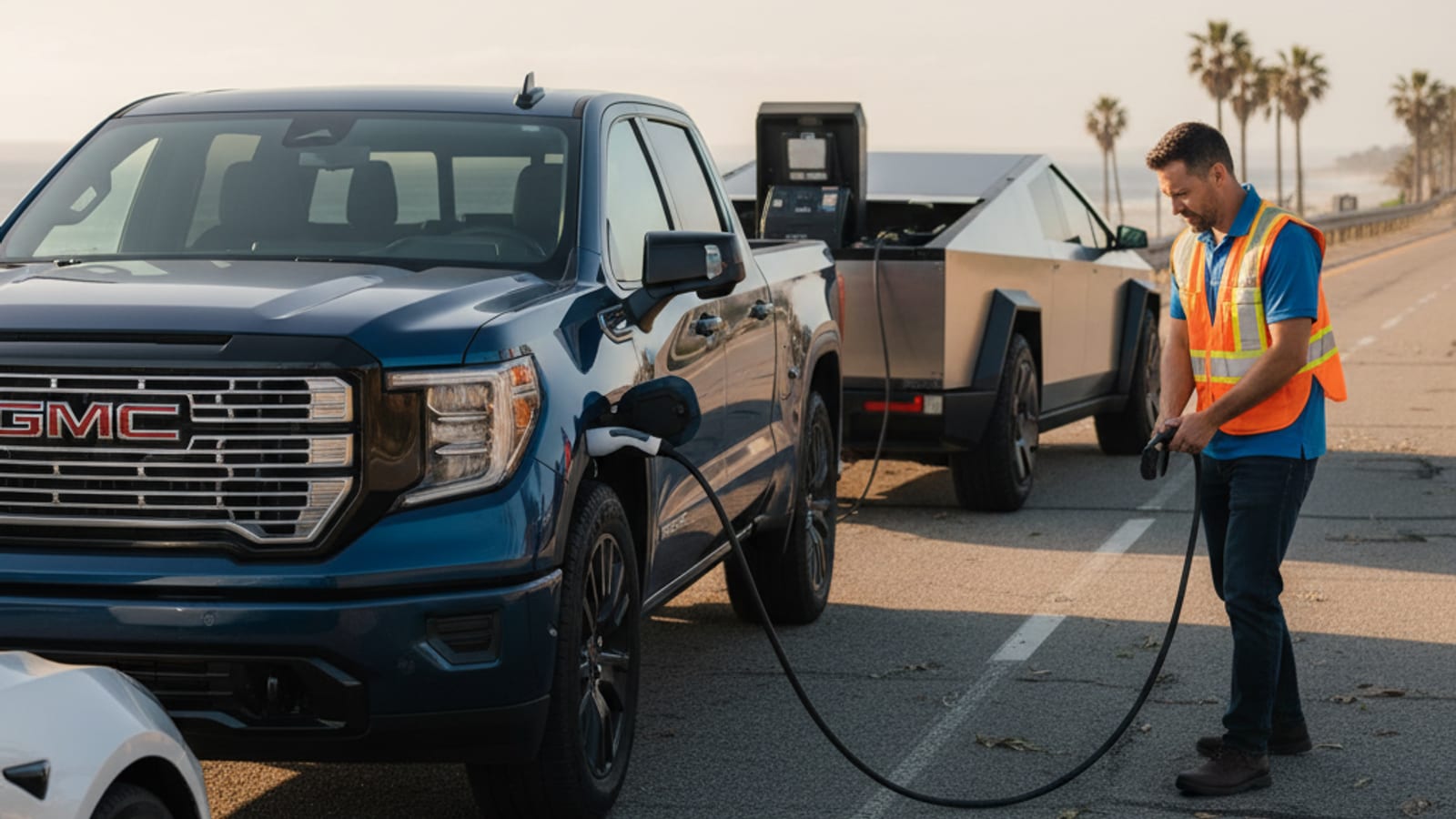
A GMC Sierra EV that hits empty in Orange County has a plug problem Tesla drivers don’t share. Tesla runs 48 Supercharger sites here, with 861 DC fast ports. Tesla holds 59 percent of the county’s public DC fast ports. Your truck needs CCS. Most of those stalls won’t take a GMC. The honest empty-pack path is 240V at the vehicle. Then you drive to a CCS stall you can actually use.
That’s GMC Sierra EV emergency charging in this market. You’re not waiting on Tesla’s map. You’re buying enough range to reach a network that matches your port.
Orange County’s fast-charge map is Tesla-first
Orange County had 210,842 battery-electric vehicles on the road as of December 31, 2025. The California Energy Commission published that count in its vehicle population file. Teslas are 138,121 of those BEVs. That’s 65.51 percent of the county’s battery-electric fleet. California’s Tesla share of BEVs is 61.34 percent. Orange County is 6.4 points more Tesla-concentrated than the state.
The Supercharger layer matches that mix. AFDC station data, filtered to public Tesla DC fast sites inside the county boundary, shows 48 sites and 861 ports. Non-Tesla DC fast charging is a smaller inventory. The same AFDC pull finds 175 non-Tesla DC fast stations and 591 ports.
A Sierra EV lives on that second list.
ZEVs as a group are 260,833 vehicles in Orange County. That’s 10.56 percent of the light-duty fleet. BEVs alone are 8.54 percent. Orange County holds 12.02 percent of California’s battery-electric vehicles. It’s 8.33 percent of the state’s light-duty fleet. New-sale share stays above the state too. In 2026 Q2, ZEVs were 24.77 percent of Orange County’s new light-duty sales, against 19.09 percent statewide. Don’t read that as a boom still climbing. California’s ZEV share of new sales peaked at 25.31 percent in 2024. 2026 Q1 was the weakest quarter in the CEC series, at 15.76 percent. The CEC also changed its new-sale method in 2023 and again in 2025. Year-over-year jumps across those breaks aren’t clean.
The stranded-truck point is simpler. This county has a lot of EVs. Most of the DC ports were built for Teslas.
What 861 Supercharger ports mean for a GMC
Those 861 ports are real. They’re clustered in cities with big lots. Anaheim alone has seven Supercharger sites. They sit on Lincoln, Imperial, Katella, Euclid, and Santa Ana Canyon Road. Irvine has six Supercharger sites. The lot at 1920 Main St has 40 stalls. Tustin has four Tesla sites, including 36 stalls at 14661 Franklin Ave. Garden Grove has 32 stalls at 12891 Harbor Blvd. It also has a 16-stall, 500 kW Tesla site at 12161 Valley View St. San Clemente has 49 stalls at 101 W Avenida Vista Hermosa, plus 16 more at 990 Avenida Vista Hermosa. Huntington Beach has 24 stalls at 6913 Warner Ave. Santa Ana has 28 stalls at 1008 17th St and 20 at 300 E 5th St.
A CCS truck can’t treat that list as a rescue map. One Tesla site in the county is listed with Magic Dock. That’s Lake Forest at 24372 Rockfield Blvd, CCS1 plus NACS. It has 16 stalls at 325 kW. The AFDC open date is August 28, 2026. If you’re already near Rockfield, that hardware can take CCS. If you’re not, you’re aiming at Electrify America, EVgo, EVCS, or a 240V operator at the curb.
North county Tesla sites follow the same pattern. Fullerton, Brea, Buena Park, Yorba Linda, and Cypress all have Superchargers. None of those stalls is listed as Magic Dock. A Sierra EV shouldn’t treat them as a CCS stop.
Other Tesla clusters fill south and central county. Costa Mesa has three Supercharger sites. Fountain Valley has two. Laguna Hills has Tesla DC on Moulton and Cabot. Mission Viejo has 24 stalls at 27741 Crown Valley Pkwy. The Shops at Mission Viejo site at 555 The Shops lists 10 stalls. Tesla’s own figure for that site is 72 kW, which is the number to use when AFDC disagrees. Newport Beach has 12 Tesla stalls at 4241 MacArthur Blvd. Westminster Mall has 24 Tesla stalls at 75 kW. These are NACS Superchargers. Your Sierra EV isn’t looking for them.
ChargePoint has the most DC sites in the county, 71 stations and 76 DC ports. That’s about 1.1 ports per site. A lot of those are dealership and office single plugs, not a bank you can count on after dinner. Confirm the stall is public, working, and CCS before you roll toward it.
CCS sites you can name once you have a few miles
Electrify America, Dana Point Station, 25825 Las Vegas in Capistrano Beach, has 12 DC fast ports. That’s the largest non-Tesla DC site in south Orange County in the AFDC file. Electrify America at Walmart 2242, 440 N Euclid St in Anaheim, has 10 DC fast ports. Electrify America at Fashion Island, 401 Newport Center Dr in Newport Beach, has 8.
EVgo at Plaza Antonio, 22351 Antonio Pkwy in Rancho Santa Margarita, has 14 DC fast ports. EVgo at Ocean View Plaza, 638 Camino de los Mares in San Clemente, has 10. EVgo at Westar Mercantile East, 27542 Antonio Pkwy in Ladera Ranch, has 8. EVgo at 801 Pacific Coast Hwy in Seal Beach has 4 stalls.
Public Level 2 is a wider net. The CEC charger file for December 31, 2025 counts 5,600 public Level 2 ports in Orange County. It also counts 1,475 public DC fast ports. That’s 7,095 public ports. Shared private adds 4,685 more. Public Level 1 is 20 ports countywide. A wall outlet isn’t how you recover a full-size electric truck on a shoulder.
Orange County has 36.8 ZEVs per public port. Statewide it’s 24.4. The county is worse served per EV than California as a whole. A mapped stall can still be occupied, offline, or the wrong plug. That’s why on-site 240V is the empty-pack move. It isn’t a last-ditch hunt across town.
For a non-Tesla that’s already stopped, start with non-Tesla EV rescue.
First minutes after the Sierra EV quits
The truck will warn you before it sits down. Use that window. Get off the travel lane. Don’t try to stretch a dying pack to a Supercharger your port won’t take.
Shoulder, hazards, and staying put
Turn on the hazards as soon as the power fades. Ease onto the shoulder or into a lot if you can still roll. On I-5 south of Irvine, stay on the shoulder. On I-405, the 91, or SR-22 at the Crush, do the same. Stay in the truck unless the spot itself is unsafe. Note the freeway, the nearest exit, and a mile marker if you can see one. On a city street, note the cross street and which side you’re on.
If you’re already stopped on a freeway, don’t walk for a stall. Read out of charge on an Orange County freeway for the stay-put version of that call. A 240V operator comes to the truck. A CCS stall only helps after you can drive.
Coast lots and inland lots fail the same way. You parked, you ran the cabin, and the return trip was longer than the estimate. Huntington Beach, Costa Mesa, and Newport Beach add stop-and-go after a beach day. Anaheim and Buena Park add long sits in theme-park lots. Tustin office parks hide workplace plugs that are reserved or already taken. The stall across the lot only helps if it’s CCS, open, and you can still roll.
What the truck does as the pack hits the floor
EVs don’t usually go from full power to a brick in one second. You’ll feel limited acceleration first. Climate control may drop out. The truck may creep a short distance in a reduced mode. Then the traction pack hits its low limit and the Sierra EV stops.
The 12-volt battery is a separate system. It still runs hazards, locks, and the screen for a while after the pack is empty. If the truck is fully dark, silent, and won’t wake, you may have a 12-volt failure. That isn’t the same as an empty pack. The Silverado EV is the Sierra EV’s sibling on that 12-volt layout. The checks in Chevy Silverado EV 12V won’t start are the right first pass. Operators in this network can jump or replace a dead 12-volt on site. Don’t assume a tow until you’ve sorted pack versus 12-volt.
Tesla’s owner’s manuals describe a related trap on their cars. Once range is exhausted, the low-voltage battery can lose support. The car then needs external power before the high-voltage pack will take a charge. This research didn’t confirm GM’s wording for the Sierra EV. Treat a dark Sierra EV as a 12-volt check first, then a pack charge.
240V at the curb is the empty-pack path
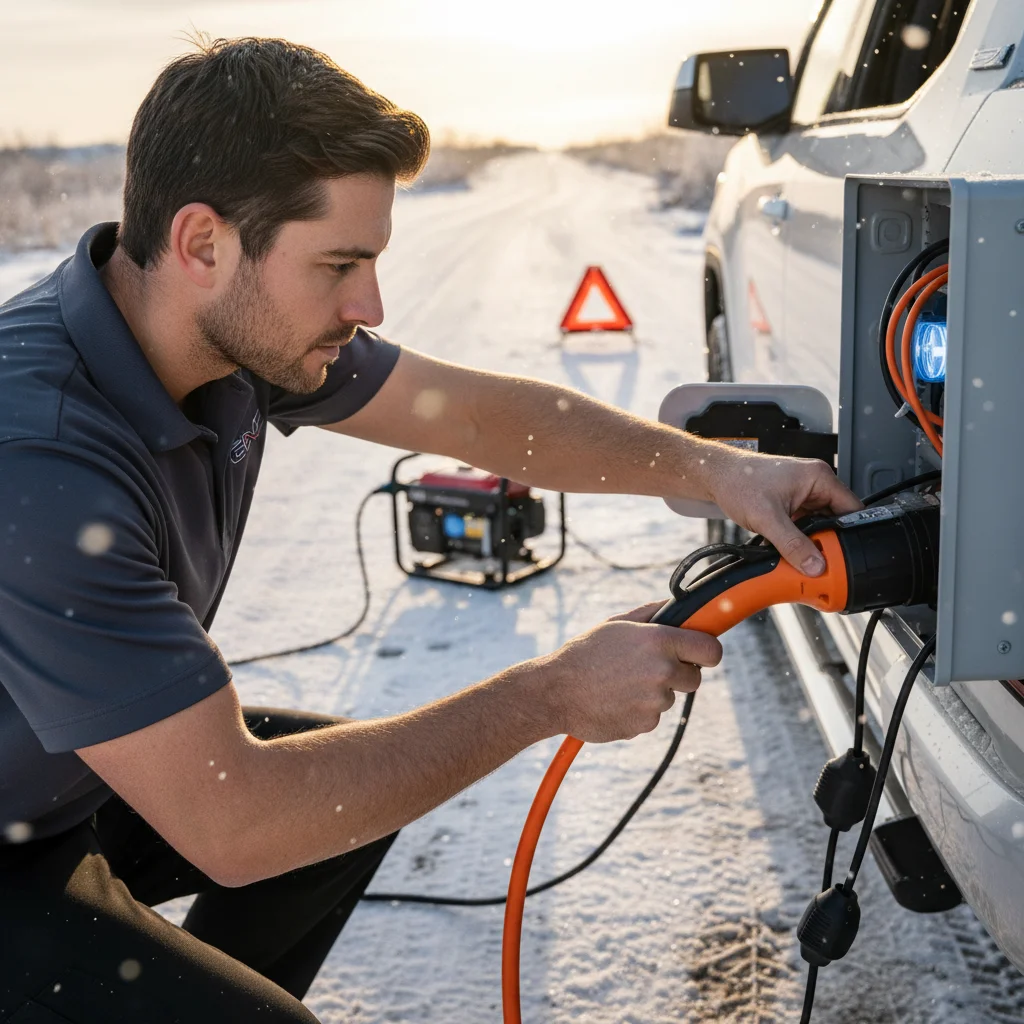
If the pack is empty, a public CCS stall only helps after you can move. A household outlet is too slow to matter on a shoulder. Vehicle-to-vehicle charging isn’t a plan you should count on either. See can one EV charge another on the road. The practical path is a mobile Level 2 source at the truck.
What the operator brings to a Sierra EV
Charge Pro OC is a referral line. It matches stranded EV drivers with independent local mobile rescue operators. It doesn’t own trucks. It doesn’t employ technicians. It doesn’t set prices. The operator quotes you before starting and bills you directly.
The operator brings a 240V Level 2 source to the car. The truck’s native plug on the operator side is NACS. For a GMC, they use a CCS adapter. They also carry J1772 for other non-Tesla EVs. Typical charging time is 15 to 30 minutes. That session usually adds 10 to 20 miles of range. That’s charging time, not an arrival promise. Ten to 20 miles is enough to reach a CCS stall you already picked. It’s also enough to get home if home is that close.
That service lives on mobile EV charging. For an empty pack with no 12-volt issue, out-of-charge recovery is the same idea in plainer words. Charge the truck where it sits. Then drive to a stall.
Tell the operator it’s a GMC Sierra EV so they bring CCS, not a Tesla-only drop. Tell them whether the truck is dark or just empty. A 12-volt jump is a different job from a pack top-off. Tell them if you’re on a shoulder, behind a gate, or in a structure. The operator needs a way in. Operators in this network handle Tesla and every major EV brand. A Sierra EV is in that second group on purpose.
Why a tow is usually the worse first call
A tow moves the truck. It doesn’t put energy in the pack. You still need a CCS stall or a shop drop after the hook. A dual-motor electric truck often needs a flatbed, not a bumper pull. Confirm that with the tow operator before they hook up. This research doesn’t publish a GMC Sierra EV towing spec, so don’t guess a procedure. Ask, then wait for the right equipment.
Towing also dumps you into the same plug problem. A Tesla Supercharger lot isn’t a useful drop for a CCS GMC. A GM dealer may not have an open DC stall the moment you arrive. You can still sit and wait after the tow. Compare the two paths in mobile EV charging or a tow. Charge on site first when the truck’s only problem is an empty pack.
Tesla roadside is a different product, and it isn’t built for your GMC. Tesla’s own roadside policy answers a depleted Tesla pack with transportation, not on-site charging. Running out of charge isn’t framed as a warrantable breakdown on Tesla’s published language. Tesla roadside is 877-798-3752. GMC’s factory roadside terms weren’t confirmed in this research. Check your glovebox packet or the GMC app for what your plan actually sends. Many factory plans default to a tow. That still leaves you hunting a CCS stall after the drop.
Grades, lots, and the roads that eat a truck’s range
A Sierra EV is a heavy pickup. Payload, a trailer, and a long grade all cut range. Orange County isn’t one driving surface. Coastal north county, inland north county, the central cities, the canyon roads, and south county each spend the pack differently.
Freeways where an empty pack strands a GMC
I-5 south of Irvine is a long, fast pull with lots of trucks. I-405 through Costa Mesa and Fountain Valley is stop-and-go, then a surge. The 91 across Anaheim, Yorba Linda, and the north county edge is the theme-park commute. SR-22 at the Orange Crush stacks lanes and eats patience. None of those shoulders is a good place to browse an app for a Tesla stall you can’t use.
If you’re on I-5, stay on the shoulder and call for a charge. If you’re on I-405, same move. If you’re on the 91, same move. Don’t idle the climate system trying to stretch the last bar. The operator needs a safe pin on the map. Give them the freeway, direction, and the nearest exit.
City lots have their own version. Anaheim and Buena Park theme-park lots hold trucks all day. Santa Ana downtown blocks and Garden Grove arterial lots leave you between Tesla banks that won’t take CCS. Westminster Mall’s Tesla stalls are 75 kW NACS hardware. They don’t solve a GMC that’s already sitting. Costa Mesa structures and Huntington Beach beach lots leave a Sierra EV parked after the last errand.
Hills, planned streets, and south county CCS you can actually use
Yorba Linda, North Tustin, and the canyon roads off Santiago Canyon chew range on the way up. Regenerative braking gives some back on the way down. It doesn’t help if you already arrived empty. Ortega Highway is a climb. Laguna Canyon is a climb. The Newport Coast grade is a climb. Plan the return with more buffer than the outbound.
Coastal drives are flatter, then the cabin AC still pulls in summer. Inland north county around Brea, Fullerton, and Anaheim runs hotter cabin loads on still days. South county around Irvine, Lake Forest, and Mission Viejo mixes planned streets with fast freeways. Canyon communities add grade on both the outbound and the return. You don’t need a made-up percent to respect that. Watch the energy graph, not just miles-to-empty.
Once you have 10 to 20 miles, pick a CCS target from the sites named above. In Newport Beach, Fashion Island’s Electrify America is CCS. The MacArthur Supercharger is Tesla. Don’t mix them up. In San Clemente, the 49-stall site is Tesla. Ocean View Plaza is the CCS EVgo bank. Lake Forest’s Magic Dock at 24372 Rockfield Blvd is the Tesla site that lists CCS1.
Home charging still matters for the next day. A Level 2 at the house is how a Sierra EV should wake up. Utility EV rates weren’t confirmed in this research. Ask your utility for the current EV time-of-use schedule before you assume a cheap overnight window. Don’t invent a number at the panel. Confirm it.
Tesla’s share of new Orange County ZEV sales has moved around. It was 56.9 percent in 2023, 47.2 percent in 2024, and 44.7 percent in 2025. It was 56.4 percent in the first half of 2026. The installed Supercharger layer still dominates DC ports. Non-Tesla trucks are a real slice of new ZEVs, and they still plug into the smaller CCS pile. That’s why a Sierra EV empty-pack call looks different from a Model Y call on the same street.
How a referral charge actually works
You call. Charge Pro OC matches you with an independent operator who can reach your pin. The operator tells you the quote before any cable goes in. You accept or you don’t. They bill you, not the referral line.
What they won’t do is fill the pack. Fifteen to 30 minutes at Level 2 is a bump, not a full charge. Pick the CCS stall before they unplug. Have the app open. Have a second stall in mind if the first is offline. Then drive. Don’t sit on the shoulder hoping a Supercharger icon turns CCS-colored.
Charge Pro OC doesn’t publish hours, and it doesn’t promise when someone arrives. It doesn’t hold a license, and it doesn’t perform the work. The pros it connects you with are licensed. That’s a claim about the network. The work, the quote, and the cable are the operator’s.
If the truck still won’t move after a 12-volt jump and a pack bump, you’re past rescue. That’s a shop job. Don’t keep charging a truck that has a thermal warning or a mechanical fault.
Keep the next empty-pack day from happening
Start long Orange County days with a high state of charge. Towing or a bed full of tools needs more buffer than an empty commute. Watch the energy graph on a grade, not just the miles-to-empty number. That number assumes the last few miles looked like the next few. On Santiago Canyon or Ortega, they don’t.
Use the truck’s nav and a charging app before you’re low. Filter for CCS. Pin Electrify America and EVgo first, then confirm Magic Dock if you’re near Lake Forest. Don’t navigate to the 40-stall Tesla site at 1920 Main St in Irvine when your port doesn’t fit. Don’t aim at San Clemente’s 49 Tesla stalls for the same reason. Use the Alternative Fuels Data Center station locator if you want the federal file behind those pins.
Public ports in Orange County total 7,095. The ZEV-to-port ratio is 36.8. Stall hunting while empty is how Sierra EV drivers end up on a shoulder. Charge at home when you can. Keep a CCS stop on the return from San Clemente or the ranchos. Leave a reserve for the climb back.
Software updates and GM’s service schedule are on GMC. This page doesn’t invent a Sierra EV maintenance interval. Follow the owner’s manual. If the truck throws a battery warning that isn’t range, that’s a dealer conversation, not a roadside top-off.
When the pack is already at zero, skip the lecture. Get the hazards on. Stay put. Call for 240V. Drive to CCS. That’s the whole play.
Frequently asked questions
Will a Tesla Supercharger charge a GMC Sierra EV
Usually no. Orange County’s 861 Tesla DC ports are built around NACS Supercharging. Your Sierra EV needs CCS. The AFDC file lists one Magic Dock exception. It’s Tesla’s site at 24372 Rockfield Blvd in Lake Forest, with CCS1 and NACS. Don’t assume every Supercharger icon is that site. If you’re empty, 240V at the truck is the honest path to a CCS stall you can name.
How long does on-site 240V charging take on a Sierra EV
Operators typically add 10 to 20 miles of range in 15 to 30 minutes of charging. That’s session time at the cable, not a promise about when the truck shows up. It isn’t a full charge. It’s enough to reach a named CCS stall, such as Electrify America in Anaheim or Fashion Island. EVgo in Rancho Santa Margarita, San Clemente, Ladera Ranch, or Seal Beach works the same way. The operator quotes you before they start.
What GMC Sierra EV emergency charging costs, and who bills you
No countywide price was confirmed for this page. Charge Pro OC doesn’t set rates. The independent operator quotes you before work starts and bills you directly. Ask for that number before the cable goes in. If you wanted a published fee, it isn’t here, and a made-up figure wouldn’t help you anyway.
If you’re already stranded, call (949) 444-0151. That’s the referral line for a local operator. They can put 240V on a GMC Sierra EV and get you to a stall that actually fits.