Orange County has 48 Tesla Supercharger sites and 861 DC fast ports. A Tesla needs 25 to 40 minutes on those stalls to hit about 80%. Home Level 2 is a different clock: 6 to 10 hours from near empty. The local catch is the line, not the plug. As of 2025-12-31, the California Energy Commission counted 260,833 zero-emission vehicles here. Public ports totaled 7,095. That’s 36.8 ZEVs per public port. California’s ratio is 24.4. More cars share each charger, so a short session can still start with a queue.
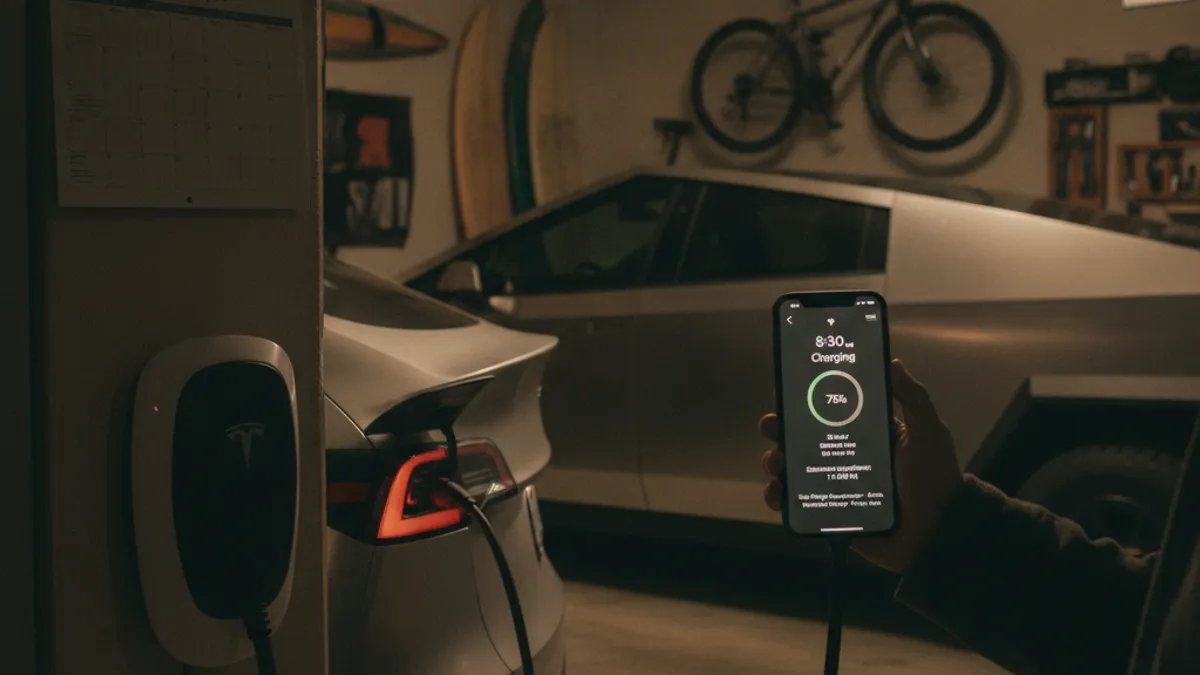
Supercharger minutes, then the wait around them
DC fast charging skips the car’s onboard charger. It pushes current straight into the pack. A Model 3 or Y climbs fast on a 250 kW stall. Ten percent to 80% commonly lands in 25 to 35 minutes. Older Model S and Model X cars pull less. So do older stalls.
The U.S. DOE Alternative Fuels Data Center lists max connector power. That’s not Tesla’s V2, V3, or V4 label. Treat the kW as a ceiling. Session time moves with that ceiling. Orange County’s sites don’t match.
San Clemente at 101 W Avenida Vista Hermosa has 49 stalls at 250 kW. It’s the largest Tesla site in the county. Irvine at 1920 Main St has 40 stalls at 250 kW. Tustin at 14661 Franklin Ave has 36. Garden Grove at 12891 Harbor Blvd has 32 at 250 kW. Those pads handle a rush better than a small lot.
Mission Viejo at 555 The Shops has 10 Superchargers. Tesla lists them at up to 72 kW. Anaheim’s Santa Ana Canyon Road site has 20 stalls at 75 kW. Westminster Mall has 24 stalls at 75 kW. Santa Ana at 300 E 5th St has 20 stalls at 75 kW. Santa Ana’s 17th Street site has 28 stalls at 325 kW. Same city. Very different minutes on the clock. Fountain Valley at 17940 Newhope St dates to 2015, with 16 stalls at 150 kW.
Garden Grove at 12161 Valley View St opened in 2026. It has 16 stalls at 500 kW. That’s the top of the local range. If those stalls are packed, this Garden Grove Supercharger note covers the next move. Anaheim stacks seven Supercharger sites along Lincoln, Katella, Euclid, Imperial, and Santa Ana Canyon. Theme-park days load those pads. Anaheim Tesla Superchargers when they’re full is the local playbook.
Huntington Beach at 6913 Warner Ave has 24 stalls at 325 kW. Buena Park at 8888 Knott Ave has 28 at 325 kW. Yorba Linda’s two sites have 8 stalls each at 250 kW. You’re choosing a kW rating and a stall count.
Why 861 Tesla ports still fill up
Teslas dominate the battery-electric fleet here. CEC registration data as of 2025-12-31 puts 138,121 Teslas on Orange County roads. That’s 65.51% of the county’s 210,842 battery-electric cars, and 5.59% of all light-duty vehicles. California’s Tesla share of BEVs is 61.34%. This county is more Tesla-heavy than the state.
Those cars aim at one network. Tesla holds 59% of Orange County’s public DC fast ports. That’s 861 of 1,452 in the AFDC station file. Electrify America, EVgo, ChargePoint, and smaller networks hold the rest. They don’t drain a Tesla queue at Lincoln or Harbor.
New-sale share still runs ahead of California, even as the trend has cooled. In 2025, 28.76% of Orange County’s new light-duty sales were ZEVs, against 22.93% statewide. 2024’s share was higher. The registered fleet still shows up at the same 48 sites. The Orange County EV charging hub maps those sites. It can’t tell you how many Model Ys want the same stall after work.
Overnight at home, and the wall-outlet crawl
Most weekday miles never need DC. A 240V Level 2 connector adds about 20 to 44 miles per hour. That depends on the onboard charger and the circuit. From near empty to full, you’re usually looking at 6 to 10 hours. Plug in after dinner. Leave with a full pack. For daily miles, read how long a Tesla charge lasts through an Orange County day.
A 120V household outlet is the floor. It adds roughly 3 to 5 miles of range per hour. A Model 3 or Model Y often lists 250 to 330 miles of range. Filling from near empty on 120V can take two to three days. It works if the car sits. It fails if you have to drive in the morning.
The last 20% is a different clock
Lithium-ion cells take charge fastest in the middle of the gauge. They taper near full to protect the pack. Ten percent to 80% can take about half an hour on a strong Supercharger. Eighty to 100% on that same stall can take almost as long again. That’s why most trip stops end at 80%. Waiting for 100% is how a coffee break turns into an hour.
Pack temperature changes the curve. A cold battery accepts DC slowly until it warms. A hot pack can throttle while cooling. Tesla’s navigation preconditions the battery when you route to a Supercharger. Set the stall as the destination before you roll. That habit shortens the DC session without guessing the day’s weather.
When you can’t wait for a stall
An empty pack on I-5, I-405, or the 91 isn’t a Supercharger errand. Tesla’s roadside policy answers a depleted battery with transportation, not a charge at the car. Running out of charge isn’t treated as a warrantable breakdown.
Charge Pro OC is a referral line. It matches stranded Tesla drivers with independent local operators. The operator brings a 240V Level 2 source to the car. The plug is native NACS. Typical on-site charging time is 15 to 30 minutes. That’s about 10 to 20 miles of range. That’s charging time, never an arrival time. The operator quotes you before starting and bills you directly. If you need mobile EV charging or out-of-charge recovery, call (949) 444-0151. There’s also a walkthrough of mobile Tesla charging near me in Orange County.
Frequently asked questions
How long does it take to charge a Tesla from empty on a Supercharger?
About 25 to 40 minutes to reach roughly 80%, depending on the model and the stall. Stalls here range from 72 kW in Mission Viejo to 500 kW in Garden Grove. Charging past 80% slows sharply, so most drivers stop there.
How long does a home Tesla charger take overnight?
A 240V Level 2 home charger typically takes 6 to 10 hours. That’s near empty to full. That window fits a normal night of sleep.
Can I charge a Tesla on a regular wall outlet?
Yes. A 120V outlet adds only 3 to 5 miles of range per hour. A full charge from empty can take two to three days.