You parked for a long day. Now the screens stay black. The traction pack still had range when you left. The 12-volt battery didn’t survive the sit. That’s the usual story in Orange County airport garages and theme-park structures.
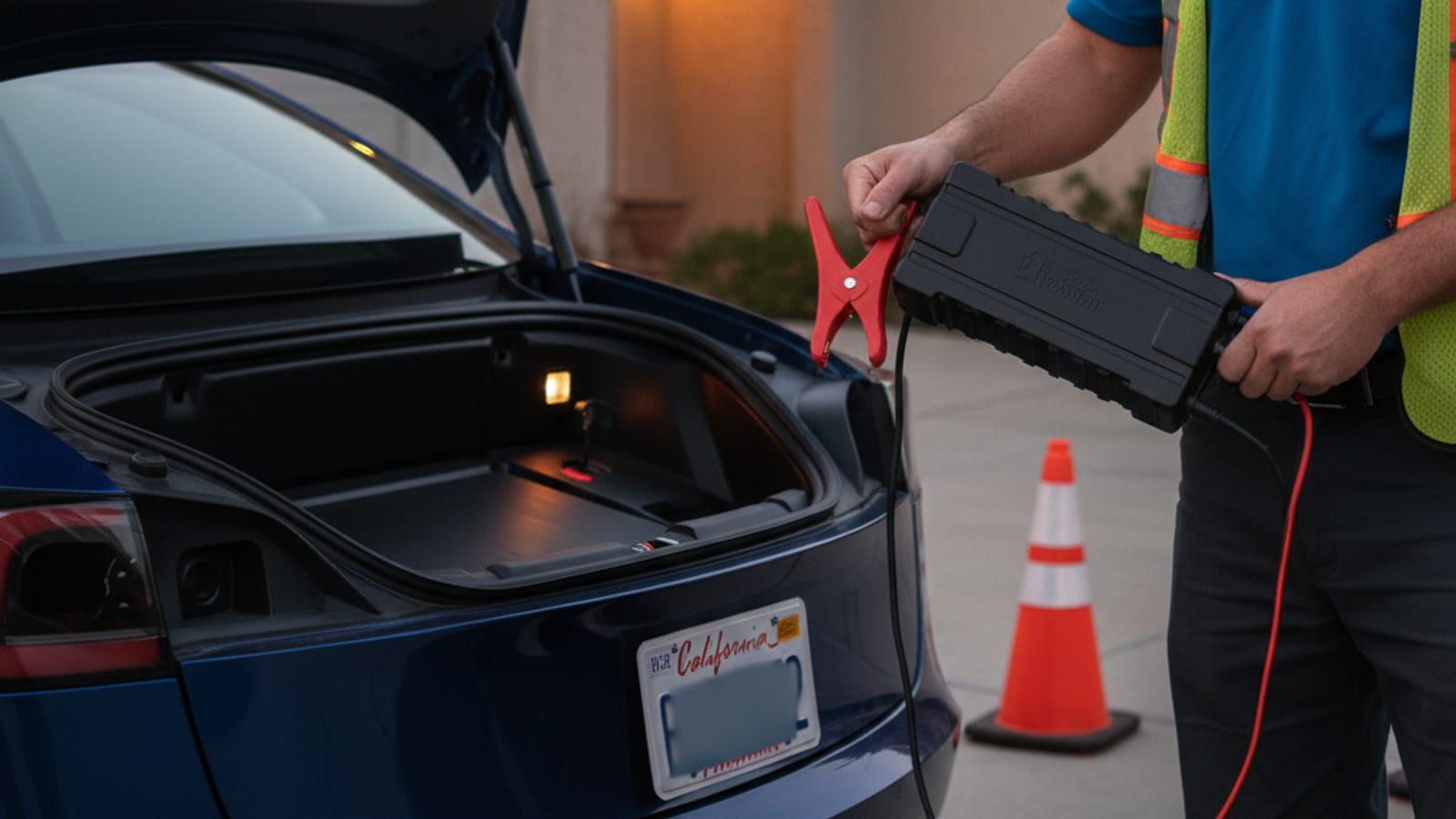
This is a 12-volt failure, not an empty pack
A dead 12-volt looks like a dead EV. Locks freeze, the charge port stays shut, and the app goes quiet. The big pack can still hold tens of miles. It can’t connect until the small battery wakes the contactors.
The California Energy Commission counted 210,842 battery-electric vehicles in Orange County. That count is as of December 31, 2025. Teslas were 138,121 of them, 65.51 percent of those BEVs. Most 12-volt failures in these garages are Teslas. Hyundai, Kia, Ford, Rivian, and Chevy owners still get stuck the same way.
A Supercharger won’t start a session if the car can’t close its contactors. Anaheim has seven Tesla Supercharger sites, including 2404 E Katella Ave. Costa Mesa has stalls at 1400 Bristol St. Those help an empty pack, and they don’t wake a flat 12-volt.
Long sits in these garages drain the small battery
The car keeps sipping power while you’re gone. Cabin sensors and security cameras add draw, and heat in a closed structure adds more. A multi-day garage sit is harder than an overnight driveway.
Costa Mesa airport lots hold cars for whole trips. Anaheim theme-park structures hold them for a full park day. Buena Park visitor lots see the same all-day sit. The 12-volt was fine at drop-off and may not be at pickup.
If the last reading was already a few percent, you may have two failures. Jump the 12-volt first, and treat range as a separate step.
How you can tell which battery failed
Think back to the last screen you saw. Comfortable range means this isn’t a charger hunt. A car that was already crawling to a stall may need both.
Watch for no wake chime and dark interior lights. A quiet app, dead handles, and a stuck charge port point the same way.
Tesla’s Model Y owner’s manual covers a related case. Once driving range is gone, the low-voltage battery can lose support. The car then needs an external 12-volt supply before the high-voltage pack can charge. A healthy-looking pack in a garage isn’t that case. You still start with a controlled 12-volt jump.
Tesla-only steps are in how to tell your Tesla 12V is dead, then jump it.
Don’t clip onto a running gas car
A running gas car doesn’t feed a clean 12 volts. Its alternator can spike. EV 12-volt wiring feeds a DC-DC converter and body computers. A spike, or reversed clamps, can damage those parts. Makers want a dedicated lithium jump pack, not another vehicle’s cables. Skip the helpful stranger in the next stall.
Keep a lithium jump pack in the car
A jump pack is a small battery with leads. It puts out a controlled 12 volts. Packs with reverse-polarity protection won’t fire if you swap the clamps. Cables from a neighbor’s SUV don’t give you that. Charge the pack at home and check its lights every few months. Store it in the frunk or the trunk.
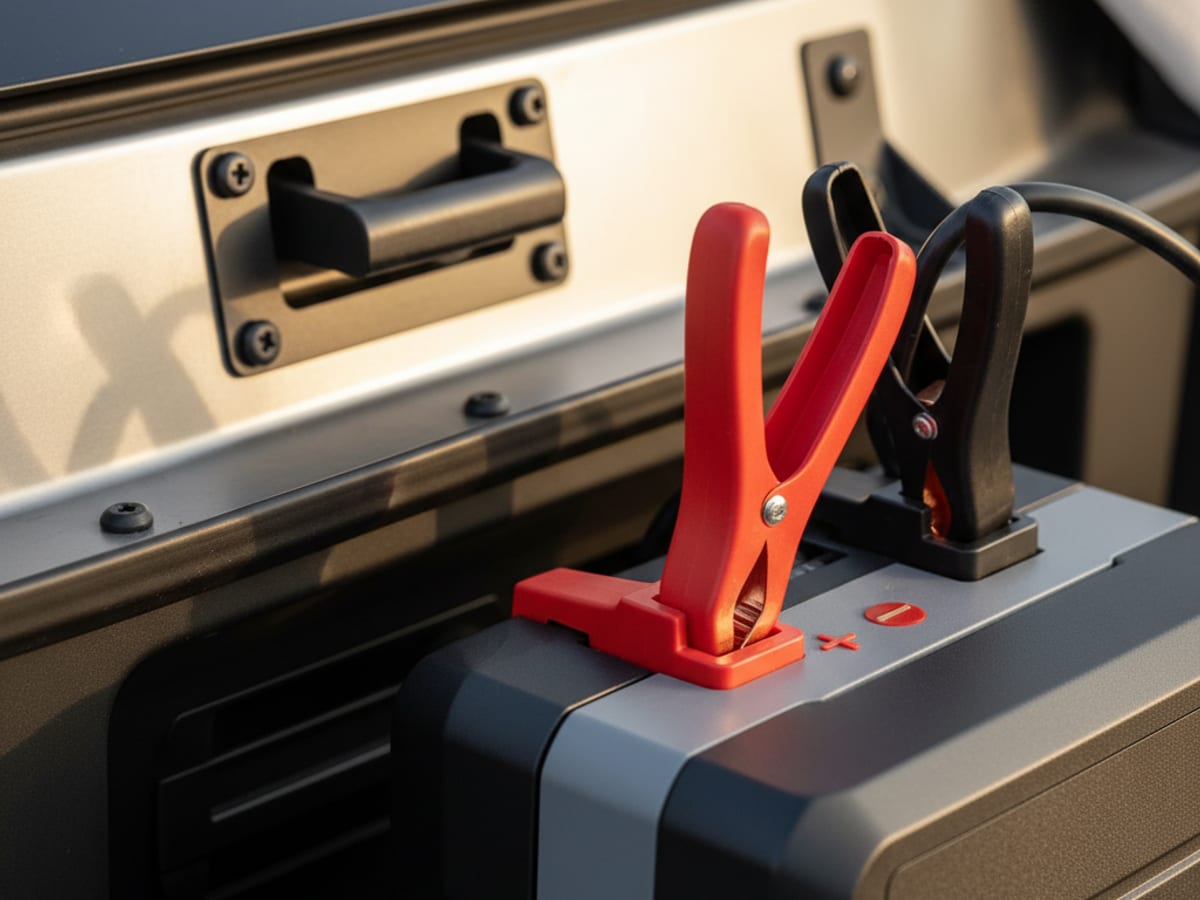
The safe order of connections
Work through these steps, and don’t skip the waits.
- Confirm the jump pack itself has charge. Weak lights mean stop.
- Find the marked 12-volt posts for your car.
- Clip red to the positive post or the marked red lead.
- Clip black to the marked ground. Don’t grab a random bolt. Skip the negative battery post unless your maker says that post is the ground.
- Wait about 30 seconds so voltage can settle.
- Try a wake. Tap a handle, try the app, or open the driver door.
- Once the car wakes, leave the pack connected about two more minutes. That window lets the DC-DC converter take over.
- Disconnect black first, then red.
Never reverse polarity. Red goes to positive, and black goes to the designated ground. A current pack should refuse a reverse hookup. Old cables won’t, and reverse current can destroy the DC-DC converter.
Jump points by where you stand
You often jump from front posts. You don’t always need the battery in your hands.
Tesla bumper leads, and older S and X
On Model 3 and Model Y, pop the tow-eye cover on the driver-side front bumper. Two leads sit behind it. Red is positive and black is ground. Connect the jump pack there. When the frunk unlatches, open it and feed the real 12-volt for those extra minutes. Pre-2021 Model S and Model X use that same tow-eye access.
Newer Model S and Model X, inside the frunk
From 2021 on, use the front door’s mechanical release. Inside, pull the frunk release under the carpet. Jump on the 12-volt terminals in the frunk.
Power frunks that won’t open
Rivian R1T and R1S fobs won’t pop a dead power frunk. Use the manual release cord behind the grille. A small cover comes off with a Phillips screwdriver. The 12-volt sits under a passenger-side panel. Jump the positive post and the marked ground stud.
On a Ford F-150 Lightning, look under the front bumper for a pull loop. The 12-volt is on the driver side of the frunk, on standard posts.
Polestar 2 keeps the 12-volt in the frunk. If the lid stays shut, the manual cable sits behind the driver-side headlight housing.
Rear battery, front posts
Hyundai Ioniq 5, Kia EV6, and Kia EV9 hide the 12-volt in back. Jump from the front posts instead. Use the red positive and the marked ground.
Chevrolet Bolt follows the same idea. The 12-volt is under the rear load floor. Jump from the front: a red-capped positive post and a ground stud.
Ford Mustang Mach-E keeps the 12-volt in back. Labeled jump posts sit in the frunk. If the app can’t open the frunk, use the kick-plate cable.
If you’d rather not hunt posts in a dark structure, use Tesla 12V battery jump. Non-Tesla EV rescue is the path for other brands.
Once it wakes, feed the 12-volt from the pack
Drive, or plug in. Either path lets the DC-DC converter recharge the 12-volt from the main pack. A short Level 2 session or some road time is the usual recovery. Sitting in the same garage with accessories on can flatten it again.
If the 12-volt dies again within a day, treat the battery as failed. A jump is a wake-up, not a new battery. Replace it before the next long sit. Dash messages about 12-volt service are an early clue. So are slow wakes, brief screen resets, and an app that drops a parked car. Act on those at home, and don’t wait for a theme-park pickup. More on the pattern is in when an EV 12V battery dies on the road.
Empty pack plus a dead 12-volt
Some cars sit all day on a pack that was already low. Then both systems fail. Tesla’s published roadside policy for a depleted battery answers with transportation. It doesn’t send an on-site charge. Running out of charge isn’t the warrantable-breakdown tow.
A local operator can jump the 12-volt at the car. The same operator can add range from a 240-volt Level 2 source. That charge typically adds 10 to 20 miles. Plan on 15 to 30 minutes of charging. That’s charging time, not a promise of when someone arrives. The operator quotes you before work starts and bills you directly. Charge Pro OC is the referral line, and it doesn’t own the truck.
Anaheim park days show this mix. So do Costa Mesa airport pickups and Buena Park all-day lots. For the Anaheim lot pattern, see EV roadside assistance in Anaheim. For Costa Mesa structures, see stalled in a Costa Mesa parking structure.
No jump pack in the car
Stay with the car if the structure feels unsafe. Don’t take a gas-car jump from a passerby. If you can’t reach a pack, call (949) 444-0151. That number matches you with an independent local operator. They bring a lithium jump pack. They can replace a 12-volt that won’t hold. They handle Tesla and every major EV brand.
You still want the posts identified and the polarity right. The goal is a wake-up that doesn’t take out the DC-DC converter. For the broader roadside path, start at EV roadside assistance.