If your EV is out of charge on Ortega Highway, stay with the car. Then get range added where you sit. This South Orange County climb is a long rural grade. Treat an empty pack as a stop, not a scavenger hunt. Don’t walk the shoulder looking for a plug. Don’t creep on the last bar through a two-lane climb. Stay put, hazards on, then charge.
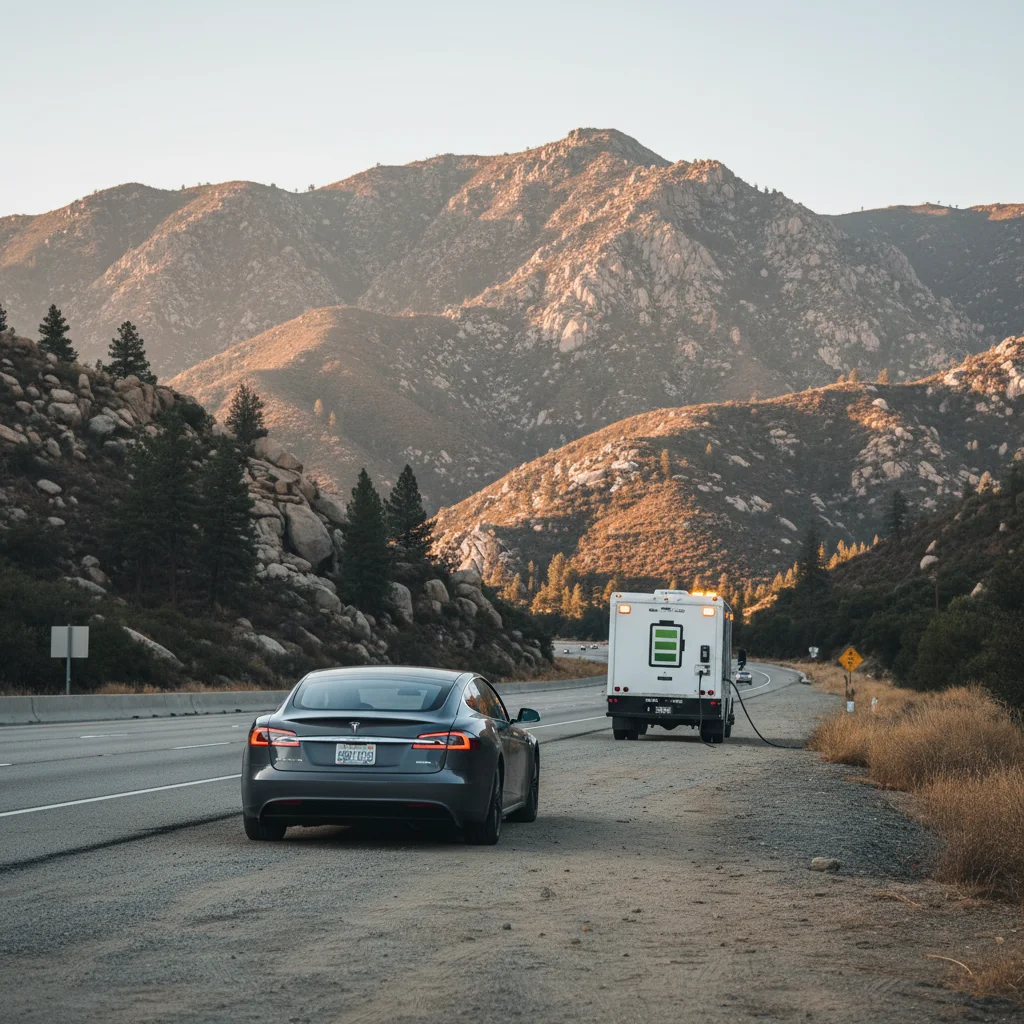
Stay on the shoulder until help is at the bumper
Ortega Highway is the South OC grade between the coastal cities and the canyon communities. Drivers use it when they leave San Juan Capistrano for the hills. The road is two lanes, with long uphill pulls. If the pack’s already empty, the car is done moving. A tow is a last move, not the first one. Out-of-charge recovery means an independent operator brings 240V to you. Charge Pro OC is a referral line. It matches you with that operator. It owns no trucks and performs no work.
Keep everyone inside unless you’re in immediate danger. Set the hazards. Stay off the travel lane. If you can ease onto a turnout or a wide shoulder, do that once, then stop. Rolling another mile on hope puts you in a worse spot.
Why this climb burns range faster than the dash said
Your estimated miles are a guess from recent driving. They’re not a contract. A long grade makes the motor hold a high load. That’s true on any mountain road, and it’s true here. Cabin climate control draws from the same high-voltage pack. So does battery thermal management on a hot afternoon. You won’t get those miles back in full on the descent. Regenerative braking returns some energy. It doesn’t repay a long climb one for one.
Watch energy use, not the range bubble. If your car shows kWh per mile climbing, trust that number. Slow down and use the efficiency mode. Avoid hard acceleration out of corners. None of that’s a rescue if you’re already at zero. It’s how you keep a thin buffer from becoming a stop.
A live plug count along Ortega Highway itself could not be confirmed. The files used for this page don’t list this corridor stall by stall. The California Energy Commission and the U.S. DOE Alternative Fuels Data Center cover Orange County as a whole. Confirm what is open on the AFDC locator or in PlugShare. Don’t treat a pin as real until you do.
Named DC fast sites on the South OC side, if you can still roll
If you still have miles, aim at a published site. Tesla Superchargers in San Juan Capistrano sit at 26701 Verdugo St. That AFDC record lists 12 stalls, up to 250 kW. A second site is at 31971 Camino Capistrano, 7 stalls, up to 125 kW. Mission Viejo has 24 stalls at 27741 Crown Valley Pkwy, up to 250 kW. It also has 10 stalls at 555 The Shops at Mission Viejo. Tesla lists those Shops stalls at up to 72 kW. Use Tesla’s 72 kW figure when AFDC disagrees.
Farther on the South County map, Lake Forest has 24 stalls at 24301 Muirlands Blvd. It also has 16 Magic Dock stalls at 24372 Rockfield Blvd. Laguna Hills has 16 stalls at 23701 Moulton Pkwy and 16 at 25248 Cabot Rd. San Clemente has 49 stalls at 101 W Avenida Vista Hermosa. It has 16 more at 990 Avenida Vista Hermosa. Electrify America lists 12 DC fast ports at 25825 Las Vegas in Capistrano Beach. EVgo lists 14 DC fast ports at Plaza Antonio, 22351 Antonio Pkwy in Rancho Santa Margarita. EVgo also lists 8 ports at 27542 Antonio Pkwy in Ladera Ranch.
Those addresses are AFDC records as of December 31, 2025, accessed 2026-09-05. They’re not a claim that a stall is open or unused. If you can’t reach one, stop hunting. Get mobile EV charging at the car instead.
Canyon neighbors such as Trabuco Canyon sit off the same hill country. So do Silverado, Coto de Caza, and Rancho Santa Margarita. A pin in a nearby city isn’t proof you can make the road miles left. If the bar’s already gone, stay where you are.
Orange County’s EV fleet is large, and public ports are busy
This isn’t a rare-car problem. The California Energy Commission counts 210,842 battery-electric vehicles in Orange County. That’s the on-road figure as of December 31, 2025. ZEVs as a group are 260,833. That’s 10.56% of the county’s light-duty fleet. California’s ZEV share is 7.54% in the same file. Orange County holds 12.02% of the state’s battery-electric vehicles. It holds 8.33% of the state’s light-duty fleet.
Public charging in the county, same CEC vintage, is 7,095 public ports. That split is 20 Level 1, 5,600 Level 2, and 1,475 DC fast. That works out to 36.8 ZEVs per public port. Statewide the ratio is 24.4. Orange County is thinner per EV than the state average. Tesla accounts for 138,121 of those BEVs. That’s 65.51% of the county battery-electric fleet. Tesla also holds 861 of the county’s public DC fast ports across 48 Supercharger sites. That’s about 59% of DC fast ports in the AFDC county extract.
New ZEV sales in Orange County were 28.76% of light-duty sales in 2025. They were 24.77% in 2026 Q2. That’s still above the state. It’s not an accelerating boom. California’s ZEV share of new sales peaked at 25.31% in 2024. The 2026 Q1 figure was the weakest quarter in that series. CEC also changed its new-sale method in 2023 and again in 2025. Year-over-year comparisons across those breaks are messy.
County totals don’t tell you which stall is open on your mile of the climb. Check the locator. If you’re already stopped, stay put.
Empty pack versus a dead 12V
Before you assume the traction battery is at zero, look at the symptoms. A true empty pack usually still lets you sit in the car. The range warning already fired. A dead 12-volt battery can make the whole car look completely dead. You’ll get no screens, no door electronics, and no ready state. Tesla’s Model Y owner’s manual notes a hard follow-on. Once range is exhausted, the low-voltage battery can lose support. It may need external power before the high-voltage pack will take a charge.
If the car is silent and locked, you may need a 12V jump on site. That’s not the same job as a range top-up. Operators in this network handle Tesla and every major EV brand. They bring a native NACS plug. They carry CCS or J1772 adapters for non-Tesla cars. Typical charging time on a 240V Level 2 stop is 15 to 30 minutes. That window is charging time, never an arrival time. It usually adds about 10 to 20 miles. That’s often enough to reach a published stall after the session. That’s only true if one is still in range.
Tesla’s own roadside policy answers a depleted pack with transportation, not with charging at the bumper. Search-index text from Tesla’s roadside page could not be opened directly during research. That snippet says running out of charge isn’t a financially covered service. Covered transport of up to 500 miles to a Service Center is narrower. It’s for a warrantable breakdown that leaves the car undrivable. Confirm the current wording at tesla.com/support/roadside-assistance. Also open Tesla’s North American roadside policy PDF before you count on a free tow. Tesla’s published roadside number, as listed on the Santa Ana service page, is 877-798-3752.
A Tesla transporter may not be what you want on this two-lane climb. A local operator who can charge on site instead of towing first is the other path. Similar South OC grades strand drivers on Santiago Canyon Road and Laguna Canyon.
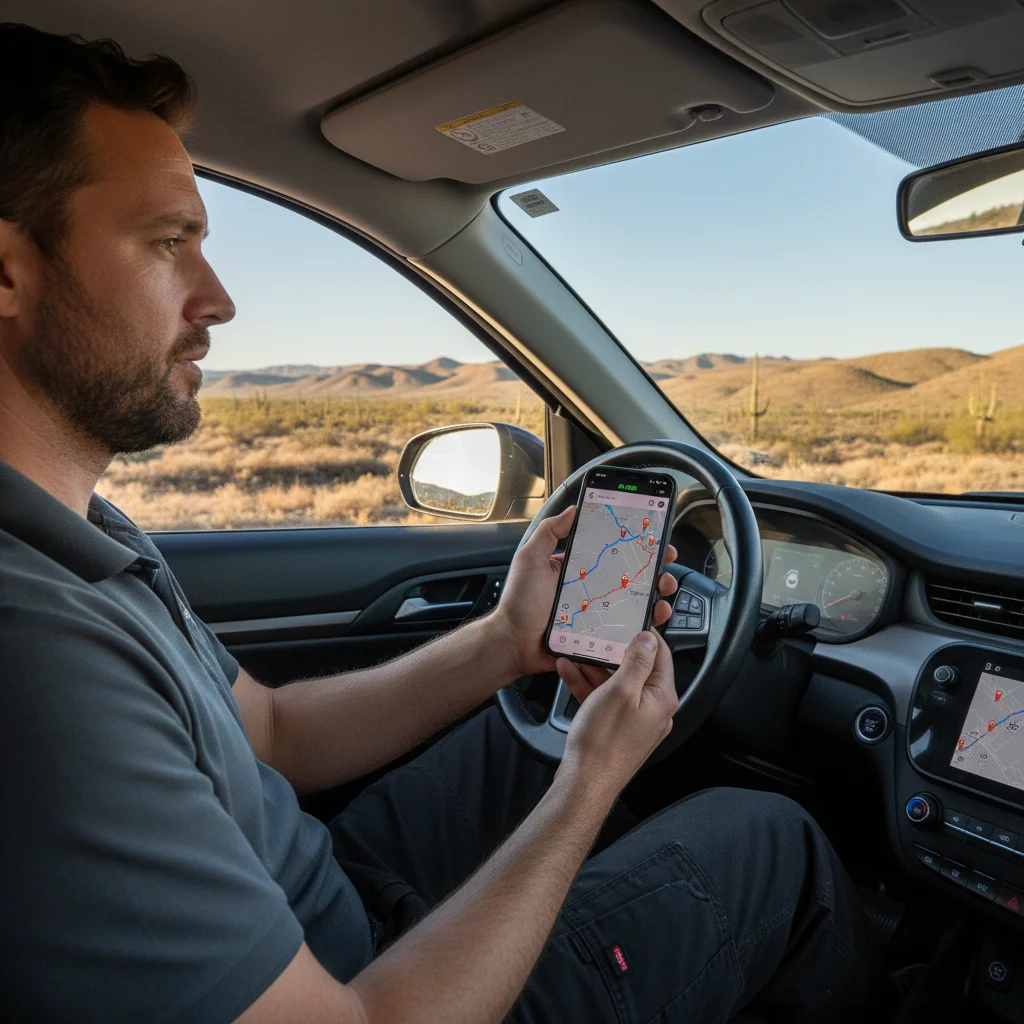
Set the trip up before the grade, not after the warning
Charge at a known site while you still have a plan. San Juan Capistrano, Mission Viejo, Lake Forest, and San Clemente are named above. Those are the South County Tesla sites to start from. Pre-cool or pre-heat the cabin while the car is still plugged in there. That uses site power instead of pack power. Then drive the climb in the efficiency mode. Hold a steady legal speed.
Open your charging app before you leave town streets. Confirm the stall you might need isn’t marked offline. If the app already shows you won’t make it, you waited too long. Don’t treat a hotel or workplace Level 2 pin as a roadside rescue. A Level 2 session that isn’t at your bumper is a long wait you didn’t schedule.
If you’re in a Tesla, remember the 12V support issue once the pack is truly empty. If you’re in another brand, the same 12V failure mode is common. Either way, call the operator who can work on the car where it sits.
When you’re already stopped on Ortega Highway
You already answered the hard part by staying with the car. Call a referral line that sends an independent local operator. That operator quotes the job before starting. You pay that operator directly. Charge Pro OC doesn’t set the price. It doesn’t promise an arrival window.
The network serves every city in Orange County. The Ortega Highway climb sits in that service area. The pros we connect you with are licensed. They’re not Charge Pro OC employees.
If the pack is empty, ask for on-site charging. If the car is dark, say so. The 12V may be the real failure. If a tow is truly the only path, that’s a later decision. Charging and a 12V check come first.
Call (949) 444-0151 when you need that match. Stay with the vehicle until the operator is on scene. Take the quote before any cable goes on.