If your EV hits empty on SR-22 at the Crush, stay on the right shoulder. Turn the hazards on. Stay with the car. Then get a 240V charge brought to you. That’s how you leave the interchange on your own power. Don’t chase a stall you can’t reach from a dead stop in that stack.
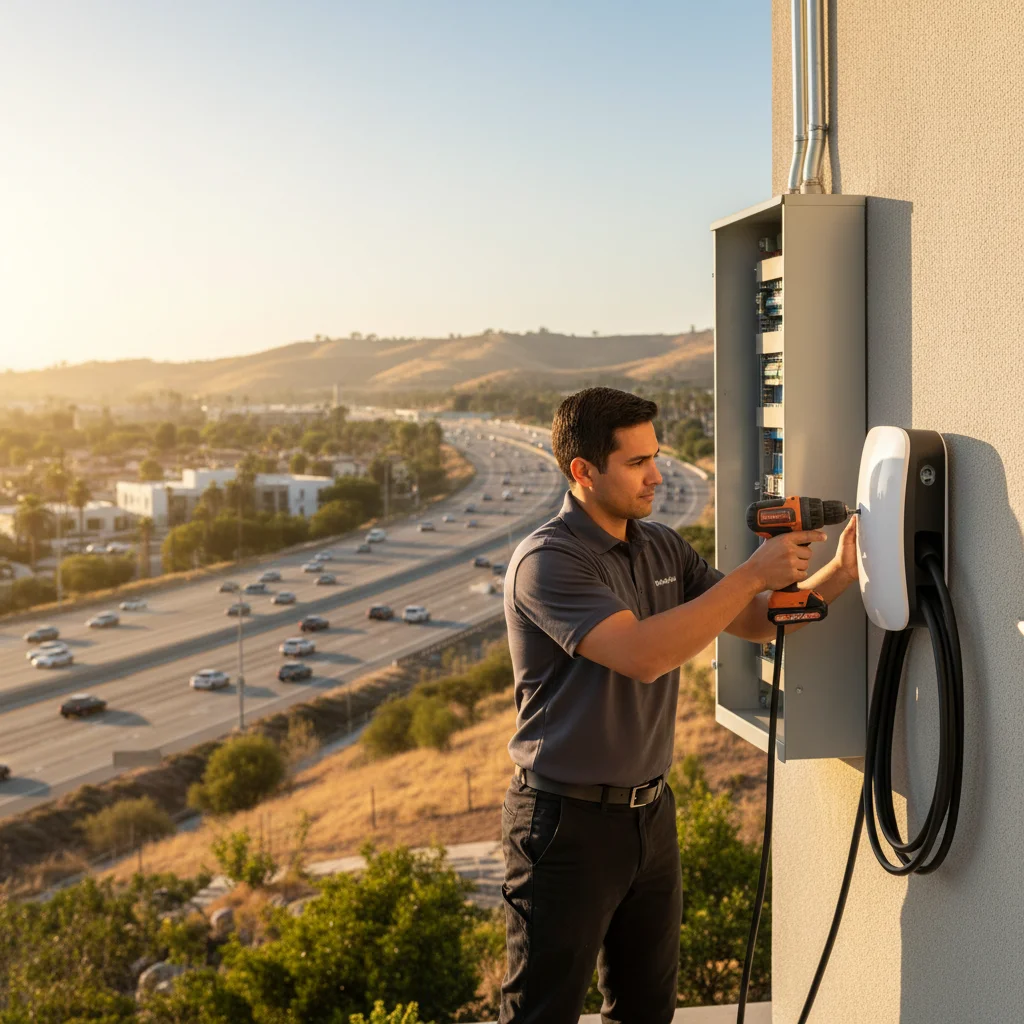
SR-22 at the Crush is a stop-and-go east-west jam
State Route 22 is Central Orange County’s main east-west freeway. Through the City of Orange it meets I-5 and SR-57. That stack is the Orange Crush. It isn’t a quiet merge. It’s a three-freeway knot with short weaves, stacked ramps, and long queues.
You’re not on a rural two-lane here. You’re in the middle of the county’s commute spine. Garden Grove sits on the west side of this stretch. Santa Ana sits just south of the stack. Orange sits on the ramps themselves. Midway City sits farther west along the 22. A stall there is still a freeway problem. Read the Midway City EV roadside guide. Use it if that’s where you rolled to a stop.
Range math from a flowing stretch can fall apart in this queue. Stop-and-go uses more energy than a dashboard guess from a clear run. Cabin climate in late summer heat adds more draw. If you entered the Crush already low, the last few percent can vanish. They can vanish while you’re still in the lanes.
Freeway Service Patrol does work Orange County freeways, including this one. It does so on posted hours only. Those hours aren’t something this page can lock in for you. Check Caltrans or CHP for the current FSP window. Do that before you assume a patrol truck is coming. After those hours, you’re waiting on whoever you call.
This corridor is busy with EVs for a reason the state published. As of December 31, 2025, Orange County had 210,842 battery-electric vehicles on the road. That’s 8.54% of the county’s light-duty fleet. Teslas were 138,121 of those BEVs, or 65.51%. A lot of the cars in this jam are Teslas. Many drivers expect a Supercharger at the next exit. When the pack is already at zero, that expectation doesn’t move the car.
CEC counted 7,095 public ports in Orange County as of December 31, 2025. That’s 36.8 ZEVs per public port. Statewide the ratio is 24.4.
Empty on the 22 is two different failures
One failure is a high-voltage pack at zero. The car still talks to you, then it won’t go. The other is a dead 12-volt. That one can look like a brick. Screens stay dark. Locks may not act right. You can’t tell from the shoulder whether a Supercharger would even wake it.
Tesla’s Model Y owner’s manual is blunt on the empty-pack case. Once range is exhausted, the low-voltage battery can lose support. The car may need external power before the high-voltage pack will take a charge. That’s a technical fact, not a sales line. It’s why a tow to a stall is the slower plan. A charge at the bumper is the faster one.
If you still have miles left, aim at a published site. You need a clean exit to do that. The U.S. Department of Energy lists Tesla Superchargers in cities on this corridor. Garden Grove has 32 stalls at 12891 Harbor Blvd, up to 250 kW. Garden Grove also has 16 stalls at 12161 Valley View St, up to 500 kW. Santa Ana has 28 stalls at 1008 17th St, up to 325 kW. Santa Ana also has 20 stalls at 300 E 5th St, up to 75 kW. Westminster Mall has 24 stalls at 1025 Westminster Mall, up to 75 kW. Anaheim has 16 stalls at 2404 E Katella Ave, up to 250 kW.
Those are real plugs with real addresses. They help only if you can drive to them. If you’re already on the SR-22 shoulder, stay put. Don’t walk toward a pin on your phone. Stay with the car. Call for out of charge recovery that comes to the shoulder.
Non-Tesla DC fast exists in the county too. AFDC counts 175 non-Tesla DC fast stations and 591 ports in Orange County. Electrify America at 440 N Euclid St in Anaheim has 10 DC fast ports. Use it after you can drive. Don’t treat it as a reason to coast through the stack.
If the remaining range is already in single digits, skip the hunt. A missed exit in this interchange is a long way around. Pulling over on your terms beats dying in a gore point. If you’re still moving, use the low-range guide. That’s the earlier decision, before you stop.
Stay on the shoulder, then make the call
California’s divided-highway basics still apply on SR-22. This page isn’t a statute. It’s the practical sequence that keeps you out of live lanes.
Get as far right as the car will still roll. Clear the travel lane if you can. If the shoulder is tight near a ramp, use whatever remaining motion you have. Pass the merge if you can still creep. Don’t stop on the gore. Don’t stop in a blind spot under a ramp.
Hazards go on the moment you know you won’t make the next exit. Don’t wait for the car to finish dying. Other drivers need that blink as soon as you’re a fixed object.
Exit on the passenger side when you need to get out. The driver’s door on a right-shoulder stop opens toward traffic. Stand behind the right rear corner. Don’t stand between the car and the lane. Don’t walk the shoulder toward an exit. SR-22 through Garden Grove and Orange carries heavy traffic.
If you’re in immediate danger, call 911. For a non-injury stall, CHP still wants a location. Give direction of travel, eastbound or westbound. Give the last exit you passed. If you were joining I-5 or SR-57, say which ramp. The Crush puts those names in the same breath.
Stay with the vehicle unless a peace officer tells you to move. Sitting inside, hazards on, away from the driver’s door, is usually the calmer wait. If FSP is on duty during posted hours, a patrol truck may find you. Don’t count on that as your charge. FSP’s job is a safe stop and a tow path. It isn’t a 240V session.
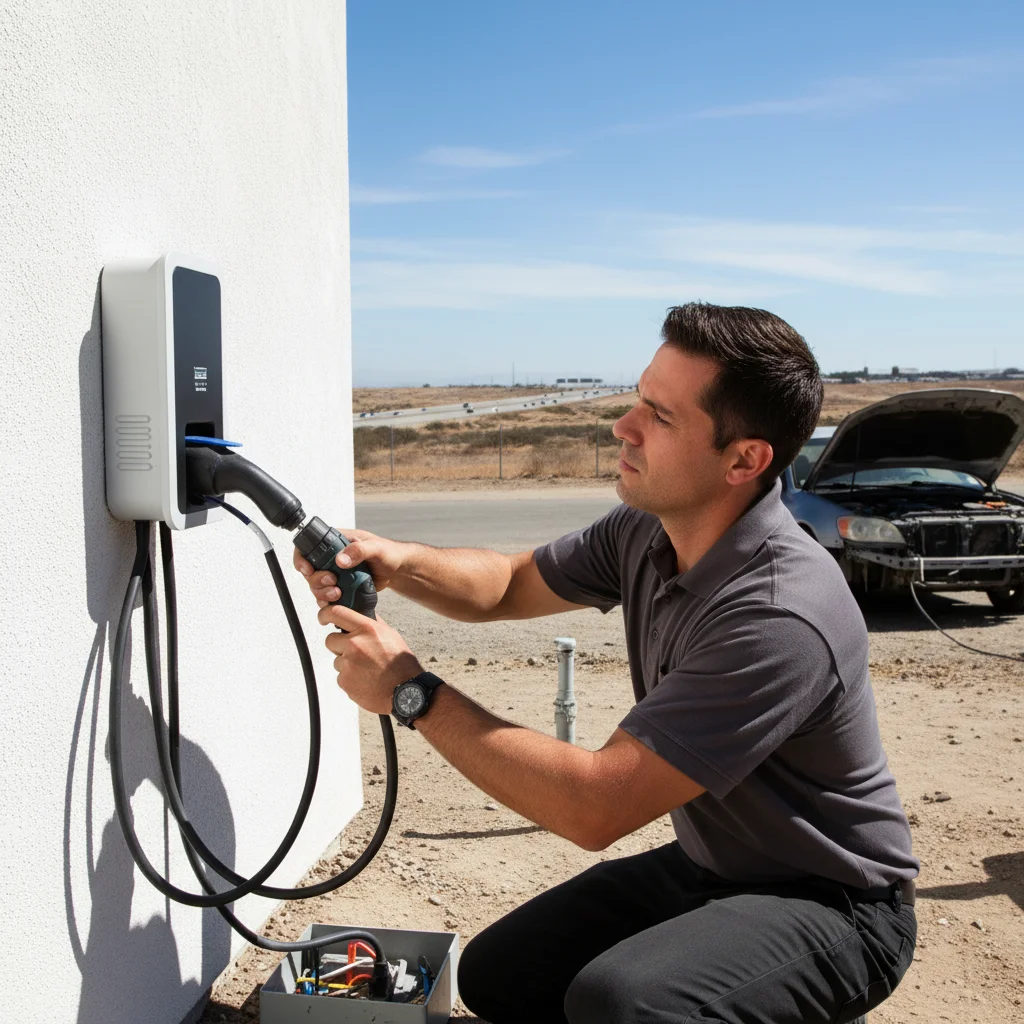
What a mobile charge actually does on this freeway
Charge Pro OC is a referral line. We don’t own the truck. We don’t hold a trade license for this work. We match you with an independent local operator who comes to the car. That operator quotes you before anything starts. They bill you directly.
What those operators bring is a 240V Level 2 source. Teslas take a native NACS plug. Other EVs use a CCS or J1772 adapter. Typical added range is 10 to 20 miles. That takes 15 to 30 minutes of charging time. That’s plug time, not a promise of when someone arrives.
That 10 to 20 miles is enough to leave the Crush. You can then reach a stall you already picked. It isn’t a full recharge. You’re buying an exit from the shoulder, not a road trip.
When you call, keep the details short. Direction of travel. Last exit, or the I-5 or SR-57 ramp you were on. Make and model. Pack percent, if the screen still works. Say westbound 22, just west of the 57. Add make, color, and percent if you have them. If the 12-volt is dead and the car is silent, say that too. The operator needs to know pack charge or 12-volt jump.
Operators we connect you with handle Tesla and every major EV brand. If your car takes a standard inlet, they can feed it. Confirm the make when you call so the right adapter is on the truck.
For the cities that sit on this jam, start local. Orange EV rescue near the Crush is the stack itself. Garden Grove roadside help covers the dense blocks west of it. If you died farther west toward Midway City, use that city guide.
The same playbook holds on the rest of Orange County’s freeways. Read out of charge on an Orange County freeway for the wider shoulder version.
Tesla’s own roadside policy answers a depleted battery with transportation, not with on-site charging. Running out of charge isn’t a financially covered Tesla service. Covered transport of up to 500 miles is for a warrantable breakdown. That breakdown has to leave the car undrivable. An empty pack is outside that. Tesla Roadside Assistance is 877-798-3752, published on the Santa Ana service page. Tesla can arrange a tow you pay for. That isn’t the same as a charge on the bumper.
We serve every city in the county. The operator who takes the job is the one who quotes it. If you want mobile EV charging as the named service, that’s the 240V truck.
After the pack has enough to move
Once the operator unplugs, don’t re-enter the Crush. Don’t test whether you can make it. You just spent time on a shoulder. Drive to the stall you named before the session started. Harbor Blvd in Garden Grove has 32 stalls. Santa Ana’s 17th St site has 28. Anaheim’s Katella site is 16 stalls at 2404 E Katella Ave. Westminster Mall is slower at 75 kW.
If the 12-volt was the real failure, a pack charge won’t fix it. Say so if the car already needed a jump this week. The operator can jump or replace a 12-volt on site. A second failure on the same shoulder is a shop problem. It isn’t another 2% gamble.
Don’t walk to a shopping-center plug from the freeway. Don’t accept a random jump on the high-voltage system from a passing driver. The 12-volt is the only jump these cars are built for.
Frequently asked questions
What should I do if my EV dies on SR-22 at the Crush?
Pull as far right as you can. Turn the hazards on. Stay with the car. Give CHP your direction and the last exit or ramp. Then get a 240V charge at the bumper. Don’t hunt a stall you can’t reach from a dead stop in that interchange.
Can the operator charge Teslas and other EVs on SR-22?
Yes. The truck brings a native NACS plug for Teslas. CCS or J1772 adapters cover the rest. Confirm the make and model when you call. That’s how the right inlet hardware shows up.
Does Freeway Service Patrol charge an empty EV on SR-22?
FSP works posted hours only. Confirm those hours with Caltrans or CHP. A patrol truck can make the stop safer. It isn’t a Level 2 charging session. After posted hours, you’re arranging your own help.
If the pack is dead on SR-22 at the Crush, call Charge Pro OC. The number is (949) 444-0151. We’ll connect you with a local operator. That operator quotes the job, then charges the car where it sits.