The Rivian roadside assistance phone number you want lives on Rivian’s own channels. Open the official app, or Rivian’s support site, and use the contact shown there. This site’s verified facts don’t list a current Rivian roadside number. That’s why no third-party figure appears in this post. Tesla still dominates Orange County’s battery-electric fleet. Rivian owners still need a verified contact path of their own. Keep a local backup for the stop that official route doesn’t fit.
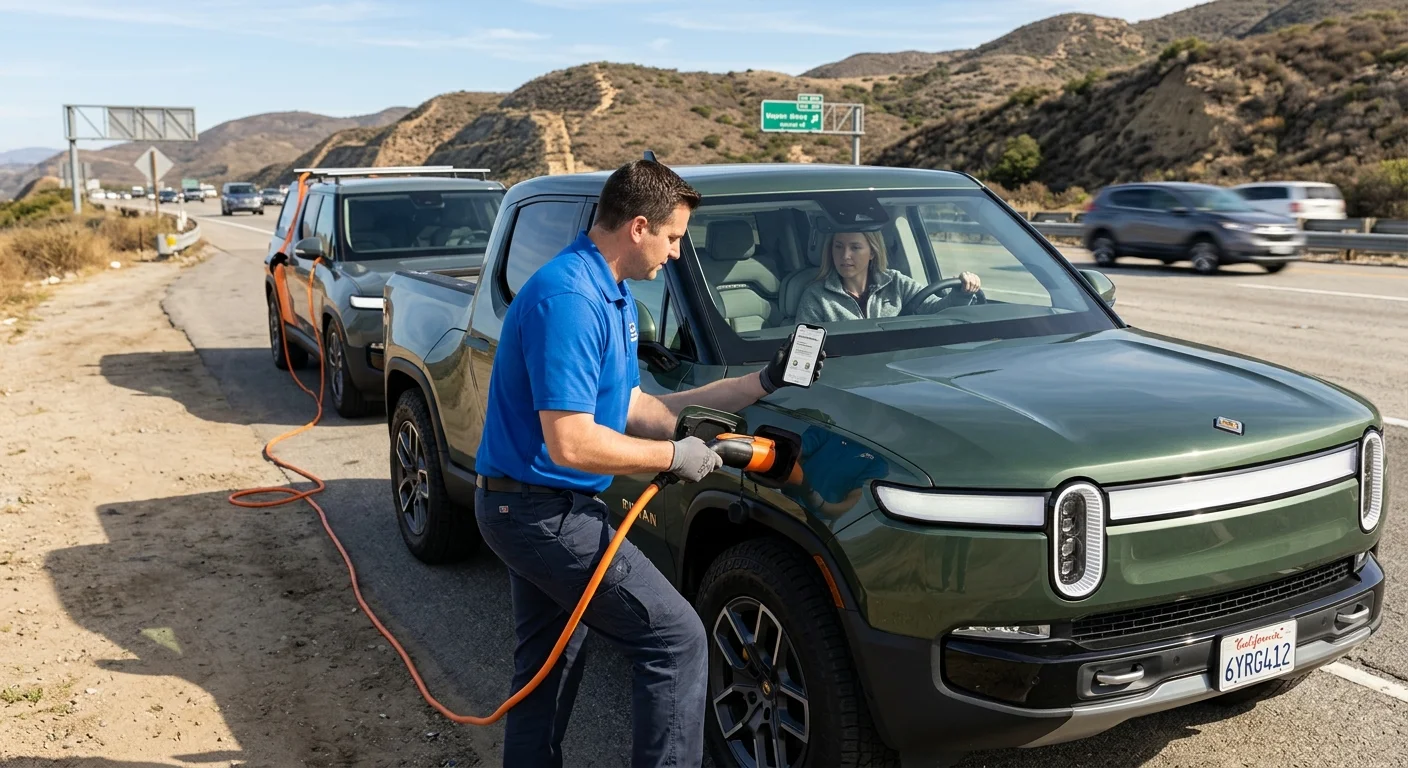
Get the live path from Rivian, not from a search snippet
Rivian controls its contact methods. Start in the Rivian app on the phone you already carry. If the app won’t open, use Rivian’s official support site. Confirm the page belongs to Rivian before you tap.
Skip forum threads, map listings, old screenshots, and search snippets. They aren’t the authority for Rivian’s current route. If the app and the site disagree, follow the newer official instruction. Save that path once you’ve checked it.
Keep Rivian’s line and a local backup as two different tools. Rivian sets eligibility, manufacturer support, and its own contact rules. Charge Pro OC doesn’t speak for Rivian. We connect you with licensed independent local EV rescue operators across Orange County.
Tesla-heavy Orange County still isn’t a Rivian playbook
Orange County’s EV mix isn’t a California average with a city name swapped. The California Energy Commission reports Orange County’s battery-electric count as of December 31, 2025. That count is 210,842 battery-electric vehicles on the road. Tesla held 138,121 of those BEVs, or 65.51% of the fleet. That’s 6.4 points more Tesla-concentrated than the state. Tesla took 44.7% of Orange County’s new ZEV sales in 2025.
Federal Alternative Fuels Data Center records for Orange County show 1,452 public DC fast ports. Tesla holds 861 of those ports, 59% of the county total. The same file lists Rivian Adventure as two stations and 22 DC fast ports. Non-Tesla networks still add 175 stations and 591 DC fast ports. Electrify America publishes a 12-port site at 25825 Las Vegas in Capistrano Beach. It also lists eight DC fast ports at Fashion Island in Newport Beach. EVgo lists 14 DC fast ports at Plaza Antonio in Rancho Santa Margarita.
Those sites help when the truck can still roll. They don’t give you Rivian’s current phone number. They also don’t wake a truck that’s already sitting still. That includes an Irvine garage, a Santa Ana structure, or a Huntington Beach lot. Compare the three manufacturer programs in Tesla, Rivian, and Lucid roadside compared in OC.
Tell whoever answers the model, the pin, and the screen
Start with the model and the exact spot. Say R1T or R1S. Give the street, the nearest cross street, and the garage or lot name. On I-5, I-405, the 91, or SR-22, read the nearby signs. Report the route and the direction they show.
Copy the warning word for word. Don’t shorten it. Don’t replace it with your own diagnosis. Photograph the display if it still lights. Report the shown charge and any range figure.
Then describe the last thing that worked. Say whether the truck was parked, plugged in, or moving. Note which locks, lights, and screens still answer. If the charge port is involved, say whether a cable is locked in. Say so if the door won’t open. Start with the R1T and R1S 12V checks if the truck won’t wake. Don’t assume the pack is empty.
Say whether the vehicle blocks a lane. Note a gate, a garage, or tight clearance. If people are in danger, call 911 first. If the screen changes while you’re talking, send the newest wording. None of that is a diagnosis. It’s a clean record of what you can see.
An empty pack and a dead 12-volt aren’t the same request
Don’t treat every unresponsive Rivian as an empty main battery. Don’t call it low voltage unless the truck shows that warning.
If the display was falling before the stop, report the last visible percent. Include any range or charging warning you still have. If you reached a stall, report only what the charger and the truck showed. Tesla Superchargers at 1920 Main St in Irvine sit in the federal station file. They don’t help a truck that already won’t move.
If a low-voltage warning is on the screen, quote it exactly. Say which controls still respond. Don’t treat those notes as proof of a failed part. Wait for guidance before any electrical work.
Mobile charging, a 12-volt jump, and a tow aren’t interchangeable. An operator needs an accurate description first. Connector fit is vehicle-specific too. What charger a Rivian uses on Orange County roads covers what to confirm. For a local non-Tesla rescue, start on our non-Tesla EV rescue page. The operator still decides whether the job fits the truck and the spot.
Rivian’s route first, then a local operator if it doesn’t fit
Start with Rivian when the question is Rivian’s. That includes eligibility, account access, manufacturer programs, and vehicle-specific instructions. Charge Pro OC can’t confirm those terms.
Don’t assume Rivian covers this event. Don’t assume the help is free. This site’s verified sources don’t include Rivian coverage terms, prices, hours, or arrival times. Ask Rivian for the current terms before you authorize anything.
A local backup can make sense for a practical roadside option in Orange County. That talk can cover a 240V Level 2 charge at the car. It can also cover a 12-volt jump or replacement on site, or transport. Operators we connect you with typically add 10 to 20 miles of range. That takes 15 to 30 minutes of charging at the car. That’s charging time, never an arrival time. They bring a native NACS plug, plus CCS or J1772 adapters for non-Tesla EVs.
Access changes the job. A gated street in San Juan Capistrano isn’t an open freeway shoulder. A Costa Mesa parking structure isn’t a Seal Beach curb. Give the gate code, the floor, and the entrance. Local help isn’t Rivian-authorized unless Rivian says so. Ask who’ll do the work, what they’ll do, and whether manufacturer approval is needed.
Our EV roadside assistance service is a local connection point. It doesn’t replace Rivian’s authority over the vehicle or the policy. See Rivian Highway Assist versus a local operator when you need that contrast.
What Charge Pro OC actually does on the call
Charge Pro OC is a referral line for Orange County. We match stranded EV drivers with licensed independent local mobile rescue operators. We don’t charge vehicles, jump batteries, tow, or repair. We don’t own trucks, and we don’t hold a trade license. The operator quotes you before starting, and bills you directly.
Have the same details ready. Model, pin, displayed charge, warning text, and access. Say whether you want mobile charging discussed, a 12-volt check, or transport.
The matched operator decides what it can do. Ask that person to explain the plan before you accept it. Confirm price, payment, equipment, and limits with the operator. Charge Pro OC doesn’t set prices or warranties.
If a tow is proposed, confirm the destination first. If mobile charging is discussed, ask the operator to confirm compatibility with your Rivian. Don’t assume fit from a connector photo. Keep Rivian’s official guidance open while you talk. Send original warning photos, not a rewrite.
Save both routes, then pick the one that fits this stop
Save Rivian’s official path after you verify it. Keep a local referral number beside it. Orange County’s Tesla-weighted fleet doesn’t make Rivian roadside simpler. Most public DC fast ports here sit on Tesla’s network. Your truck still needs a current Rivian contact. It also needs a backup that can come to the curb.
Call when your Rivian needs a local mobile EV rescue operator. Use this line when Rivian’s route doesn’t fit the stop. Have the location, model, charge display, and warning ready. Call (949) 444-0151 and we’ll connect you with a local EV rescue operator.