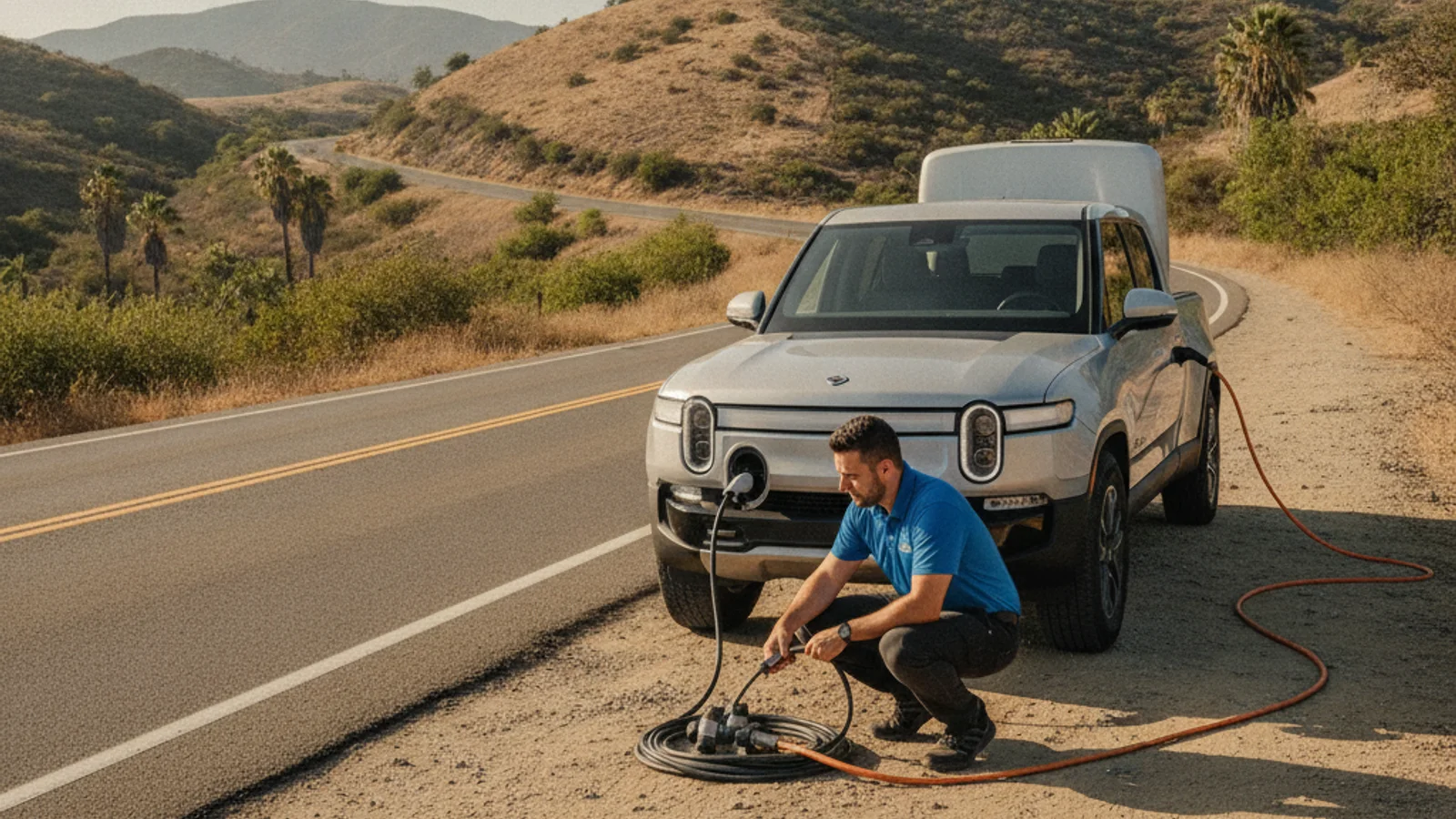
A stranded Rivian on Orange County roads still needs 240V. The source has to present NACS, CCS, or a J1772 adapter. Open the charge port before you name the plug. The badge on the tailgate won’t settle it.
Orange County had 210,842 battery-electric vehicles registered as of December 31, 2025. That’s from the California Energy Commission’s county file. Tesla accounted for 138,121 of those BEVs, or 65.51%. The rest of the battery fleet is every other make. Rivian owners sit in that remaining share of the fleet. Their connector question isn’t the Tesla Supercharger question.
The same CEC file shows why this county keeps coming up. Orange County held 12.02% of California’s battery-electric vehicles. It was only 8.33% of the state’s light-duty fleet. That BEV share outran the public-port share in the same file. CEC counted 7,095 public ports here at year-end 2025. Level 2 made up 5,600 of those ports. Public DC fast made up 1,475, and 20 were Level 1. That’s 36.8 ZEVs per public port across the county. Statewide the same ratio was 24.4 ZEVs per port. The countywide math is why a curb session still happens.
Open the port, then confirm the year
Rivian sells the R1T pickup and the R1S SUV. Production hardware has changed since the first model year. Software has changed across those years as well. A used truck’s sale year isn’t the build year. Read the door-jamb sticker or the registration card. The Rivian app lists the year under the vehicle profile. Write that year down before you call for help.
Don’t copy a neighbor’s answer for your inlet. Don’t trust a forum post about “the Rivian.” Two model years can differ at the charge port. A rental R1S and a privately owned R1T can differ too. Confirm the vehicle you’re standing next to, not a similar one.
Then look at the hardware on this truck. Lift the charge-port door and see the inlet. Cross-check Rivian’s current owner materials for that exact year. Connector policy can change after a truck leaves the factory. An old PDF can be stale by the time you need it. A dealership conversation from last year can be stale too.
The US Department of Energy tracks connector families for this country. That’s the Alternative Fuels Data Center connector ledger. J1772 covers Level 1 and Level 2 AC charging. J3400, also called NACS, is the Tesla-designed plug now used more widely. CCS is a DC fast-charging family, and CHAdeMO is another. That ledger is only background for the categories. It doesn’t name the inlet on your VIN. It doesn’t say whether an adapter shipped in the frunk.
If the port or adapter still isn’t confirmed, say that. Guessing a connector after the cable is in hand helps nobody.
Match the source to that inlet
Your inlet is only half of the matching problem. The charging source has its own plug and its own output. Network maps list connector families on each pin. They don’t promise your year will take that stall without an adapter. Check the live app before you drive toward a listed stall. Treat the listing as a start, not a handshake.
A mobile EV charging stop follows the same matching rule. The operator’s equipment has a native plug plus adapters. That kit has to fit your Rivian before anything is inserted. The operator quotes you before any work starts. They bill you directly for the charging session. Charge Pro OC is the referral line that makes the introduction. We don’t own the truck, and we don’t set the rate. We don’t promise when someone arrives at the car.
Operators in this network bring a 240V Level 2 source to the car. That source can present a native NACS plug. It can also present CCS or a J1772 adapter for non-Tesla EVs. A typical session adds 10 to 20 miles of range. That’s 15 to 30 minutes of charging time, not an arrival window.
That bump is what 240-volt charging at home, or on the shoulder is built around. It’s enough to reach a public stall you already confirmed. It isn’t a full DC fill on the curb.
Public DC you can look up by address
AFDC’s station file for Orange County is specific. The September 2026 pull counted 223 public DC fast stations. It counted 1,452 DC fast ports inside the county. Remove Tesla and you still have 175 stations and 591 ports. Tesla held 59% of the county’s public DC fast ports.
Rivian Adventure is in the same federal table. AFDC listed two Rivian Adventure stations in Orange County, with 22 DC fast ports. Confirm those pins in Rivian’s current map and in AFDC before you roll. Those two station addresses could not be confirmed here. Check Rivian’s live map instead of guessing a pin.
Tesla Superchargers are the dense DC layer here. AFDC listed 48 Supercharger sites and 861 DC fast ports inside the county. Tesla’s Lake Forest site at 24372 Rockfield Blvd is recorded as Magic Dock. That’s CCS1 plus NACS, listed with 16 stalls. Whether your Rivian can use that stall still depends on Rivian’s rules. Those rules are for your model year, and they can change. Confirm in the Rivian app before you treat it as a plan.
Non-Tesla DC sites sit in the same federal file. Electrify America lists 12 DC fast ports at 25825 Las Vegas in Capistrano Beach. It lists 10 ports at Walmart 2242, 440 N Euclid St in Anaheim. Fashion Island in Newport Beach shows 8 DC fast ports at 401 Newport Center Dr. EVgo lists 14 DC fast ports at Plaza Antonio in Rancho Santa Margarita. That EVgo site is at 22351 Antonio Pkwy. San Clemente has EVgo at Ocean View Plaza on Camino de los Mares. That site lists 10 DC fast ports at 638 Camino de los Mares.
Those addresses are places to verify in the live apps. They aren’t a guarantee your R1T will handshake. Connector family, adapter rules, and the payment app all have to line up.
Fashion Island isn’t the same pin as Walmart on Euclid in Anaheim. Dana Point’s Las Vegas Street site is another listing entirely. Rancho Santa Margarita’s Plaza Antonio cluster sits inland of those coastal listings. None of that changes the plug you need. You still match the inlet you confirmed to a 240V source.
When a charge isn’t the job
A low traction pack isn’t the only way an R1T or R1S stops. If the dash shows a fault that isn’t state of charge, stop. Charging gear won’t clear that kind of fault. If the port door won’t open, that’s a mechanical problem. Our walkthrough on a stuck Rivian charge port covers that separate issue.
A dead 12-volt auxiliary battery can mimic an empty pack. The truck may not wake, unlock, or answer the app. That’s a different system from the high-voltage battery. If the Rivian is dark, say so on the call. Start with the R1T and R1S 12V checks. Operators in this network can jump a 12V on site.
Don’t treat a black screen as proof the pack is empty. Let the lights, locks, and app pick the response that fits.
What to have ready when you call
A non-Tesla EV rescue operator can’t confirm fit from “it’s a Rivian.” Bring a short, accurate list to the call.
- R1T or R1S, plus the model year from the sticker
- What the inlet looks like with the door open
- Any charge or 12V message on the dash or in the app
- Whether you packed an adapter in the frunk
- Your exact pin, including lot level, gate code, or shoulder marker
You’re not being asked to guess a standard name. You’re being asked to report what’s in front of you. “I’ll check the frunk for an adapter” is better than a confident wrong call.
Tell the operator the lot name and stall row if you can read them. A pin at 1920 Main St in Irvine has its own access. So does 24372 Rockfield Blvd in Lake Forest. They don’t change the matching rule for the plug. 240V still has to present NACS, CCS, or J1772 for the inlet you opened.
When the connector is still unclear
If the inlet, the adapter, and the available source still don’t line up, stop guessing. Charge Pro OC matches stranded EV drivers with independent local operators. Those operators handle Tesla and every major EV brand, including Rivian. The pros we connect you with are licensed. They quote before they start, and they bill you directly. Call (949) 444-0151 and we’ll make the introduction.